
There have been multiple periods in my life when I was on medical leave due to a surgery, unable to do the strenuous physical and mental work of a nurse, but able to be very productive in other ways. In 2005, I was able to use the six weeks after a pacer/AICD placement to kickstart the Ithaca Free Clinic. In 2010, after a failed Medtronic pacer wire and a second pacer/AICD, I was able to visit with family and friends, and reconsider my vocation. I didn’t see the connection until now, but that time away from the Emergency Department lead me back to school. I love to learn, but didactic education was something which I swore I would never suffer again, after the trial of working full-time while studying full-time back in the early 1990s.
Something else I’ve done during all of my medical leaves was watch movies. My wife and I have seen a lot of movies together. After all, she was working in the Ritz 5 in the Old City of Philadelphia when we met. But I can palpate the times when I was in recovery, because I’ll reference a film and she’ll say, “You must have watched that by yourself.” What’s implied in that statement is, “It’s not a movie I would have chosen to watch.” But I loved those movies.
There was Downfall (2004), a German film that shows Adolf Hitler’s final days in his Berlin bunker as World War II ends and the Nazis are defeated. Or, Lady Vengeance (친절한 금자씨, 2005), a stylish Korean revenge thriller in which a woman wrongly imprisoned for a child’s murder teams up with the families of the real serial killer’s other victims to collectively torture and execute him. There was the deadpan Belgian black comedy Aaltra (2004), two feuding rural neighbors—one a farmer—end up paralyzed in wheelchairs after a bitter argument leads to a tractor accident. Forced to rely on each other, they embark on a darkly humorous road trip across Europe toward Finland to seek compensation from the manufacturer, turning their animosity into reluctant companionship amid absurd mishaps. In the Icelandic film Children of Nature (1991), an elderly farmer named Þorgeir, unable to tend his remote sheep farm any longer, shoots his loyal shepherd dog, sells his flock, and moves to the city to live with his daughter’s family before ending up in a Reykjavík nursing home. (I’ll never forget the image of him wrapping the gun in a newspaper and the look of trust his dog gives him before he shoots it). There he reunites with his old childhood sweetheart Stella; after growing disillusioned with institutional life, the pair escapes by stealing a vehicle and embarks on a poignant journey back to her abandoned village in the remote Westfjords. Stella dies upon reaching her childhood home, and Þorgeir buries her as she wished, finding a final sense of peace and freedom in nature before his own story concludes.
Which leads me to another film I watched by recuperating. Noise (2007), the Australian drama-thriller directed by Matthew Saville, centers on Constable Graham McGahan (Brendan Cowell), a cop whose life is increasingly dominated by severe tinnitus following an on-duty incident. The condition of tinnitus is woven directly into the sound design and plot: Graham’s world is constantly interrupted by a persistent, high-pitched ringing that fluctuates in intensity, sometimes drowning out dialogue, traffic, or conversations so completely that he struggles to function. The film smartly uses a technique called point-of-audition audio—muffling ambient sounds while amplifying or isolating the ringing—to put the audience inside his head, making his isolation, frustration, and disorientation feel immediate and visceral.
This exceptional portrayal of tinnitus isn’t just a medical detail; it drives the story and themes. Assigned to a low-key night shift in a police information van in a troubled Melbourne suburb after requesting lighter duty, Graham becomes a reluctant listener to community trauma while barely able to hear himself. The ringing underscores his emotional detachment and vulnerability, especially as he gets entangled in the aftermath of local murders. It’s one of the most realistic and immersive depictions of living with constant ear noise I’ve seen—raw, unrelenting, and deeply human—turning a personal affliction into a powerful cinematic device.
When I watched Noise sixteen years ago, I did not have tinnitus. The closest I had come to it was when I was a boy, playing with firecrackers, and one went off in my hand right next to my ear. My ear(s) rang for hours, but that faded away. The Covid shots changed that in 2021, and bilateral tinnitus and hearing loss have been my constant companions since then. But Brendan Cowell’s performance in Noise had elicited my empathy for others with this condition long before it impacted my own life.
There is a tool used by ENTs call the Tinnitus Handicap Inventory or THI. It was developed and validated in 1996 by Craig W. Newman, Gary P. Jacobson, and Jack B. Spitzer. Published in the Archives of Otolaryngology–Head & Neck Surgery, it is a 25-item self-report questionnaire designed to quickly measure how tinnitus affects daily life across functional, emotional, and catastrophic domains. Initial validation studies showed strong reliability (high internal consistency and test-retest stability) and good validity through correlations with depression scales and tinnitus severity ratings. It provides a total score (0–100) with severity grades and has since been adapted and validated in many languages, becoming one of the most widely used tools for assessing tinnitus handicap in both clinical practice and research.
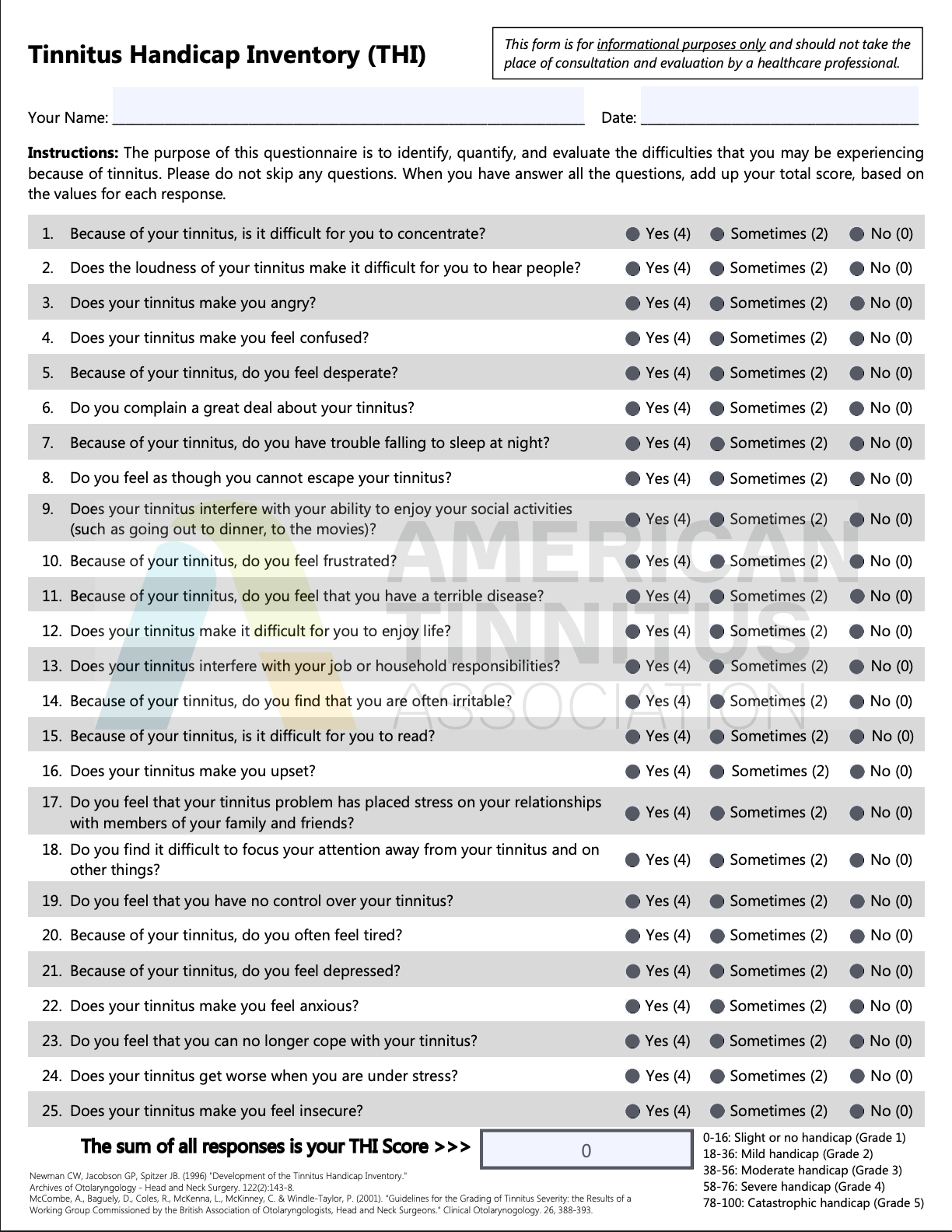
As the Principal Investigator of a pilot study using two compounded medications to treat tinnitus in patients with PASC and injury from the Covid shots, I have been administering and evaluating the THI for study candidates. In order to qualify for study participation, patients need to have a score of at least 20. Most have scores of 60 or above. What those numbers confirm for me is that these patients are suffering tremendously, but they have not been offered viable treatments. I hope that we can change that.
What makes the movive Noise so effective, is how completely it commits to letting the audience feel tinnitus rather than just being told about it. The sound design doesn’t simply add a ringing tone in the background; it actively sabotages Graham’s ability to navigate the world in real time. Conversations drop out mid-sentence. Sirens and traffic become distant murmurs one moment and overwhelming the next. The ringing doesn’t stay politely in the background—it takes over, exactly the way people with severe tinnitus describe. You don’t just watch a man struggling with a medical condition; you’re pulled inside the exhausting, disorienting experience of trying to function when your own ears are betraying you.That immersion reveals how tinnitus reshapes identity and relationships far beyond the physical noise. Graham is a cop who can no longer fully trust his own senses at a moment when the job demands sharp attention and human connection. His assignment to the quiet night shift in the information van is both a practical accommodation and a kind of exile. He becomes a reluctant listener to other people’s trauma while his own inner noise constantly threatens to drown everything out. The film shows, without melodrama, how something invisible can isolate you even when you’re surrounded by people who need you.
It strikes me that the movie treats tinnitus as both a personal affliction and a kind of unwanted superpower. The same ringing that disrupts Graham’s life also forces him into a different way of being present. He can’t tune things out the way he used to. In a strange way, the condition keeps him tethered to the raw, unfiltered reality of the neighborhood he’s been sent to observe. It’s not romanticized, but it’s honest about the complicated ways chronic conditions can change how someone moves through the world.Most of all, Noise captures the quiet, grinding toll—the way tinnitus erodes sleep, concentration, patience, and the simple ability to be in your own head without interference. There are no dramatic breakdowns or miracle cures. Instead there’s the steady, relentless presence of the ringing and the small, daily negotiations it demands. That restraint is what makes the portrayal feel so true. It doesn’t turn tinnitus into a plot device; it lets tinnitus be the atmosphere the story moves through.
Through all these films—whether it was watching Hitler unravel, families exact collective revenge, feuding neighbors bond in wheelchairs, an old farmer bury his dog and his past, or a cop navigate a ringing world—I was quietly learning how to sit with suffering, limitation, and the strange grace that can emerge from both. Now, as I evaluate the THI scores of patients in our pilot study, those solitary recovery watches feel less random. They were preparation: a reminder that the most powerful stories don’t always fix the pain, but they help us witness it more clearly and, sometimes, find ways to ease it.
Comments
Nothing yet. Say the first thing.
Sign in to join the conversation.