
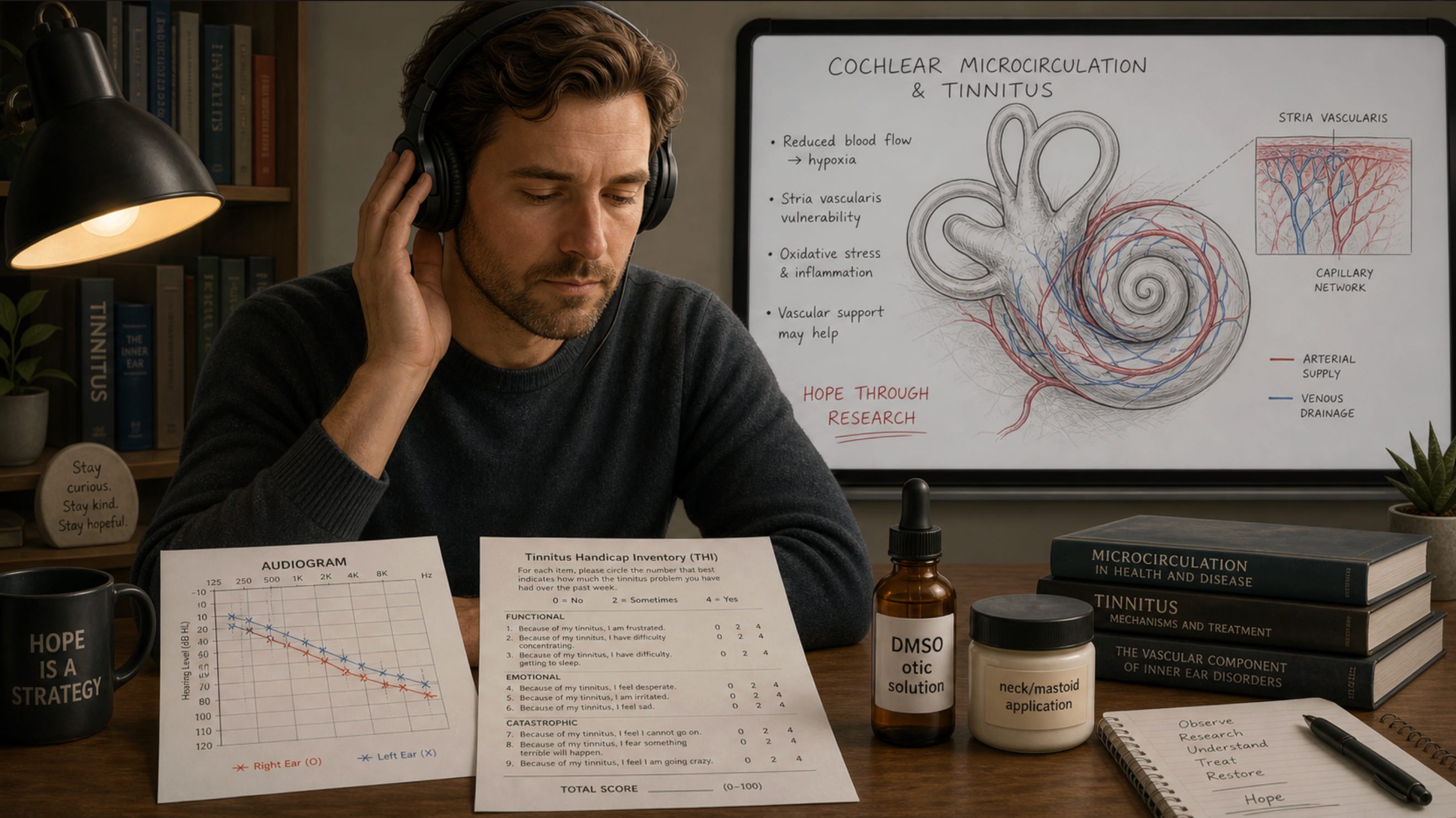
Over the past few years at Leading Edge Clinic, tinnitus has stopped being a niche complaint and started to look like a signal.
Among more than 4,000 patients with Long COVID (PASC) and post‑COVID vaccine injury, over 500 now live with intrusive, often refractory tinnitus. Many had normal audiograms before the pandemic. Many developed tinnitus in temporal proximity to SARS‑CoV‑2 infection or mRNA vaccination. And many also show clinical and lab evidence of microcirculatory dysfunction: fibrin pathology, autonomic instability, and signs of impaired tissue oxygenation. This is not the usual “older guy with noise exposure” story.
DART‑TINN (NCT07567274) is our attempt to formally study that signal—a first‑in‑the‑world, DMSO‑centered tinnitus trial that treats DMSO as part of the therapy itself, not just background chemistry, in adults with Long COVID and post‑COVID vaccine injury.
The immediate inspiration for DART‑TINN wasn’t a journal article. It was a patient.
He lives in the Midwest and has suffered immeasurably from post‑COVID vaccine tinnitus and hearing loss—the kind of suffering that doesn’t fit neatly into a THI score box: sleepless nights, constant noise, the feeling that his auditory world has been hijacked.
After one particularly difficult visit with him, I went looking for something—anything—that might offer a different angle. That search led me to a 1975 paper I had vaguely heard of but never read. The PDF wasn’t free. I paid the $40 anyway, and it turned out to be the best $40 I’ve spent in a long time.
In that paper, Aristides Ziga Caro reported on “Dimethyl Sulfoxide Therapy in Subjective Tinnitus of Unknown Origin,” treating 15 adults with constant subjective tinnitus.
His regimen:
A medicated DMSO spray into the external auditory canal every four days
Daily intramuscular injections containing DMSO plus anti‑inflammatory and vasoactive agents
Nine of the fifteen reported complete resolution of tinnitus that did not return over a year of follow‑up; the remaining six improved to varying degrees.
By modern standards, the study is anything but perfect: no control group, tiny sample size, subjective endpoints, and a mechanistic story that leans on “microcirculatory malnutrition” of auditory nerve cells. But the basic idea—that tinnitus in some patients might respond to focused microcirculatory and anti‑inflammatory therapy using DMSO as a penetrant and potentiator—refused to leave my mind, particularly in the context of spike‑related endothelial injury and fibrin microclots. [3–6]
We are not copying 1975 ENT lore. We are re‑examining it with today’s PASC/post‑vaccine lens and testing it with modern tools and oversight.
Since Caro’s time, tinnitus research has exploded. We now think of chronic subjective tinnitus as a neural network phenomenon: reduced input from the inner ear, maladaptive “central gain” in the brain, and emotional/attentional circuits that determine how intrusive the phantom sound becomes. [7–9]
In simplified terms:
The ear gets injured—by noise, infection, toxins, or microvascular compromise—and sends less signal.
The brain turns up the volume to compensate, and some circuits become hyperactive and synchronized.
Limbic and attention systems decide whether that activity is barely noticeable or utterly overwhelming.
Vascular, immune, and metabolic factors are part of the upstream story. They help explain why certain cochleas and pathways get injured, rather than being the whole picture.
In our Long COVID and post‑vaccine cohort, tinnitus rarely arrives alone. It rides in with dysautonomia, cognitive fog, neuropathic pain, and evidence of spike‑associated microclots and endothelial dysfunction. [3–6,10] Seen through that lens, Caro’s focus on microcirculation looks less quaint and more prescient—he was nudging an upstream mechanism we now have much better language for.
DMSO is a controversial molecule. It has been called everything from snake oil to miracle solvent. The reality, as usual, is more nuanced.
What interests us are its practical properties:
It penetrates skin and mucosa, including external ear canal and periauricular tissues
It modulates inflammation and can alter microvascular tone and rheology
It carries other small molecules with it, enhancing tissue penetration [11–13]
In DART‑TINN, we use DMSO in two key ways:
As a primary vehicle and potentiator for an otic solution containing betahistine, dexamethasone, and lidocaine, applied into the external auditory canal every four days
As a transdermal carrier for levocarnitine and N‑acetylcysteine, applied nightly to the mastoid, periauricular skin, and upper posterior neck
The therapy is adjacent to, not a replacement for, systemic treatment of spike‑induced coagulopathy. We still use systemic tools—anticoagulant or antiplatelet strategies, endothelial support, autonomic regulation, and therapies aimed at fibrin amyloid microclots—for many PASC and vaccine‑injured patients. DART‑TINN lives next to that work: a focused ear‑ and neck‑level intervention aimed at the auditory end‑organ and nearby microvasculature. [3–6]
The hypothesis is simple:
If tinnitus in Long COVID and post‑vaccine injury is driven, in large part, by microcirculatory injury and neuroinflammation in the auditory system, then concentrated local modulation of those processes—while delivering neuroprotective and rheologic co‑agents—may relieve the burden enough for central gain to downshift.
None of this would exist without people who live and breathe compounding and logistics.
Vitahealth Apothecary in NYC—owner and pharmacist David Restrepo and compounding pharmacist Boris—helped turn Caro’s conceptual model and our updated formulation ideas into actual medications. Creating the cream used in the study has at times meant stinking the pharmacy to high heaven with the unmistakable sulfur/egg smell of N‑acetylcysteine. They kept at it anyway.
Infuserve America in St. Petersburg, FL—particularly Director of Case Management Ashley Kramer and pharmacist Jenrose Kratz—helped us tackle a practical problem: water‑based ear drops are fragile and expensive. Infuserve worked with us to adapt the formulation, using glycerin as a shelf‑stable base with added antibacterial function. That pivots the therapy from “theoretically interesting but logistically impossible” to something real people can use at home.
Behind these details are months of back‑and‑forth, tweaking concentration, base, stability, smell, and usability. The trial listing makes it look tidy. It wasn’t.
DART‑TINN is a prospective, single‑arm, open‑label Phase 2 pilot in adults with refractory subjective non‑pulsatile tinnitus linked to Long COVID or post‑COVID vaccine injury. Key features include:
Adults 18–70 years with chronic subjective tinnitus (≥6 months)
Clinically significant tinnitus, defined by a Tinnitus Handicap Inventory (THI) score ≥ 20
Documented PASC or post‑COVID vaccine injury, with tinnitus onset or clear worsening in that context
Failure of at least two prior tinnitus therapies (sound therapy, counseling/CBT, pharmacologic treatments, steroids, etc.)
All participants receive 30 days of dual‑route DMSO‑based therapy. The primary outcome is the proportion of participants achieving a ≥50% reduction in THI score at Day 30. Secondary outcomes track:
THI change over time
Tinnitus loudness and annoyance (visual analog scales)
Sleep and concentration
Patient global impression of change
Vertigo, insomnia, headache, and fatigue scores
with follow‑up out to 12 months for durability and safety.
To our knowledge, DART‑TINN is the only registered clinical trial in the world that uses DMSO itself as a therapeutic intervention for tinnitus, rather than simply as a solvent or inactive carrier for another drug. Most modern studies treat DMSO as background chemistry; we are deliberately testing its biological and delivery properties as part of the intervention in a clearly defined Long COVID and post‑vaccine tinnitus population. For patients and clinicians who are tired of “nothing we can do,” this kind of careful, mechanism‑driven innovation is exactly what we need more of.
This is intentionally a pilot. We want to know:
Does this mechanistic bet produce clinically meaningful relief in an enriched PASC/vax‑injured tinnitus population?
Is the regimen feasible and tolerable in real life?
What signal, if any, justifies a larger, controlled trial?
Right now, the study is roughly 50% enrolled. Early recruitment focused on Leading Edge Clinic patients invited from our existing panel. It turns out that getting people to complete the THI questionnaire, schedule an ENT visit, and then actually get ENTs to fill out a study form (or at least send the required information) is a bit like herding cats. For my patients who know how much I love the felines of this world….

DMSO is not a toy. Experimental work shows concentration‑ and time‑dependent toxicity in various cell types, including cochlear hair cells at higher doses and prolonged exposure. Clinical reviews describe adverse reactions ranging from garlic‑like body odor, warmth, and headaches to gastrointestinal upset and rare organ or hematologic effects, depending on route and dose. [11–15]
We designed DART‑TINN with that in mind:
Concentrations and application schedules are chosen to avoid continuous high‑dose exposure to cochlear tissues while still leveraging DMSO’s penetration and carrier function
Both formulations are prepared by licensed compounding pharmacies with strict quality control
Safety monitoring is built in: telemedicine access, structured adverse‑event reporting, and 6‑ and 12‑month follow‑up visits to capture delayed effects
In our broader practice at Leading Edge Clinic, we have extensive experience using DMSO across multiple indications. Serious toxicity has been very rare. One notable adjunctive cancer patient developed chronic anemia that appeared to be related to oral DMSO; when the DMSO was stopped, the anemia improved. Cases like that have pushed us to tighten monitoring and be more conservative with systemic dosing. They have not suggested that carefully controlled local and transdermal use is inherently unsafe.
We are not ignoring DMSO toxicity data. We’re respecting them and designing around them—while also honoring the reality that, in the right dose and context, DMSO can be a potent, underutilized therapeutic tool.
DART‑TINN also exists because someone believed this kind of work was worth funding.
The non‑profit Rebuild Medicine accepted DART‑TINN as a project aligned with its mission: bridging the gap between real patients’ clinical needs and the thoughtful use of repurposed medicines. Funding from Rebuild—thanks to Ron Morris and Michael Barton, and to my practice partner Dr. Pierre Kory for facilitating that introduction—allows us to:
Provide a stipend for the ENT visit prior to initiation of medication
Cover the cost of the compounded medications themselves
Initially, enrollment was by invitation from within Leading Edge Clinic. At this point, it is possible to enroll Long COVID and post‑vaccine‑injured individuals who are not currently LEC patients.
To do that, they would:
Become members of the First Nation Medical Board (FNMB), a tribal entity under which LEC operates (currently a $35 annual membership fee)
Agree to be seen under the agreements we hold as tribal providers caring for public members of a tribal entity, which gives them access to a discounted visit price specifically for the study
Anyone interested in learning more can email DART‑TINNstudy@drpierrekory.com and ask about eligibility and next steps.
The easiest thing to do with tinnitus in PASC and post‑vaccine injury is to call it “anxiety,” hand out a sound generator, and hope for habituation. That hasn’t matched what our patients live through—or what their labs and clinical exams show.
When you see fibrin‑heavy blood, dysautonomia, microcirculatory signs, and tinnitus in the same person, the more honest answer is: this is probably vascular plus neural, not simply psychological. Spike protein’s effects on endothelium, fibrin(ogen), and microclots are now reasonably well described. The tinnitus literature has matured enough to map how peripheral injury feeds central gain and limbic distress. DART‑TINN sits at the intersection of those two bodies of work. [3–9]
If DART‑TINN fails, we’ll learn something important about the limits of localized microcirculatory therapy in this phenotype and refine where we focus systemic spike‑coagulopathy treatment and neural‑targeted interventions. If it succeeds—even partially—it will justify larger, controlled trials and help open a more nuanced conversation about how spike protein, fibrin, microclots, and auditory networks intersect in real patients.
Either way, the people who have been told for years that their tinnitus is “just stress” deserve more than reassurance. They deserve careful, mechanism‑informed experimentation and data that actually reflect the complexity of their condition—and a few stories about stinky pharmacies and $40 PDFs along the way.
Inclusion Criteria
Adults 18 to 70 years of age
Chronic subjective non‑pulsatile tinnitus for at least 6 months
Bothersome tinnitus defined by a Tinnitus Handicap Inventory (THI) score ≥ 20 at screening
Documented history of post‑acute sequelae of SARS‑CoV‑2 (PASC, Long COVID) or post‑COVID‑19 vaccine injury, with tinnitus onset or clear worsening temporally associated with that event
Failure of at least two prior tinnitus therapies (for example, sound therapy, counseling or cognitive‑behavioral approaches, pharmacologic treatments, or steroid therapy)
Willing and able to provide informed consent
Able to complete telemedicine visits and electronic questionnaires in English and to attend a baseline in‑person otolaryngology (ENT) evaluation
Exclusion Criteria
Objective or pulsatile tinnitus, or tinnitus primarily synchronous with the heartbeat
Active middle‑ear infection, acute otitis media, tympanic membrane perforation, or current otorrhea
Recent exposure (within the past 3 months) to known ototoxic medications associated with new or rapidly worsening tinnitus
Known hypersensitivity or allergy to dimethyl sulfoxide (DMSO) or any component of the study formulations (betahistine, dexamethasone, lidocaine, levocarnitine, N‑acetylcysteine, or excipients)
Pregnancy or breastfeeding
Uncontrolled or severe psychiatric illness (for example, active psychosis, acute suicidality) that, in the opinion of the investigator, would interfere with participation or completion of questionnaires
Inability to comply with study procedures, including telemedicine visits, electronic data capture, or topical/otic dosing instructions
Any other otologic or neurologic condition judged by the investigator to confound tinnitus assessment or pose unacceptable risk with DMSO‑based therapy
ClinicalTrials.gov. DMSO Dual‑Route Therapy for Refractory Tinnitus in Long‑COVID and Post‑COVID‑19 Vaccine Injury (DART‑TINN). NCT07567274.
Caro AZ. Dimethyl sulfoxide therapy in subjective tinnitus of unknown origin. Ann N Y Acad Sci. 1975; [PubMed PMID: 1055561].
Pretorius E, et al. Proteomics of fibrin amyloid microclots in long COVID/post‑acute sequelae of COVID‑19. Cardiovasc Diabetol. 2023.
Kell DB, Pretorius E. Amyloid fibrin microclots as a central feature of Long COVID. Hematology/Long COVID review.
Mao S, et al. Prevalence and prognosis of tinnitus in post‑COVID‑19 patients. Acta Otolaryngol. 2024. [PubMed PMID: 39512084].
Yih WK, et al. Tinnitus after COVID‑19 vaccination: Findings from the Vaccine Safety Datalink and VAERS. CDC Stacks.
Henry JA, et al. Underlying mechanisms of tinnitus: a review and clinical implications. J Am Acad Audiol. 2014.
De Ridder D, et al. Pathology of tinnitus and hyperacusis: clinical implications. J Neurol. 2015. [PubMed PMID: 26313440].
Langguth B, et al. The neuroscience and treatment of tinnitus. Physiol Rev. 2021.
Hearing Health Foundation. Tinnitus and COVID‑19 (overview article).
Gallardo‑Villagrán M, et al. Dimethyl sulfoxide: a bio‑friendly or bio‑hazard chemical? Molecules. 2022.
Qi W, et al. Cytotoxic effects of dimethyl sulphoxide on cochlear hair cells in vitro. Hear Res. 2007. [PMC2262105].
Hoyberghs J, et al. DMSO concentrations up to 1% are safe in zebrafish embryo assays. Front Toxicol. 2021.
Jacob SW, Rosenbaum EE, Wood DC. Dimethyl sulfoxide: basic concepts. New York: Marcel Dekker; 1971.
Petrillo S, et al. Adverse reactions of dimethyl sulfoxide in humans: a systematic review. Pharmacol Res. 2019. [PMC6707402].
Comments
Nothing yet. Say the first thing.
Sign in to join the conversation.