
There are things from 2020 that I can still smell.
Most of all, I remember the chemical outgassing smell from the N-95 I had to wear for the 13 hours of a 12 hour shift. The stale air of an overcrowded Emergency Department. The plastic. The sweat. The metallic edge of panic when a young person is running out of time and everybody in the room knows it. I was working at SUNY Upstate then, in the Level-1 trauma center, and I can still picture twenty-year-olds coming in by EMS in acute respiratory distress, then getting intubated in the hallway because there was nowhere else to put them. Some nights it still feels like I’m walking those hallways, only now the stretchers roll past on a Zoom screen instead of linoleum. Back then, the disease often had a rhythm to it. A patient would seem to be hanging on, and then around day 8, the floor could drop out from underneath them. That was often the day they arrived in the ED.
Years later, most of my work happens through telemedicine at Leading Edge Clinic’s Long COVID program and its post-vaccine syndrome program. The setting is different now: no beeping monitors, no transport stretchers, no ventilators humming in the background. Instead, I stand in front of a screen and meet people in bedrooms, kitchens, home offices, parked cars, and the occasional closet where they’ve hidden from the rest of the household to have enough quiet for a medical visit. But what I hear all day long is not peace. It is the aftersound of that same protein.
Call her Vesni. Before all this, she was the sort of person who walked fast on purpose, just to burn off the day; now she plans her week around two loads of laundry, and she cannot walk around the block without paying for it for three days. Another was a CEO who used to run meetings and now loses the thread of a sentence halfway through speaking it. Another tells me she feels as though her body has become allergic to life itself: food, heat, cold, perfume, exertion, stress, the wrong supplement, the wrong cup of tea. A middle-aged man who had always been sturdy and useful says, with embarrassment, that he now has to sit down to fold laundry. An older woman says she misses herself. That one stays with me.
These aren’t ICU patients in the old sense, but they are not mild.
Two recent papers by Gerlach et al. have helped me put words to a pattern I have been circling around for years. The first, Unprecedented Pathological Features of the SARS-CoV-2 Spike Protein and Their Conservation across Variant Evolution: A Source-Agnostic Feature Inventory, lays out a source-agnostic inventory of unusual features of the SARS-CoV-2 spike protein and argues that most of the deeper pathological machinery of spike was conserved, and in some cases strengthened, as the virus evolved into late Omicron lineages. The second, A Proposed Mechanism for Reduced COVID-19 Severity with Omicron: Could Systematic NTD Loop Deletions Have Eliminated Allergenic Determinants in SARS-CoV-2 Spike Protein?, offers a structural hypothesis for why the acute face of COVID changed so dramatically with Omicron: three short, surface-exposed loops in the ancestral N-terminal domain may have functioned as allergenic determinants, and those loops were systematically deleted in Omicron.
If that hypothesis is right, it explains something that has otherwise been hard to name cleanly. Omicron may have removed one of the most explosive short-term triggers for acute respiratory collapse while leaving behind the rest of spike’s pathological toolkit. In plain English: the fire alarm got quieter, but the wiring in the walls stayed hot.
Early in the pandemic, many of us were learning with our hands; the Emergency Department has a brutal way of teaching fast. We were trying to understand what kind of illness this was by watching bodies fail in real time. Long before there was consensus language for it, there was a sense among some bedside clinicians that a subset of these patients were not simply drowning in viral pneumonia. There was something immunologic, allergic, or mast-cell driven happening in at least some of the worst crashes.
Dr. Pierre Kory went to Washington and testified before the Senate about the role of steroids in saving lives. At the time, he was mocked for it. History hasn’t been kind to the mockers. It would also be wrong to tell this story without paying homage to Dr. Shankara Chetty, our common colleague at RAPID, who was the first physician to clearly identify the day-8 hypersensitivity pattern and adapt that model into clinical practice. Long before this hypothesis had structural language, Dr. Chetty was seeing the pattern at the bedside and acting on it, and a great many clinicians recognized, in his work, something they had been witnessing but had not yet fully named. The Omicron loop paper doesn’t prove that those early day-8 crises were allergenic reactions to specific NTD loops, but it does provide a plausible structural framework for why antihistamines and corticosteroids sometimes worked so dramatically in the pre-Omicron era, and why that particular pattern largely faded afterward.
That matters to me because the memories are not academic. I remember bringing patients up to the ICU from the ED and walking back down knowing I would probably be doing it again in an hour. I remember the sheer wrongness of seeing previously healthy young adults vanish into ventilators. If we had understood then what these papers are proposing now, some of those scenes may have unfolded differently.
The second paper is the one that made me put my green Rooibos tea down, because every now and then a paper arrives that doesn’t merely add another citation to the pile but instead reaches back through the years, grabs a handful of half-formed clinical memories, and suddenly arranges them into something that looks less like coincidence and more like the edge of understanding.
Its core idea is simple: three short loops on the surface of the ancestral spike N-terminal domain, around H69-V70, V143-Y145, and N211, may have acted as allergenic determinants in susceptible patients. Omicron deleted all three while preserving spike trimer integrity through compensatory remodeling. If those loops were part of what was provoking the day-8 hypersensitivity phenotype, then their disappearance could help explain why the ICU story changed so abruptly once Omicron took over.
This is still a hypothesis. The authors are careful about that. They call for peptide allergenicity testing, mast-cell activation work, patient immunophenotyping, and structural-functional studies comparing ancestral and Omicron NTDs. Good. That is exactly what should happen. But a hypothesis does not need to be proven before it becomes useful. Sometimes a good hypothesis acts like a flashlight. It illuminates what you have already been stumbling around in.
For me, the light falls backward and forward at the same time. Backward, to the ward patients who crashed hard and fast. Forward, to the people I now see with mast-cell activation, dysautonomia, weird inflammatory surges, flushing, palpitations, burning skin, sleep disruption, and post-exertional misery who often do not look anything like the patients we were intubating in 2020, yet seem to belong to the same family of injury.
The companion Gerlach paper is, in some ways, even more unsettling. It asks a straightforward question: as SARS-CoV-2 evolved, which spike features actually disappeared? And the answer, according to their review, is basically none of the major protein-level pathobiologic ones. The furin cleavage site remained. The amyloidogenic epitopes remained. The superantigen-like and toxin-like motifs remained. The prion-like domains were modified but not abolished. The neuropilin-related loop remained. The glycosylation shield remained. ACE2 binding stayed strong or got stronger.
This is the part of the story that feels most consistent with what I see now in PASC and vaccine injury. Acute disease got softer up front, but the protein did not suddenly become gentlemanly. It kept the features that could contribute to vascular injury, abnormal clot architecture, autonomic chaos, neuroinflammation, and chronic immune disturbance.
Take the furin cleavage site. The paper argues that Omicron’s nearby mutations increase cleavability, which means more efficient generation of free S1 fragments. That matters because once you have more circulating S1, you still have access to the downstream problems: amyloidogenicity, neuropilin-1 engagement, inflammatory signaling, and all the rest. So while Omicron may have become less likely to trigger the spectacular day-8 crisis, it may not have become less capable of seeding slower, stranger systemic harm.
That rings true.
Lightning Bug has never been, for me, just a place to summarize papers. It is where the papers and the people have to meet.
I think about the family story in “All Along the Watchtower”, where a physician father working in a busy clinic had unexpectedly low spike antibody levels compared with the rest of his household, and the clue turned out to be an old habit of sipping a homemade Baobab drink all day at work. That post was not just about a supplement. It was about what happens when you are paying close enough attention that an odd lab value turns into a hypothesis, and a hypothesis turns into a small act of care. The same thing happened with mast-cell activation. It did not arrive in my practice as an abstract theory. It arrived through patients who kept reacting to everything, until the pattern was too loud to ignore.
In “Table 12”, I wrote about a younger vaccine-injured patient who went in for dental work, got procaine, then later nearly died after a cascade that included an alpha-gal reaction and emergency epinephrine. I also wrote about an elderly patient with metastatic renal cell carcinoma whose swollen arm looked, to Dermatology, like mast-cell disease, but to Oncology looked like cellulitis. He then got hit with an IV cephalosporin and gadolinium MRI contrast, both of which likely worsened mediator release and delirium in an already fragile system. Those cases are messy, human, imperfect, and clinically real. They are also exactly the sort of cases that make the Omicron NTD hypothesis feel relevant. If ancestral spike really did carry an exposed allergenic cassette, and if later spike variants deleted it while leaving the deeper machinery intact, then the movement from acute respiratory hypersensitivity to chronic mast-cell, neurologic, and inflammatory instability starts to make a lot more sense.
I think too about “Do Not Go Gently”, where I wrote about my own family and the painful realization that what many people dismiss as “aging” may, in some cases, be vascular, neurologic, or inflammatory damage layered on top of time. That piece was personal because this work is personal. It is one thing to write “brain fog” in a chart. It is another to watch someone grieve the self they used to be. When a patient tells me she cannot read novels anymore because by page three she no longer remembers page one, no amount of tidy academic prose can improve that sentence. It can only honor it.
My own thinking about microclotting has changed over time. The signal is real. The spike inventory paper gives a plausible molecular basis for fibrinolysis-resistant fibrin through amyloidogenic segments like Spike685. And certainly there are patients in whom clotting biology looks front and center. I have seen blood that clots in the tube. I have seen patients with striking improvement on anticoagulation. I have also seen the opposite: patients whose microclot scores do not correlate neatly with how sick they feel, or whose symptoms improve only partly, or not at all, despite treatment aimed squarely at coagulation.
That is where humility has to enter. If you do this work honestly, the patients will eventually cure you of reductionism. If you read “You look mahvelous!”, you know how much I care about the small wins—hair growing back, color returning to a face. Those are the kinds of changes that tell me we are tugging on the right part of this knot.
More and more, I have found the perspective of Ruth Kriz, MSN, APRN helpful here. Kriz places fibrin in a broader terrain of chronic illness, not just as a marker of pathological clotting but as structural scaffolding for biofilm, persistent infection, poor perfusion, and immune evasion. In that framework, spike does not merely cause “microclots.” It may aggravate a fibrin-rich ecosystem in susceptible patients, especially those with hypercoagulation tendencies, where infection, inflammation, immune dysfunction, and sometimes cancer biology all begin feeding each other.
That feels closer to the truth of what I now see. Not a single mechanism. Not a silver bullet. More like a knot.
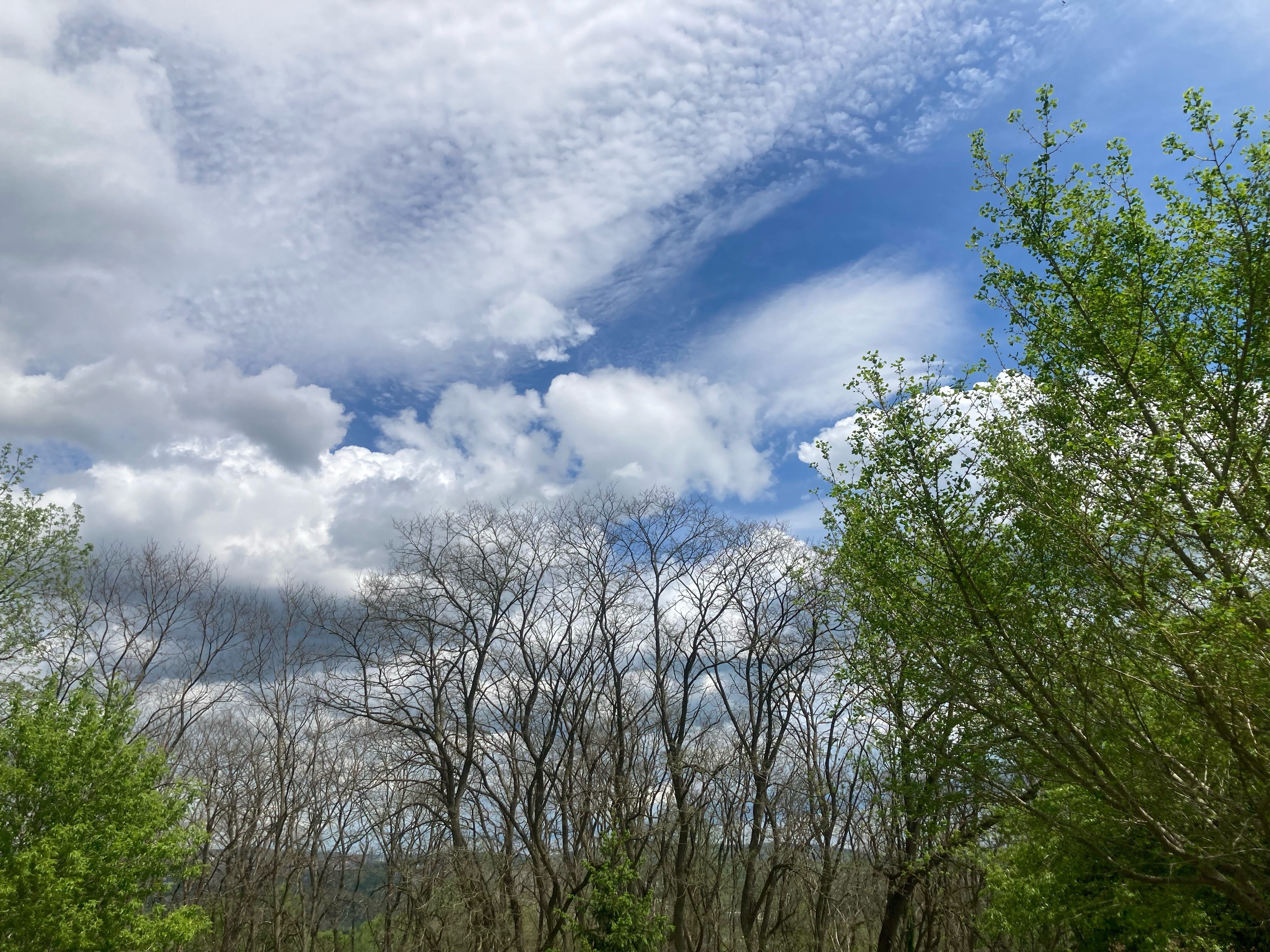
Outside my office, where I wrote this piece, is a view I usually only catch out of the corner of my eye between visits. Today was a rare day when there was time to stop and really take it in. The trees on the edges have already gone green, but the stand in the middle is still all branches and promise, late to leaf out but not dead. I’ve watched clouds my whole life; what was different today was how the ones in the foreground were rolling and roiling upward, almost boiling as they joined the higher layers and slowly covered the blue sky. It felt like a snapshot of where we are with spike now—new growth starting at the edges of life, older damage in the middle still catching up, and a sky that looks fine until you pay attention to how quickly it’s filling in.
There is a temptation, especially among people who want to be done with all of this, to treat Omicron as the point where the problem solved itself. The hospital numbers improved, therefore the virus mellowed, therefore the rest is exaggeration. The people saying this are usually not the ones spending an hour with a patient who cannot tolerate a grocery store, a dentist appointment, a glass of wine, a family argument, a flight of stairs, or a night of poor sleep. I understand the impulse. It’s human to want the credits to roll. Biology doesn’t care about our narrative arcs.
The two Gerlach papers suggest a better framing. Omicron may indeed have lost something important: a set of ancestral NTD loops that made acute hypersensitivity crises more likely. But it may have kept, and in some respects enhanced, the structural elements of spike that drive chronic multisystem harm. That hypothesis does not explain everything. It does, however, explain a great deal about the historical difference between pre-Omicron and post-Omicron patients, both in Long COVID and in injury related to the COVID shots.
It also raises uncomfortable questions for future vaccine design -- not because every question has been settled, but because too many were never asked in the first place. If first-generation mRNA products encode the ancestral spike with most of these deeper features intact, then “safe enough” can no longer mean only “provokes antibodies” or “reduces hospitalization.” It also has to mean that the protein being expressed has been stripped of the structural liabilities that the virus itself has shown it can live without.
The catastrophe of 2020 was loud. Ventilators. Sirens. Body bags. The catastrophe that followed is quieter. It looks like someone canceling dinner again. Someone lying flat in a dark room. Someone losing a job they loved. Someone carrying Benadryl, Cromolyn, Ketotifen, a pulse oximeter, an EpiPen, and a private fear that their body is one bad input away from going off the rails.
The loud catastrophe was easier for the world to recognize. This story is not only about what the virus did in 2020, but also about what spike keeps doing after the world has decided to look away.
The quiet one is harder. It unfolds in kitchens and bedrooms, on Zoom calls, in the silence after a patient says, “I just want my life back.”
That is why these papers matter. Not because they prove everything, but because they offer a coherent, testable framework for what so many of us have witnessed. The ancestral spike may have carried an allergenic front end that helped drive the day-8 crash. Omicron may have deleted that front end. But the deeper spike toolkit—furin cleavage, amyloidogenicity, neuroactive motifs, neuropilin access, glycan shielding, vascular and neurologic potential—appears to have stayed.
Which means the story was never simply that the virus got mild.
It may be closer to this: the scream faded, but the injury kept talking. If your body is still telling you that story, you are not crazy, you are not weak, and you are not alone. You are living in the long echo of a protein the world has not fully faced yet.
P.S. This post of Lightning Bug is dedicated to Faith. Thank you for supporting Lightning Bug and being an engaged reader. We will find our way forward, together.
1. Gerlach J, Baig AM, Jaeger B, et al. *Unprecedented Pathological Features of the SARS-CoV-2 Spike Protein and Their Conservation across Variant Evolution: A Source-Agnostic Feature Inventory*. ResearchGate preprint. February 2026. DOI: 10.13140/RG.2.2.16496.11521. Available at: https://www.researchgate.net/publication/401309711_Unprecedented_Pathological_Features_of_the_SARS-CoV-2_Spike_Protein_and_Their_Conservation_across_Variant_Evolution
2. Gerlach J, Baig AM, Jaeger B, et al. *A Proposed Mechanism for Reduced COVID-19 Severity with Omicron: Could Systematic NTD Loop Deletions Have Eliminated Allergenic Determinants in SARS-CoV-2 Spike Protein?* ResearchGate preprint. May 2026. DOI: 10.13140/RG.2.2.16772.49280. Available at: https://www.researchgate.net/publication/404805453_A_Proposed_Mechanism_for_Reduced_COVID-19_Severity_with_Omicron_Could_Systematic_NTD_Loop_Deletions_Have_Eliminated_Allergenic_Determinants_in_SARS-CoV-2_Spike_Protein
3. Whittaker GR, Daniel S. SARS-CoV-2 spike and its adaptable furin cleavage site. *Journal of Molecular Biology*. 2023;435(16):167375. DOI: 10.1016/j.jmb.2023.167375.
4. Johnson BA, Xie X, Kalveram B, et al. Furin cleavage site is key to SARS-CoV-2 pathogenesis. *Nature*. 2021;591(7849):293-299. DOI: 10.1038/s41586-021-03237-4.
5. Peacock TP, Goldhill DH, Zhou J, et al. The furin cleavage site in the SARS-CoV-2 spike protein is required for transmission in ferrets. *Nature Microbiology*. 2021;6(7):899-909. DOI: 10.1038/s41564-021-00908-w.
6. Nyström S, Hammarström P. Amyloidogenesis of SARS-CoV-2 spike protein. *Journal of the American Chemical Society*. 2022;144(20):8945-8950. DOI: 10.1021/jacs.2c01829.
7. Westman J, Hammarström P, Nyström S. Spike685 amyloid fibrils template fibrin and generate fibrinolysis-resistant clots. *Biochemistry*. 2025;64(2):336-350. DOI: 10.1021/acs.biochem.4c00593.
8. Boschi C, de Candia P, Catapano AL, et al. SARS-CoV-2 spike protein amyloid fibrils impair fibrin polymerization and promote fibrinolysis resistance. *International Journal of Molecular Sciences*. 2025;26(22):12321. DOI: 10.3390/ijms262212321.
9. Cheng MH, Zhang S, Porritt RA, et al. Superantigenic character of an insert unique to SARS-CoV-2 spike supported by skewed TCR repertoire in patients with hyperinflammation. *Proceedings of the National Academy of Sciences USA*. 2020;117(41):25254-25262. DOI: 10.1073/pnas.2010722117.
10. Cheng MH, Zhang S, Porritt RA, et al. A monoclonal antibody against staphylococcal enterotoxin B superantigen inhibits SARS-CoV-2 entry in vitro. *Structure*. 2021;29(9):951-962.e3. DOI: 10.1016/j.str.2021.06.006.
11. Tetz G, Tetz V. Prion-like domains in spike proteins of SARS-CoV-2 differ across its variants and enable changes in affinity to ACE2. *Microorganisms*. 2022;10(2):280. DOI: 10.3390/microorganisms10020280.
12. Daly JL, Simonetti B, Klein K, et al. Neuropilin-1 is a host factor for SARS-CoV-2 infection. *Science*. 2020;370(6518):861-865. DOI: 10.1126/science.abd3072.
13. Cantuti-Castelvetri L, Ojha R, Pedro LD, et al. Neuropilin-1 facilitates SARS-CoV-2 cell entry and infectivity. *Science*. 2020;370(6518):856-860. DOI: 10.1126/science.abd2985.
14. Wrapp D, Wang N, Corbett KS, et al. Cryo-EM structure of the 2019-nCoV spike in the prefusion conformation. *Science*. 2020;367(6483):1260-1263. DOI: 10.1126/science.abb2507.
15. Iuliano AD, Brunkard JM, Boehmer, et al. Trends in disease severity and health care utilization during the early Omicron variant period compared with previous SARS-CoV-2 high transmission periods — United States, December 2020-January 2022. *MMWR Morbidity and Mortality Weekly Report*. 2022;71(4):146-152. DOI: 10.15585/mmwr.mm7104e4.
16. Adjei S, Hong K, Molinari NM, et al. Mortality risk among patients hospitalized primarily for COVID-19 during the Omicron and Delta variant periods — United States, April 2022-June 2022. *MMWR Morbidity and Mortality Weekly Report*. 2022;71(37):1182-1189. DOI: 10.15585/mmwr.mm7137a4.
17. Nyberg T, Ferguson NM, Nash SG, et al. Comparative analysis of the risks of hospitalisation and death associated with SARS-CoV-2 Omicron (B.1.1.529) and Delta (B.1.617.2) variants in England: a cohort study. *The Lancet*. 2022;399(10332):1303-1312. DOI: 10.1016/S0140-6736(22)00462-7.
18. Abdullah F, Myers J, Basu D, et al. Decreased severity of disease during the first global Omicron variant COVID-19 outbreak in a large hospital in Tshwane, South Africa. *International Journal of Infectious Diseases*. 2022;116:38-42. DOI: 10.1016/j.ijid.2021.12.357.
19. Meng B, Abdullahi A, Ferreira IATM, et al. Altered TMPRSS2 usage by SARS-CoV-2 Omicron impacts infectivity and fusogenicity. *Nature*. 2022;603(7902):706-714. DOI: 10.1038/s41586-022-04474-x.
20. Hui KPY, Ho JCW, Cheung MC, et al. SARS-CoV-2 Omicron variant replication in human bronchus and lung ex vivo. *Nature*. 2022;603(7902):715-720. DOI: 10.1038/s41586-022-04479-6.
Comments
Nothing yet. Say the first thing.
Sign in to join the conversation.