
A connection request is a commitment of time.
The conversation that follows, the scheduling, the pre-recording preparation, the recording itself, the follow-through after, all of it flows from the decision made when the connect button gets pressed.
A connection sent to the wrong guest doesn’t just fail to produce a great episode. It consumes the time and the connection slot that could have gone to a guest who was genuinely right.
A Talks guest profile contains enough information to make that decision well before the connection goes out.
Most hosts read a profile the way they’d skim a resume, scanning for obvious red flags and moving forward if nothing looks wrong. That approach finds guests who aren’t disqualifying.
Strategic selection requires reading profiles for the signals that distinguish genuinely right from merely acceptable.
Those signals are in the profile.
Reading them takes 5 minutes. The 5 minutes pay back across every stage of the collaboration that follows.
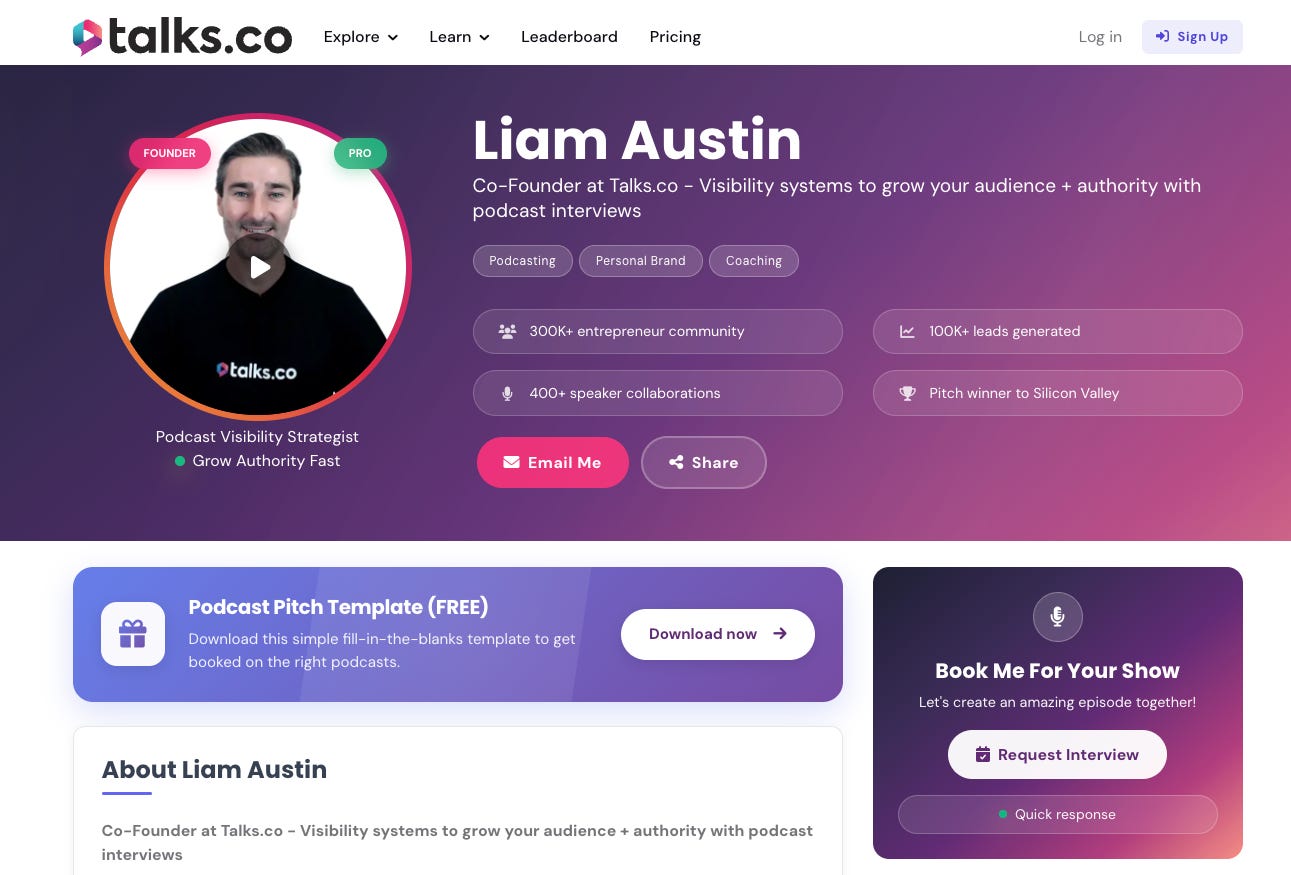
Before covering how to read a profile strategically, it’s worth being precise about what’s actually there to read.
A complete Talks guest profile contains 7 elements that each carry specific information about guest fit, collaboration quality, and audience overlap potential.
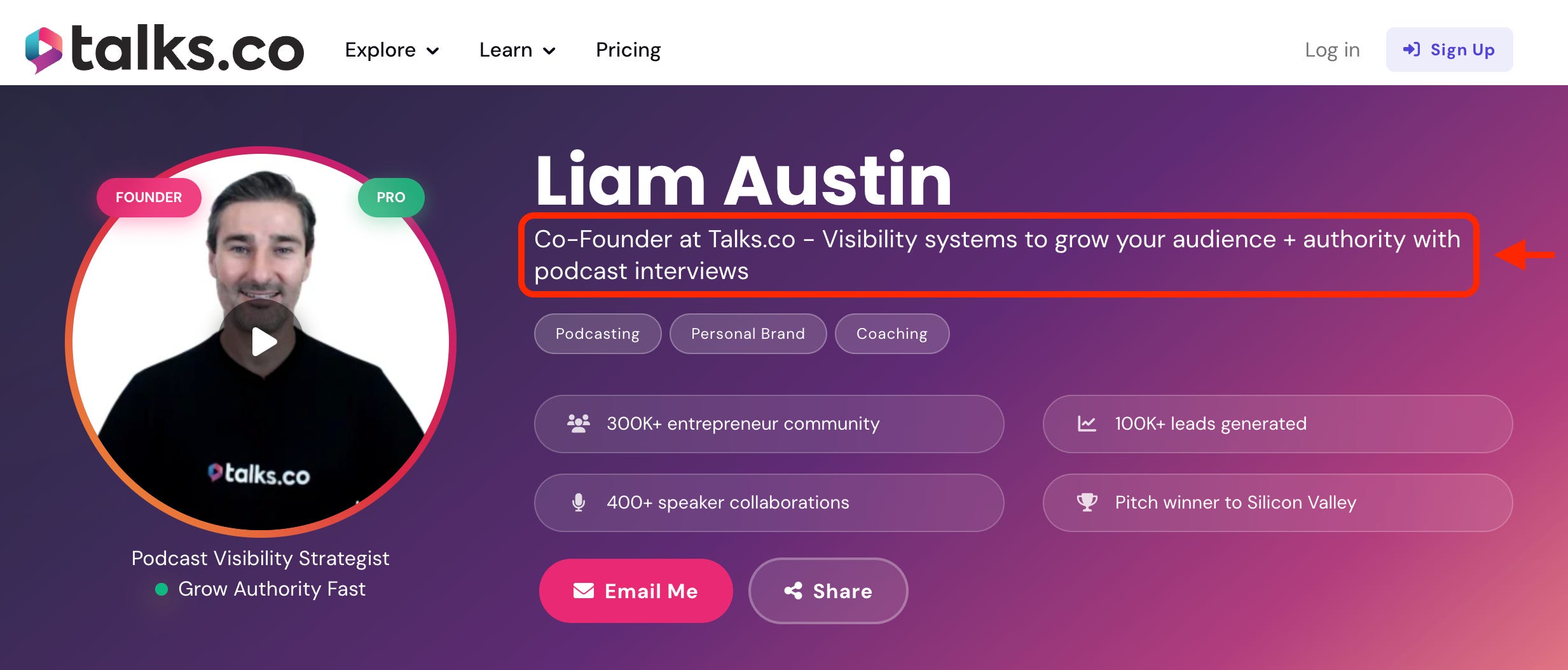
The headline is the podcast guest’s own one-sentence description of who they help and what they help them do.
What a specific headline tells you: That the guest has done the positioning work to know who their audience is and what they actually need. A guest with a specific headline is a guest who knows their lane and stays in it during recordings.
What a vague headline tells you: That the podcast guest hasn’t defined their audience precisely enough to describe it in a sentence. Vague positioning in the headline tends to mean vague positioning in the episode.
What to look for: Whether the audience described in the headline overlaps with the show’s existing listeners. If the headline describes people your audience either are or aspire to be the overlap potential is genuine.
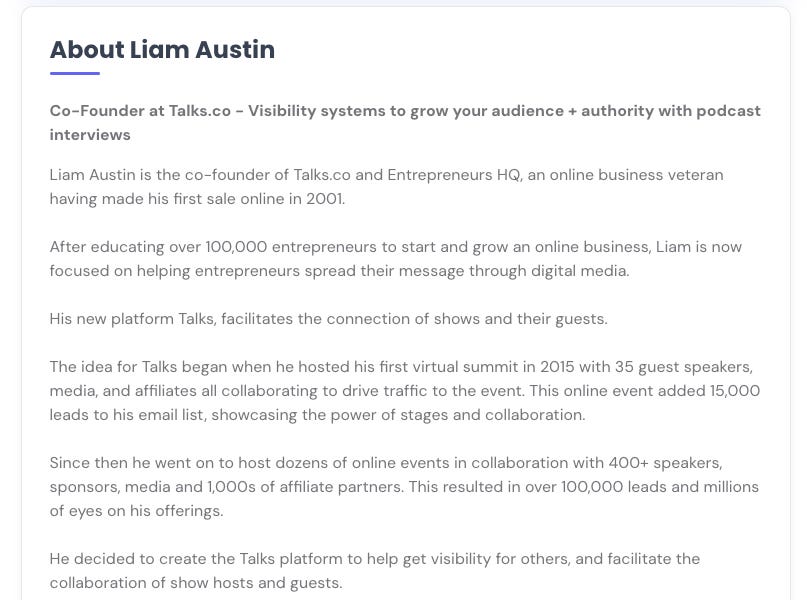
The story section covers how the podcast guest arrived at their current expertise and what that expertise is built on.
What an earned story tells you: That the podcast guest’s expertise comes from experience rather than observation. A podcast guest who developed their knowledge through doing produces more specific and credible content than a guest who developed it through studying what others did.
What a credential-heavy story tells you: That the guest leads with qualifications rather than experience. Qualifications matter but they’re a weaker predictor of episode quality than a story that shows where the knowledge came from.
What to look for: Whether the guest’s story produces a natural episode angle for the show’s audience. A podcast guest whose story lands them in the exact situation the show’s audience is navigating is a guest whose episode will feel made for that audience.
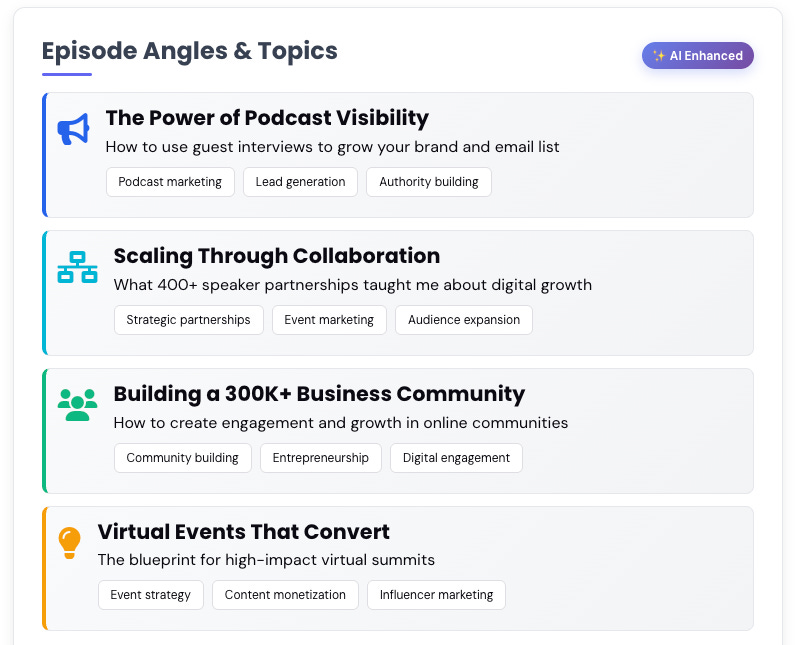
Topics are the specific things the guest covers in interviews, phrased as the subjects they can speak to.
What specific topics tell you: That the podcast guest knows what they’re going to say and can deliver it consistently regardless of how the host frames their questions. Specificity in topics predicts specificity in the recording.
What broad topics tell you: That the podcast guest is pitching their general expertise rather than a specific angle. A podcast guest who lists “leadership, mindset, entrepreneurship, and personal development” is a guest who can talk generally about a lot of things. A guest who lists “what happens to high performers when they get promoted into management for the first time” can talk specifically about one thing that matters.
What to look for: Whether any of the guest’s specific topics address the current questions the show’s audience is actively carrying. A topic that answers the show’s audience’s most pressing current question is a topic worth building an episode around.
Suggested questions are the questions the guest has prepared for hosts to ask them.
What listener-perspective questions tell you: That the guest understands how podcasting works and has thought about what the host’s audience needs rather than what the guest wants to say. A guest who writes questions from the listener’s perspective is a guest who is going to show up audience-first rather than self-promotion-first.
What host-perspective questions tell you: That the guest has thought about what they want to cover but not necessarily about whether the host’s audience will find it useful. The subtle distinction produces meaningfully different episodes.
What to look for: Whether the questions would produce answers that the show’s audience would find immediately useful. If the questions produce answers the show’s audience would find useful the episode will too.
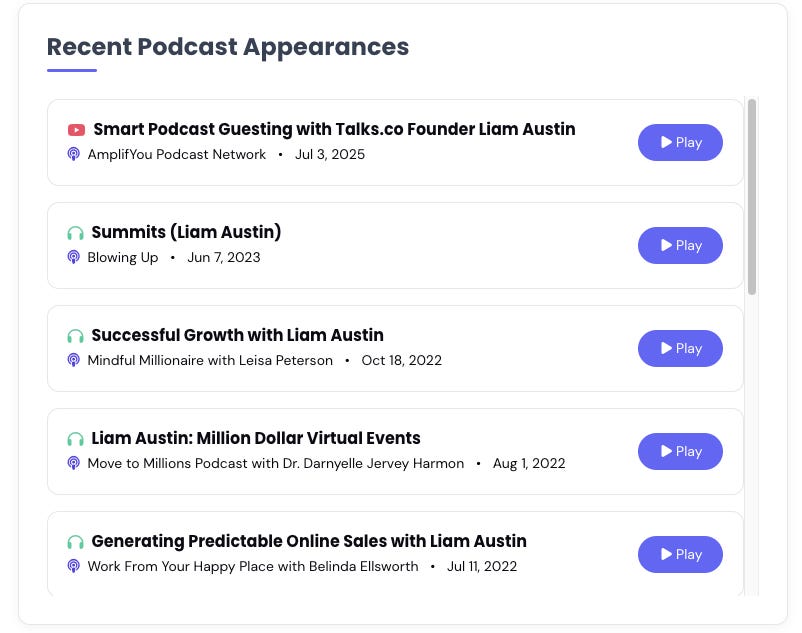
Past appearances are the shows the guest has appeared on previously, with episode titles and links where available.
What a concentrated past appearances list tells you: That the podcast guest has a consistent niche and delivers a consistent angle across multiple shows. Consistency predicts that the episode on this show will be consistent with the quality documented elsewhere.
What a scattered past appearances list tells you: That the podcast guest pitches broadly across multiple unrelated niches. Broad pitching tends to mean the podcast guest adjusts their angle for each show rather than delivering a consistent, deeply developed perspective.
What to look for: Whether the shows the guest has appeared on previously serve audiences similar to the show’s own audience. A podcast guest who has appeared consistently on shows for coaches and consultants is a guest whose angle is developed for that audience; that development transfers.
The video pitch is 60 seconds of the guest speaking naturally about who they help and why they’d be a strong guest.
What a specific video pitch tells you in 30 seconds: How the guest communicates on mic. Their pace, their energy, their ability to make complex ideas accessible, and whether they seem like someone the show’s audience will find engaging for 45 minutes.
What a vague or absent video pitch tells you: Either that the podcast guest hasn’t invested in making the selection decision easy for hosts, or that their communication style doesn’t serve them well enough to record it. Neither is a strong signal for a strategic collaboration.
What to look for: Whether the guest’s communication style matches the show’s tone. A podcast guest who communicates with the energy and specificity the show’s audience responds to is a guest whose episode will feel consistent with what the show delivers.
The Talks review profile is the public record of what previous hosts and guests have said about the collaboration experience.
What specific written reviews tell you: Exactly what it was like to work with this guest; a review that says “arrived with 3 specific talking points, shared the episode with their own list when it went live, and sent the resources they mentioned the next morning” tells you more about collaboration quality than any other element on the profile.
What absent reviews tell you: That either the guest hasn’t completed many collaborations or the collaborations they’ve completed didn’t produce experiences worth documenting; both possibilities are worth noting before sending a connection.
What to look for: Reviews that specifically mention preparation, follow-through, and promotion behavior. Those 3 qualities predict whether the collaboration will produce the growth outcomes covered in Post 1.
🆓 Create Your Free Talks Show Profile
Audience overlap is the mechanism that produces subscriber crossover when the guest promotes the episode. Identifying it from a profile requires reading the profile as a description of the guest’s audience rather than a description of the guest.
Four questions worth answering from every profile before sending a connection.
The headline, topics, and story together describe the guest’s audience. The question is whether that audience overlaps with the show’s existing listeners.
What meaningful overlap looks like: The guest serves people who are either in the same situation as the show’s audience or in the situation the show’s audience aspires to reach. A show for early-stage coaches whose guest serves established coaches has meaningful overlap because the early-stage coaches want to know what the established coaches know.
What superficial overlap looks like: The guest serves people in the same broad category as the show’s audience without serving people with the same specific needs. A show for coaches and a guest who serves “entrepreneurs broadly” have superficial overlap that rarely produces meaningful crossover.
Past appearances tell you which shows the guest has previously reached. The audiences of those shows give you a picture of where the guest’s audience currently discovers content.
What to look for: Past appearances on shows similar in topic and audience to your own. If the guest has appeared on three shows whose audiences would recognize themselves in your show’s positioning the overlap is real and the crossover potential is genuine.
What scattered past appearances indicate: That the guest’s audience is spread across multiple unrelated shows. Crossover from a scattered audience is less concentrated and less likely to produce subscribers who are precisely right for the show.
A guest with a dramatically larger audience than the show’s current reach may not find the collaboration reciprocal enough to promote actively. A guest with a dramatically smaller audience may not produce meaningful crossover even with active promotion.
What proportional means in practice: A guest whose audience is in the same order of magnitude as the show’s reach, positioned in the same topic area, with an engagement rate that reflects genuine investment from their audience.
What disproportionate size produces: Either a guest who treats the collaboration as a minor addition to a much larger promotional calendar or a guest whose promotion reaches an audience too small to produce meaningful crossover.
The most reliable audience overlap indicator is whether the guest’s specific topic would make a specific member of the show’s audience stop what they’re doing to listen.
What a specific episode-producing topic looks like: “What to do when you’ve been a high performer your whole life and suddenly you’re in management and nothing you knew how to do applies anymore” stops a specific person in a specific situation and makes them feel found.
What a general topic looks like: “Leadership development for high performers” describes a category that many people could apply to themselves and few people feel specifically addressed by.
A consistent evaluation process applied to every profile produces a selection system that improves over time. Three steps that take five minutes total.
Step 1: Read the headline and topics first: If the audience described in the headline and the topics listed don’t overlap with the show’s listeners in any of the four ways above close the profile and move to the next one. The remaining elements don’t need to be read.
Step 2: Watch the video pitch if the headline and topics pass: 60 seconds tells you whether the guest’s communication style will work for the show’s audience. If it doesn’t the written profile content is irrelevant.
Step 3: Read the reviews if the video pitch passes: 3 specific written reviews tell you more about collaboration quality than the rest of the profile combined. If the reviews describe preparation, follow-through, and promotion behavior the guest is worth a connection request.
3 steps. 5 minutes. A selection decision made on the evidence that predicts strategic fit rather than the surface impression that predicts generally acceptable.
💡 The most valuable element on any Talks guest profile is the one most hosts skip: the video pitch.
A host who reads every other element and skips the video pitch is making a selection decision without the single piece of information that best predicts whether the guest will be engaging on mic for 45 minutes. Watch it. Every time.
The 30 seconds it takes is the 30 seconds that most reliably prevents a recording that turns out to be the wrong fit.
🚀 Access the Full Profile Data on Talks
Pull up the profiles of the last 5 guests who produced the best episodes on the show.
Read each profile now, after knowing how the episode turned out, and identify which elements predicted the quality of the collaboration before it happened.
The pattern across those 5 profiles is the selection framework the show needs.
The specific things those guests had in common in their headlines, their topics, their past appearances, and their reviews are the criteria worth applying explicitly to every profile evaluated from this point forward.
The best selection system the show can build is the one built from the evidence of its own best collaborations.
This is Part 3 of a 5-part series on growing your podcast with the right guests using Talks.
The full series:
✅ Part 1: Why the right guest can accelerate podcast growth faster than more content
✅ Part 2: Using advanced search filters to find better-fit guests faster
✅ Part 3 (you’re here): How to evaluate guest profiles and identify audience overlap
Part 4: Using the inbox workflow to move from match to recorded episode efficiently
Part 5: Building a repeatable guest selection system for long-term show growth
🔖 Save this post before the next guest search. The 3-step evaluation process and the 4 audience overlap questions are worth having open while reading the first few profiles to build the habit before it becomes automatic.
🎯 Evaluate Guest Profiles on Talks
P.S. The review profile is the element that most reliably predicts collaboration quality and the element most hosts spend the least time on.
A guest with 15 strong written reviews from previous hosts has 15 separate pieces of evidence about what working with them is actually like. Read 3 of them before sending the connection.
The 3 minutes invested in those reviews is the 3 minutes that most reliably prevents the 2 hours lost to a collaboration that didn’t produce what the profile suggested it would. 👇
Keep Talking,
Liam
~
Visibility systems to grow your personal brand, audience + authority with guest appearances. First online sale in 2001. Built multiple 6–7 figure online businesses. 400+ interviews. Malta, Stockholm, Sydney. Love soccer, surf & burritos.
No posts
Comments
Nothing yet. Say the first thing.
Sign in to join the conversation.