
Strategic guest selection produces better candidates.
A better candidate sitting in an inbox that loses momentum is still a missed recording.
The gap between a connected conversation and a confirmed recording date is where more strategically selected guests get lost than at any other point in the process.
The selection was right. The profile evaluation was thorough. The connection request went to exactly the right person.
And then the thread went silent somewhere between the first message and a date on the calendar and the opportunity that the selection work produced just… evaporated.
Momentum in a booking conversation is fragile. Once it’s gone it’s expensive to recover and often impossible to fully restore.
The Talks inbox workflow exists to keep every conversation moving through the stages that turn a connected podcast guest into a recorded podcast episode before the momentum has a chance to dissipate.
A podcast guest who is generally available for any show that asks is a podcast guest who will move slowly through a booking conversation because the stakes for them are low.
A podcast guest who is strategically right for the show, whose audience overlaps meaningfully, who is selective about where they appear, is a podcast guest who has other options.
They’re evaluating the show while the show is evaluating them.
A conversation that loses momentum signals to that podcast guest that the podcast host isn’t organized enough to make the collaboration worth pursuing.
3 things a strategically selected guest notices that a generally available guest doesn’t.
Response time: A strategically selected podcast guest who sends a message and waits three days for a reply has already mentally moved on to the next conversation in their inbox. Getting back on their radar after a 3-day gap requires more effort than staying on it would have.
Clarity in the scheduling process: A strategically selected podcast guest who receives “What times work for you?” without any constraints or booking link has been given a task rather than an option. Podcast guests with multiple options pursue the option that makes the collaboration easiest, not the host who made them do the most work.
Follow-through on small commitments: A podcast host who says “I’ll send you the episode brief by end of week” and doesn’t has already told a selective podcast guest something about what the collaboration will be like at every subsequent stage.
The inbox workflow on Talks is designed to prevent all 3 of these failures by giving every conversation a clear stage, a clear next action, and a clear record of where it stands.
🆓 Create Your Free Talks Show Profile
Every conversation in the Talks inbox moves through 5 stages. Understanding what each stage requires and what happens when a conversation stalls at it is the foundation of a booking process that consistently converts strategic selections into recordings.
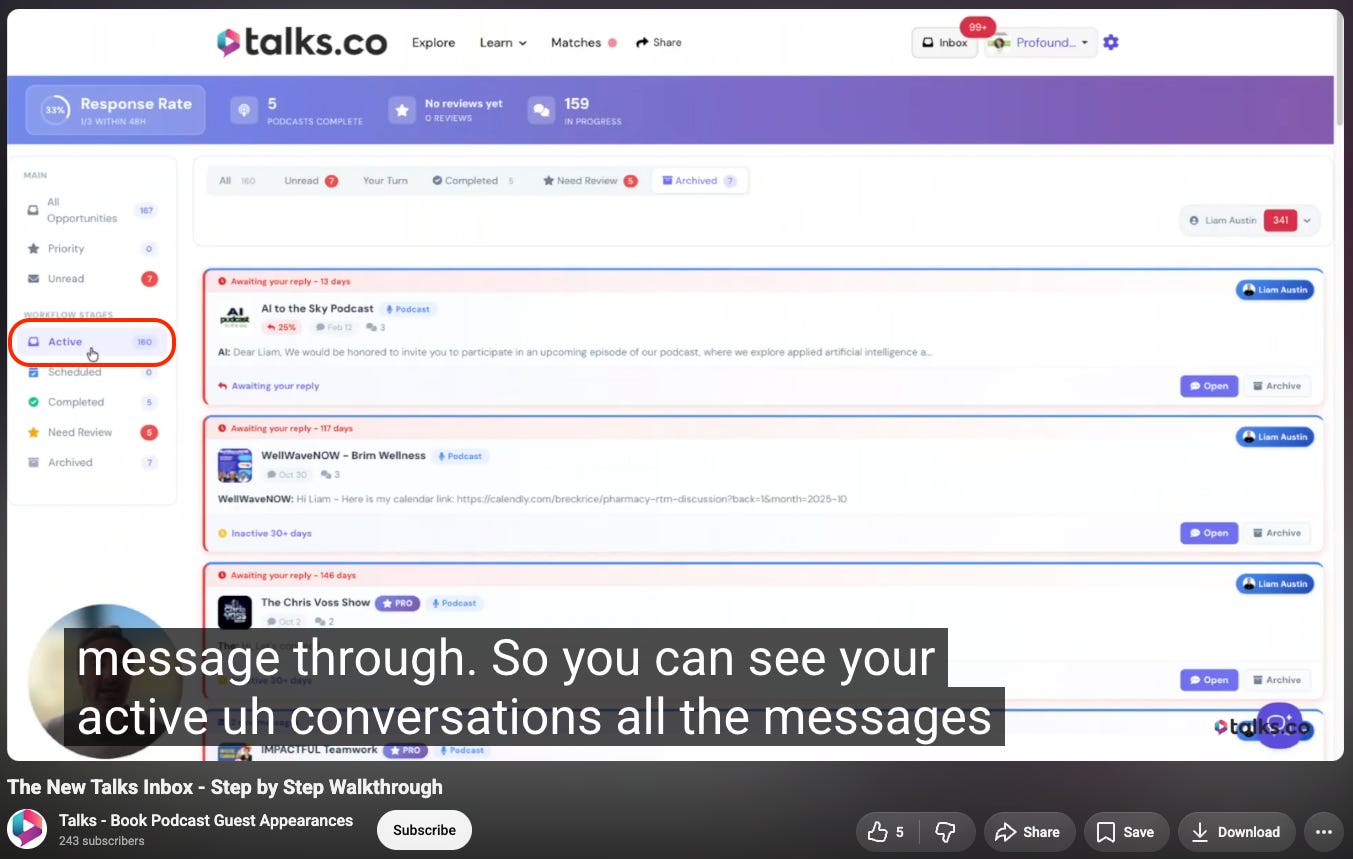
Every new conversation starts in active. The match has opened. The first message has been sent or received. The guest is in a state of fresh interest that will either develop into a scheduled recording or dissipate into a connection that never went anywhere.
What the active stage requires from a host: A first message that is warm, specific, and moves immediately toward the next concrete step. A first message that says “Great to connect, looking forward to chatting sometime” is a message that ends the conversation rather than continuing it.
What a strong first message looks like: A specific reference to something in the guest’s profile that demonstrates genuine evaluation, a one-sentence connection between the guest’s topic and the show’s audience, and a clear invitation to discuss a specific episode angle; three sentences, specific, and moving toward something concrete.
What the twenty-four hour rule produces: A conversation that stays in the guest’s active attention rather than one that requires them to re-engage from a cold start; every hour after twenty-four that passes without a reply is an hour where the guest’s attention moves further from the conversation.
The most common reason active conversations stall: A first message that was warm but not specific enough to give the guest something concrete to respond to; a guest who receives “I loved your work and think you’d be great on the show” has been complimented but not engaged.
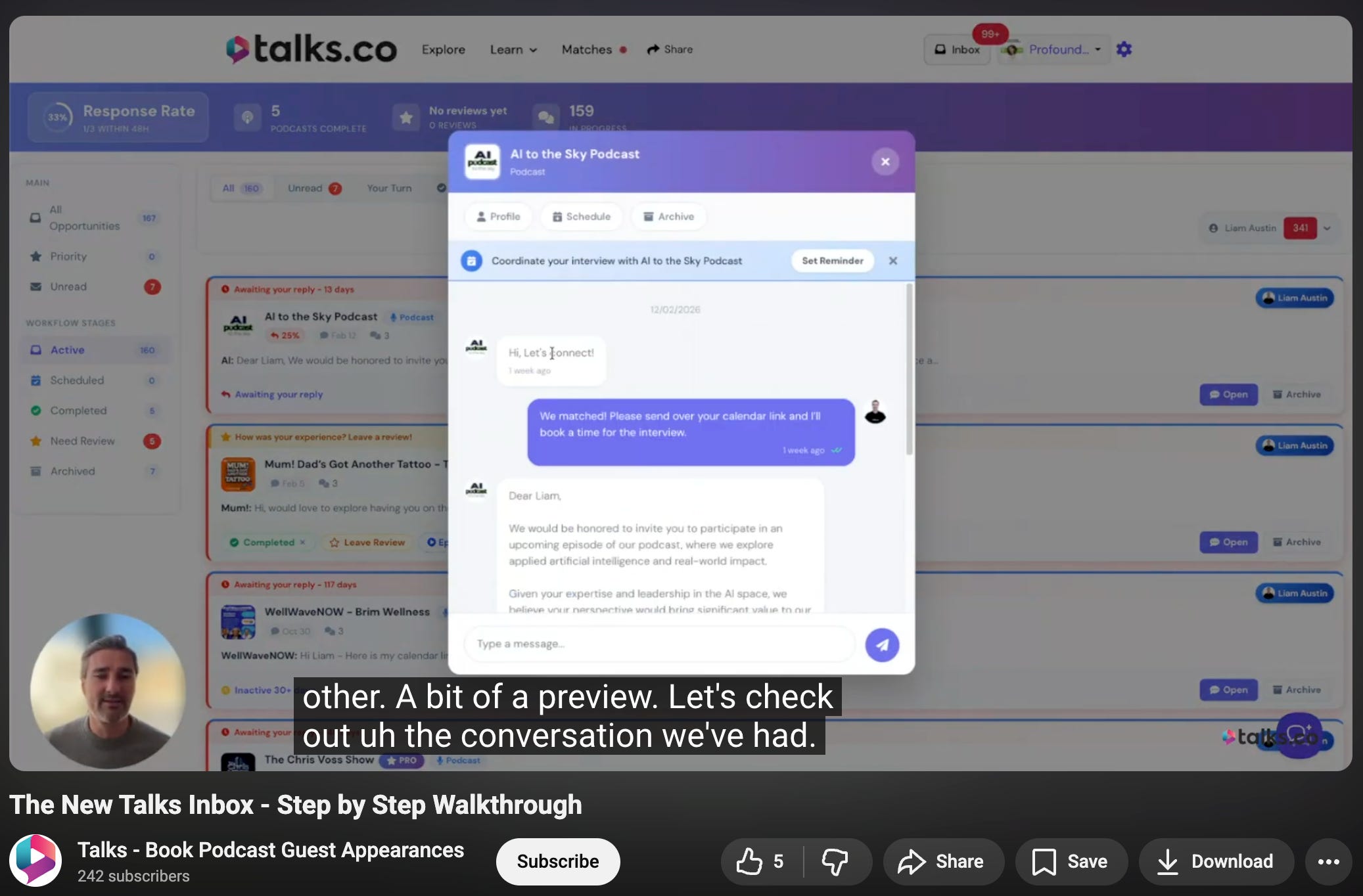
Once a recording topic and time have been agreed on the conversation moves to scheduled. A strategically selected guest who reaches this stage has already passed every selection criterion. What happens here determines whether the selection pays off.
What to do immediately: Enter the recording date and time inside the Talks system rather than only in a personal calendar. Logging it inside Talks activates the platform’s reminder system, which reduces no-shows and last-minute cancellations from guests who were genuinely interested but not organized enough to appear without a reminder.
What a strategically selected guest expects at this stage: A brief confirmation of the recording details, the platform being used, and any specific topics or formats the host wants to cover or avoid. A host who provides this unprompted is a host who demonstrates the same preparation they’re expecting from the guest.
What logging inside Talks produces for the show profile: An updated scheduled count visible to future guests who evaluate the show before connecting. A host with a high scheduled count is a host who converts conversations to recordings consistently. That signal attracts more strategically selected guests because selective guests look for hosts who follow through.
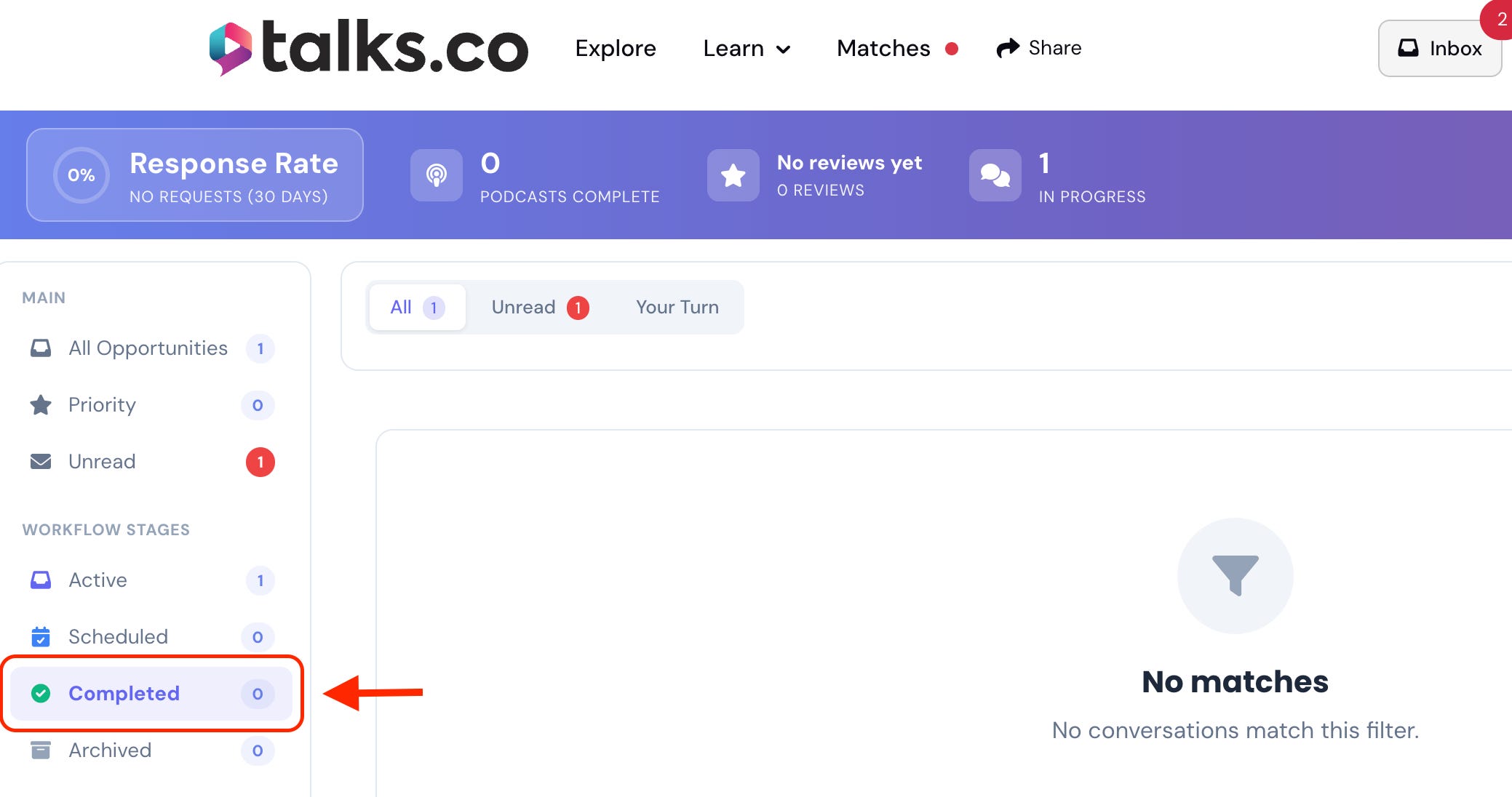
After the recording the conversation moves to completed. Most hosts move to their next task immediately after the recording ends. The completed stage is where the follow-through that produces strong reviews and referrals happens.
What needs to happen within 24 hours of every recording: The conversation moves to completed in Talks, a written review is left for the guest while the specifics are still fresh, and any resources mentioned during the recording are sent to the guest before they have to ask.
What the 24 hour window produces: A review that contains specific details rather than general impressions, a guest who receives the follow-through they were hoping for but not necessarily expecting, and a platform signal that the collaboration was completed promptly rather than left in limbo.
What hosts lose by delaying completed stage actions: The review that would have been specific becomes general; the guest who would have promoted immediately gets busy. The resources that would have demonstrated follow-through arrive when the memory of the collaboration has faded.
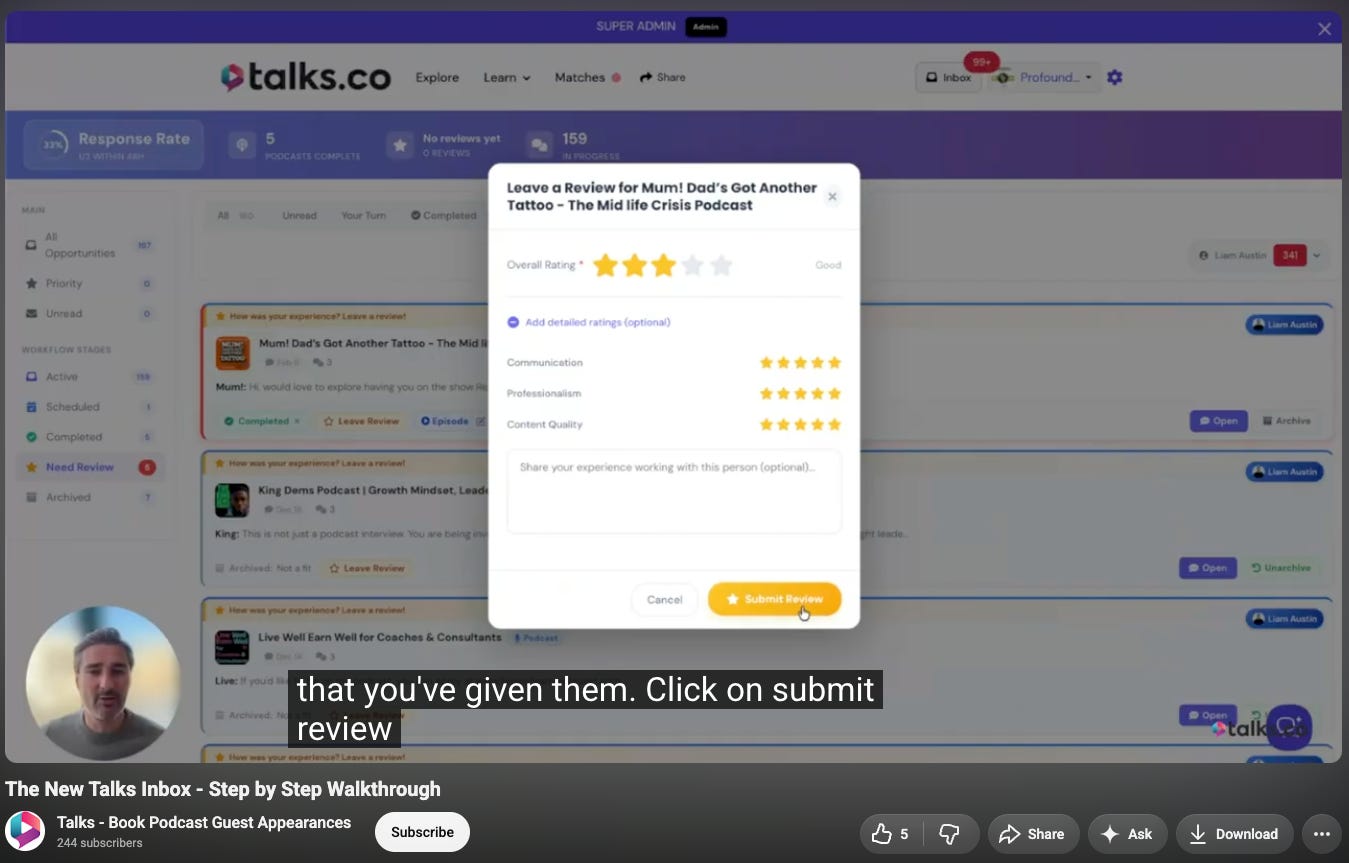
The review prompt appears after the conversation moves to completed. Leaving a thoughtful written review within 24 hours is the action that activates the reciprocal dynamic covered in Post 1 of this series.
What a specific written review produces for the guest: Public documentation of a collaboration they’re likely to reference when recommending the show to others or when deciding whether to appear again. A guest who received a specific, genuine review from a host is a guest who is primed to make an introduction when someone in their network is looking for a show to appear on.
What a specific written review produces for the host’s profile: Evidence that the collaboration was worth documenting. Future guests who read the host’s outgoing reviews get a picture of the quality of collaborations the show produces before they’ve committed to appearing.
What happens to the reciprocal dynamic when reviews are delayed: The guest who would have left a strong review in the first 48 hours leaves a shorter, less specific review 6 weeks later when the prompt finally arrives; The review is still positive but the specificity that makes a review useful to future guest evaluators is gone.
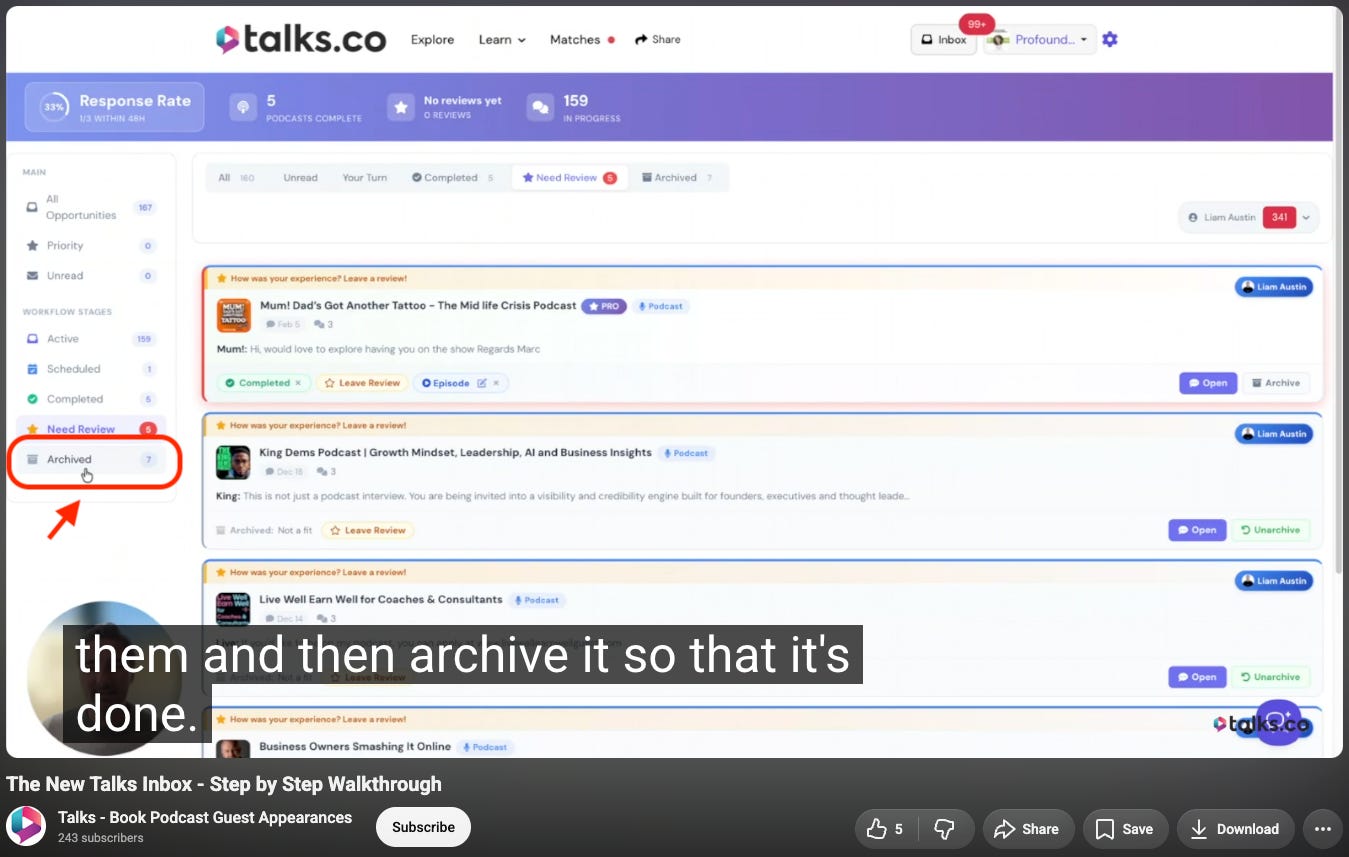
Once the review is done the conversation moves to archived and the workflow is complete. A host who archives promptly has a clean inbox that shows exactly which conversations are active and which ones need attention.
What a clean inbox produces for strategic guest selection: Clarity about the pipeline’s current state. A host who can see at a glance that they have 4 active conversations, 2 scheduled recordings, and 3 conversations in need of review knows exactly what needs attention before sending new connection requests.
What a cluttered inbox produces: A host who can’t distinguish between active conversations that are moving and archived conversations that are done. That confusion produces missed follow-ups, double messages, and the kind of disorganization that selective guests notice and factor into their decision about whether to promote the episode actively.
When to archive without a completed recording: When a conversation clearly isn’t going to produce a recording. A host who archives a stalled conversation after two unanswered follow-ups has kept their pipeline clear and their attention on conversations that are actually moving.
The 5-stage workflow is the structure. 3 habits keep conversations moving through it.
A first message to a strategically selected guest should reference something specific from the three-step profile evaluation in Post 3.
What specific reference demonstrates: That the host actually evaluated the profile rather than sending a generic connection to a list of filtered results. A strategically selected guest who receives a generic first message concludes that the filter produced the connection, not genuine interest.
What it does to the conversation dynamics: A guest who feels genuinely seen in a first message is a guest who engages with the conversation as a specific dialogue rather than a generic booking inquiry. The quality of the subsequent conversation reflects the quality of the opening.
The three-sentence structure that works: One sentence referencing something specific from the profile evaluation, one sentence connecting the guest’s topic to the show’s audience, one sentence inviting a specific next step.
When a conversation reaches the scheduling stage offer 2 or 3 specific time windows with timezone rather than asking the guest when they’re available.
What offering specific windows produces: A scheduling process that resolves in one or two messages rather than a back-and-forth that can take a week. A strategically selected guest with multiple options chooses the host who makes the scheduling process easiest.
What “when are you free?” produces: A task for the guest who now has to check their calendar, consider their other commitments, and propose options that may or may not work for the host. Every step in that process is friction that can cause the conversation to stall.
What a booking link produces instead: A direct path from agreement to confirmed date without any back-and-forth. A guest who clicks a link and sees available slots makes a choice in 60 seconds that a back-and-forth process takes a week to produce.
When an active conversation goes quiet for 3 days send a single short follow-up that re-opens without pressure.
What an effective follow-up looks like: One sentence referencing the previous message, one sentence restating interest briefly, one sentence making it easy to re-engage. “Circling back in case this got buried, still think there’s a strong episode here for your audience if the timing works.”
What an ineffective follow-up looks like: A long message that restates everything from the beginning. Length signals anxiety rather than confidence and selective guests respond to confidence.
When to archive rather than follow up: After 2 unanswered follow-ups the conversation isn’t going to produce a recording. Archive it, note what the stall point tells you about the guest’s current interest level, and redirect the attention to conversations that are moving.
💡 The inbox workflow is measurement as much as management.
A host who looks at their inbox and sees 8 active conversations, 5 scheduled recordings, and 3 completed reviews knows the pipeline is healthy.
A host who sees 40 conversations in varying states of activity has a pile rather than a pipeline.
The workflow turns the pile into measurable stages that tell the host exactly what needs attention before the calendar empties rather than after.
Manage Your Pipeline at Full Capacity
Open the Talks inbox and answer 4 questions honestly.
How many active conversations are genuinely progressing toward a scheduled recording?
How many have been quiet for more than 3 days and need a follow-up or an archive?
How many recordings are confirmed and logged with a date?
How many completed recordings are waiting for a review?
The answers tell the story of the pipeline’s current health more accurately than the number of connection requests sent this month.
A pipeline with stalled active conversations doesn’t need more connections. It needs the stalled conversations resolved before new ones arrive to compete for the same attention.
Resolve the stalls first. Then add the connections that the cleared pipeline can absorb.
This is Part 4 of a 5-part series on growing your podcast with the right guests using Talks.co.
The full series:
✅ Part 1: Why the right guest can accelerate podcast growth faster than more content
✅ Part 2: Using advanced search filters to find better-fit guests faster
✅ Part 3: How to evaluate guest profiles and identify audience overlap
✅ Part 4 (you’re here): Using the inbox workflow to move from match to recorded episode efficiently
Part 5: Building a repeatable guest selection system for long-term show growth
🔖 Save this post before the next strategic guest conversation opens. The 5 stages and the 3 habits above are worth having in mind before the first message goes out rather than after the conversation has already stalled.
🎯 Manage Your Pipeline at Full Capacity
P.S. The completed stage is the one most hosts rush through and the one that produces the most downstream value when it’s handled properly. A written review left within 24 hours, resources sent before the guest has to ask, and the conversation moved to completed in the Talks system.
3 actions. 20 minutes total. The guest who receives all 3 within 24 hours of a recording is the guest most likely to promote the episode, leave a strong review in return, and make an introduction when someone in their network is looking for a show to appear on. 👇
Keep Talking,
Liam
~
Visibility systems to grow your personal brand, audience + authority with guest appearances. First online sale in 2001. Built multiple 6–7 figure online businesses. 400+ interviews. Malta, Stockholm, Sydney. Love soccer, surf & burritos.
No posts
Comments
Nothing yet. Say the first thing.
Sign in to join the conversation.