
Manual guest research is a tax on your show.
Every hour spent searching through podcast directories, reading bios, cross-referencing social profiles, and making judgment calls on incomplete information is an hour not spent recording, editing, or growing.
The research might produce a good guest. It might produce a guest who looked good from the outside and turned out to be wrong once the conversation started.
Either way the process starts again next week.
The advanced search filters on Talks Pro compress that research cycle dramatically.
A search that takes two hours manually takes twenty minutes with the right filters applied.
The podcast guests it surfaces aren’t just available. They’re evaluated against the criteria that predict episode quality and audience overlap before a single connection request goes out.
That compression is what makes strategic guest selection practical rather than aspirational for hosts who are running shows alongside everything else in their lives.
An unfiltered search on any platform returns results based on availability, not fit.
The podcast guests who appear at the top are the podcast guests who signed up most recently, updated their profiles most recently, or paid for premium placement without necessarily being the guests most precisely right for the show’s audience right now.
A podcast host who browses unfiltered results is making selection decisions from a pool that hasn’t been qualified against any of the criteria that predict whether a podcast guest will produce the 4 growth outcomes covered in Post 1.
3 things happen when hosts rely on unfiltered searches.
Connection requests go to guests who look generally appropriate: Generally appropriate guests produce generally appropriate episodes. They fill the calendar without producing the audience crossover, the precisely resonant content, and the referral relationships that strategic selection generates.
Time gets spent on conversations that don’t convert: A conversation with a guest who seemed right from an unfiltered search and turned out not to be is time that could have gone to a conversation with a guest who was evaluated against real criteria before the connection was sent.
The selection process stays intuitive rather than systematic: An intuitive process produces variable results. A systematic process produces improvable ones. The difference between the two is whether the selection criteria are explicit enough to be refined based on which guests produced the best outcomes.
Filters make the selection process systematic and a systematic process produces improvable results. Improvable results compound.
🆓 Create Your Free Talks Show Profile
Talks Pro members on Talks get access to advanced search filters that go beyond the basic topic matching available on free profiles. 5 of them matter specifically for hosts who are selecting guests strategically rather than filling slots with available people.
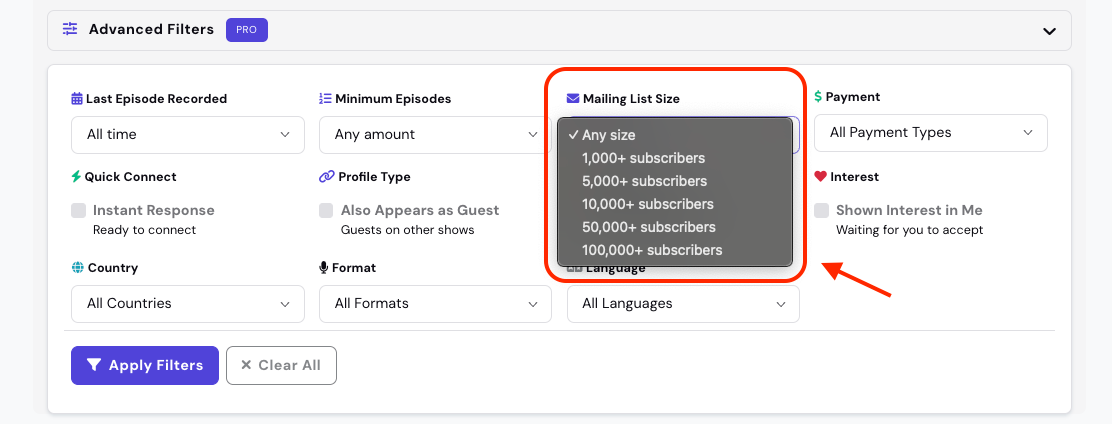
The audience size filter gives hosts access to actual mailing list and social following data for guests on the platform. Most hosts set a minimum and stop there. The hosts who use it most effectively use it to answer a more specific question.
The question worth answering with audience size data: Does this guest’s audience overlap with mine in a way that produces meaningful crossover when they promote the episode?
What meaningful overlap looks like: A podcast guest whose audience is in the same topic area and demographic as the show’s existing listeners, at a size that makes their promotion meaningful without being so large that the show’s current track record can’t attract them.
What the stage-matching principle produces: A podcast host booking guests whose audience size matches the show’s current stage books guests who are genuinely interested in appearing, who treat the collaboration reciprocally, and whose promotion adds subscribers who are precisely right for the show rather than peripherally interested.
The filter setting worth trying: A range rather than a minimum. Setting a maximum alongside a minimum surfaces guests whose audience size produces genuine reciprocity rather than a one-sided collaboration where the guest’s reach dramatically exceeds the show’s.
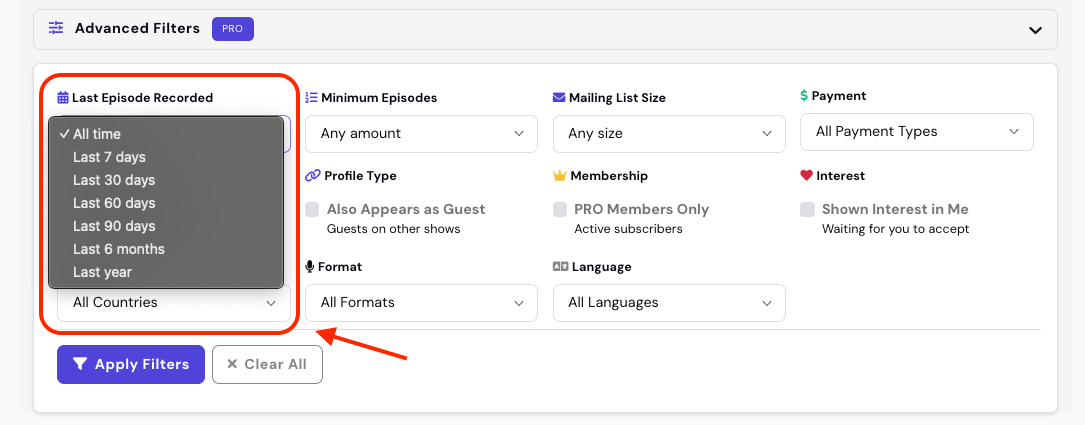
A podcast guest who signed up for Talks 6 months ago and hasn’t logged in since is a podcast guest who is not actively pursuing podcast appearances regardless of how good their profile looks.
What recent activity signals: That the podcast guest is in an active guesting phase, has a current angle they’re pitching, and is in a decision-making state about which shows to appear on. Those 3 conditions together produce the fastest path from connection request to scheduled recording.
What it signals about promotion behavior: A podcast guest who is actively pursuing appearances is a guest who is actively promoting the episodes that result from those appearances. Active promotion behavior and active appearance behavior tend to occur together.
When to turn it off: In narrow niches where the pool of precisely right guests is small; in those cases it’s worth reaching out to guests who aren’t currently active and waiting for a response rather than filtering them out entirely.
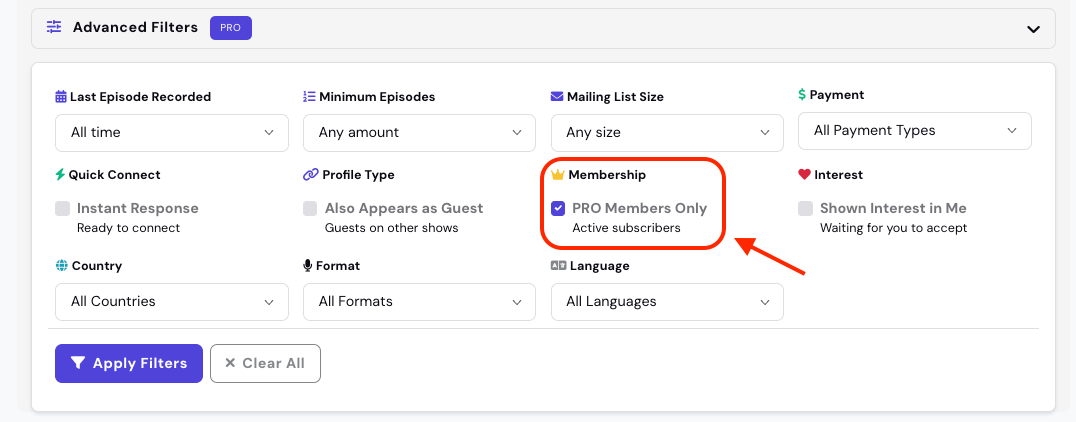
A Talks Pro guest has invested real resources in being on the platform. That investment is a selection signal.
What Pro status signals about a guest: That they’re treating podcast guesting as a serious visibility strategy rather than a casual experiment. Serious podcasy guests prepare thoroughly, promote consistently, and follow through on every commitment made during the collaboration.
What Pro status signals about episode quality: A guest who invests in their platform presence tends to invest in the quality of their appearances. The preparation, the specific talking points, the follow-through after recording all tend to be stronger from guests who take the process seriously.
What filtering for Pro guests does for connection efficiency: Every connection request sent to a Pro guest goes to someone who has already demonstrated the level of investment that predicts a strong collaboration. The selection work is partially done by the filter before the profile is even read.
The guest swap filter surfaces hosts who are also pursuing guest appearances on other shows. For strategic guest selection this filter produces a category of opportunity that the other filters don’t.
What a guest swap produces beyond the episode: A reciprocal relationship where both parties promote each other’s appearances, share each other’s audiences, and make introductions to other hosts and guests in their networks. The growth compounds on both sides simultaneously.
What the audience crossover looks like in a swap: Both shows gain subscribers from the other’s audience. The crossover is mutual and the relationship that produced it is strong enough to continue producing value through introductions and ongoing collaboration.
Who to prioritize for swaps: Podcast hosts whose shows serve audiences that overlap meaningfully with your own but approach the topic from a different angle. The overlap produces crossover and the different angle ensures the collaboration adds something new rather than duplicating what the show already covers.
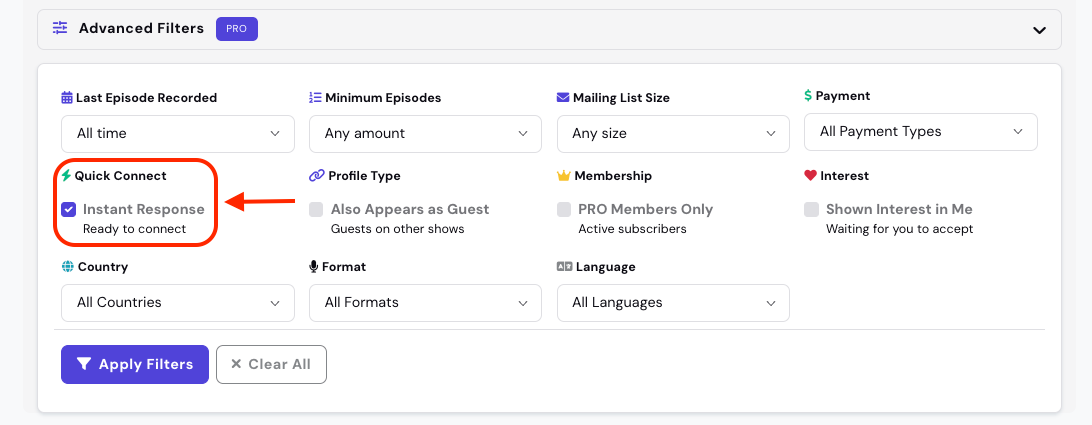
Strategic guest conversations have more moving parts than generic ones. The guest evaluation, the topic alignment discussion, the scheduling, the pre-recording preparation all require momentum to reach the recording stage before either party’s attention moves elsewhere.
What high response rate signals: That the guest is organized, professional, and treats communication with the same seriousness they bring to the recording. Those qualities in the booking process predict those qualities in the episode itself.
What slow response rate costs in a strategic conversation: Momentum; a conversation that takes 3 days between each message loses the energy that makes the collaboration feel like a genuine partnership. The episode that results from a slow-moving booking process often reflects that energy.
When this filter matters most: When the recording calendar has specific slots to fill and strategic conversations need to convert quickly. Faster responders move from connected to scheduled in days rather than weeks.
The 5 filters produce different results in different combinations. 3 combinations are worth knowing before the next guest search.
For audience growth through crossover: Recently active, Pro members, audience size range that matches the show’s current stage. This combination surfaces guests whose promotion behavior is active, whose investment in the platform is genuine, and whose audience size produces meaningful crossover rather than a symbolic one.
For episode quality and precise topic alignment: Recently active, Pro members, guest swap opportunities. This combination surfaces guests who are active collaborators, serious about their appearances, and open to reciprocal relationships that produce ongoing value beyond a single episode.
For filling the calendar quickly with strategic guests: Recently active, faster responders, Pro members. This combination surfaces guests who are in an active booking phase, respond promptly, and have demonstrated the seriousness that predicts a smooth collaboration from connection to recording.
💡 The 30 monthly Pro connections are the resource that strategic guest selection allocates.
An unfiltered search produces thirty connection requests directed at the most recently active profiles in a broad topic area.
A filtered search produces thirty connection requests directed at guests who have been evaluated against the criteria that predict strategic fit before the first message is sent.
Same 30 connections. Completely different outcomes at the end of the month.
Access Advanced Search on Talks Pro
Open Talks Pro and run a filtered search using the combination that matches the show’s current growth goal.
Look at the first 10 results. For each profile ask the question from Post 1:
Does this guest’s audience overlap meaningfully with my show’s existing listeners?
A yes means evaluate the profile further. A no means move to the next profile. A maybe means read the show description and recent appearances more carefully before deciding.
That question, applied consistently across every filtered search, is the selection criterion that transforms a search from a volume exercise into a precision one. The filters produce the right pool. The question identifies the right guest within it.
Send only the connections where the answer is yes.
This is Part 2 of a 5-part series on growing your podcast with the right guests using Talks.
The full series:
✅ Part 1: Why the right guest can accelerate podcast growth faster than more content
✅ Part 2 (you’re here): Using advanced search filters to find better-fit guests faster
Part 3: How to evaluate guest profiles and identify audience overlap
Part 4: Using the inbox workflow to move from match to recorded episode efficiently
Part 5: Building a repeatable guest selection system for long-term show growth
🔖 Save this post before your next guest search. The 3 filter combinations above are worth having as a reference when deciding which combination matches the show’s current growth priority.
🎯 Start Finding Better Guests on Talks
P.S. The audience size filter gives you access to actual mailing list and social following data for guests on the platform. Set a range rather than just a minimum.
A guest whose audience dramatically exceeds your show’s current reach is a guest who may not find the collaboration reciprocal enough to pursue actively.
A guest whose audience size produces genuine reciprocity is a guest who promotes the episode because appearing on your show moved the needle for them too.
That mutual value is what produces the audience crossover that compounds. 👇
Keep Talking,
Liam
~
Visibility systems to grow your personal brand, audience + authority with guest appearances. First online sale in 2001. Built multiple 6–7 figure online businesses. 400+ interviews. Malta, Stockholm, Sydney. Love soccer, surf & burritos.
No posts
Comments
Nothing yet. Say the first thing.
Sign in to join the conversation.