
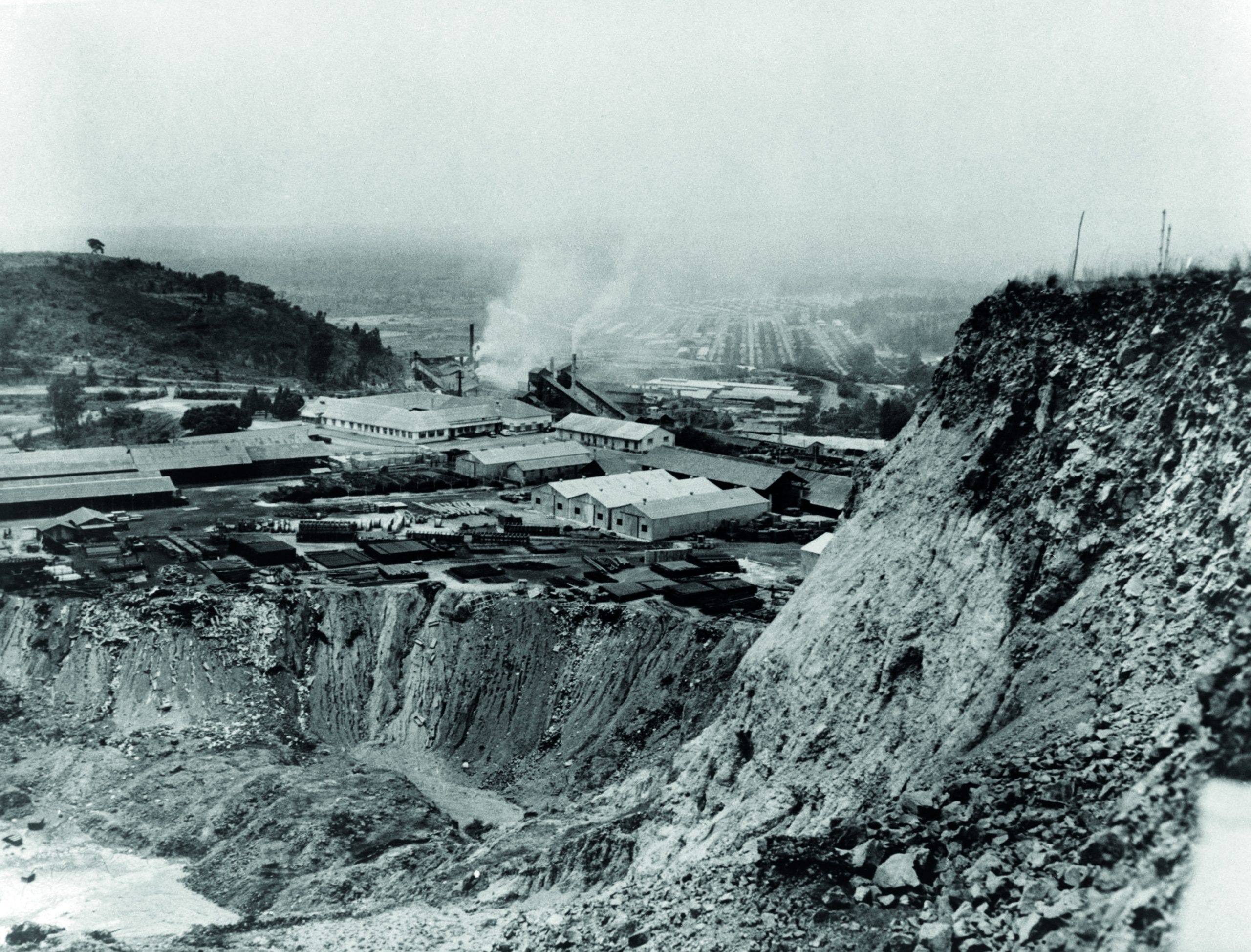
Shinkolobwe uranium mine, circa 1954.
On September 18, 1942, Lieutenant Colonel Kenneth Nichols entered the Manhattan office of Edgar Sengier, a corporate executive of the Belgian mining company Union Minière du Haut-Katanga. Nichols was not in uniform; he wore a civilian suit. He was deputy district engineer of the newly created Manhattan Engineer District and had recently been given responsibility for quietly procuring uranium for the secret atomic bomb project.
Nichols had heard that Sengier controlled a large supply of extraordinarily rich uranium ore mined at Shinkolobwe in the Belgian Congo. Even more remarkably, some 1,200 tons of it were already in the United States, sitting in a warehouse on Staten Island. Sengier had brought the ore across the Atlantic to keep it out of German hands and, for months, had been trying—with remarkably little success—to interest the U.S. government in buying it.
Sengier was therefore a little skeptical when another civilian-looking stranger appeared asking about uranium. He asked Nichols whether he was actually a contracting officer and whether he had authority to buy.
Nichols said that he did.
“How much authority do you have?” Sengier asked.
Nichols replied:
“I’ve got more authority than you have uranium, I’m sure.”
“Come on in,” Sengier said.
This was the beginning of the first American uranium crisis. The early American effort to build an atomic bomb had no clear idea how much uranium would ultimately be needed—in fact, acquiring uranium ore was not especially high on the initial priority list.
Edgar Sengier, however, already understood that uranium was likely to become an important military resource. Sengier had no training as a physicist. He was a mining engineer who had risen through the ranks of Union Minière du Haut-Katanga and had responsibility for Shinkolobwe, perhaps the richest uranium deposit ever discovered. Mining at Shinkolobwe during the first decades of the twentieth century focused not on uranium itself, but on one of the radioactive products in its decay chain: radium. The commercial value at Shinkolobwe was in the radium, not in the uranium left behind.
However, in 1938, a discovery changed the world and the value of uranium.
Otto Hahn and Fritz Strassmann produced the experimental evidence for nuclear fission; Lise Meitner and Otto Frisch supplied the physical explanation. Within months, Frédéric Joliot and his collaborators in France demonstrated that uranium fission released additional neutrons. The implication was profound: those neutrons might produce additional fissions, releasing still more neutrons and creating a self-sustaining chain reaction—and an enormous release of energy.
Joliot began filing patents on applications of the chain reaction, but there was an obvious practical problem. If this new physics was ever to become anything more than a laboratory experiment, he would need uranium—lots of uranium.
In May 1939, Sengier was approached by Joliot and his French collaborators about obtaining uranium from Union Minière. The discussions were serious enough that the company contemplated cooperation with the French scientists. At about the same time, while in London on Union Minière business, Sengier met Sir Henry Tizard, one of the most important scientific advisers in the British defense establishment. Tizard asked for an option that would give Britain access to the Shinkolobwe uranium. Sengier declined to give Britain exclusive control of it. But Tizard impressed upon him something much more important: whatever the future commercial value of uranium might be, this material must not fall into German hands.
Within a matter of weeks, two independent groups of extremely accomplished scientists—one French and one British—had told this mining engineer that a material his company possessed in almost absurd abundance might suddenly have consequences far beyond the radium business.
There is no reason to believe that Sengier understood the physics in any detail, or even imagined what an atomic bomb would ultimately become. But he did not need to -- he understood his ores, markets, war, and risk. He had lived through the German invasion of Belgium during the First World War. When war returned to Europe in September 1939, Sengier moved to New York with authority to manage Union Minière’s interests should Belgium itself be occupied. In May 1940, Germany invaded Belgium. The danger Tizard had warned about was no longer hypothetical.
Sengier acted. In late 1940, Union Minière shipped roughly 1,200 tons of extraordinarily rich Shinkolobwe ore from Africa to New York and stored it in a warehouse on Staten Island. There it sat. Remarkably, the United States government knew it was there and initially was not especially concerned about acquiring it.
In early 1942, the planning board of the Office of Scientific Research and Development’s S-1 Section (the OSRD group overseeing uranium research and the early atomic-bomb program) estimated that no more than about 150 tons of uranium oxide would be required through the summer of 1944. Canada appeared capable of supplying much of what was needed from the Eldorado operation at Great Bear Lake. There were also uranium-bearing residues from the vanadium industry on the Colorado Plateau. Against the requirements then imagined by the scientists, uranium supply did not appear to be a serious constraint. In July 1942, the S-1 Executive Committee again concluded that there was no immediate need to bring additional uranium ore under government control.
That assessment changed quickly as an experimental physics program began turning into an industrial undertaking of unprecedented scale.
Vannevar Bush was at the center of that transformation. Bush, director of the Office of Scientific Research and Development and President Franklin Roosevelt’s trusted adviser on wartime science, had been pushing the atomic project forward as the experimental evidence became increasingly persuasive. He understood that if the bomb was actually going to be built, the problem was no longer simply proving that the physics worked. Everything had to be scaled up—enrichment, reactors, chemical processing, factories, electrical power, and ultimately raw materials.
Then, in late August 1942, Bush learned that Canada’s Eldorado company was attempting to purchase 500 tons of Sengier’s Staten Island stockpile.
That changed the nature of the uranium problem. The question was no longer simply whether enough uranium existed. The question was whether the United States would control enough uranium to ensure that its bomb program could not be starved of its essential raw material. Bush alerted the Army and urged that uranium exports be controlled. Within days, the S-1 Committee recommended purchasing all 1,200 tons of Sengier’s Staten Island ore.
By the time Japan surrendered in August 1945, after atomic bombs had destroyed Hiroshima and Nagasaki, one of the largely forgotten facts of the Manhattan Project was that the American bomb program had been fueled overwhelmingly by foreign uranium. Roughly two-thirds of the uranium used by the project came from the Belgian Congo, with most of the remainder coming from Canada and only a comparatively small fraction from the United States.
That fact complicates the mythology of the Manhattan Project as an entirely American technological triumph. The laboratories were American. The vast enrichment plants at Oak Ridge and the reactors at Hanford were American. The scientists, engineers, construction workers, military officers, and industrial companies assembled an undertaking of almost unimaginable scale. But the raw material that made much of it possible had come across the Atlantic from central Africa.
It is difficult to know what the Manhattan Project would have looked like had Sengier not ordered those 1,200 tons of extraordinarily rich Shinkolobwe ore shipped to New York. The bomb almost certainly would still have been pursued. Uranium existed in Canada and in the American West, and additional sources could have been developed. But those ores were vastly poorer and would have required mining, transporting, and processing far greater quantities of rock. Time was the commodity the Manhattan Project possessed in the shortest supply.
Without Shinkolobwe, uranium procurement would have become a much larger part of the Manhattan Project itself. Production might have been delayed. Less fissile material might have been available by the summer of 1945. Perhaps fewer weapons could have been produced on the timetable that actually unfolded. We cannot know the counterfactual with certainty.
What we can say is that when the United States confronted its first genuine uranium crisis, domestic uranium mining did not save the atomic bomb program. Foreign uranium did. And the most important supply came from an African mine whose ore had been moved out of harm’s way because a Belgian mining engineer listened when scientists told him that the world had changed.
The lesson of the first uranium crisis was not lost on the United States government. The Manhattan Project had succeeded, but its dependence on foreign uranium was now impossible to ignore. If nuclear weapons were going to become a permanent part of American national security, dependence on foreign uranium looked like an obvious vulnerability.
The solution was to create an American uranium industry.
The Atomic Energy Act of 1946 established the Atomic Energy Commission, and on January 1, 1947, the AEC inherited the facilities, responsibilities, and uranium problem of the Manhattan Project. Domestic uranium exploration and mining became a national priority. The government guaranteed that it would purchase domestically produced uranium and offered remarkable incentives to anyone who could find it. A general guaranteed price of $3.50 per pound of recoverable U3O8 was accompanied by bonuses for new discoveries; one particularly spectacular incentive offered $10,000 for the discovery and delivery of 20 tons of ore assaying 20 percent uranium oxide.
The federal government did far more than offer money. The AEC and the U.S. Geological Survey sent geologists across the Colorado Plateau, drilled exploration holes, published maps and results for prospectors, provided assay services, built or improved access into remote country, and eventually surveyed tens of thousands of square miles from the air with radiation detectors. The government did not merely encourage a uranium market. It helped create one.
The result was one of the great mineral rushes in American history. Ten of thousands of prospectors arrived on the Colorado Plateau carrying picks, drills, Geiger counters, geological maps, and dreams of becoming rich. Some were experienced miners and geologists; most were not. Families would organize their summer vacations to trudge around the Colorado Plateau with Geiger counters, only to become dirty and sunburned. Uranium prospecting became a cultural phenomenon, promoted in magazines and newspapers and encouraged by a federal government that wanted every possible domestic source identified.
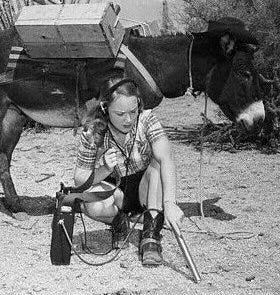
A government ad promoting uranium prospecting…all you need is a Geiger counter and a mule. The US government spent 10’s of millions of dollars promoting uranium prospecting and built more than 1200 miles of roads across the Colorado Plateau to facilitate exploration.
Then, in 1952, Charlie Steen did exactly what every uranium prospector dreamed of doing. After nearly two penniless years prospecting around Moab, Utah, he drilled into the rich Mi Vida deposit in Lisbon Valley. Steen became enormously wealthy, and his discovery electrified the uranium rush (as a side bar, Charlie used his fortune to build a fabulous mineral collection). Thousands more arrived. Moab’s population exploded and the town proclaimed itself the “Uranium Capital of the World.” Contemporary accounts described a town with roughly two dozen millionaires among a population of only about 6,000 people.
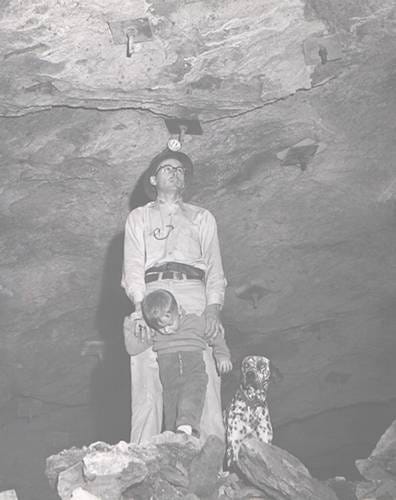
Charlie Steen underground with his son at the Mi Vida Mine, ca 1955
The incentives worked almost beyond expectation. By the mid-1950s there were about 800 major uranium producers on the Colorado Plateau, and ore production was doubling roughly every eighteen months. What had been a small industry associated largely with vanadium and radium became an enormous mining enterprise spread across Utah, Colorado, New Mexico, and Arizona.
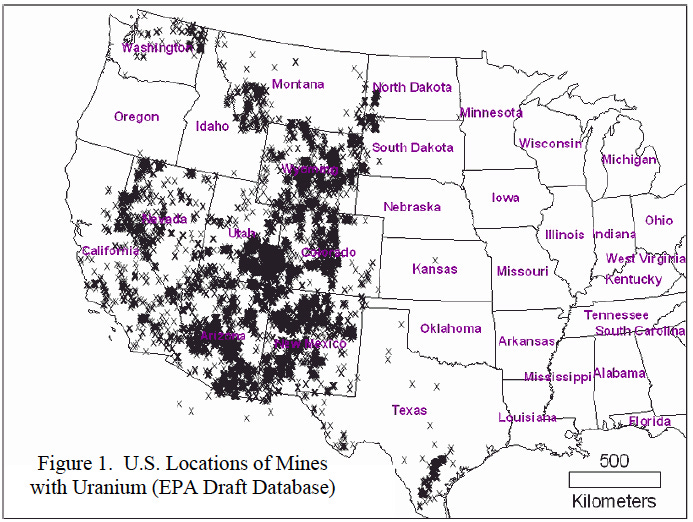
Mines with some Uranium in the western US. Most of these mines only have minor amounts of uranium, but those in Utah, Colorado, New Mexico and Arizona contain about 92% of the nation’s reserves.
In fact, the government eventually realized it had succeeded too well. By the late 1950s the immediate fear of inadequate domestic uranium had been replaced by concern about surplus production. In 1958 the AEC announced that future purchases would largely be restricted to reserves already developed. Government purchase contracts continued for years, but the great prospecting boom was ending. The federal government had accomplished what it set out to do: it had created a large domestic uranium industry and an enormous domestic resource base.
The great uranium rush left the American West with environmental consequences that few people imagined when prospectors first poured onto the Colorado Plateau.
My father and I visited many of the old uranium mines—mostly abandoned ones in Utah—in the early 1970s. I collected a boatload of what I thought of as “yellow smears,” the brightly colored secondary uranium minerals deposited in the sandstones of the Colorado Plateau. Carnotite, tyuyamunite, and other uranium minerals fascinated me. I learned how to read X-ray diffraction films by studying samples I had prepared for identification. I was cautioned, wisely, to store these treasures in the barn rather than in my bedroom because of the radon and radioactive decay associated with them.
I never really built a systematic uranium-mineral collection, and eventually most of my specimens were disposed of for environmental and safety reasons. What remained was my fascination with the story of uranium minerals—why they were there, how they formed, and how something that appeared as a yellow stain on a sandstone fracture could become so important to the history of the world.
In 1974, I read Edward Abbey’s Desert Solitaire and was deeply affected by his descriptions of isolation, silence, canyon country, and the mountains surrounding Moab. I knew some of that country already, but Abbey gave words to something I had begun to understand from wandering through it: wilderness has value precisely because we have not remade it for our immediate purposes. Once destroyed, something more than scenery is lost.
By the late 1970s, it was also becoming clear that the uranium rush had left behind something far darker than abandoned headframes and prospect pits. Nowhere was that legacy more devastating than on the Navajo Nation. From 1944 through 1986, nearly 30 million tons of uranium ore were mined from Navajo lands. Navajo men supplied much of the labor, often working underground with poor ventilation and little understanding of the radiation hazard. Mines and mills operated close to homes and communities. When the industry disappeared, it left behind hundreds of mines, piles of waste rock, contaminated structures, and polluted water sources.
The tragedy of the miners themselves eventually became impossible to dismiss. The greatest occupational danger underground was not simply the uranium dust covering clothing and skin. Uranium decays through a chain that includes radium and then radon, an invisible radioactive gas. In poorly ventilated underground mines, radon accumulated. Its short-lived decay products attached themselves to airborne dust and aerosols and, when inhaled, lodged in the respiratory tract, irradiating the surrounding tissue. The result was an extraordinary excess of lung cancer and other respiratory disease among uranium miners, including Navajo miners who had smoked little or not at all. Health studies indicate that Navajo men with a history of uranium mining had an estimated 28.6-fold greater lung-cancer risk than Navajo men without such a history.
Closing a uranium mine, however, does not end its environmental life. Waste rock and mill tailings retain radioactive decay products. Radium continues to produce radon. Wind moves contaminated dust beyond the mine site. Storm runoff carries material into washes and surface water. Uranium and other contaminants can migrate into groundwater. The spectacular yellow minerals that attracted prospectors—and me as a young mineral collector—were only the visible part of the problem. Much of the hazard is colorless, microscopic, or invisible altogether.
We have a benign bureaucratic word for all of this: legacy.
It is an oddly comforting word. A “legacy site” sounds like something inherited from a distant past, almost as though the contamination simply arrived with history. But these sites are not natural inheritances. They are unpaid costs from an industry deliberately stimulated by federal policy. The government wanted uranium quickly. It guaranteed prices, paid bonuses, mapped deposits, assisted exploration, and created the market. Private companies mined the ore and, when the market was good, earned the profits. The wastes remained after the ore was gone.
The country was, in effect, billed twice. We paid once to create the industry. We pay again to deal with what the industry left behind.
Moab provides an almost painfully literal example. The uranium boom made Moab famous and made fortunes for some of the people who participated in it. A uranium mill was built along the Colorado River in 1956 and later operated by Atlas Minerals. After decades of operation, millions of tons of radioactive tailings remained beside one of the most important rivers in the American West. Atlas declared bankruptcy in 1998. The company was gone, but the tailings were not. Responsibility eventually passed to the Department of Energy. By 2026, the federal cleanup project had moved more than 16 million tons of tailings and contaminated material away from the Colorado River. The federal government (meaning all of us as tax payers) now pays the cleanup costs.
That is not to say that corporations never pay. EPA enforcement actions and legal settlements have forced some surviving companies and corporate successors to finance some cleanups. On Navajo lands, settlements worth well over a billion dollars have been secured for abandoned uranium mines. But even those settlements reveal the asymmetry of the problem: they came decades after the mining, after communities had already lived with the contamination, and after years of federal investigation and litigation. Today more than 500 abandoned uranium mines remain on or near Navajo lands, and funding is available to begin assessment and cleanup at fewer than half of them.
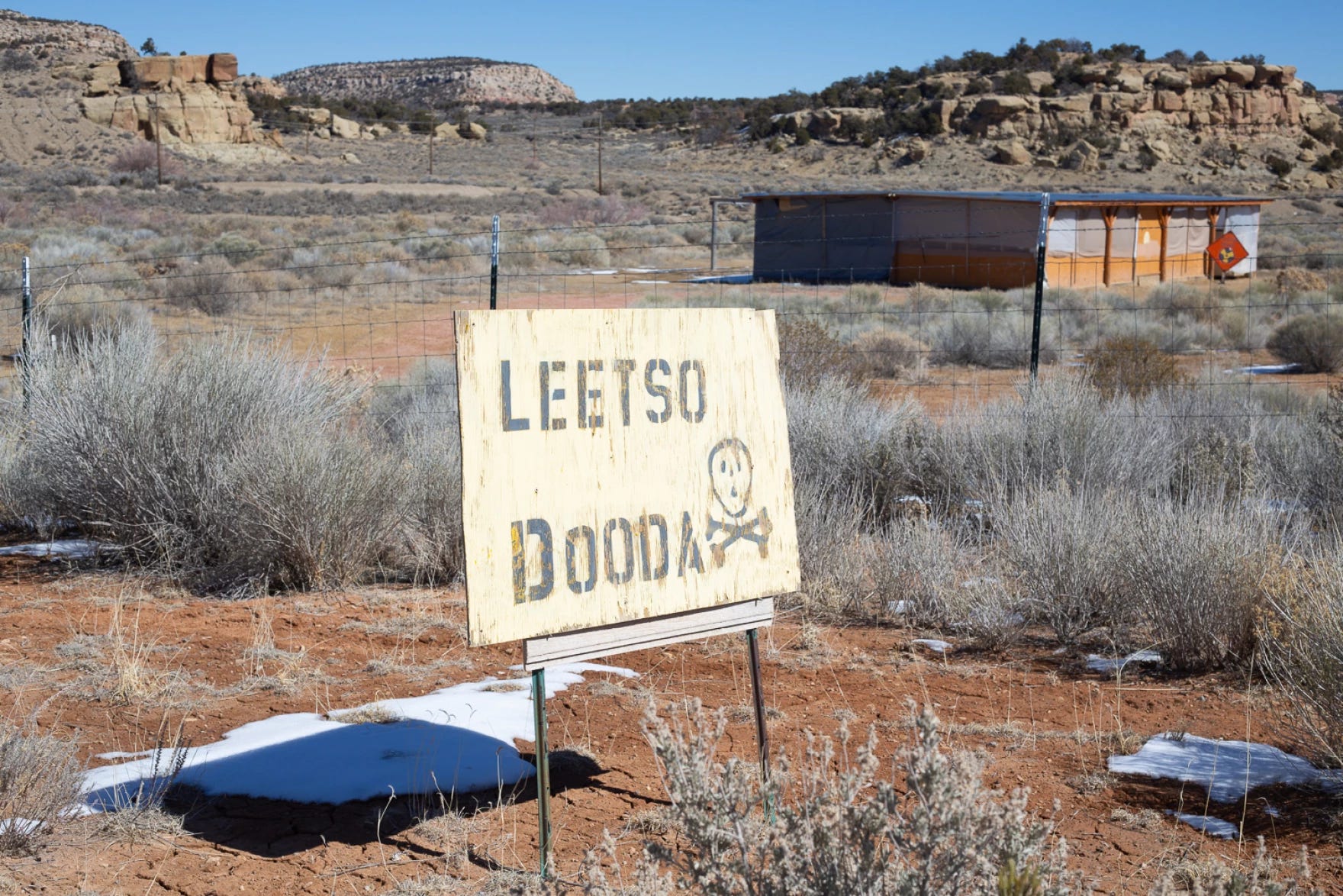
A sign in Diné that reads “Leetso Dooda,” meaning “No Uranium” on the Navajo reservation.
The economic incentive is immediate; the environmental liability is delayed. Profits can be booked during the years a mine operates. Contaminated groundwater, mine waste, radon, and health effects can persist for generations. The company that benefited may merge, reorganize, disappear, or declare bankruptcy long before the final environmental bill arrives. The landscape and the people living on it do not have that option.
This is why I really dislike the word legacy as applied to environmental issues. It tends to hide responsibility. Society did not merely inherit these problems. We created them as part of a national policy, and then allowed much of the true cost of uranium to be shifted into the future. The government paid a price for uranium, but that price was never the full cost of uranium.
The full cost includes the miner breathing radon progeny and contaminated dust underground. It includes the family living beside waste rock. It includes contaminated wells and tailings piles, federal reclamation programs, decades of groundwater monitoring, and landscapes that cannot simply be returned to what they were before the first drill arrived. Environment is not an externality to be considered after a national-security decision has been made. It is part of the decision.
That lesson should matter enormously if the United States is about to declare a second uranium crisis.
On March 20, 2025, President Trump signed an executive order intended to accelerate domestic mineral production. Its justification was framed explicitly in terms of national security: “Our national and economic security are now acutely threatened by our reliance upon hostile foreign powers’ mineral production.” The order specifically included uranium among the minerals covered and directed federal agencies to facilitate domestic production.
Two months later, on May 23, the administration made the uranium argument even more explicit. An executive order titled Reinvigorating the Nuclear Industrial Base declared that America’s nuclear fuel-cycle infrastructure had “severely atrophied,” leaving the country “heavily dependent on foreign sources of uranium as well as uranium enrichment and conversion services. These trends cannot continue.” That same day, Secretary of the Interior Doug Burgum announced accelerated approval of the Velvet-Wood uranium-vanadium mine in southeastern Utah with the rejoinder: “This is mineral security in action.”
The language is clear: the United States faces a uranium problem; dependence on foreign sources threatens national security; therefore America must mine more uranium at home.
But is there actually a uranium crisis?
There certainly is foreign dependence. In 2025, only 7 percent of the uranium delivered to operators of American civilian nuclear reactors originated in the United States. Canada supplied 32 percent, Kazakhstan 28 percent, and Australia 15 percent. Those numbers sound alarming until one looks more carefully at what “foreign” means. Canada and Australia alone supplied nearly half of America’s uranium. Unless we intend to continue treating Canada as an enemy, foreign uranium is not automatically hostile uranium.
More importantly, uranium ore is only the first step in making nuclear fuel. Ore is milled and concentrated into uranium oxide, commonly called yellowcake and generally expressed as U3O8. That material is converted to uranium hexafluoride, UF6, which is a fed stock for an enrichment plant. Only then does the extraordinarily difficult problem of separating uranium isotopes begin.
Natural uranium is about 99.3 percent uranium-238 and only about 0.7 percent uranium-235. U-235 readily sustains the fission chain reaction used in conventional light-water reactors, and its concentration generally must be increased to several percent before the uranium can be used as reactor fuel. That separation process—not the existence of uranium atoms in the Earth’s crust—is where the modern American vulnerability lies.
In 2025, only 23 percent of the enrichment services purchased by operators of American civilian nuclear reactors were of U.S. origin. Seventy-seven percent came from foreign enrichment facilities, including 26 percent from Russia. That is where there is a genuine national-security vulnerability – the enrichment of uranium.
But it is not like the uranium crisis of the Manhattan Project. There is plenty of uranium being mined across the globe, and it is geographically widespread. The United States can purchase large quantities from countries such as Canada and Australia. The real strategic weakness lies farther down the fuel cycle: conversion and, especially, enrichment.
The irony is that the United States once dominated uranium enrichment. The Manhattan Project invented industrial-scale gaseous diffusion at Oak Ridge, and during the Cold War the federal government built enormous additional enrichment plants at Portsmouth, Ohio, and Paducah, Kentucky. Gaseous diffusion worked, but it consumed staggering amounts of electricity. As centrifuge technology became more efficient and the Cold War ended, the old American plants became technological dinosaurs. The government moved commercial enrichment toward privatization, but a comparably large American-owned centrifuge industry did not immediately replace the capacity that was being shut down. Portsmouth stopped enriching uranium in 2001. Paducah, the last of the great American gaseous-diffusion plants, halted in 2013.
The result is the uranium “crisis” of today. The United States still operates nuclear reactors, talks of a nuclear renaissance, and anticipates small modular and advanced reactors that may require new forms of enriched fuel, yet much of the enrichment work is done elsewhere.
The Trump administration, interestingly, does appear to understand this. In January 2026 the Department of Energy announced $2.7 billion in awards to rebuild domestic enrichment capacity for both conventional low-enriched uranium and high-assay low-enriched uranium, or HALEU. That investment addresses the actual weakness.
However, digging another uranium mine does not. But a central pillar in the new policy is to open public lands and remove environmental regulation to mining uranium, and once again, the Colorado Plateau is the primary target.
A mine produces uranium ore, and a mill concentrates it. Neither operation separates U-235 from U-238. If the United States mines twice as much uranium but remains dependent on foreign conversion and enrichment to turn it into reactor fuel, then we have produced more yellowcake without solving the national-security problem.
That distinction becomes especially important when the words national security are used to justify opening protected public lands to mining.
On July 13, 2026, President Trump sharply reduced Bears Ears National Monument, excluding more than a million acres from monument protection. The proclamation explicitly identified uranium, along with other minerals and coal, as resources whose development could serve national priorities, and it argued that the United States should not rely on foreign sources for these materials.
Bears Ears lies only a short distance from Moab on the Colorado Plateau. Bear Ears is located within 150 miles of at least 212 abandoned uranium mines that have not been remediated. The “legacy” is to repeat the post WWII rush, mine now, worry about consequences in the future.
The history of the great uranium rush is not incidental. It should be part of the decision. Yet the national-security argument treats uranium beneath the land as an asset while the environmental costs of extracting it are largely absent from the accounting. There is discussion of mineral wealth, jobs, domestic production, and foreign dependence. There is remarkably little discussion of the abandoned mines, contaminated groundwater, radioactive wastes, or communities that are still paying for the first uranium rush.
This is the part of the argument I find hardest to accept. We are told that national security requires another push to mine uranium from the American West, even as the federal government remains responsible for cleaning up the consequences of the previous push. We are prepared to spend public money rapidly to stimulate new production and much more slowly to repair what earlier production left behind.
Calling those abandoned mines and tailings piles a “legacy” does not make them merely history. They are present day environmental liabilities. They are present day health concerns. And they are present day financial obligations.
If America truly wants a secure nuclear-fuel supply, then rebuild the capability to convert and enrich uranium. Develop the HALEU production required by advanced reactors. Maintain reliable uranium supplies from allies while developing reasonable domestic production where mining can be done responsibly. But do not use national security as a magic phrase that makes environmental costs disappear.
We have already conducted that experiment on the Colorado Plateau once - and we know the results. I am not anti-nuclear, or anti-mining. But I am anti-”environmental profiteering”.
The first uranium rush showed what science, government, and industry could accomplish when the nation confronted a genuine security problem. It also showed what happens when the environmental costs of that accomplishment are deferred until later. The lesson is not that America should never mine uranium. The lesson is that the full cost must be part of the calculation from the beginning.
To fix the modern uranium vulnerability, we must address enrichment. To honor the people and landscapes that paid the price of the first uranium rush, we must finish addressing its environmental legacy. And if we are going to mine again, we must protect the future rather than simply creating the next generation of “legacy” sites.
No posts
Comments
Nothing yet. Say the first thing.
Sign in to join the conversation.