
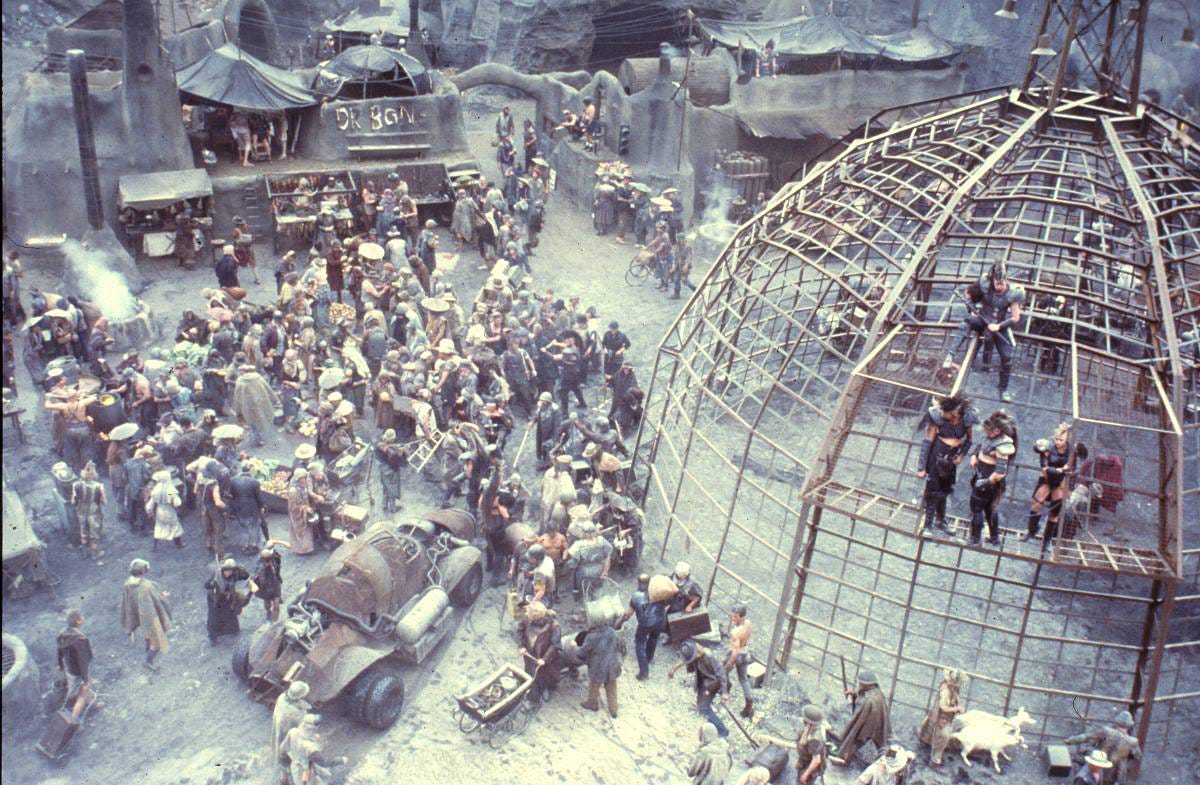
“Who run Bartertown?”
“Master Blaster runs Bartertown.”
— Mad Max Beyond Thunderdome (1985)
It is quite likely that everyone reading this essay is already a regular user of artificial intelligence (AI). Some readers use it directly—and knowingly—to write computer code, analyze data, draft or copy edit reports, or have one of the systems like ChatGPT—the system I use—organize a workflow or even finances. Others, perhaps less knowingly, engage AI more casually: asking an iPhone, “Is there anywhere good to eat around here?” getting directions around slow traffic, translating a menu, cleaning up a photograph photobombed by a wandering tourist, or noticing that a first visit to an online store seems uncannily good at knowing what you might be interested in buying.
Make no mistake: AI now touches nearly everything we do when we use a computer of almost any kind. And make no mistake about something else—we are not going back to a world in which finding an answer meant walking down to the local library, consulting an encyclopedia, or calling someone who might know. Artificial intelligence has already become part of the infrastructure of modern life, much as the internet did a generation ago.
Despite the ubiquity of AI, and despite the newspaper headlines about fights over building new data centers or fears that AI will somehow escape human control, most of us have only a vague idea of how AI actually works.
I can pick up my iPhone, open the ChatGPT app, press the microphone button, and say, “Why is the sky red tonight?” Within seconds I receive an answer that may discuss sunlight, atmospheric scattering, smoke, dust, and perhaps even fires burning in Western Washington. The whole interaction feels pretty much effortless: I ask a question, my phone listens, and an answer appears.
The phone seems central to this “magic,” but in fact almost none of the important work is actually being done by the little metal rectangle in my hand.
My voice is converted into digital data and sent across a communications network—either my internet connection or the cellular network—to computers located somewhere else. Those computers are housed in those ubiquitous data centers.
The computers in a data center do not look much like the laptop or desktop that you are likely using to read this essay. There are thousands of servers: thin, rectangular machines stacked one above another in tall metal racks and connected by extraordinarily fast networks. Surrounding them are storage systems, network switches, electrical transformers, batteries, cooling equipment, pumps, and miles of cable. Increasingly, the largest AI data centers contain tens or even hundreds of thousands of specialized processors.
The buildings themselves are engineered largely around two physical problems: getting enormous quantities of electricity into the computers and getting the resulting heat back out of the building.
Inside these machines, specialized processors perform an extraordinary number of mathematical operations—comparing patterns, calculating probabilities, moving information in and out of high-speed memory, and generating a response one small piece at a time. The result is sent back across the network to the small glass rectangle in my hand.
This whole loop—from my voice asking a question to a couple of lines of text appearing on my phone—seems trivial, almost weightless. But it is anything but.
Before the computer can answer my question, it first has to do something surprisingly difficult: it has to convert human language into mathematics.
The systems behind ChatGPT and similar AI programs are called large language models, or LLMs. The name is actually quite descriptive. They are “large” because they contain enormous numbers of numerical values—called parameters—that were adjusted during training as the model examined patterns in vast amounts of language. They are “language models” because their fundamental task is to determine how pieces of language relate to one another and, ultimately, what piece of language should come next.
The first step is to divide language into smaller units called tokens. A token may be an entire word, part of a word, punctuation, or some other fragment of text. These tokens can then be represented numerically and processed by the computer.
That sounds straightforward until one considers what we actually expect the machine to understand. Suppose I ask, “Is there anywhere good to eat around here?” A computer cannot simply look up the definition of the word eat. I am not asking about the physical process of chewing and swallowing food. I probably mean a restaurant, and depending upon the time of day I may mean lunch or dinner. “Around here” implies that my location matters. “Good” is not a physical property at all; it probably means well regarded, appropriate to my tastes, perhaps open now, and within a reasonable distance.
If instead I wrote that “acid will eat through the metal,” the identical word eat suddenly means something altogether different.
Humans make these distinctions without really thinking about them—it is our language. If you have ever tried to translate casual conversation into another language, say Spanish, you know that it is not remotely as simple as looking up each word in a Spanish-English dictionary and stringing those words together.
An AI system has to make that translation mathematically.
The tokens representing my sentence are converted into numerical representations, and the model examines their relationships to one another. Modern AI systems use an architecture called the transformer, first introduced in 2017. One of its critical features, called attention, allows the model to determine which parts of a sentence are most important in interpreting the other parts.
Thus eat, good, anywhere, and around here are not treated as isolated dictionary entries. Their meaning comes from their relationship to one another and from patterns the model learned during training.
The important point is that this apparent “understanding” can ultimately be reduced to arithmetic. The computer multiplies numbers, adds numbers, compares numerical relationships, and moves enormous arrays of numbers into and out of high-speed memory. It does this through layer after layer of the model and eventually calculates which token should come next in its answer. After selecting that token, it essentially repeats the process to generate the next one, and then the next. That is why a ChatGPT answer often appears progressively on the screen rather than materializing all at once.
Simply breaking my sentence into tokens requires relatively little computation. The extraordinary amount of work comes afterward, as those tokens are repeatedly passed through the immense mathematical machinery of the model.
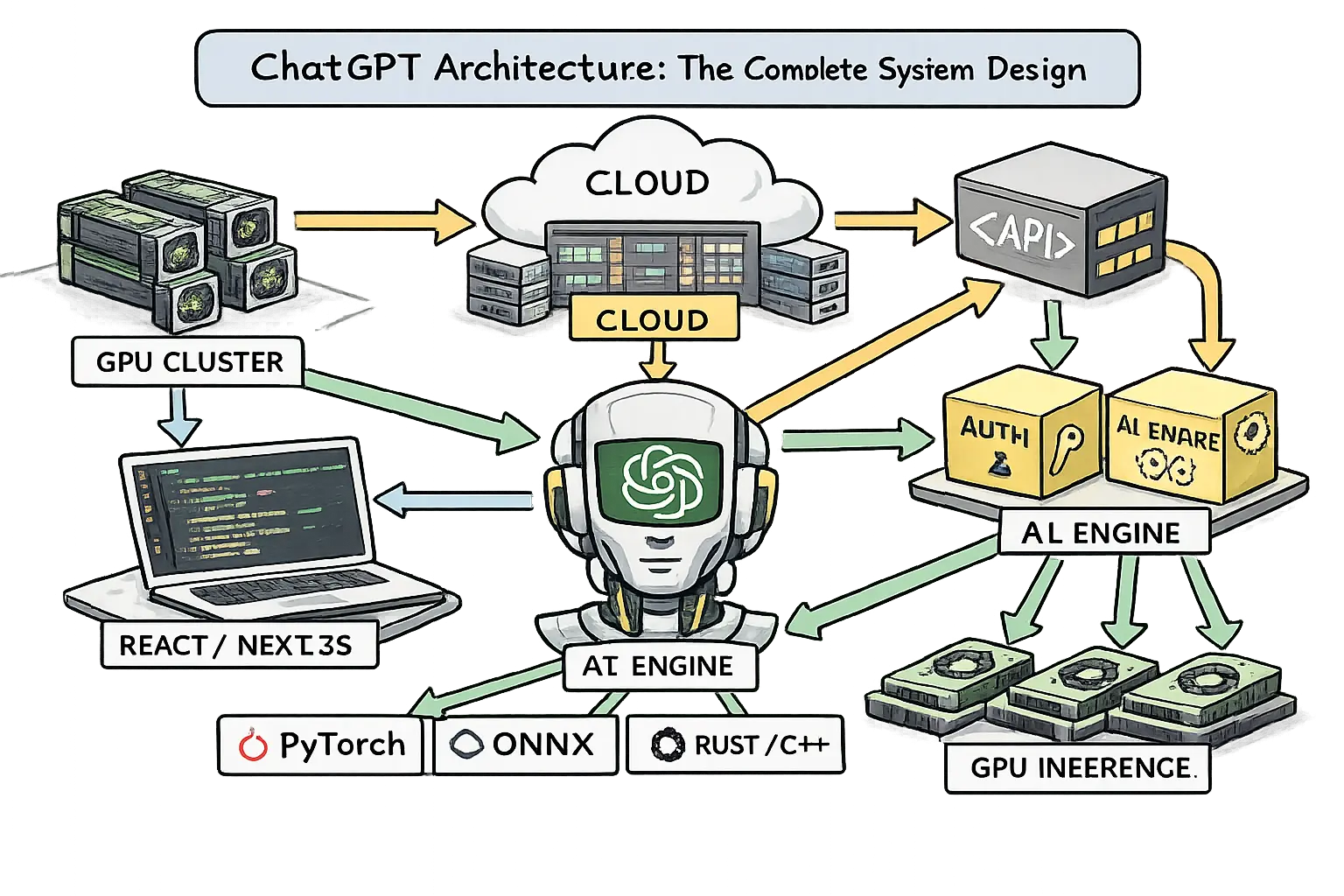
I do not know precisely how many mathematical operations ChatGPT performs to answer my restaurant question. OpenAI does not publish enough information about which model handles every request, how many parameters are active, or how the computation is distributed across its machines. But a reasonable back-of-the-envelope calculation for a contemporary large language model suggests that a short question followed by a modest answer can involve several trillion mathematical operations.
Think about that—trillions of operations just to help find a food truck.
I say perhaps eight words into my phone. A few seconds later several sentences appear on the screen. Between those two events, computers somewhere else may have performed something on the order of five trillion mathematical operations.
Now scale this from me asking one question to millions of people asking multiple questions every day. By July 2025, OpenAI reported that people were sending ChatGPT more than 2.5 billion messages every day. That is about 104 million every hour, 1.7 million every minute, or nearly 29,000 requests every second of every day.
If, simply for illustration, every one of those messages required the roughly five trillion operations of my little restaurant question, that would represent something on the order of 12.5 sextillion mathematical operations every day. That is not an estimate of ChatGPT’s actual computational load—questions vary enormously in complexity, different models perform different tasks, and the necessary internal information is not public. It is simply a way of appreciating the scale.
And ChatGPT is only one AI system. Google, Microsoft, Meta, Amazon, Anthropic, Apple, xAI, and thousands of other companies are doing comparable computation. Many applications are vastly more demanding than my restaurant question: generating photographs, creating video, analyzing enormous databases, writing software, interpreting medical images, running scientific calculations, or allowing an AI agent to work on a complicated problem for minutes or hours rather than seconds.
Every one of those mathematical operations takes place in a physical machine that runs on electricity. Data must be moved into and out of memory. Processors must communicate with one another. Electrical charges move through transistors. And virtually all of the electricity consumed by that machinery eventually becomes heat that must somehow be carried away.
Every calculation requires energy.
One calculation requires an almost unimaginably small amount. Even trillions of calculations associated with one ordinary question can be performed with remarkable efficiency by modern processors. But repeat those calculations billions of times every day, build larger models, generate images and videos, and ask AI systems to reason continuously about increasingly complicated problems, and something profound happens.
Artificial intelligence becomes an energy hog—it sucks in electricity to find my food truck and then uses still more energy to cool the processors doing the calculations.
When the transformer architecture underlying modern AI was introduced in 2017, few people imagined the scale at which these machines would be operating less than a decade later. The amount of electricity now being demanded by AI data centers—and projections of how much more will be required over the next decade—is staggering.
Which brings us to the real subject of this essay: when we say that artificial intelligence requires more power, what exactly do we mean?
We mean new power plants to generate electricity. We mean transmission lines to move that electricity across hundreds of miles. We mean substations and transformers to deliver enormous concentrations of power to individual data centers. We mean natural gas pipelines, nuclear reactors, solar and wind farms, batteries, cooling systems, and, in some cases, entirely new electrical infrastructure built principally to satisfy the appetite of computation.
Although we all know the expression “it’s in the cloud,” it turns out that the “cloud” has a very large extension cord.
The Return of Electricity Demand
To understand why this sudden demand for electricity is such a challenge—or simply a problem—it helps to establish some context by looking at how Americans have used electricity over the last half century.
In 1970, the United States consumed about 1.39 trillion kilowatt-hours of electricity. By 1980 that had risen to about 2.1 trillion kWh, by 1990 to 2.8 trillion, and by 2000 to 3.6 trillion. In 2005, American electricity consumption reached roughly 3.8 trillion kWh. In thirty-five years, our appetite for electricity had nearly tripled.
There was nothing particularly surprising about that growth. The population grew, more Americans bought air conditioners, refrigerators, televisions, clothes dryers, dishwashers, computers, and countless other electrically powered devices. Houses became larger. Commercial buildings multiplied. Industry became increasingly electrified. For most of the twentieth century, economic growth and electricity consumption marched upward together.
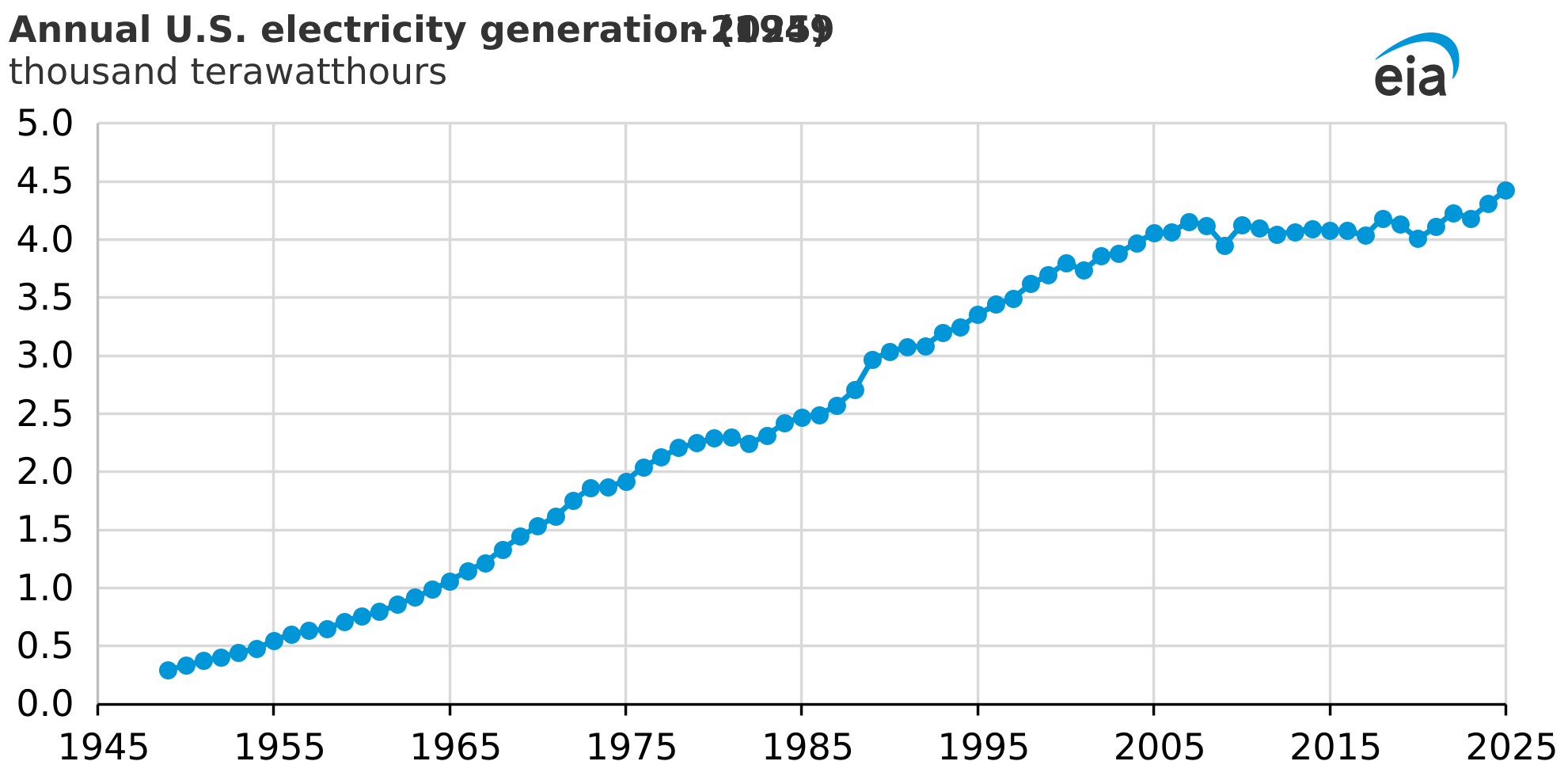
But something dramatic happened after 2000—the demand for electricity leveled out. From 2005 through 2019, U.S. electricity demand increased at an average rate of only about 0.1 percent per year. Total end-use electricity consumption was about 3.81 trillion kWh in 2005 and about 3.95 trillion kWh in 2019—less than a four percent increase in fourteen years.
There were several reasons for this flattening of demand, but the biggest was energy efficiency. Refrigerators, air conditioners, motors, lighting, and other appliances became dramatically more efficient. Incandescent bulbs gave way first to fluorescent lighting and then to LEDs. The American economy continued its long shift away from some of its most electricity-intensive manufacturing industries. Population continued to grow and Americans continued buying more electronic devices, but efficiency improvements largely offset the additional demand. This represented a tremendous saving to Americans and certainly eased environmental pressures. When politicians scoff at energy efficiency, they are beyond stupid.
For almost fifteen years, therefore, the people responsible for building America’s electrical system lived in a world of remarkably flat demand. That assumption is now obsolete.
Electricity demand began climbing again around 2020. From 2020 through 2025, U.S. electricity demand grew at roughly 1.7 percent per year, compared with just 0.1 percent annually during the previous fifteen years. Total electricity consumption reached a record of roughly 4.2 trillion kWh in 2025.
One of the principal forces behind that renewed demand is the data center. Data centers, of course, existed long before ChatGPT. Banks, universities, government agencies, retailers, Google searches, streaming video, social media, and the entire infrastructure of the internet have required enormous amounts of computation for decades.
In 2014, U.S. data centers consumed roughly 70 billion kWh of electricity—about 1.8 percent of all U.S. electricity consumption. Computer efficiency was improving so rapidly that, for a time, researchers believed data-center electricity consumption might remain relatively stable.
Then AI arrived, and data centers became a major electricity consumer. By 2023, American data centers were consuming approximately 176 billion kWh—4.4 percent of all electricity used in the United States. Between 2017 and 2023, data-center electricity demand more than doubled.
In June 2026, Lawrence Berkeley National Laboratory estimated that by 2030 American data centers could consume about 649 billion kilowatt-hours every year—11.8 percent of all U.S. electricity. Although no one really knows how quickly AI will grow, the range is enormous: 9.5 to 15.3 percent of all U.S. electricity consumption. Only a decade earlier, data centers were consuming less than 2 percent of the nation’s electricity.
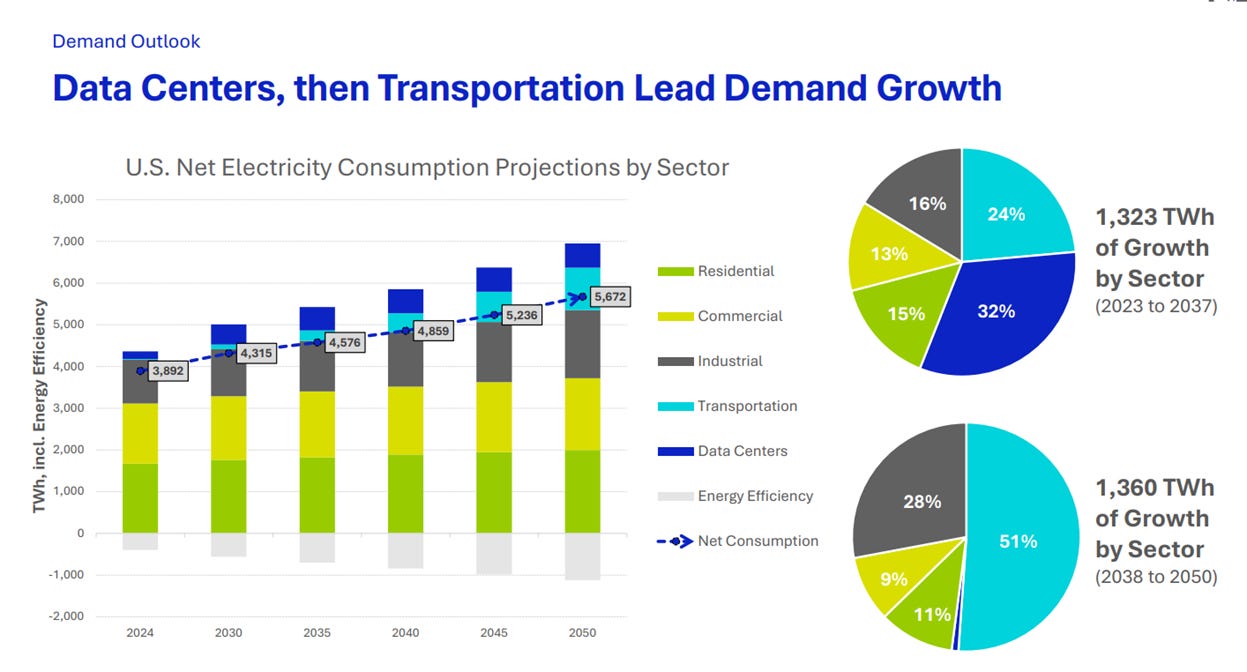
The U.S. is expected to see electricity demand increases of two percent annually and 50 percent by 2050. Data centers are the largest new demand.
Within four years, something approaching one out of every eight kilowatt-hours generated in the United States could be consumed by data centers. In the high-growth case, it could be closer to one out of every six.
Consider this: the projected 649 billion kWh consumed by data centers in 2030 would equal nearly half of all the electricity consumed by the entire United States in 1970.
All of this additional electricity has to come from somewhere.
Where Will the Electricity Come From, and How Will It Get There?
Perhaps nothing illustrates the scale of this new demand better than what is happening at Three Mile Island. For Americans of my generation, those three words require little explanation.
On March 28, 1979, a reactor at Three Mile Island near Harrisburg, Pennsylvania, suffered the most serious accident in the history of commercial nuclear power in the United States. There was a partial meltdown of the reactor core, days of uncertainty and confusion, and television images that helped permanently change the American public’s attitude toward nuclear energy.
The damaged reactor was Unit 2. Sitting beside it was Three Mile Island Unit 1, an entirely separate reactor that was not involved in the accident. Unit 1 continued generating electricity for another forty years before shutting down in 2019—not because of a safety problem, but because it could no longer compete economically with cheap natural gas.
Now there is an effort to turn Unit 1 back on. In 2024, Microsoft signed a 20-year power purchase agreement with Constellation Energy that made restarting Three Mile Island Unit 1 economically attractive. Microsoft wants the electricity to help meet the huge power requirements of its data centers. The reactor can produce about 835 megawatts of electricity.
The Nuclear Regulatory Commission has not yet given final approval for the restart. Constellation is moving through the licensing, safety, environmental, and inspection process, but it is likely to be online within a year.
Imagine this: a single private technology company anticipates needing so much electricity that its demand can help justify bringing a nuclear power plant back from the dead. And not just any nuclear power plant. Three Mile Island.
Whatever one thinks about nuclear energy, the cultural significance is hard to miss. Three Mile Island became almost synonymous in the American mind with the danger of nuclear power. Yet less than fifty years after the accident, demand from the computing industry is helping resurrect the undamaged reactor sitting next door.
That gives some sense of the scale of the AI power problem.
Nuclear energy has an obvious attraction for a data center. A nuclear reactor can produce enormous amounts of electricity essentially twenty-four hours a day without emitting carbon dioxide while operating. But restarting an old nuclear reactor is unusual, and building an entirely new one takes years.
The electricity is needed much sooner.
The Trump administration has recognized the political problem created by this demand. If a technology company builds a data center requiring a gigawatt of electricity, somebody must pay to construct the generation, transmission lines, substations, and transformers necessary to serve it.
If those costs simply become part of a utility’s rate base, people who have absolutely nothing to do with the data center could discover that their electric bills have increased to pay for it. In March 2026, President Trump brought several of the largest technology companies to the White House to sign what the administration calls the Ratepayer Protection Pledge. Amazon, Google, Meta, Microsoft, OpenAI, Oracle, and xAI agreed to “build, bring, or buy” the additional generating capacity required by their data centers and to pay for the associated power-delivery infrastructure rather than simply shifting those costs onto ordinary utility customers.
In effect, the message was simple: if you are going to build an enormous data center, bring your electricity with you.
The administration did not invent this movement toward privately supplied power. It was already happening. But it recognized that electricity costs were becoming a drag on the economy and formalized an extraordinary change in the relationship between large industrial customers and America’s electrical system.
And when a company asks what type of power plant it can actually build quickly, the answer increasingly is natural gas. A nuclear plant can take years. A large transmission line can take years just to permit. Grid interconnection queues can stretch for years. Wind and solar farms can often be built comparatively quickly, but their output varies with sunlight and wind. A data center filled with computers running twenty-four hours a day requires electricity twenty-four hours a day.
A natural-gas turbine, on the other hand, is familiar technology. It can be manufactured, transported to a site, connected to a natural-gas pipeline, and begin producing large amounts of reliable electricity relatively quickly. Nearly every company working in AI has decided to invest in its own power production, primarily powered by natural gas.
Crusoe, a major AI infrastructure company, has ordered large fleets of natural-gas turbines for its data-center projects. In one order alone, 29 GE Vernova turbines were capable of supplying nearly a gigawatt of electricity. In 2026, the company announced another agreement for approximately 750 megawatts of natural-gas generating equipment at several U.S. AI data-center sites.
Chevron and its partners have gone further, developing plans for several gigawatts of natural-gas generation located with data centers—projects they rather revealingly call “power foundries.”
There is even a new phrase for much of this: behind-the-meter generation.
Instead of relying entirely upon a utility to deliver electricity from distant generating stations, the data-center operator puts some or all of the generating plant on or near its own property. The electricity may never enter the ordinary electrical grid. A natural-gas pipeline comes to the site, turbines burn the gas, generators make electricity, and cables carry that electricity directly into the buildings filled with computers.
The data center has, in effect, acquired its own power company. From the company’s point of view, this solves several problems. It reduces dependence upon an already congested grid. It may avoid years of waiting for a transmission connection. It gives the company control over when its generating capacity comes online. And it provides the continuous electricity that racks filled with AI processors demand.
But the phrase self-powered is misleadingly comforting. The power plant may be behind the company’s fence, but its consequences belong to the planet.
The Neighborhood Bill
Natural gas is certainly cleaner than coal. It produces substantially less carbon dioxide for each kilowatt-hour generated and far less sulfur pollution. But it is still a fossil fuel. Burning natural gas still means taking carbon that was buried underground for millions of years and putting it into the atmosphere as carbon dioxide.
At the average emissions rate of a U.S. natural-gas power plant, a one-gigawatt generating facility operating continuously could produce something on the order of four million metric tons of carbon dioxide every year.
In simple terms: one data center, one gigawatt, millions of tons of CO2 sent into the atmosphere.
There is also a neighborhood bill. Natural-gas turbines have exhaust stacks. They emit nitrogen oxides and carbon monoxide, along with smaller amounts of other pollutants. Modern combustion controls can reduce these emissions enormously, but they do not eliminate them.
Then there is noise.
Data centers already contain enormous cooling systems, fans, pumps, transformers, and backup electrical equipment that operate day and night. Add an industrial generating station to the site and the data center becomes something altogether more physically intrusive.
Perhaps the clearest preview of this new neighborhood problem is in Memphis.
Elon Musk’s xAI built its enormous Colossus supercomputer there and turned to on-site natural-gas turbines to provide electricity while other electrical infrastructure was being developed. The turbines became controversial enough that surrounding South Memphis communities and local government found themselves debating the air pollution and other impacts of a power plant that had appeared because a company wanted to bring an AI supercomputer online quickly.
A person living near one of these facilities does not necessarily experience artificial intelligence as a clever chatbot answering questions; that person may also experience AI as a power plant.
The benefits of artificial intelligence may be distributed around the nation or the world. Someone in Colorado can ask a question, someone in California can generate a video, someone in New York can have an AI system write computer code, and someone in Europe can analyze a scientific dataset.
But the turbine is somewhere. The exhaust travels downwind somewhere. The noise is in a neighborhood. And, of course, the carbon dioxide goes everywhere.
That is the bargain now beginning to take shape as we race to build the infrastructure of artificial intelligence. We have taken something that appears nearly weightless on a computer screen and attached to it some of the heaviest industrial infrastructure human beings build: power plants, pipelines, transmission lines, substations, transformers, and enormous cooling systems.
The cloud has acquired not only an extension cord—it is also acquiring its own power plants.
A Good Byte to Eat
There is one major piece of the AI infrastructure story that I have deliberately left out of this essay: water. The processors inside a data center do not merely consume electricity. They produce enormous amounts of heat, and that heat has to be removed continuously if the computers are to keep operating.
Cooling can range from what amounts to very sophisticated air-conditioning systems to liquid-cooling systems in which water or other fluids circulate directly through the racks of processors. At the largest facilities, this can involve substantial quantities of water.
And that raises an entirely different set of questions.
Where does that water come from? How much is actually consumed rather than returned? What happens when an enormous data center is built in an arid region, or in a community already struggling with limited water supplies? And as increasingly powerful processors generate still more heat, does water become yet another constraint on how rapidly artificial intelligence can grow?
Those questions deserve an essay of their own.
So, returning to the seemingly trivial question with which I began: “Is there anywhere good to eat around here?” Perhaps I should have asked where I could get a good byte to eat. The pun is terrible, but the point is not.
What appears to be a nearly weightless exchange between me and the little rectangle in my hand is actually the beginning of a remarkably long physical chain.
My question travels through communications networks to a data center. There, processors perform trillions of mathematical operations. Those processors require electricity. That electricity has to be generated somewhere. It requires power plants, turbines, transmission lines, substations, transformers, and increasingly natural-gas pipelines and dedicated generating stations. The computation produces heat, which requires still more infrastructure—and often water—to remove.
All of that happens so that, a few seconds after asking the question, I can learn where to get a hamburger.
One question is insignificant. One answer consumes very little energy. But multiply that by billions of questions every day, hundreds of millions of users, increasingly complicated AI systems, and ultimately by a world of more than eight billion people, and the scale becomes something altogether different.
Much of the public discussion about artificial intelligence has understandably focused on whether these machines will become too intelligent, whether they will replace human workers, whether they can be trusted, or ultimately whether human beings will remain in control of them.
Those are important questions. But they are not the only questions. In fact, the environmental considerations may be more immediate.
Artificial intelligence is also becoming an enormous physical presence on the planet. It requires electricity, land, minerals, power plants, transmission systems, cooling equipment, and water. It produces heat, pollution, carbon dioxide, noise, and demands upon infrastructure that someone, somewhere, must accommodate.
Which brings me back to the words at the beginning of this essay:
“Who run Bartertown?”
Mad Max Beyond Thunderdome imagined a post-apocalyptic society occupying the ruins left behind after humanity had largely destroyed itself through war. Bartertown survives because it possesses something indispensable: energy. Deep beneath the settlement, Master Blaster operates a primitive industrial complex that converts methane into electricity. Whoever controls that energy controls Bartertown.
There is an uncomfortable irony in returning to that movie forty years later.
Artificial intelligence represents perhaps the most sophisticated computational technology humans have ever created. Yet one of the quickest ways we have found to satisfy its enormous appetite for electricity is remarkably familiar: burn methane.
We call it natural gas rather than methane, and instead of the crude machinery beneath Bartertown we use extraordinarily sophisticated turbines, generators, pipelines, and emissions controls. But the underlying chemistry has not changed. Carbon that has been buried underground for millions of years is oxidized so that we can make electricity.
The irony should not be lost on us.
We are building machines capable of performing trillions of mathematical operations in seconds, translating languages, discovering patterns in proteins, writing computer programs, generating photographs, and perhaps transforming almost every intellectual endeavor humans undertake. But like the world of Mad Max, we may also be peering at an Armageddon of our own making.
No posts
Comments
Nothing yet. Say the first thing.
Sign in to join the conversation.