
We live in a world where we experience a regular and predictable rhythm. The sun rises, the sun sets, winter eventually blooms into spring, and most of what surrounds us appears either nearly permanent or to change so slowly that we hardly notice. That daily experience trains us to think about change in a simple, almost linear way: if something changed a little yesterday, we expect it to change more or less the same amount tomorrow.
But nature—and increasingly the human world—does not behave so predictably. Change is often episodic. Long periods of apparent stability are interrupted by sudden events—major forest fires, flash floods, droughts or storms. Rates of change can accelerate or slow. Feedbacks coupling different phenomena can dramatically change the rate of either. One change produces another, which in turn changes the rate of the first. And sometimes growth “compounds” and becomes exponential.
I have found that one of the greatest obstacles in discussing climate and environmental change is not understanding the individual facts, but understanding rates. A small rate sustained for a long time can produce an enormous change. A rate that is itself increasing can transform a system with astonishing speed. To understand the environmental world we have created, we must learn to think not simply about change, but about the rate of change.
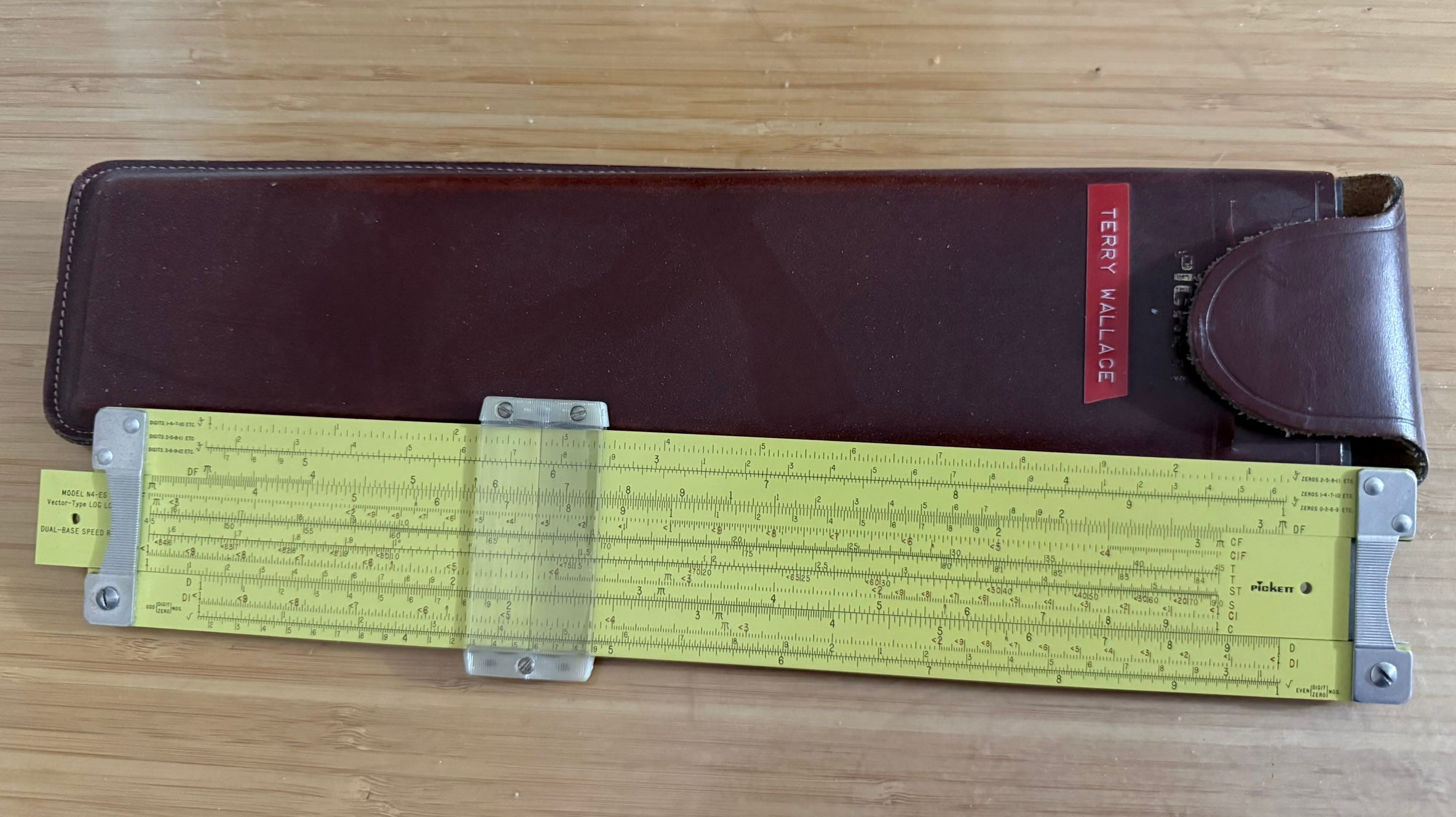
On my 14th birthday my father gave me a fancy slide rule. I suppose that in my family this gift was as close as we could get to passing on the family crest or a magic sword. The slide rule—which I still have—was a Pickett N600. It was the same model of slide rule carried on the Apollo missions as an emergency calculator should the crew find themselves out of communication with Mission Control.
The slide rule was my introduction to the word logarithm, and to the remarkable idea that mathematical space can be mapped in different ways. Logarithms provide a transformation in which multiplication becomes addition. It is a simple but profound concept, and one I think has largely been lost with the advent of calculators and now smartphones into which we simply speak a mathematical operation and receive an answer.
In the early seventeenth century, a Scottish mathematician named John Napier discovered a remarkable mathematical transformation. In 1614 he published Mirifici Logarithmorum Canonis Descriptio—roughly, A Description of the Wonderful Rule of Logarithms. Henry Briggs soon helped develop the base-10 logarithms that generations of students would eventually learn in school.
In logarithmic space, log (AB) = log (A) + log (B)
Multiplication has become addition.
In 1620, Edmund Gunter marked numbers along a ruler according to their logarithms, and about two years later William Oughtred placed two logarithmic scales beside one another so that they could slide. The slide rule was born.
There are few devices in the history of science in which an abstract mathematical idea becomes so wonderfully tangible. You can hold a logarithmic transformation in your hand.
I received and used a slide rule only near the end of its nearly four-century reign. By the mid 1970s, pocket calculators appeared and quickly swept the sliding scales away. But the mathematical idea behind that birthday present never disappeared. In fact, logarithms became vastly more important to me as a scientist. Earthquake magnitude, sound, radioactive decay, acidity, stellar brightness and countless other natural phenomena span ranges so enormous that logarithmic scales become the only sensible way to describe them.
The inverse of a logarithmic transformation is an exponential transformation.
The “invention” of the exponential can be traced in part to the work of Jacob Bernoulli in 1683. Bernoulli was thinking about finance—specifically how compound interest works. As a very simple illustration, suppose you invest one dollar in an account that pays 100 percent annual interest. At the end of one year you receive one dollar in interest, and your account is flush with two dollars.
But suppose the interest is paid every six months. After six months your account contains $1.50. Six months later you receive 50 percent interest on that new amount, or another 75 cents. The annual interest rate is unchanged, but because it has been compounded in shorter intervals your account now contains $2.25.
Compound the interest quarterly and your money grows faster still. Monthly, still more. Daily, slightly more again. Bernoulli asked what happened as the number of compounding periods became indefinitely large. Out of that problem emerged the strange and wonderful number we now call (e), approximately 2.71828.
The exponential function was not “discovered” at a single instant in quite the way Napier published his logarithms. The Bernoullis, Leibniz and others developed the mathematics, and in the eighteenth century Leonhard Euler put exponential and logarithmic functions into much of the form we recognize today. His great Introductio in Analysin Infinitorum, published in 1748, helped establish (e) as one of the fundamental constants of mathematics.
There is a repugnant irony in the fact that one of our fundamental ideas about exponential growth emerged from thinking about money.
A vast number of human activities—and much of nature—behave through some form of compounding. The “interest rate” does not have to be large to have a dramatic effect, especially because time allows the accumulation to become nonlinear.
An obvious example on the human side of the equation is population.
For most of human existence there were fewer than one billion people on Earth. The world reached roughly one billion around 1804. It took another 123 years to reach two billion, in 1927. Three billion came in 1960. Four billion in 1974. Five billion in 1987. Humanity passed eight billion in November 2022.
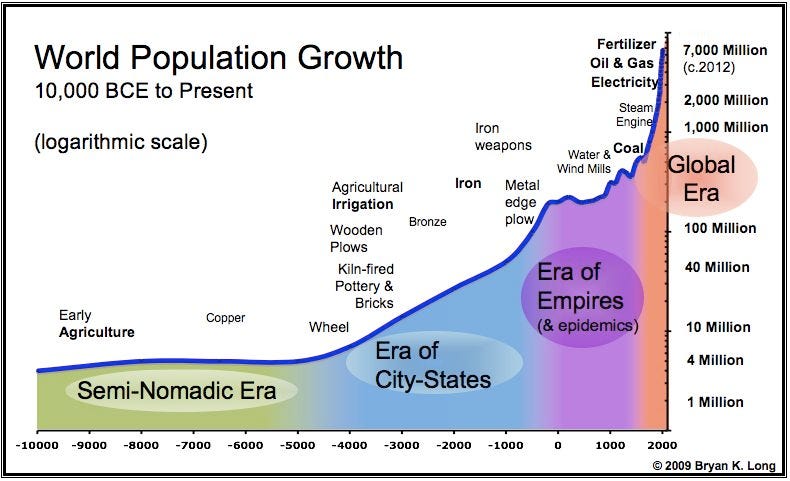
World population on a logarithmic scale. The real explosion came with the Industrial Revolution.
It is important to note that human population today is not continuing on a simple exponential trajectory. The global population growth rate peaked decades ago and has declined substantially. The passage from eight to nine billion people will take longer than the passage from seven to eight billion. What is happening is that the “interest rate”—in this case the birth rate—is declining, so the compounding is becoming less dramatic.
But the great expansion of human population—which looks almost like an instantaneous explosion when viewed on a geologic time scale—begets rapid growth in many other human activities.
More people do not simply mean more people. They mean more houses, more food, more electricity, more transportation, more manufactured goods and more waste. And each of these can begin to develop a growth rate of its own.
Consider the automobile.
On June 29, 1956, President Dwight Eisenhower signed the Federal-Aid Highway Act, authorizing 41,000 miles of Interstate highways across the United States. It was the largest public-works project in American history to that time. The result was an extraordinary web of concrete and asphalt joining cities that previously had been connected by much slower and smaller roads.
But the Interstate highways were only the backbone. Every interchange had to lead somewhere. Highways encouraged development farther from urban centers; those developments required arterial roads, neighborhood streets, parking lots, gas stations, shopping centers and still more connections to the highways.
More roads made automobile travel easier, which encouraged more automobile ownership and more driving, which in turn created demand for still more roads. Here was compounding of a different sort: not simply one quantity growing, but two quantities joined in a feedback loop.
We can even express that feedback loop with a couple of simple equations.
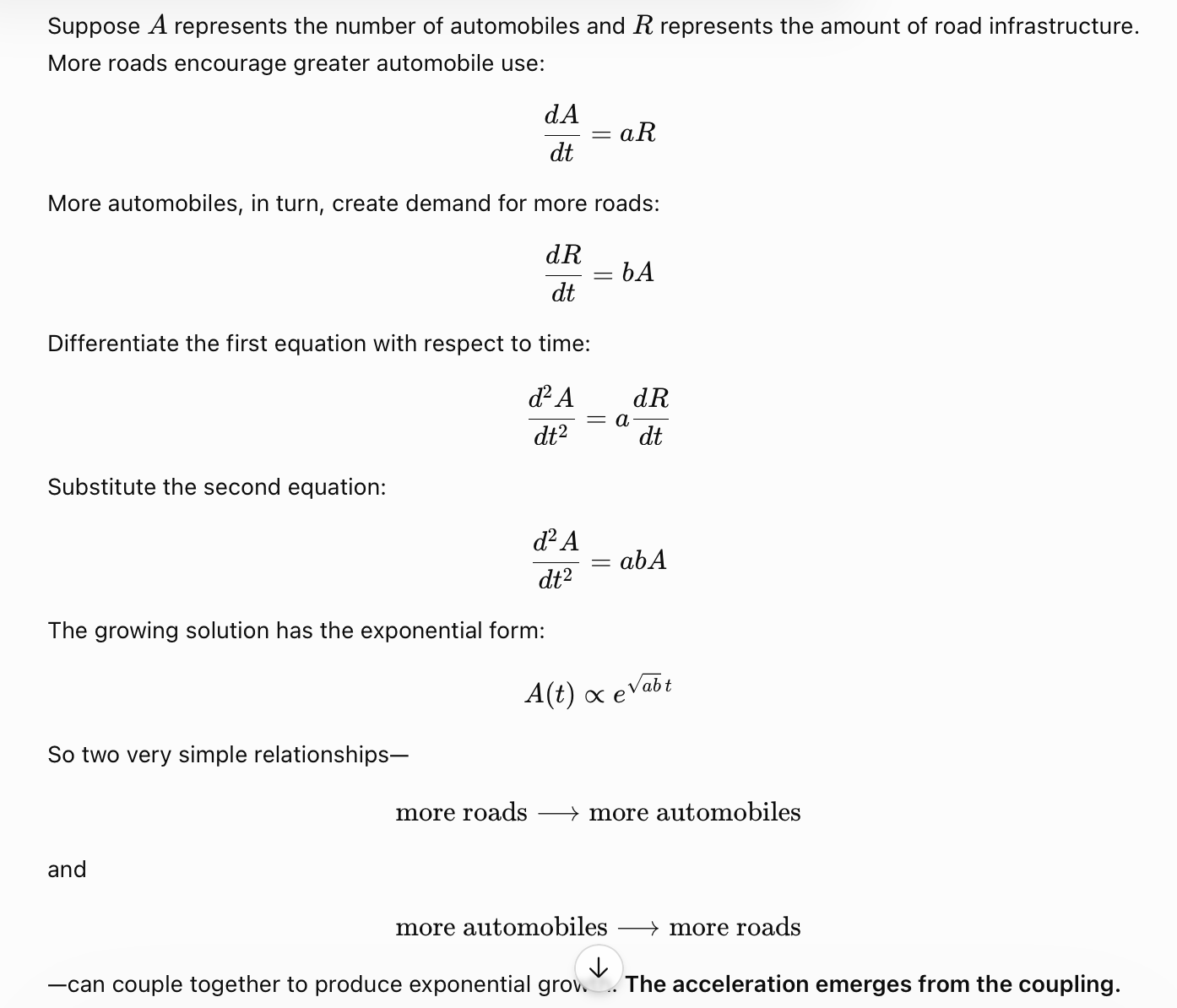
it is easier for me to write equations in latex than word — so I turned it into a figure. The terms are derivatives — meaning rates. So equation is the rate of change in the number of automobiles is proportional to the total miles of roads available to drive. The last equation states the number of automobiles as a function of time is proportional the the exponential of the demand for roads and cars.
I fully realize that no one is reading this essay for the mathematical formulas. The point is much simpler than the equations make it look. More roads stimulate automobile use. More automobiles create demand for more roads. The acceleration emerges from the coupling between them.
I suspect almost every reader has seen a version of this in their own community. A new road or additional lane temporarily decreases traffic congestion. For a while the problem appears solved. Then development follows the improved road, more people drive it, traffic increases, and before long another construction project is proposed to add yet another lane.
A feedback loop is mathematically different from simple growth. If more roads encourage more automobiles, and more automobiles create demand for more roads, then the rate of growth of each depends on the size of the other. Two quite ordinary relationships can combine to produce extraordinary growth simply because each stimulates the other.
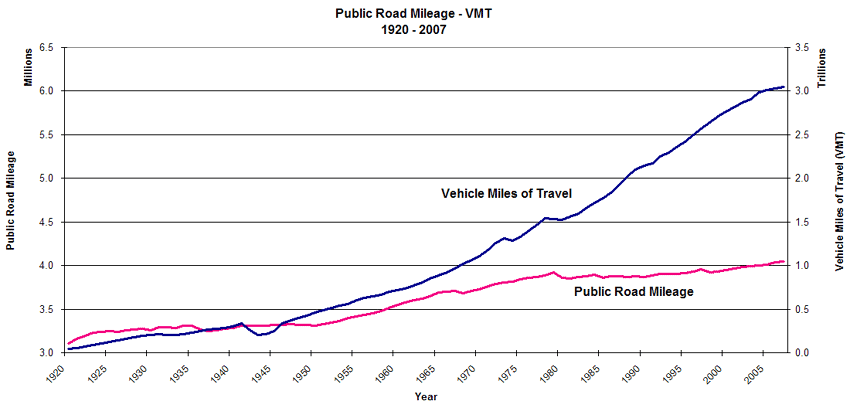
The coupled curves: miles driven (y axis on the right) in trillions of miles, and miles of road (y axis on the left) in millions of miles
The automobile boom had already begun before Eisenhower signed the Interstate Highway Act, so it would be wrong to claim that the Interstate System caused it. But the numbers show how extraordinary the growth became. In 1950 the United States had about 49 million registered motor vehicles. By 1970 it had more than 108 million—more than twice as many in only twenty years.
Even more revealing is how much those vehicles were driven. Americans traveled about 458 billion vehicle-miles in 1950. By 1970 that number had climbed to 1.11 trillion miles. The number of miles driven had increased by a factor of about 2.4 in only two decades.
For a period, automobiles were multiplying much faster than Americans. From 1950 through 1977 the U.S. population grew at an average rate of about 1.3 percent per year. Motor-vehicle registrations grew at about 4.2 percent per year, and vehicle-miles traveled at about 4.4 percent.
That difference between 1.3 percent and 4.4 percent may not sound particularly dramatic. But that is precisely the point of this essay. Rates that sound small become enormous when compounded over decades.
And the automobile did not exist by itself. Every additional mile driven required energy. Transportation energy consumption in the United States rose from about 8.5 quadrillion BTUs in 1950 to more than 16 quadrillion BTUs in 1970—nearly doubling in twenty years. Total American energy consumption followed almost exactly the same trajectory, rising from about 35 quadrillion BTUs in 1950 to nearly 68 quadrillion in 1970.
So population growth begat automobile growth. Automobile growth begat highway construction and suburban expansion. Those, in turn, encouraged more driving. More driving demanded more petroleum. More petroleum meant more drilling, more refining, more pipelines and ultimately more carbon dioxide released to the atmosphere.
This is why environmental impacts—from greenhouse gases to plastic waste—are much more complicated than simply counting people.
Human population creates demand, but consumption per person increases with time also. When both rise together, their effects multiply. A population growing at two percent while consumption per person also grows at two percent does not produce a two-percent increase in environmental demand. It produces something closer to four percent.
We have compounded the compounding.
Once that idea is understood, the extraordinary environmental transformation of the twentieth and early twenty-first centuries begins to look much less mysterious, and more ominous.
I entitled this essay Exponentialism, Not Exceptionalism because we are constantly told that it is our destiny to expand: expand the economy, expand markets, expand production, expand consumption. Economic growth will lift the common person, and therefore growth itself becomes not simply desirable but necessary. A successful economy must be larger next year than it was this year, and larger still the year after that.
But perpetual growth is not a philosophy that survives the scrutiny of mathematics.
We have built a world economy around the assumption that consumption must continually increase—that next year we should extract more, manufacture more, sell more, travel more and consume more than we did this year. But the Earth is finite, and exponential growth running into a finite resource does not produce a problem comfortably waiting for some distant generation.
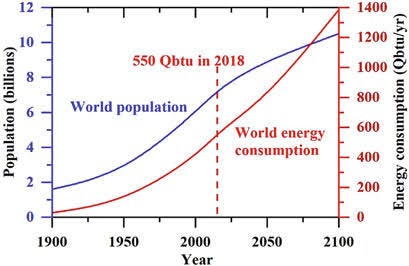
Projects of world population vs energy consumption. Population growth is expected to ease, but energy use per capita will accelerate.
It produces a collision.
We are already seeing that collision around the world: freshwater aquifers being depleted faster than they can recharge, forests and wild lands disappearing, fisheries depleted, soils degraded, plastic accumulating from the deepest oceans to the most remote landscapes, and wild flora and fauna pushed into ever smaller fragments of their former world.
Climate change is perhaps the largest expression of the same mathematics of exponentialism. We continue adding greenhouse gases to an atmosphere that has no mechanism for making our annual emissions simply disappear. The urgency comes from rates. If consumption continues to compound while the resources and natural systems supporting it do not, we will overrun those systems far faster than our day-to-day intuition tells us is possible.
The consequences are not several generations away. They are not even one generation away. They are here now.
Exceptionalism tells us that human ingenuity will somehow exempt us from the limits of the physical world. Exponentialism reminds us that the mathematics of the universe grants no such exemption.
No posts
Comments
Nothing yet. Say the first thing.
Sign in to join the conversation.