
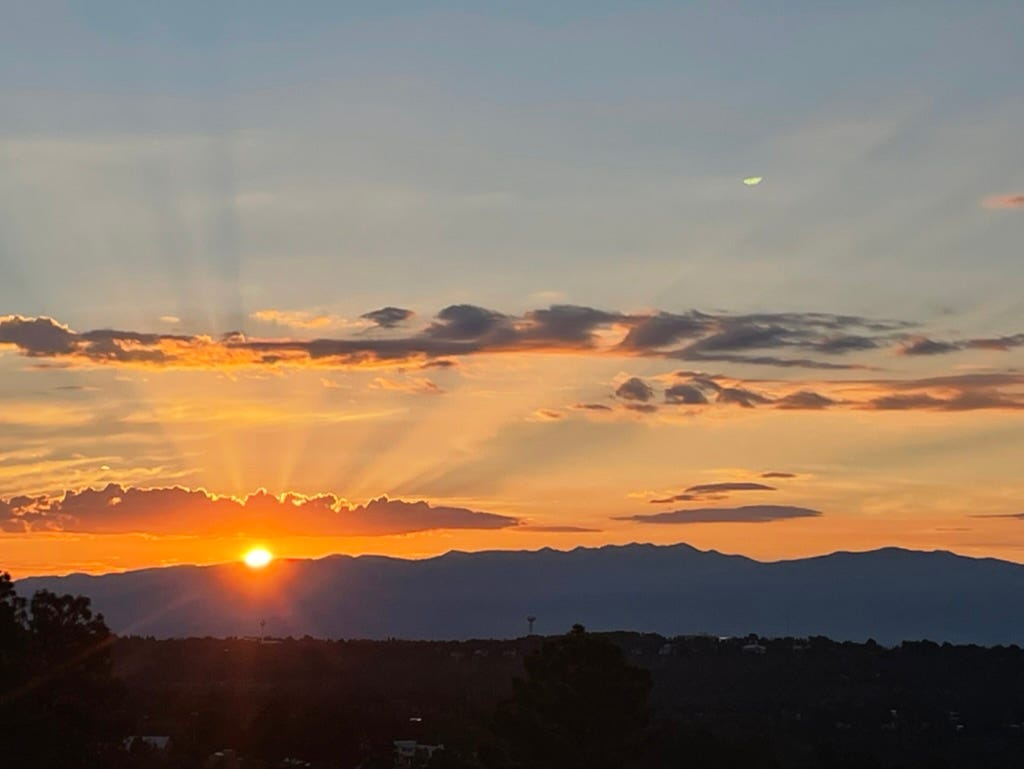
Sunrise over the Sangre de Cristo mountains from Los Alamos
The historic American nuclear weapons enterprise stretches across the breadth of the nation. From three underground nuclear tests on Amchitka Island in the Aleutians to experiments in the salt domes of Mississippi, and from 928 nuclear tests in the deserts of southern Nevada to the enormous plutonium-production reactors along the Columbia River at Hanford, Washington, the nuclear age left its fingerprints across the American landscape. At Oak Ridge, Tennessee, the immense K-25 gaseous-diffusion plant—covering 44 acres and once the largest building under one roof in the world—was dedicated to enriching uranium-235. At Mound Laboratory in Ohio, workers manufactured polonium-beryllium neutron initiators for atomic weapons. At the Savannah River Site in South Carolina, five heavy-water reactors produced tritium and plutonium for the nuclear arsenal.
The nuclear weapons complex eventually encompassed more than one hundred sites in dozens of states. But no place in America has a nuclear history quite like New Mexico.
New Mexico is home to Los Alamos, where the atomic bomb was invented and built; to Trinity, where the first nuclear explosion in human history occurred in the Jornada del Muerto about 35 miles southeast of Socorro; and to Sandia National Laboratories in Albuquerque, the engineering laboratory that turns the nuclear explosive package into a weapon system. It is home to two additional underground nuclear explosions, Gnome and Gasbuggy, conducted as part of the extraordinary Plowshare program that sought peaceful uses for nuclear explosives. Near Carlsbad lies WIPP, the nation’s only deep geologic repository for defense-generated transuranic waste. And west of Albuquerque, near Grants and Laguna Pueblo, lies the Jackpile-Paguate uranium mine, once the largest open-pit uranium mine in the world.
From uranium in the sedimentary rocks of the Colorado Plateau, to the invention of the bomb, to its first detonation, to experiments using nuclear explosions as tools, to the engineering of nuclear weapons, and finally to burying some of the waste these weapons have left behind, New Mexico has carried more than eight decades of the American nuclear age.
No other piece of American real estate has been asked to carry so much of it – and strangely, many of these same threads describe my own life.
In the ancient world, fate was often imagined as a destination already fixed. The path toward it might twist and turn, and along that path people could make choices—exercise what we would now call free will—but somehow the final destination had already been written. It is an appealing idea. Fate gives order to events that otherwise appear accidental, and it relieves us of having to acknowledge just how large a role coincidence and serendipity play in shaping a life.
We moderns like to think we have escaped such ancient notions, but I am not sure that we have. We still speak casually of things that were “meant to be,” of people we were “destined” to meet, of careers that somehow “had to happen.” Fate is comforting because the alternative is unsettling: consequential events may depend upon timing, geography, an unexpected opportunity, a chance encounter—or simply being in one particular place rather than another.
As a scientist, I reject the idea that some hidden hand endowed my life with a predetermined destination. I prefer causes that can be measured, evidence that can be examined, and explanations that do not require the supernatural. Yet I also have to admit that sometimes the events of a life weave themselves into a pattern so improbable that even a scientist is tempted to stare at the tapestry and wonder about the loom.
For me, that tapestry is woven from New Mexico and the nuclear age.
Los Alamos is my hometown, although I was actually born in Ames, Iowa, shortly before my father completed his PhD in chemistry. His research was at the Ames Laboratory, itself born directly from the wartime Ames Project, which had developed the process for producing the high-purity uranium needed by the Manhattan Project.
Growing up in Los Alamos was probably very different from growing up almost anywhere else in the country, although the isolation of the town meant that I had no idea that Los Alamos was different. There were mundane peculiarities—Los Alamos County, a tiny jurisdiction carved from Santa Fe and Sandoval Counties in 1949, observed daylight saving time for years when virtually nowhere else in New Mexico did—and there were exceptional things. Long before such opportunities became commonplace, Los Alamos High School offered temporary classes taught by Laboratory personnel. I learned to program computers that read instructions from paper tape, was introduced to differential equations, and, in the tenth grade, took a class in geology.
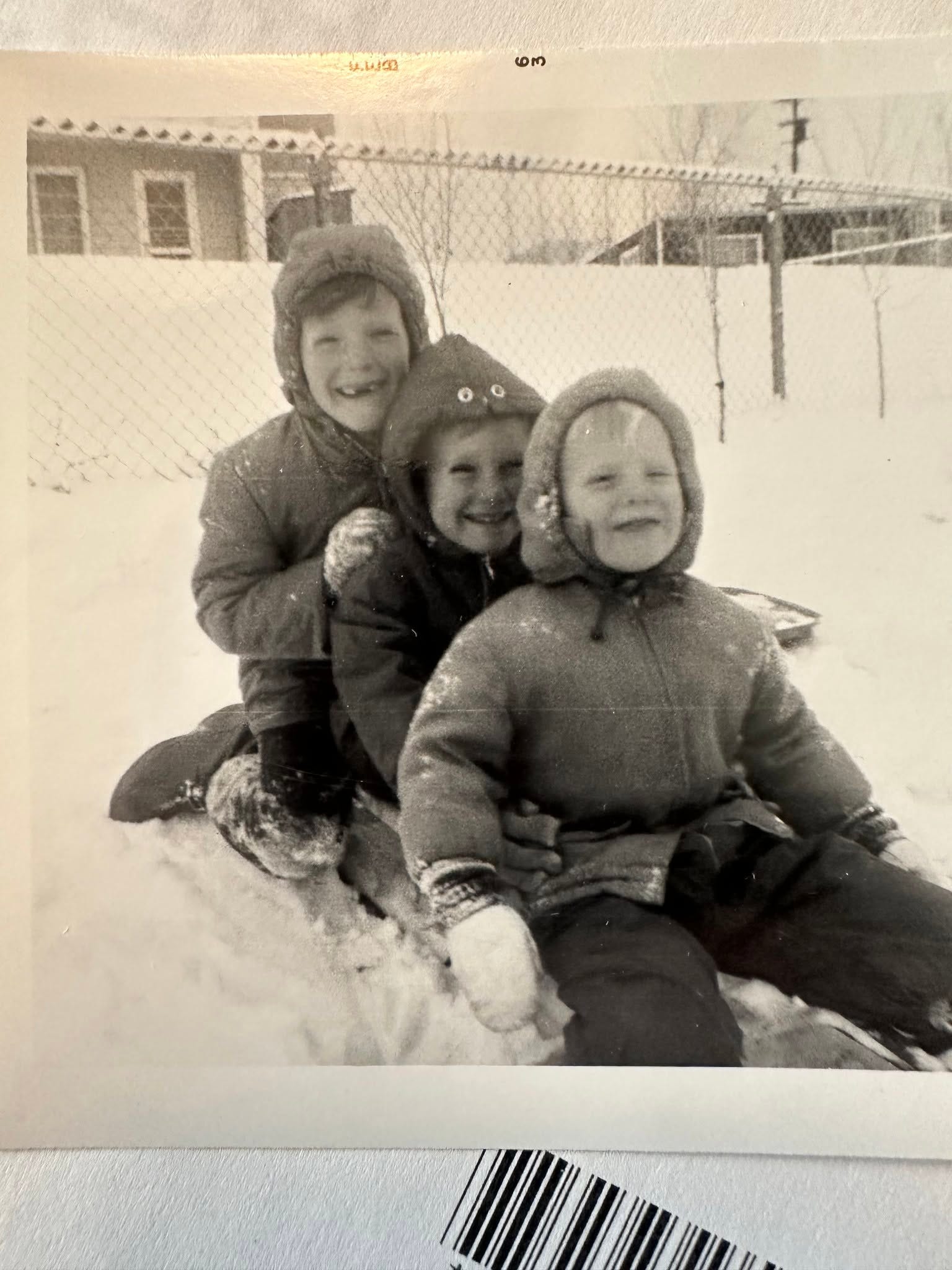
My younger brothers and I sled down the hill in backyard in Los Alamos in December 1962.
For me, Los Alamos was a perfect place to grow up: a place of opportunity, perched on the Pajarito Plateau beside one of the great volcanic calderas of North America, where curiosity was considered a precious commodity. But perhaps most importantly, Los Alamos is uniquely beautiful. The view of the sun rising over the Sangre de Cristo Mountains and illuminating the broad Rio Grande Valley, with the colors of desert and mountain, is humbling. The landscape is bold and grand, and it is difficult not to feel the power of nature.
Without the selection of J. Robert Oppenheimer to lead Project Y, it is quite possible that the laboratory that became Los Alamos would have been built somewhere else. In the fall of 1942, General Leslie Groves assigned Major John Dudley to find a location for the project. Dudley had a long list of requirements. The site had to be remote, sparsely populated, secure, and large enough to support the work of designing and testing a new kind of weapon.
Natural beauty was not on the list.
Dudley’s first choice was a place called Oak City, Utah, about 100 miles southwest of Provo. Oak City met many of the technical requirements, but it was eliminated because acquiring the site would have taken productive farmland and displaced several dozen farming families. Dudley’s attention then turned to Jemez Springs, not far from Los Alamos.
On November 16, 1942, Dudley brought Oppenheimer and Groves to Jemez Springs to inspect the proposed site. Groves saw the narrow canyon and, by Edwin McMillan’s later recollection, responded, “This will never do.” Oppenheimer knew northern New Mexico well and championed another possibility: the Los Alamos Ranch School on the plateau above the Rio Grande Valley. The party drove there that afternoon.
Groves saw the geography; Oppenheimer already knew the viewscape. By McMillan’s recollection, Groves looked at Los Alamos and declared, “This is it.”
I owe an astonishing amount of my worldview to that decision made on a snowy afternoon in November 1942.
The thread of nuclear weapons
My first memory of “nuclear weapons” came during the presidential election of 1964. Barry Goldwater spoke casually enough about tactical nuclear weapons that he contemplated using small nuclear devices against the jungles and supply routes of Vietnam. My father was aghast. I was only a boy, and I was largely oblivious to what the Los Alamos Scientific Laboratory actually did, but I remember his reaction.
It seems long removed now, but the Cuban Missile Crisis had occurred only two years earlier. The Limited Test Ban Treaty had been signed in 1963. And then came Goldwater, apparently willing to treat low-yield nuclear weapons as simply another instrument of warfare. Growing up in Los Alamos, I did not yet understand nuclear deterrence, arms control, or the physics of nuclear weapons, but I understood that my father believed there was something fundamentally different about them.
I have returned to that memory many times during my career. It became an early lesson in a principle I would encounter repeatedly throughout my life: with great power comes great responsibility.
The thread of uranium
My great-grandfather, Charles Hartman, was born in Cosby, Missouri, in 1886, and as a young man moved to the Phoenix area to seek fame and fortune. A jack-of-all-trades, he soon focused on mining. He was a self-taught assayer and property evaluator who built an impressive library of texts on minerals and mining.
My father was born in his grandfather’s home in Phoenix in 1933. He was largely raised by his grandparents, Charles and Grace, because his own parents were often absent. From an early age, my father accompanied his grandfather to small mines throughout Arizona, igniting a passion for collecting minerals. He became particularly interested in exploring old prospects and looking for nature’s treasures.
My father passed that passion on to me, and by the age of ten I was an avid mineral collector. Probably my most common weekend activity growing up was going out looking for “rocks.” We traveled across the Southwest, from the high mountains of the San Juans to the great copper mines of southern Arizona. The volume of rocks brought home from these trips and deposited first in our backyard in Los Alamos, and later in the huge barn at Pajarito Acres, was large enough to be considered a form of erosion.
My evolution as a collector followed an arc typical of a scientist. First came fascination with the perfection and beauty of a crystal. Then came the questions: Why was its chemistry important? What geologic processes could concentrate those particular elements in one place? And finally, what was happening at the atomic scale—what arrangement of atoms produced the ordered structure and symmetry that we recognized as a mineral?
When I was in high school, around 1973, the Jackpile-Paguate uranium mine near Grants, New Mexico, encountered some ore that was causing problems with its standard processing. A sample was sent to Los Alamos for analysis and ended up with my father. Dad decided this presented a “teachable moment”: I was going to learn how to do X-ray diffraction.
He brought me with him to the Laboratory. I cannot really recall how it was possible for a high-school student simply to accompany his father into a laboratory at DP East, but somehow I did. There I carried out the first of what would eventually become thousands of X-ray diffraction analyses during my career.
The Jackpile sample turned out to contain coffinite, a black colored uranium silicate. I remember looking up the diffraction peaks, seeing the name coffinite, and wondering whether this was some ominous prediction that I was going to die from analyzing a radioactive mineral. Alas, the explanation was considerably less dramatic. Coffinite was named for the American geologist Reuben Clare Coffin.
That X-ray pattern sparked a major new interest in my collecting: uranium minerals.
The uranium story around Grants was itself remarkably recent. Uranium minerals had been recognized in northwestern New Mexico before World War II, but almost no one appreciated the enormous deposits that lay beneath gently sloping landscape. The modern Grants uranium boom began in 1950 when a Navajo sheepherder, Paddy Martinez, showed businessmen in Grants yellow uranium minerals he had found near Haystack Butte, northwest of town. His discovery was in the Jurassic Todilto Limestone. Word spread quickly, the Atomic Energy Commission established an office and ore-buying station near Grants, and prospectors began searching virtually every promising exposure between Laguna and Gallup.
The scale of the discoveries changed quickly. In 1951, airborne radiation surveys and subsequent drilling near Paguate revealed the enormous deposit that became the Jackpile mine. Mining began in 1953, and within a few years Jackpile was the largest uranium mine in the United States. The Grants uranium district would ultimately produce more uranium than any other district in the country.
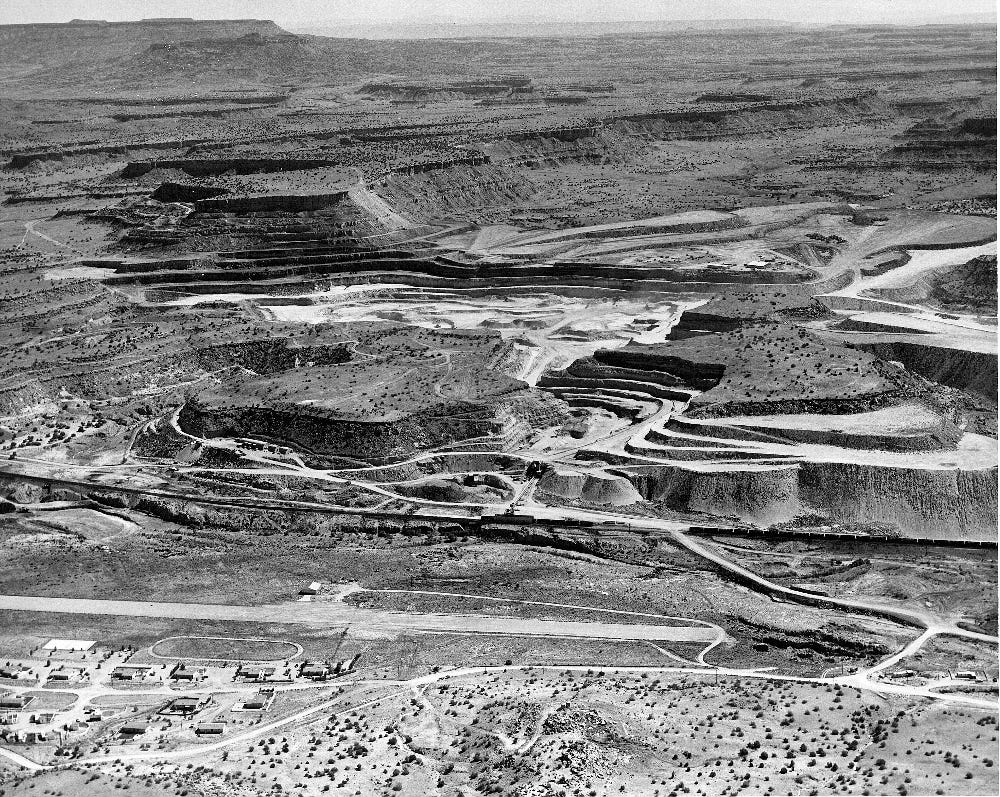
The Jackpile open pit uranium mine circa 1958.
The geology that made this possible had begun roughly 150 million years earlier. The Morrison Formation is famous across the American West as the great dinosaur-bearing formation of the Late Jurassic, but in northwestern New Mexico it became famous for something else. Rivers deposited permeable sands across broad floodplains, while finer muds accumulated between the channels. Volcanic ash periodically fell across the landscape. Over time, the resulting sediments created an almost ideal system for moving—and eventually concentrating—uranium.
Exactly where all of the uranium came from remains a subject of geologic debate. Much was probably leached from volcanic ash incorporated into the Morrison sediments, although other source rocks may also have contributed. But whatever its ultimate source, groundwater did the work. Oxygen-rich water dissolved uranium and carried it through the porous sandstone.
The trick was not moving uranium. The trick was stopping it. When uranium-bearing groundwater encountered chemically reducing conditions—organic material, carbonized plant debris, or minerals such as pyrite—the chemistry changed. Uranium became much less soluble and precipitated from the water. Grain by grain, over immense spans of time, tiny amounts of uranium became concentrated into bodies rich enough eventually to be called ore. Two characteristic minerals produced by that process were uraninite and coffinite.
At Jackpile, much of the mineralization occurred in ancient river sands near the top of the Morrison Formation, a unit appropriately known today as the Jackpile Sandstone Member.
It is beautiful geologic story: volcanic eruptions supplied at least some of the uranium is great ash falls; meandering rivers supplied the sand that served as a host for the uranium. Groundwater became the transport system. Organic matter supplied the chemical trap. And 150 million years later, human beings arrived with Geiger counters, drills and trucks to satisfy the post-World War II national appetite for uranium.
One small piece of that enormous geologic story eventually found its way from the Jackpile mine to a laboratory at Los Alamos—and into the hands of a high-school kid learning how to identify a mineral.
New Mexico uranium had become another thread in my nuclear tapestry.
The thread of nuclear waste
In the fall of 1974, I arrived on the campus of New Mexico Tech. I was fortunate to land a job in the laboratory of geophysicist Allan Sanford, and one of my duties was servicing seismic stations in southeastern New Mexico, including stations near the tiny town of Jal.
The reason for those instruments was nuclear waste.
The federal government was considering southeastern New Mexico as the site of the Waste Isolation Pilot Plant—WIPP—a permanent repository for certain radioactive wastes produced by the nation’s nuclear weapons complex. New Mexico Tech had begun studying the seismicity of the region, and by 1974 was operating instruments close to the proposed repository site.
Every other weekend I would drive from Socorro to the Jal area, recover the smoked paper from the portable seismographs, replace the paper, and check batteries and clocks. These were very long days—the round trip was about 15 hours. Once the records were brought back to New Mexico Tech, I and other students examined the traces for evidence of movement in the Earth: earthquakes, quarry blasts, or perhaps signals associated with deformation of the salt and surrounding geology.
It was tedious work, but it became part of my education as a seismologist. The work eventually contributed to my second seismology publication, Seismicity in the Area of the Waste Isolation Pilot Project (WIPP).
The choice of southeastern New Mexico for WIPP was not accidental. About 250 million years ago, during the Permian Period, a vast shallow sea repeatedly flooded and then evaporated across a great basin, leaving behind an enormous sequence of salt and other evaporite deposits. The repository itself was eventually excavated about 2,150 feet below the surface in the Salado Formation.
Salt has remarkable properties for burying radioactive waste. It is nearly impermeable, and the very existence of thick ancient salt tells us that circulating groundwater has been largely absent—otherwise the salt would have dissolved away long ago. More importantly, deep underground salt does not behave like ordinary brittle rock. It slowly flows. Mine a room into it and, over time, the salt creeps inward, closing fractures and eventually encapsulating what has been placed there.
Congress authorized construction of WIPP in 1979, and the facility was built during the 1980s. What followed was nearly two decades of scientific study, regulatory review, lawsuits and political argument before EPA finally certified the repository in 1998. On March 26, 1999, WIPP accepted its first shipment of defense-generated transuranic waste.
Appropriately enough, that first shipment came from Los Alamos.
Congress restricted WIPP to defense-generated transuranic, or TRU, waste. Much of the waste itself is surprisingly mundane: contaminated gloves and protective clothing, tools, rags, laboratory equipment, soils, residues and sludges. The objects may be ordinary; the plutonium, americium and other radioactive elements contaminating them are not.
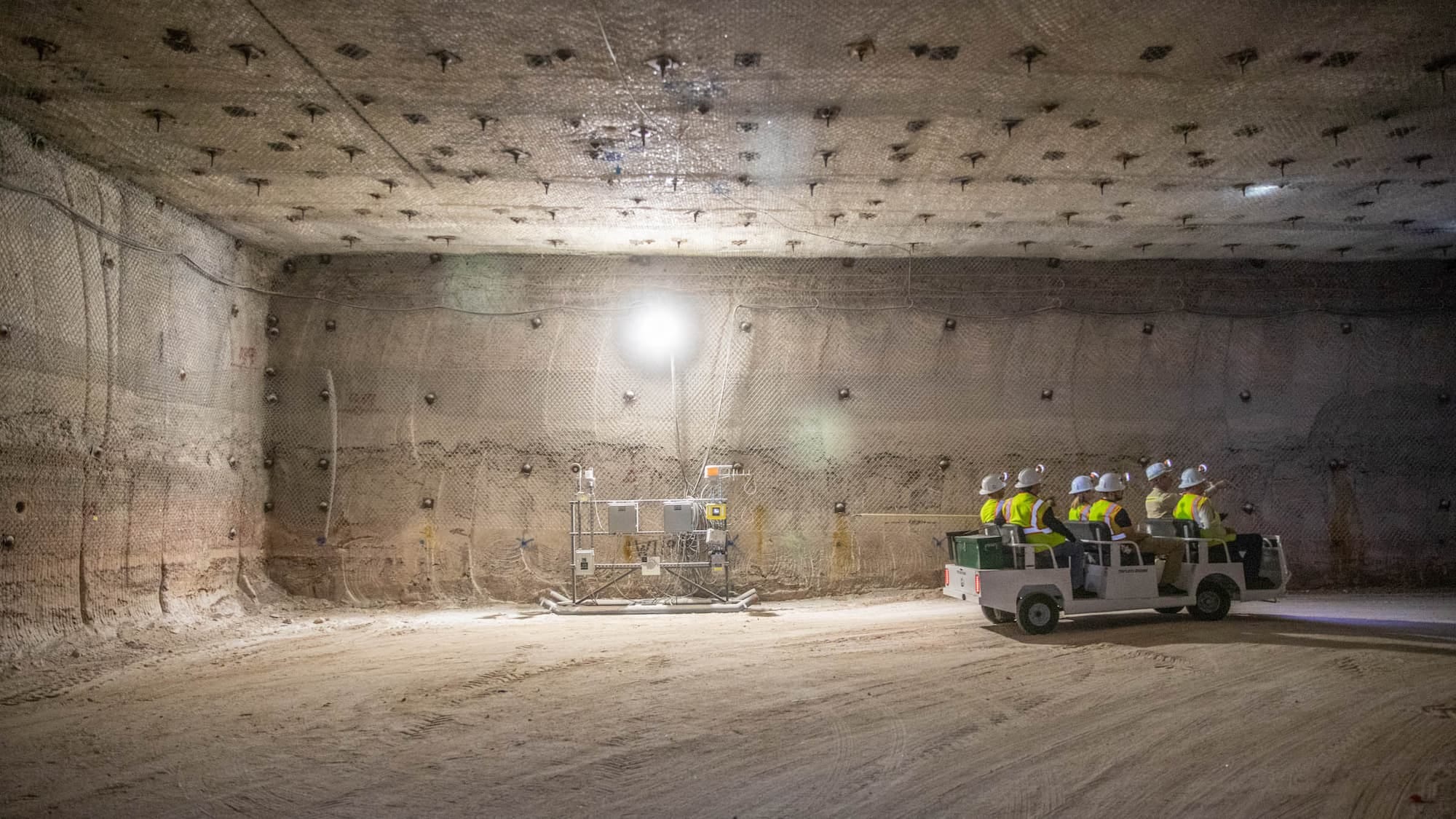
A underground storage unit in salt located in WIPP.
When I returned to Los Alamos in 2003 after my academic career at the University of Arizona, I became division leader of Earth and Environmental Sciences. EES had a group in Carlsbad supporting the geologic and engineering science of WIPP, and I became reacquainted with a project I had first encountered as a student nearly thirty years earlier.
I also became reacquainted with the politics of nuclear waste.
WIPP was—and remains—a major economic presence in southeastern New Mexico and enjoys strong local support. But it is also unique. It is the nation’s only deep geologic repository for defense-generated transuranic waste. That makes it indispensable to the cleanup of the American nuclear weapons complex, while also making it a perennial focus of debate over transportation and permanent burial of radioactive material.
By 2014, I had become the Principal Associate Director for Global Security at Los Alamos and was also the Laboratory’s senior intelligence official. My attention was focused largely outward—on the nuclear programs of other nations and countries that might harbor nuclear ambitions.
Meanwhile, in another part of Los Alamos, an apparently mundane waste-processing operation was setting the stage for one of the most consequential accidents in the Laboratory’s recent history. In December 2013, workers processing nitrate-salt waste used an organic, wheat-based absorbent instead of the inorganic material that had historically been used. The resulting waste mixture contained chemically incompatible materials. One of those containers—Drum 68660—was certified for shipment to WIPP, arrived there in January 2014, and was placed more than 2,000 feet underground.
Late on Valentine’s Day, February 14, 2014, the contents began to react. A series of exothermic chemical reactions accelerated into thermal runaway. Pressure built inside the drum until it breached, releasing plutonium- and americium-contaminated material into the underground repository. WIPP shut down.
On March 1, Laboratory Director Charlie McMillan asked me to temporarily step away from my job and serve as the recovery manager for Los Alamos WIPP operations and actions.
For the next six months, I oversaw the causal analysis of what had happened, helped develop mitigation procedures for future waste operations, and—most exhaustingly—worked the politics of WIPP from Washington, D.C., to Santa Fe to Carlsbad.
WIPP would remain closed to normal waste emplacement for almost three years.
Standing at seismic stations near Jal in 1974, changing smoked paper and checking batteries and clocks, I could never have imagined that forty years later I would be responsible for helping Los Alamos recover from an accident at the very repository whose seismic safety we were studying.
Perhaps that is serendipity, or, perhaps it is simply what happens when you spend a lifetime in New Mexico.
But nuclear waste had become yet another thread in my nuclear tapestry.
The nuclear testing thread
During the summers of 1975, 1976 and 1977, I returned to Los Alamos as a student employee at the Laboratory. I worked in J Division, which had major responsibility for preparing for and diagnosing underground nuclear tests at the Nevada Test Site. I worked on two principal projects, both involving the seismic consequences of setting off a nuclear explosion deep underground.
The first was measuring ground acceleration in the near field of an explosion. The enormous energy released underground sends powerful elastic waves through the surrounding rock, and understanding those motions was important both scientifically and for determining how structures, instrumentation and the Test Site itself responded.
My second project was somewhat different. An underground nuclear explosion instantaneously vaporizes and melts rock surrounding the device, leaving behind a large cavity. As that cavity cools, the roof commonly becomes unstable and begins to collapse. Rock falls into the void, the collapse works progressively upward, and a rubble-filled column—a chimney—forms above the explosion. Sometimes that collapse eventually reaches the surface, producing the great subsidence craters that still pockmark Yucca Flat. The collapsing rock also produces small seismic events, and we deployed instruments close to the tests to record them.
Thus, as a college student, I was using earthquakes—some natural and some created by the consequences of nuclear explosions—to understand what was happening underground.
It was an extraordinarily active time at the Nevada Test Site. The United States conducted 22 nuclear tests there in 1975 and 21 in 1976. But an important change was approaching. The United States and Soviet Union had signed the Threshold Test Ban Treaty in 1974, agreeing that beginning March 31, 1976, neither nation would conduct an underground nuclear weapons test with a yield greater than 150 kilotons. The treaty itself would not formally enter into force until 1990, but both countries observed the threshold beginning in 1976.
That deadline produced a final cluster of very large American tests. On March 14, 1976, I was at the Nevada Test Site tending instruments for a test code-named Colby. It was detonated more than 4,000 feet beneath Pahute Mesa and had a reported yield somewhere between 500 and 1,000 kilotons—many times the limit that would take effect just seventeen days later.
I was in Mercury, the support town at the Test Site, when Colby was detonated. I remember experiencing the ground roll beneath me. There is something fundamentally different about seeing a seismic trace on a piece of paper and actually feeling the Earth move from an explosion deliberately created by human beings.
Over my three summers at Los Alamos, I worked with data from more than fifty nuclear tests. I did not recognize it at the time, but those summers established the direction of much of my professional life.
If the United States and Soviet Union were going to limit nuclear testing by treaty, someone had to determine whether the other side was obeying the agreement. A nuclear explosion conducted thousands of miles away could not simply be inspected. It had to be detected, located and characterized from the signals it sent through the Earth.
That is forensic geophysics: using vibrations recorded at seismic stations to reconstruct an event one cannot directly observe. Where did it occur? How large was it? How deep was it? Was it an earthquake or an explosion? Could someone deliberately disguise an underground nuclear test?
Those questions became a major part of my scientific career. They led from Nevada nuclear tests to research on seismic discrimination and nuclear-test monitoring, and ultimately into the larger problem of verifying arms-control agreements and understanding the nuclear activities of other nations.
Years later, that work would bring the nuclear-testing thread back home to New Mexico.
Trinity was not the only nuclear explosion conducted in the state. Two more underground nuclear devices were detonated there during the 1960s—Gnome in southeastern New Mexico and Gasbuggy in the northwest. I would eventually return to the geophysical signals from both.
Neither was a weapons test in the usual sense. They were products of Project Plowshare, one of the more remarkable expressions of technological optimism during the early nuclear age. Plowshare asked whether the enormous energy of a nuclear explosion could be turned toward peaceful purposes: excavating canals and harbors, breaking rock, producing useful isotopes, generating heat, and stimulating natural-gas production. The name came from Isaiah—beating swords into plowshares. The idea was quite literally to turn the bomb into a tool.
The first nuclear detonation of the Plowshare program was Project Gnome, conducted on December 10, 1961, about 25 miles southeast of Carlsbad. A roughly three-kiloton nuclear device was placed 1,184 feet underground in the thick bedded salt of the Permian Salado Formation. Among the objectives were determining whether heat from a nuclear explosion could eventually be converted into electricity and learning how an explosion behaved when detonated in salt (spoiler, the answer is no).
The geology provides another intersection in my New Mexico nuclear tapestry. The Salado Formation is the same great Permian salt sequence that, years later, would be chosen to contain transuranic waste at WIPP. At Gnome, however, the question was not whether salt could isolate the consequences of the nuclear age, but whether it could help harness them.
The explosion created a large underground cavity. Containment was imperfect: radioactive gases escaped through the access workings. But for a seismologist, Gnome provided something remarkable—a seismic source of known location, depth, time and approximate yield, detonated in an unusual geologic medium.
Exactly six years later, on December 10, 1967, New Mexico hosted another Plowshare experiment. Project Gasbuggy was conducted in the San Juan Basin of northwestern New Mexico. This time the idea was to use a nuclear explosion as an enormous form of hydraulic fracturing. A 29-kiloton nuclear device was lowered more than 4,200 feet beneath the surface and detonated near a gas-bearing formation. The hope was that the explosion would fracture the rock and allow otherwise inaccessible natural gas to flow freely.
In one narrow sense, it worked. The explosion increased gas production. But the experiment also demonstrated the enormous flaw in using nuclear explosives to produce a commercial fuel: the gas contained radioactive contaminants. Later experiments reached much the same conclusion, and the extraordinary vision of using nuclear bombs as routine industrial tools gradually disappeared.
But for me, Gnome and Gasbuggy eventually became something else -- they were seismic sources in geologic environments that other nations were testing in.
The explosions I had studied as a student in Nevada had been conducted principally to test nuclear weapons. Gnome and Gasbuggy had been detonated for entirely different reasons. Yet once the device fired, the Earth did not care about the intent of the people who pushed the button. Whether the stated purpose was national defense, producing heat, or stimulating natural gas, an underground nuclear explosion generated elastic waves that traveled through the crust and could be recorded, measured and interpreted.
There is something uncanny about New Mexico and nuclear weapons. New Mexico hosted the first nuclear explosion in human history at Trinity. It later hosted the first nuclear explosion of Project Plowshare at Gnome. Gasbuggy attempted to turn a nuclear explosion into an industrial tool. And the same great salt formation that surrounded Gnome would later be entrusted with isolating some of the radioactive waste left by the nation’s nuclear weapons enterprise.
I certainly did not imagine any of this in the summer of 1975. I was a college student tending seismic instruments and analyzing squiggly lines produced by explosions beneath the Nevada desert. Nor could I have imagined that this work would grow into a career in forensic geophysics, nuclear-test monitoring and national security, and eventually lead me back to Los Alamos as its eleventh Director.
The nuclear threads of the tapestry kept weaving.
A final thread—mineralogy and nuclear explosions meet
When the time approached to test the first atomic bomb—a plutonium implosion device known simply as the “Gadget”—the northern part of the Alamogordo Bombing Range was selected as ground zero. The Gadget was placed at the top of a 30-meter steel tower, surrounded by dozens of instruments and miles of copper wire leading to recording equipment positioned away from the tower.
The soil beneath the tower was sandy, composed largely of quartz and feldspar. At 05:29:45 Mountain War Time on July 16, 1945, the Gadget detonated. The explosion released the equivalent of about 21 kilotons of TNT, vaporizing the test tower and much of the surrounding experimental infrastructure. The fireball swept up sand from the desert floor, subjecting it to extraordinary temperatures and pressures before some of it rained back to Earth as fused crusts and glassy droplets.
That material became known as trinitite.
Most trinitite is pale green glass formed from the quartz- and feldspar-rich desert sand. But scattered among it are much rarer pieces of red trinitite, rich in metals derived from the test tower, copper transmission lines, and other experimental equipment.
Trinitite quickly became a souvenir of what was proudly called the “dawning of the atomic age.” Visitors and collectors carried pieces away, and specimens were even sold in local rock shops. In the early 1950s the Atomic Energy Commission cleaned up the Trinity site, and much of the remaining material was scraped from the surface and buried. Trinitite collected before the cleanup remains in museums and private collections today.
It is, quite literally, a piece of the first nuclear explosion frozen into glass.
After I stepped down as Director of Los Alamos at the end of 2018, I continued working on several scientific problems I had begun years earlier. One involved nuclear forensics: asking what the debris left by a nuclear explosion might reveal about the device that produced it. The wreckage of an explosion is not simply waste. Its chemistry, mineralogy and isotopic composition can preserve information about what happened during the extraordinarily brief moments in which the explosion occurred.
In 2020, I joined a team of scientists interested in a very different question: under what extreme conditions can quasicrystals form?
Quasicrystals are exotic materials that violate the traditional rules of crystallography. In an ordinary crystal—quartz, for example—the atoms are arranged in an ordered structure that repeats periodically through space. A quasicrystal is also highly ordered, but its atomic arrangement does not repeat periodically. That unusual form of order permits symmetries that classical crystallography once considered impossible.
We began examining samples of red trinitite. Within one of them was a tiny copper-rich metallic droplet, and within that droplet was an even smaller grain, only about 10 micrometers across. X-ray diffraction showed that the grain was something extraordinary: a previously unknown icosahedral quasicrystal, with the composition Si₆₁Cu₃₀Ca₇Fe₂.
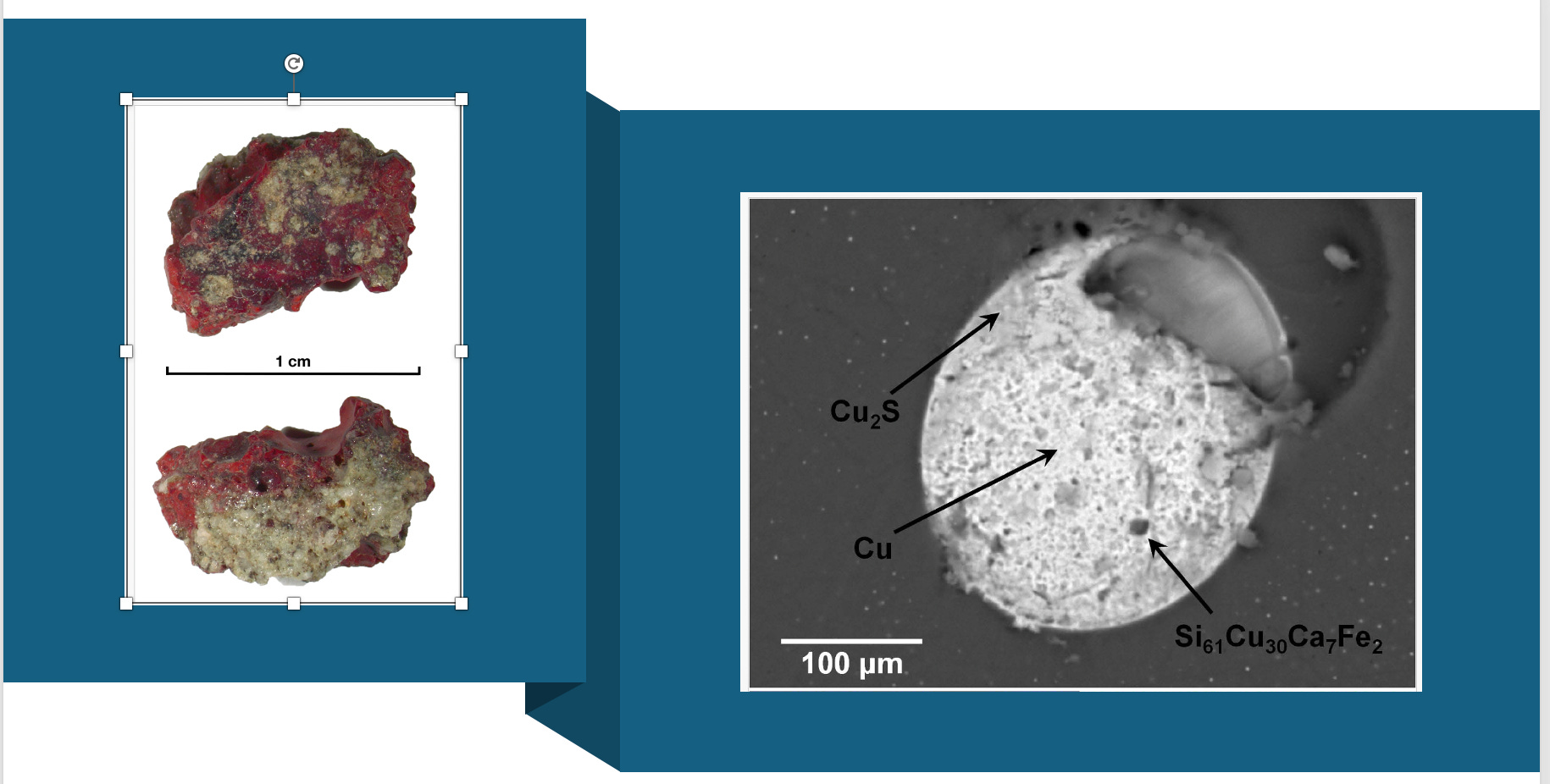
The small sample of red trinitite and the very small grain that contain the quasicrystal.
Its chemistry tells an interesting story. Silicon and calcium came from the desert sand; copper came largely from the miles of transmission wire vaporized by the explosion; iron was incorporated from the human-made material at the test site. For a few extraordinary moments on the morning of July 16, 1945, the products of human engineering and the minerals of the New Mexico desert were mixed together under pressures and temperatures rarely experienced at Earth’s surface.
Then they froze.
The result was the oldest known extant human-made quasicrystal. Unlike almost any other unusual mineral or material, we know essentially exactly when it formed: 05:29:45 Mountain War Time, July 16, 1945. Its birth was timestamped by the first nuclear explosion in human history.
My own nuclear journey had begun when I was a high-school student staring at an X-ray diffraction pattern from an exotic uranium mineral called coffinite. Nearly half a century later, mineralogy and the nuclear age came together again in another diffraction pattern—this time from an exotic form of matter created at Trinity.
My career has touch nuclear New Mexico many times, which, perhaps, that brings me back to fate.
I still do not believe that some unseen hand mapped out my life in advance. Fate, at least in that sense, remains fiction to me. A life is shaped by choices, geography, opportunity, accident and an extraordinary amount of serendipity. The quasicrystal offers an interesting metaphor. It possesses order without ordinary repetition. There is no simple repeating pattern, yet when viewed as a whole, the structure is unmistakable.
Perhaps a life can be something like that.
I was born while my father worked at a laboratory descended from the Manhattan Project and grew up in the town where the atomic bomb was invented. I studied uranium minerals from Jackpile, listened for earthquakes beneath the future WIPP repository, measured the seismic signals from nuclear explosions, returned decades later to deal with an accident that shut WIPP down, spent much of a career studying nuclear-test monitoring and nuclear proliferation, became Director of Los Alamos, and finally helped identify an exotic crystal created in the first nuclear explosion.
Uranium. Los Alamos. WIPP. Nuclear testing. Trinity. New Mexico. Perhaps their assembly is happenstance. But taken together, the pattern is difficult to ignore.
New Mexico has been shaped by the nuclear age. And so have I, whether I realized it or not.
No posts
Comments
Nothing yet. Say the first thing.
Sign in to join the conversation.