
My great-grandfather came to this country illegally. He was Irish, and he came the way a lot of people still do, not up the harbor past the Statue of Liberty but over the Canadian border, with no money and no papers. He found work on a printing press.
When the pressmen struck for fair wages, they sent him to negotiate. He walked up to the publisher’s house, and the housekeeper looked at him and said, “Servants go to the back.” He left and he built his own paper. It became a media company that stayed in my family for four generations and put thousands of people to work. I am here, typing this, because one undocumented Irishman declined to use the back door.
That is my family’s origin story. Unless you are Native American, you have one like it: somebody who showed up from elsewhere with more nerve than paperwork. We are, every one of us, the return on someone’s courage.
I am thinking about him this morning because the Supreme Court just ruled on the question his whole life was an answer to. Who belongs here. And who gets to decide.
The Court said, 6 to 3, that birthright citizenship stays. The rule is simple, and it has been the law since 1898: if you are born on American soil, you are an American, no matter who your parents are or how they arrived. Writing for the majority in Trump v. Barbara, Chief Justice John Roberts reached back to the men who wrote the 14th Amendment and quoted them on what citizenship is: “the right to have rights.” The executive order from January that tried to erase it is dead. The ruling landed four days before the country’s 250th birthday.
It did not come alone. Three weeks ago a federal judge in Providence threw out four immigration policies in Dorcas International Institute of Rhode Island v. USCIS, policies that had frozen more than a million applications, green cards and work permits and asylum claims, for people from 39 countries. The court found they were built on “anti-immigrant sentiments” posing as national-security fears. The government said it would comply and appealed the same afternoon.
I know about that case because one of my closest friends and a fierce justice warrior works at Dorcas. And here is what I need you to understand about her job: she does not process paperwork. She sits across a table from people. One of them spent the war translating for American soldiers in Afghanistan and cannot go home, because the men he helped us fight would kill him for it. His asylum claim was one of the million. To the policy, he was a frozen file. To my friend, he is the reason she comes to work.
That gap is where this whole essay lives. The distance between a number and a man at a table.
Start with the double standard, because everything else grows out of it.
We run two threat-assessment systems in this country. For immigrants, especially Black and brown ones, the rule is guilt by category: one crime by one foreign-born person becomes the reason to move against millions who never met him. One headline, a whole people indicted.
We do not do this to white men. Ever.
And it is not because the data lets us off the hook. White men were behind 103 of the 195 mass shootings recorded between 1966 and 2024, just over half.1 White supremacists and far-right extremists carried out 67 percent of domestic-terror plots and attacks in 2020.2 The Department of Homeland Security, in its own 2020 threat assessment, named white-supremacist extremists “the most persistent and lethal threat in the Homeland.”3 The FBI director testified, under oath, that they commit the most lethal attacks we see.4 By 2024, every single extremist murder in America, three years running, was the work of a right-wing extremist.5 In our schools, 81 percent of mass shooters are white.6 The most complete database in the field describes the typical shooter as a white male student or former student.7 Far-right incidents are up 250 percent over five years, three and a half times as many.8
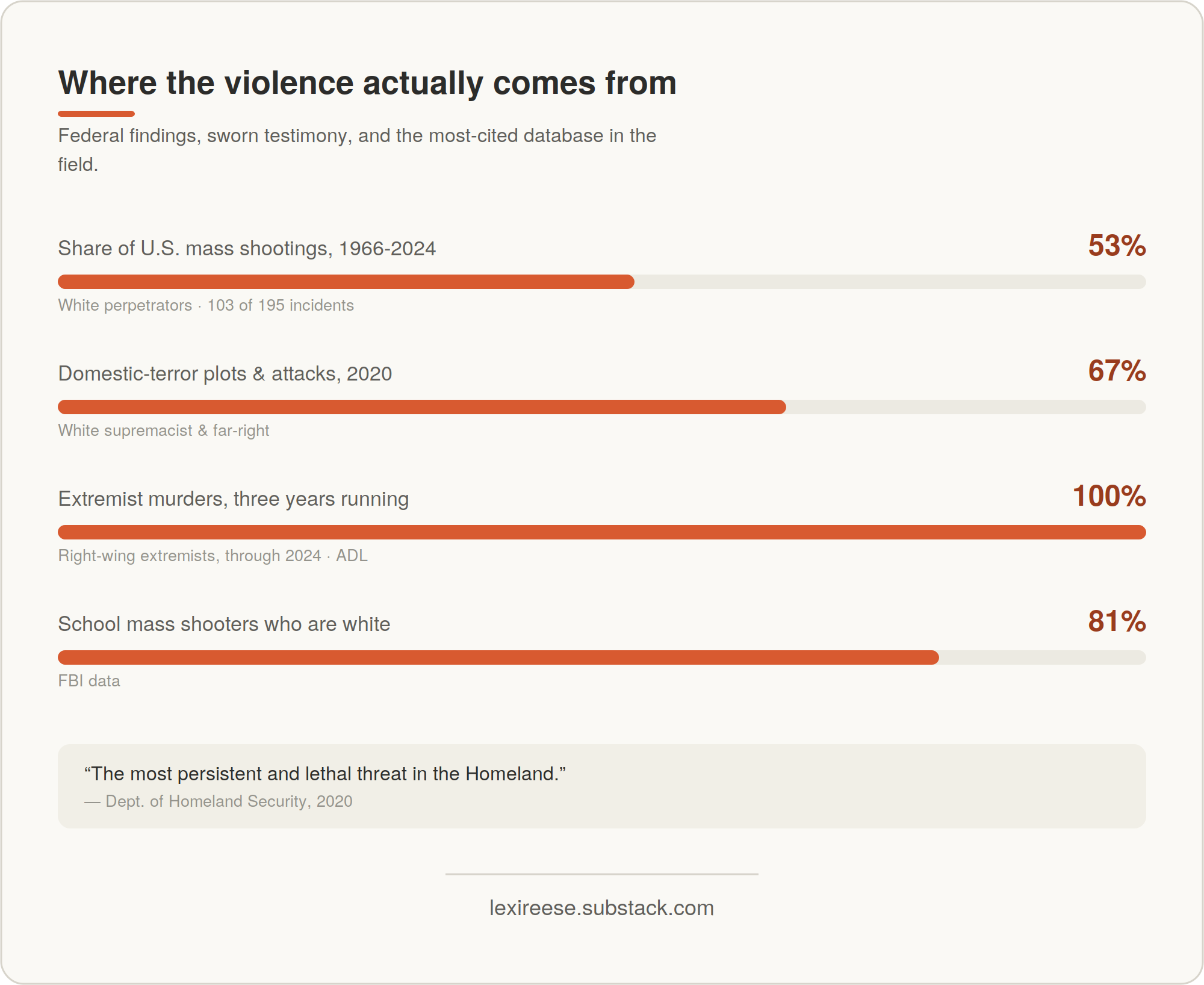
These are not my opinions. They are federal findings, sworn testimony, and the most-cited dataset we have.
So try a thought experiment. Two Afghan refugees who did something illegal were the stated reason to freeze 39 nationalities. Run that logic the other way. The record on white men is not “two incidents”; it is the leading edge of domestic terror, year after year. Apply the immigrant rule to it and you would freeze their gun permits, screen them at the schoolhouse door, and put millions of them on a watch list. We will never do that, and we are right not to. Collective punishment is wrong. Group membership is not a crime. We know this cold. We simply refuse to acknowledge this when it comes to Black and brown people, especially those who come from another country.
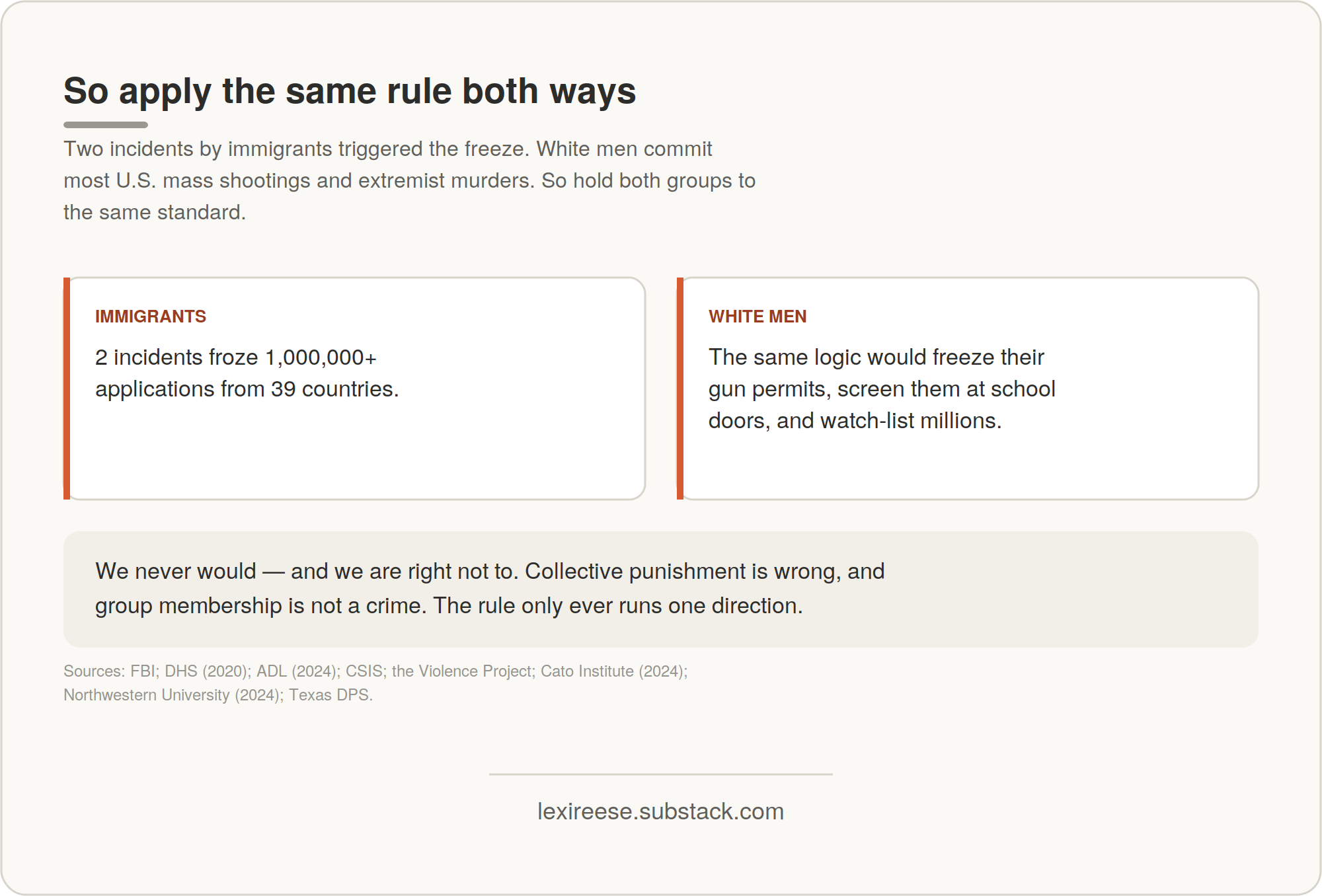
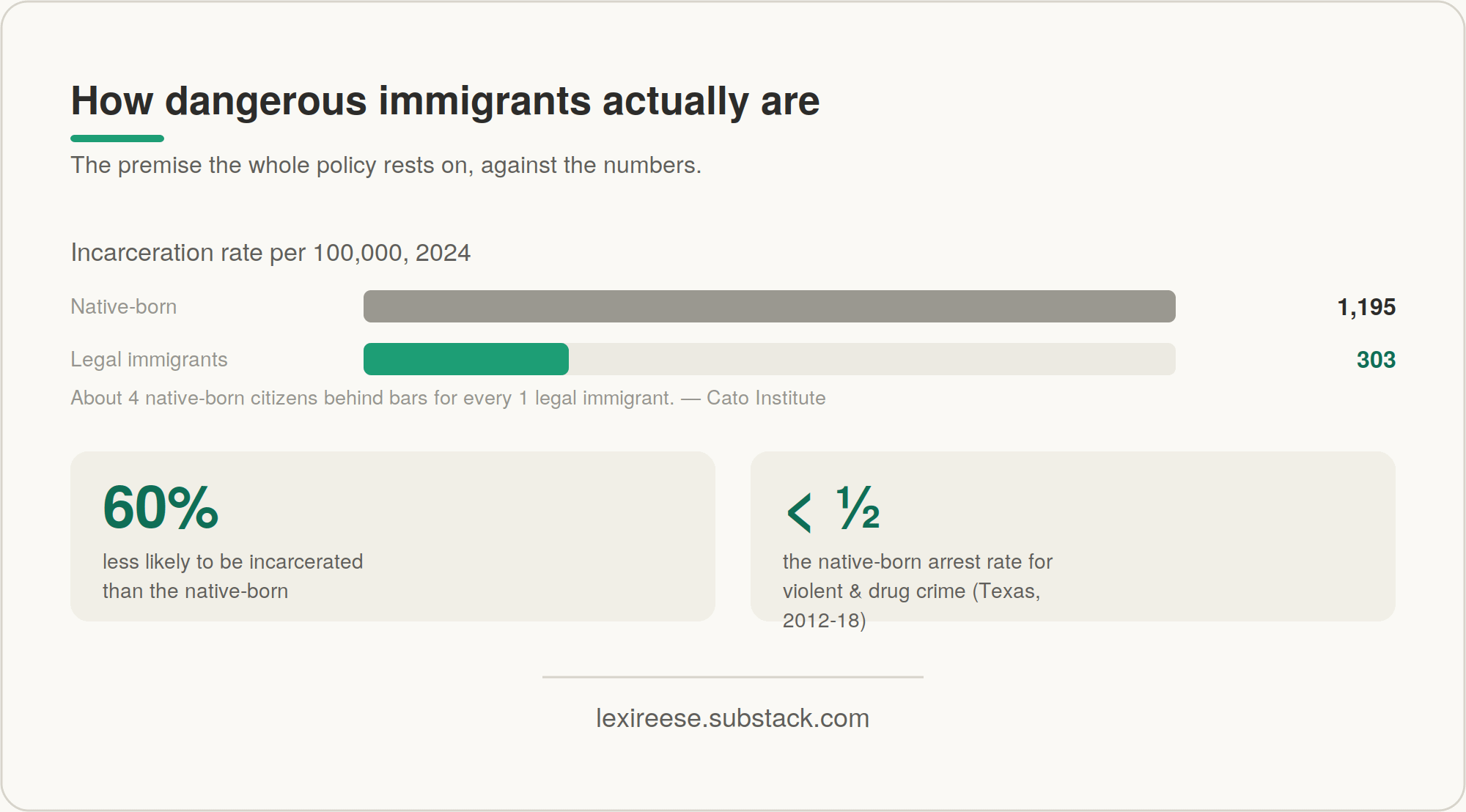
Because the whole edifice rests on one claim: that immigrants are more dangerous than the rest of us. They are not, and it is not close.
A Northwestern study spanning 150 years of census data found immigrants have never been locked up at a higher rate than the native-born, and today they are 60 percent less likely to be.9 The Cato Institute did the 2024 per-capita math: 1,195 native-born Americans incarcerated for every 100,000, against 303 legal immigrants. In plain English, for every legal immigrant behind bars, about four native-born citizens are.10 Texas tracked its own arrests from 2012 to 2018 and found undocumented immigrants arrested at less than half the native-born rate for violent and drug crimes, a quarter the rate for property crimes.11 A peer-reviewed study that controlled for income and education found immigrants simply less antisocial than people born here.12
Does some immigrant somewhere commit a crime? Of course. My own great-grandfather broke the law the minute he crossed. But the Dorcas policies were not aimed at a person. Two incidents involving Afghan refugees became the excuse to freeze Venezuelans and Nigerians and Cubans and Haitians, none of whom had anything to do with Afghanistan. The judge called the reasoning “pretextual.” That is the courtroom’s polite word for a lie with a tie on.
Here is where people who agree with me tend to lose the room, so let me not.
The capacity questions are real. A society can absorb only so many people so fast. Schools fill. Rents move. Hospitals and roads and labor markets feel it. None of that is racist to say; it is true, and pretending otherwise hands the other side the entire argument. You can believe in the words on the statue and still believe the system should be run rather than flung open. The honest position was never “no limits.” It is “decide with evidence instead of fear.” The capacity questions deserve real answers. The claim that a mother seeking asylum is an invading army does not.
So what would running it well look like? Start with the promise, because the promise is the point.
The words at the base of the statue do not ask for the skilled, the wealthy, or the convenient. They ask for the tired, the poor, the huddled masses yearning to breathe free. That was the deal offered my great-grandfather, and the interpreter in my friend’s office is exactly the person it was written for: tired, poor, hunted, and ours by every promise we have ever made. A country can argue about how many and how fast and still keep faith with that sentence.
We don’t. What we built instead is a time tax, and like every tax on time it falls hardest on the people with the least to spare. A green card can take a decade. An asylum case can outlast the war the applicant fled, which means my friend’s interpreter could grow old, or worse, waiting for a hearing on whether he gets to live. The million files a judge unfroze were never denied. They were left to rot, and for someone waiting on a work permit or a spouse, rot is denial by another name. Almost none of this is in the law. It is underfunding, understaffing, and, often enough, design. A line that never moves turns people away as efficiently as a wall, and nobody has to sign their name to it.
So the job is not to dream up a new country. It is to make this one keep its word, competently. And the raw materials are sitting in plain sight. There are about 32.5 million refugees on earth right now looking for somewhere safe, roughly the population of Texas, and a huge share are working-age adults. Meanwhile American hospitals, data centers, and hotels cannot fill the shifts they post. Those two facts belong in the same sentence far more often than they land in one. Connecting them is not charity. It is math.
And the blueprint is neither partisan nor new. Much of it was laid out a few years ago by Kristie De Peña of the centrist Niskanen Center, the Iowa news director Robert Leonard, and David Oman, a former chief of staff to two Iowa governors and once chair of the state Republican Party.13 Their case is operational, not ideological, and the best parts are already running. Washington State handed foreign-trained doctors a limited license; about ten of them now care for an estimated 20,000 residents, two thousand patients each, who would otherwise have none. No act of Congress. No new clause in the Constitution. A governor and a legislature who treated a shortage like a problem instead of a morality play.
The federal fixes come down to five, and every one does the same job: lower the time tax and keep the promise.
Keep the people we already chose. Millions of adults have been here for years, paying taxes, raising kids who are citizens, inside an economy that offers them no legal place to stand. Legalize them and you cut exploitation, raise revenue, and retire the fantasy that you are going to deport all of them. Same with two groups we are actively shoving out the door: the Dreamers, who came as children, and the children of legal H-1B holders, who can lose their status at 21 after growing up entirely here. Nearly a quarter of a million of those young people, a city the size of Buffalo, face removal over a clerical line. That is not enforcement. That is the time tax, collecting.
Let in the talent we keep turning away. The H-1B visa for skilled workers draws three to four times more applicants than there are slots; for every engineer or researcher we admit, two or three go to a competitor thrilled to have them. We spend billions educating the best minds on earth at our universities, then walk them to the airport the day they graduate. And we offer no real visa for a founder who wants to build here, which is why the next great companies are going up in Toronto and Berlin. Fix all three and you are not spending money. You are collecting on money already spent.
Add capacity, and yes, that means AI. The bottleneck in all of this is throughput, and throughput is the one thing this technological moment was built to add. The tools now drafting contracts and reading scans could translate a file in seconds, flag the missing form before a case is filed instead of two years later, schedule the hearings, and give every applicant a status they can follow like a package in the mail. Pointed at the clerical weight and not the human judgment, with people and not machines still deciding who stays, this could turn a decade of silence into a few weeks of process. Picture immigration run the way a state runs a driver’s license: one office, one line, a test you can study for, a result you can appeal, a date on the calendar. And the civics exam we make new citizens pass, the one most native-born Americans would flunk, is knowledge worth sharing rather than hoarding, the common ground a country is supposed to stand on. The technology is ordinary. The dignity is the point. What is missing is the will.
Fund the towns doing the work. The federal government settles newcomers in a community and then mails the bill for schools and clinics to a local government that never budgeted for it. Picking up that tab is not generosity. It is the cost of a system Washington runs.
Stop making the reasons worse. This is the part that should enrage fiscal conservatives most. People do not leave home for sport. They leave violence, corruption, and economies that have quit working. The cheapest border policy on earth is helping them not have to come, microfinance that lets a woman in Honduras start a business, anti-corruption work that makes a government worth staying for, development that builds a future where the future ran out. We know it works. And we are doing the opposite, gutting exactly those programs and then feigning shock when the line at the border grows. You cannot defund the reasons people stay home and then call the migration an invasion. That is not a border crisis. It is a self-inflicted wound with a flag planted in it.
None of this is a leap. Iowa has done versions of it before. Governor Robert D. Ray, a Republican, resettled Vietnamese refugees after the war and is remembered not as soft but as shrewd. The politics are friendlier than the yelling suggests: seven in ten Americans, including 58 percent of Republicans, back a path to citizenship for the Dreamers. The promise is old. The examples are real. The math works. The only missing ingredient is the decision to honor words we already cast in bronze.
On Saturday, the country turns 250. There will be fireworks and speeches, and somebody will quote the line Roberts quoted, that citizenship is the right to have rights.
The question is whether we mean it.
I keep coming back to my friend at Dorcas, and to the interpreter across her table. She and the people beside her did not save a million files. They saw a million people, and refused to look away from a single one. That is the most American thing I know how to describe. The Declaration was not written by people guarding their own power. It was written by people who decided the powerful do not get to say who counts.
My great-grandfather understood that at a publisher’s back door. He is gone, but the choice he made is the reason I exist, and the reason I cannot watch a man who fought beside American soldiers get told, in effect, to go around back.
“We are not a nation of English colonists anymore, yet we are a very successful society,” the Harvard sociologist Mary Waters has said. “Part of the reason is that we’ve been really good at absorbing people coming in.”
The fight over who belongs is the oldest one we have. What is new in 2026 is the method. We are not settling it by law, which needs consensus, or by amendment, which needs more. We are settling it by executive order and policy memo, signed overnight, breaking a million lives, enforced by bureaucratic molasses while the courts sprint to keep up.
Two judges pushed back this month. My friend pushes back every day, one human being at a time. That is not a system working as designed. It is a handful of people doing the job Congress will not.
We can argue about how many. We can argue about how fast. We can argue about what a well-run border looks like in a country that still wants to call itself a refuge. Those are real arguments, worth having out loud, with honest numbers.
None of this is hard. We have the data — immigrants are not the threat, and we know exactly who is. We have the blueprint, written by people who run Republican parties for a living. We have the votes, seven in ten of them. What we don't have is the nerve, because those in charge of protecting this country bend the knee to a President drunk on power and determined to make every vulnerable human - women, children and immigrants of color especially - cower just because he can.
So a man who translated for American soldiers sits in Rhode Island waiting on a hearing, while the country that owes him one throws itself a 250th birthday party. He kept his end. The only open question — the one we keep skipping — is whether we ever meant to keep ours.
Thanks for sharing with people who want to talk about what we want the next 250 years to look like.
Ammo.com research compiling Violence Project data, 1966–2024
U.S. Department of Homeland Security, Homeland Threat Assessment, October 2020
FBI Director Christopher Wray, congressional testimony, House Judiciary Committee, 2019. Wray repeated and elevated the finding in March 2021, stating the FBI had raised the white supremacist threat to the same priority level as ISIS.
Anti-Defamation League, Murder and Extremism in the United States in 2024 (published February 2025). The report documents 13 total extremist-related murders in 2024, all committed by right-wing extremists. From 2022 through 2024, all 61 documented extremist killings in the U.S. were attributed to right-wing perpetrators.
FBI data on K-12 school shootings by shooter race, as compiled in The Violence Project database and analysis.
The Violence Project, mass shooter database.
Center for Strategic and International Studies domestic terrorism data; Peace Alliance compilation of CSIS data, 2020.
Cato Institute, “Illegal Immigrant Incarceration Rates, 2010–2024”. Note: illegal immigrants’ rate (674 per 100,000) is also lower than the native-born rate (1,195 per 100,000).
National Epidemiologic Survey on Alcohol and Related Conditions (NESARC), published in PubMed
Kristie De Peña, Robert Leonard, and David Oman, “Over 75,000 Job Openings in Iowa Alone. Millions of Refugees Seeking Work. Make the Connection.
Comments
Nothing yet. Say the first thing.
Sign in to join the conversation.