
Health in America is, among other things, a waiting room.
At 8:30 on a humid July morning, I walk into the National Institutes of Health with a body that no one quite understands. I have had Bell’s palsy twice. Parts of my muscles are quietly wasting away. My left forearm has thinned just enough that I can no longer trust my grip on a trapeze bar (yeap, it happened!), or reliably tear open a pretzel snack bag on the plane (it is a real low moment when you need to ask your neighbor to open pretzels for you), or press down a bug-repellent nozzle with my left hand. Everyday objects have become diagnostic tools. Everyone agrees all is not well. No one agrees what, exactly, is happening.
I have spent the last year inside the Jiffy Lube version of American medicine. Excellent at changing the oil. Not built for when the engine is on fire. If you need an MRI or a colonoscopy or a C-section, the machine hums along. If you have something progressive, or multi-system, or rare, the machine starts throwing error codes. “That’s not what we do here.”
NIH feels like a different country, tucked inside this one. Check-in is swift but not brusque. The staff are friendly in a way that is efficient but not scripted. Mohammed at admissions walks me to get a coffee before my blood draw.
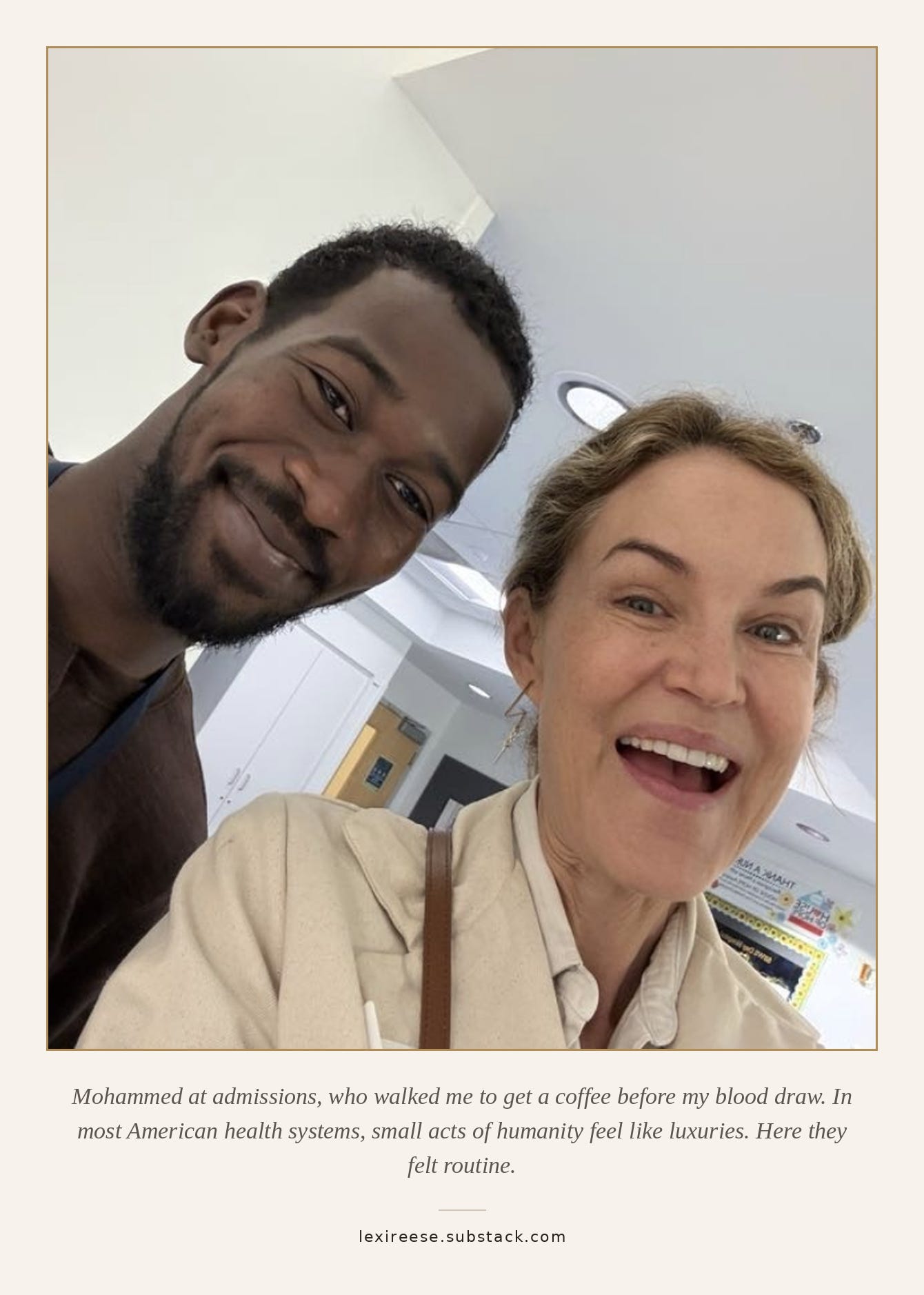
The information-desk assistant leaves his post and actually walks me down the hall instead of pointing (in fact, everyone does this). In phlebotomy, my number gets called twice and two phlebotomists each say, “I have 60.” “No, I have 60.” The nurse who finally brings me back says, “Computers can help, but humans always need to check the computer.” She pulls me, almost lovingly, into her cubicle. On her bulletin board are quotes from Maya Angelou, Martin Luther King Jr., and Jimi Hendrix. “Quality is everyone’s responsibility.” “Injustice anywhere is a threat to justice everywhere.” “When the power of love overcomes the love of power, the world will know peace.” It is earnest and homemade and tells you exactly how she thinks about her job. Not throughput. Care.
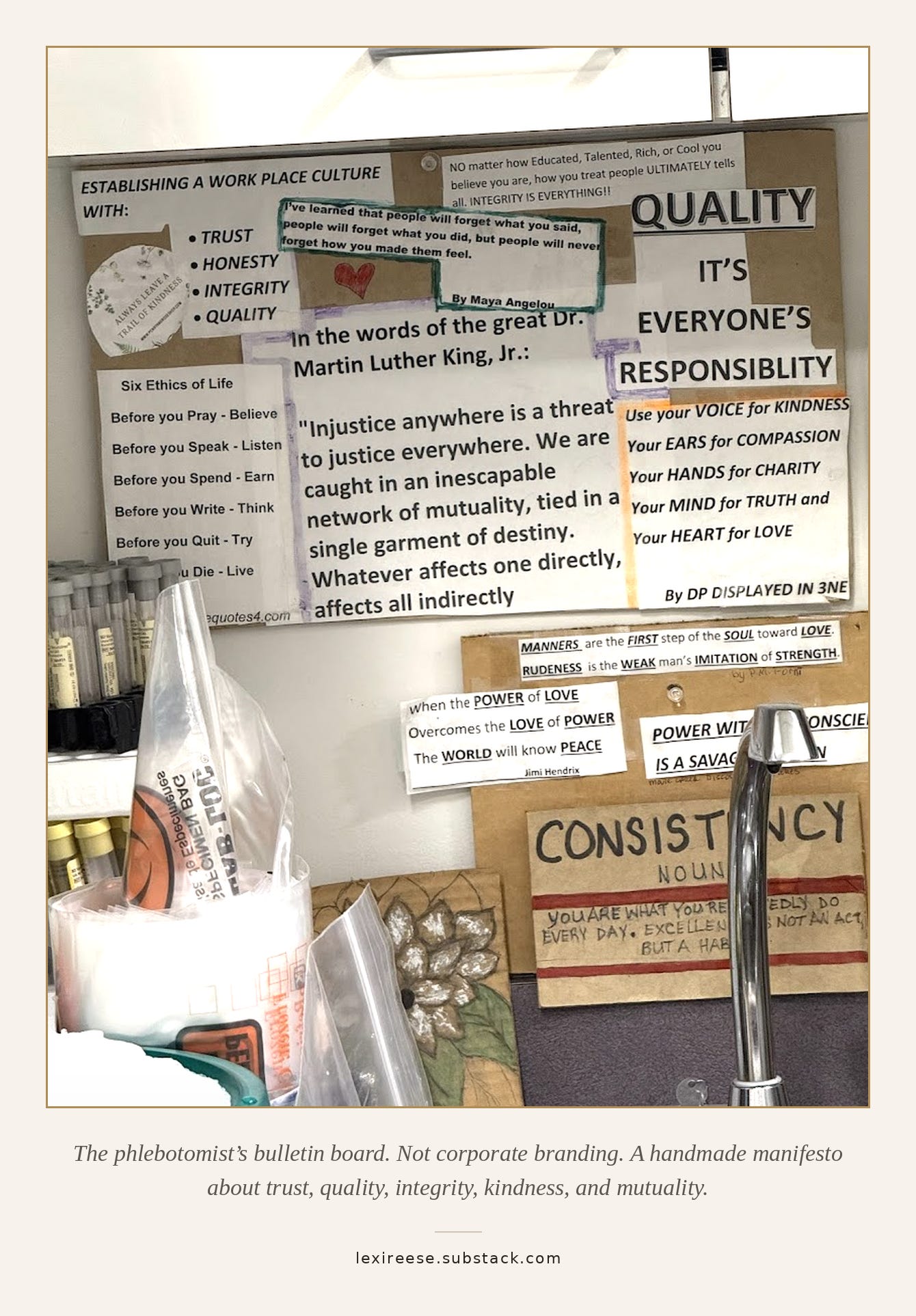
That kindness does not feel incidental. It feels structural. And that, more than anything else, is what I came to understand here.
In most of the systems I have moved through, health care feels like something else. Sutter. Stanford. UCSF. Sequoia. NYU. Cornell. Beautiful buildings. Brilliant people. A lot of very good medicine. And yet the overall sensation is speed and sorting and coding, the sense that every minute someone spends with you is a minute someone has to defend to an insurance company or to an internal dashboard.
UCSF did two MRIs on my pelvis because they got the first one wrong. The second time, they had me associated with another patient’s history and sent me to the wrong machine for the wrong procedure. I insisted “This is wrong. I am not getting in that machine” and only by being a huge pain in the poor technician’s a** did she get to the head of radiology who realized they did, in fact, have it wrong. I am pretty sure every person involved was trying to be competent. The problem was the system around them. It was moving too fast. It was chopped into too many pieces. It was more worried about filling slots than about matching the human to the chart.
For UCSF, I am probably in one of the more expensive cohorts of patients, because they keep doing nonsensical things while rushing rather than pausing and being human. And if you’ve been reading this substack, you know I appreciate AI. However, these systems are throwing AI into all the wrong places: between patients and caregivers rather than as assistants to caregivers and admin members to reduce the distance and time to resolution for the person who needs help.
Underneath all of this is the business model of American health care. We spend staggering sums, but a remarkable share of that money goes to waste. One major review estimated that between $760 billion and $935 billion a year in the United States goes to overtreatment, administrative complexity, pricing failures, fraud, and poor coordination, amounting to roughly a quarter of total health spending.¹ Hospitals and clinics still get paid mostly for visits and tests and procedures, not for outcomes and not for curiosity.² Insurance companies make money by limiting or redirecting expensive care. Hospitals make money by keeping the machine moving.
That shapes the experience of illness or being unwell. If the system gets paid to change the oil, it will get very good at oil changes. If nobody gets paid to investigate why the engine is making a strange sound, the sound will be left to you.
The choreography here also feels different. Before I ever see the doctor, they do bloodwork, MRI, vitals, a lengthy in person physical exam by a competent resident…. all of it, so that by the time I walk into his exam room he has everything at his fingertips. No “we’ll order that and see you again in three months” (if you are lucky). No “let’s start with one test and see where we land.” It feels like someone tried to design for the reality that complex disease is, well, complex.
After the blood draw and MRI and vitals, a nurse sits down with me and asks a question I have never been asked in a clinic: “How do you like to learn?” Not how I prefer to be messaged or which pharmacy I use. How I like to learn. She offers options. Reading. Hands-on demos. Videos. Play. Then she asks, “Are you willing to learn?” It is such a small thing and it changes the whole frame. I am not just a body to be scanned. I am a person who is about to be taught something about my own brain-body-nervous system connection, and they want to get the pedagogy right.
She also asks my level of pain out of ten. I say ten. In my neck, it often is. Tilting my head back or to the right is crazy painful. Any position other than standing straight or lying down with a bolster under my neck is uncomfortable. She pauses and says, very warmly, “I am so sorry for that.” No performance. Just recognition. Then, while I wait, she asks if I need anything at all and means it. She shows me the microwave to reheat my coffee, opens a cabinet of crackers, and finds a heating pad to use on my neck while I sit ther.
The NIH runs on a different spreadsheet than any other system I’ve been part of. Its stated mission is to “enhance health, lengthen life, and reduce the burdens of illness and disability through scientific discovery.”³ That sounds like brochure language until you realize it is actually a budget philosophy. Congress appropriates tens of billions of dollars to NIH each year, and the agency uses that money not to maximize billable encounters but to answer difficult medical questions, fund long-horizon science, and maintain a clinical and research infrastructure for conditions that the market might otherwise neglect.³ ⁴
That is why the atmosphere here feels different. Mohammed can walk me to coffee because his value is not reducible to throughput. A phlebotomist can stop and verify the order because getting the human match right matters more than shaving thirty seconds off an encounter. The doctor can agree to see someone with a potential progressive neurological muscle disease because “interesting” and “human” are valid reasons in this building. Public funding buys time. Time buys attention. Attention is what makes complicated medicine possible. Very competent, effective leaders at every level run this place.
The assistant who told me she could be this generous with her time because she “doesn’t have to deal with insurance” accidentally gave me the cleanest definition of nationalized health care I have ever heard. It is not government owning hospitals. It is a decision to fund places where care can be organized around need and scientific curiosity instead of billing codes. Places where your value as a patient is not how much someone can charge for you.
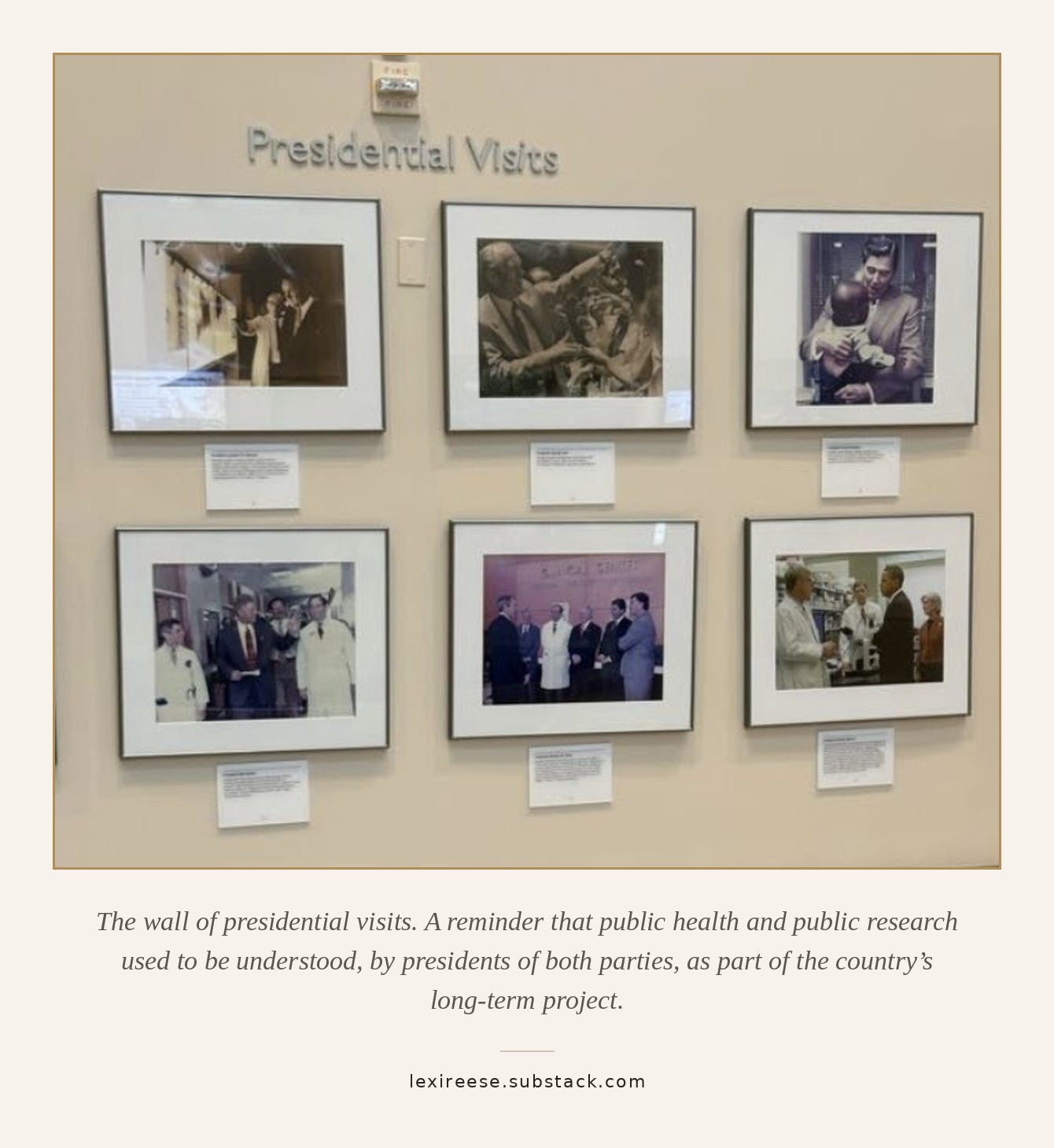
There is a long history behind that choice. NIH began in 1887 as a small Hygienic Laboratory and grew over the next century into the world’s largest public funder of biomedical research.³ ⁴ It was built precisely because some forms of health knowledge are too slow, too foundational, and too socially important to be left entirely to the market.
That is why the recent politics around NIH matter so much. President Donald Trump’s administration has repeatedly proposed cutting the agency by nearly $18 billion, roughly a 40 percent reduction from current levels, while also targeting university and hospital research support through caps on indirect costs.⁵ ⁶ ⁷ One proposal would have limited indirect costs to 15 percent and a federal appeals court later held those cuts could not go forward because they violated NIH regulations and congressional appropriations law.⁶ Another report said the administration’s broader 2026 proposal would cut $18 billion from NIH and eliminate or consolidate several institutes altogether.⁵
Even before those larger cuts are fully enacted, the administration has already disrupted substantial amounts of research. Analyses in 2025 and 2026 found that between about $1.8 billion and $2.7 billion in NIH research funding had been canceled or frozen, affecting hundreds of grants and slowing the pace of new awards.⁸ ⁹ Some of the hardest-hit areas included health for under-represented populations, large clinical trials, and training pipelines for younger scientists.⁸ ⁹ ¹⁰
That kind of damage is easy to miss because it is part of a deluge of dysfunction that doesn’t even get covered in mainstream media. It looks like a trial that pauses. A fellowship that disappears. A lab that cannot hire. A rare disease program that stops enrolling. But the effect on patients is cumulative. Treatments arrive more slowly. Diagnoses take longer. The evidence base gets thinner.
Robert F. Kennedy Jr., as Secretary of Health and Human Services, has layered a second kind of instability on top of the budget pressure. Kennedy pushed to reshape vaccine policy, including efforts to reduce the number of routine childhood vaccine recommendations and alter the CDC’s vaccine advisory system.¹² ¹³ ¹⁴ One federal judge blocked major parts of that effort, saying the moves were unlawful and warning that they could lower vaccination rates and endanger public health.¹³ Kennedy broadened the CDC vaccine advisory panel’s charter to focus more heavily on vaccine risks and added organizations with anti-vaccine reputations as liaisons.¹⁴ Trust in federal health agencies fell sharply during his first year in office.¹⁵
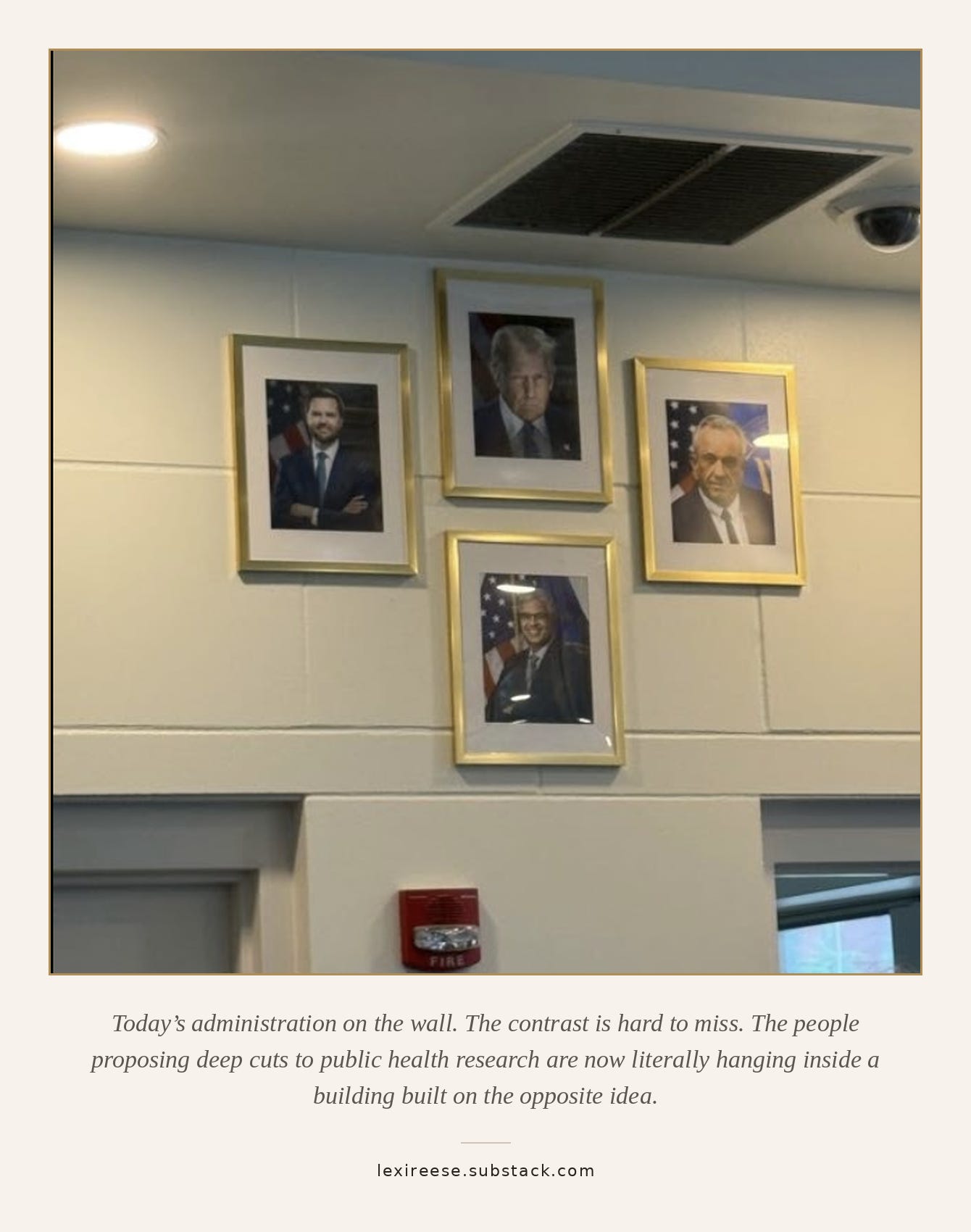
If you are healthy in a way that fits the template, you may not feel these cuts right away. If you are not, you do.
So what does it actually mean to be healthy?
It does not just mean normal lab values or a disciplined morning routine. It means being able to keep doing the things that make your life feel like your life. Holding onto the trapeze bar. Opening the pretzel bag. Working. Reading. Walking. Sleeping. Making plans without wondering which part of your body will object.
But it also means something bigger. It means living in a society whose institutions can recognize when a person is slipping, and whose systems are willing to stay with the question of why long enough to help. You can do everything right and still become sick or altered in a way that exposes the values of the country around you. Especially if your illness is slow, ambiguous, multi-system, or rare.
That is what I felt most clearly at NIH. The kindness here was beautifully designed. It was evidence of a system with enough slack, enough mission, and enough public backing to let people act like human beings.

A healthier country would not abolish markets. It would put them in a better hierarchy.
Private biotech would still matter. Drug companies would still develop therapies. Hospitals would still innovate. But the public sector would do far more to shape the ground rules. We would pay more for outcomes and continuity, and less for sheer volume.² We would treat research and rare-disease care as infrastructure rather than as luxuries.³ ⁴ We would protect institutions like NIH because they generate knowledge that later reduces disability, lost work, family caregiving strain, and expensive late-stage disease.¹ ¹⁶
There is nothing sentimental about this. Repeat MRIs cost money. Wrong procedures cost money. Long diagnostic odysseys cost money. Late-stage disease is usually more expensive than catching something earlier, and social distrust in health institutions carries its own costs when outbreaks arrive or when patients retreat from care.¹ ¹⁵ ¹⁶
We already know, in fragments, what a healthier country would feel like. It would feel like a system where a patient is matched to the right chart and the right machine the first time. It would feel like a nurse who has enough time to double-check the computer. It would feel like an admissions worker who can walk you to coffee because there is no insurer waiting to punish kindness as inefficiency. It would feel, in other words, a little more like this day at the NIH.
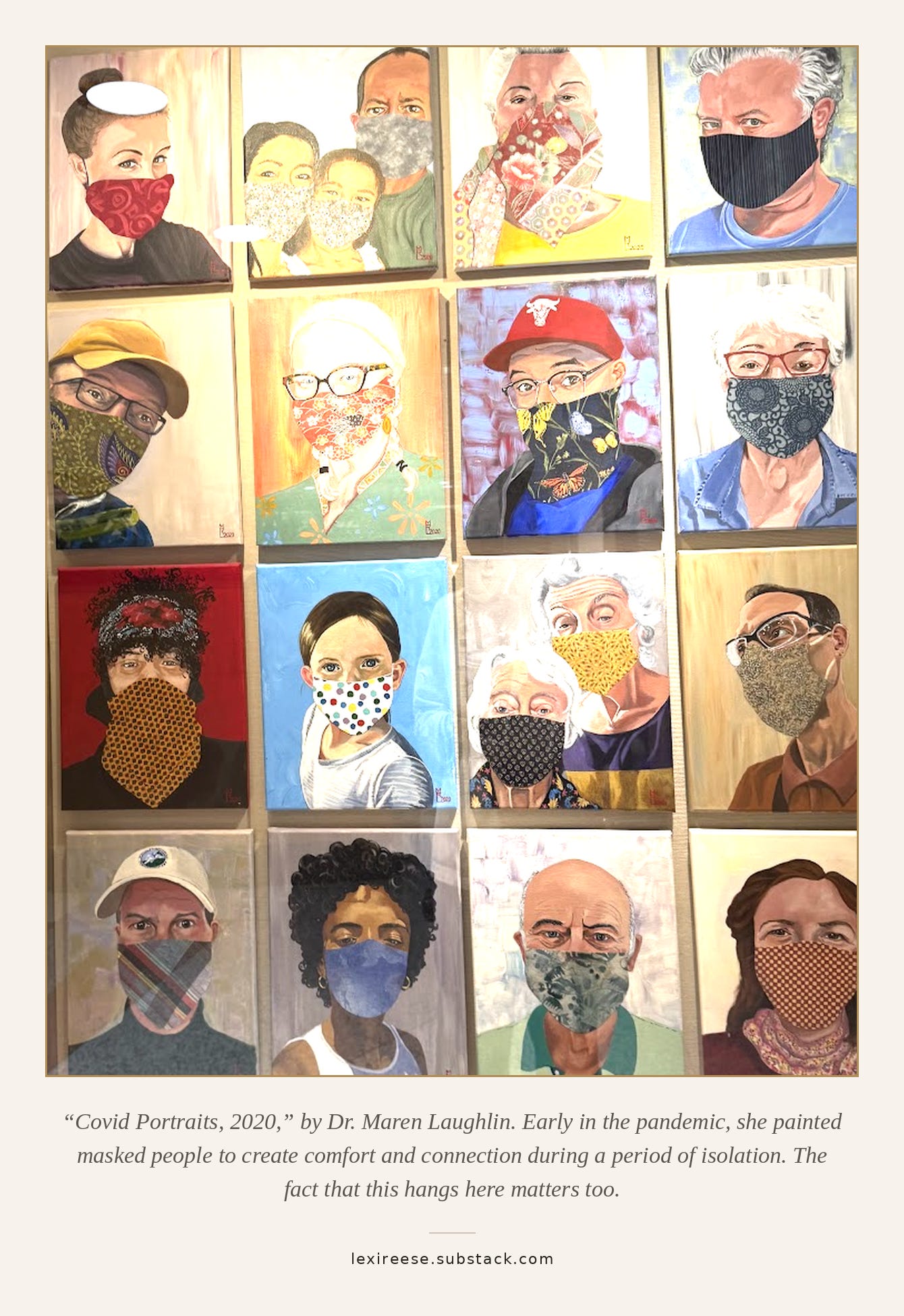
And that is the thing I did not fully understand until I got here. The opposite of a profit-driven health system is not bureaucracy. It really is attention. It is the decision, made collectively and paid for collectively, that some human problems are worth understanding even when there is no obvious market return on the first day. The strange thing is that this choice often does pay for itself. It pays in fewer errors, fewer wasted tests, fewer years lost to disability, and more people able to remain fully inside their own lives.¹ ¹⁶
While I wait, I eat Zesta saltines and sit in the one position my neck will tolerate, heat pressed against the place that looks fine on the outside but is screaming on the inside. For the first time in a long time, I feel like I am being taken care of by a system made up of people I do not know, who are all dedicated to the art and science of caretaking in a way I have never, in this whole year of seventy-plus appointments, experienced.
It is not that my other doctors and nurses have been unkind. Many have been wonderful. It is that the systems around them have been built for speed and billing and lane-keeping, not for this feeling of being held by a common project. Here that project is visible in every small decision: draw the labs and do the MRI before the visit so the doctor has what he needs; ask how I like to learn before explaining anything; empathize when one’s pain is a ten; reheat the coffee; find the crackers; crack open a heating pad.
From the outside, all of that can sound trivial. From inside a body that hurts and a year of being shuffled, it feels like policy made tangible. It feels like what happens when a country decides to put real money and real care behind the idea that health is not just an individual virtue, but a shared responsibility.
In the NIH waiting room I am one person among many. Children in wheelchairs. Adults with scars from surgeries that did not quite solve anything. People from all over the world. What holds us together is not a shared diagnosis. It is the fact that, at least today, we are in a building that treats our lives as worth the trouble.
Thank you for sharing with anyone who may need to read this. Note: to be admitted to the NIH Clinical Center you must be accepted into a specific clinical research study matching your medical condition or as a healthy volunteer. All care is provided at no charge, but you must be referred by a physician or directly contact the Office of Patient Recruitment to determine if you qualify.
Shrank WH, Rogstad TL, Parekh N. “Waste in the US Health Care System: Estimated Costs and Potential for Savings.” JAMA, 2019. PubMed
ISPOR, “US Healthcare System Overview: Background.” Link
National Institutes of Health, “History.” Link
NCBI Bookshelf, “Background: History, Funding Landscape, and NIH Structure.” Link
Reuters / Investing.com, “Trump budget proposes drastic cuts for US scientific research.” Link
Reuters, “Trump administration cannot slash NIH research funding, court rules.” Link
The Guardian, “Trump administration to cut billions in medical research funding.” Link
NBC News, “Trump administration cut more than $1.8 billion in NIH grants.” Link
CNN, “Trump administration cut $2.7 billion in NIH research funding through March, Senate committee minority report says.” Link
STAT, “NIH cuts: Trump budget slashes grants, training, research centers.” Link
Reuters, “Congressional forecaster says Trump health research cuts would lead to fewer new drugs.” Link
Reuters, “RFK Jr has ‘unreviewable’ authority to reshape vaccine policy, DOJ lawyer tells judge.” Link
Reuters, “Instant View: US court order blocking vaccine policy changes a win for public health, experts say.” Link
Reuters, “Kennedy broadens vaccine advisory panel’s role to focus on risks.” Link
CNN, “Trump promised RFK Jr. would ‘restore faith in American health care.’ A year in, trust has plummeted.” Link
Brookings, “The Trump administration’s NIH and FDA cuts will negatively impact patients.” Link
Comments
Nothing yet. Say the first thing.
Sign in to join the conversation.