
On Saturday night I was in the car with friends, headed to an art opening. (Side note if you are in the Bay Area, visit the 120710 Art Gallery to see Future Relics: Curatorial Edits from 4087 and prepare to have your mind blown.) One friend started telling me about the best Grateful Dead cover band he had seen in years, a group called BERTHA: Grateful Drag.¹ It is exactly what it sounds like, a Dead tribute act out of East Nashville, queer and allied musicians in wigs and sequins playing the catalog straight. My friend is a serious Deadhead. He does not give away praise to just any Dead cover bands. He gave it to them.
Then he told me why the band exists. BERTHA formed in response to a law. In 2023, Tennessee passed what became known as its drag ban, officially the Adult Entertainment Act.² It expanded the definition of “adult cabaret performance” to cover “male or female impersonators” deemed harmful to minors, and made performing in that category anywhere a child might be present a crime, a misdemeanor the first time and a felony the second. The word drag never appears in the text. It did not have to. Everyone knew who it was for.
A federal judge later blocked the law as unconstitutionally vague and overbroad.³ Which sounds like a happy ending, except that is not how these things work anymore. The ruling did not undo the intent. A bill like that does its job the moment it is filed, by making people calculate the risk of being themselves in public. You do not have to win in court if you can make a drag performer in Nashville wonder whether tonight is the night someone decides to test the statute on her. The fear is the product.
So some Nashville musicians did the most pointed thing artists can do when power gets ridiculous. They put on the wigs and got on stage.
By the time we reached the gallery, the three of us had talked our way through the Stoics, the Abrahamic religions, and the current era of America’s culture war, all of it circling one question: what kind of person looks at a drag Grateful Dead cover band and decides the state needs to step in? And isn’t Trump hosting a different kind of drag show for his birthday tonight?
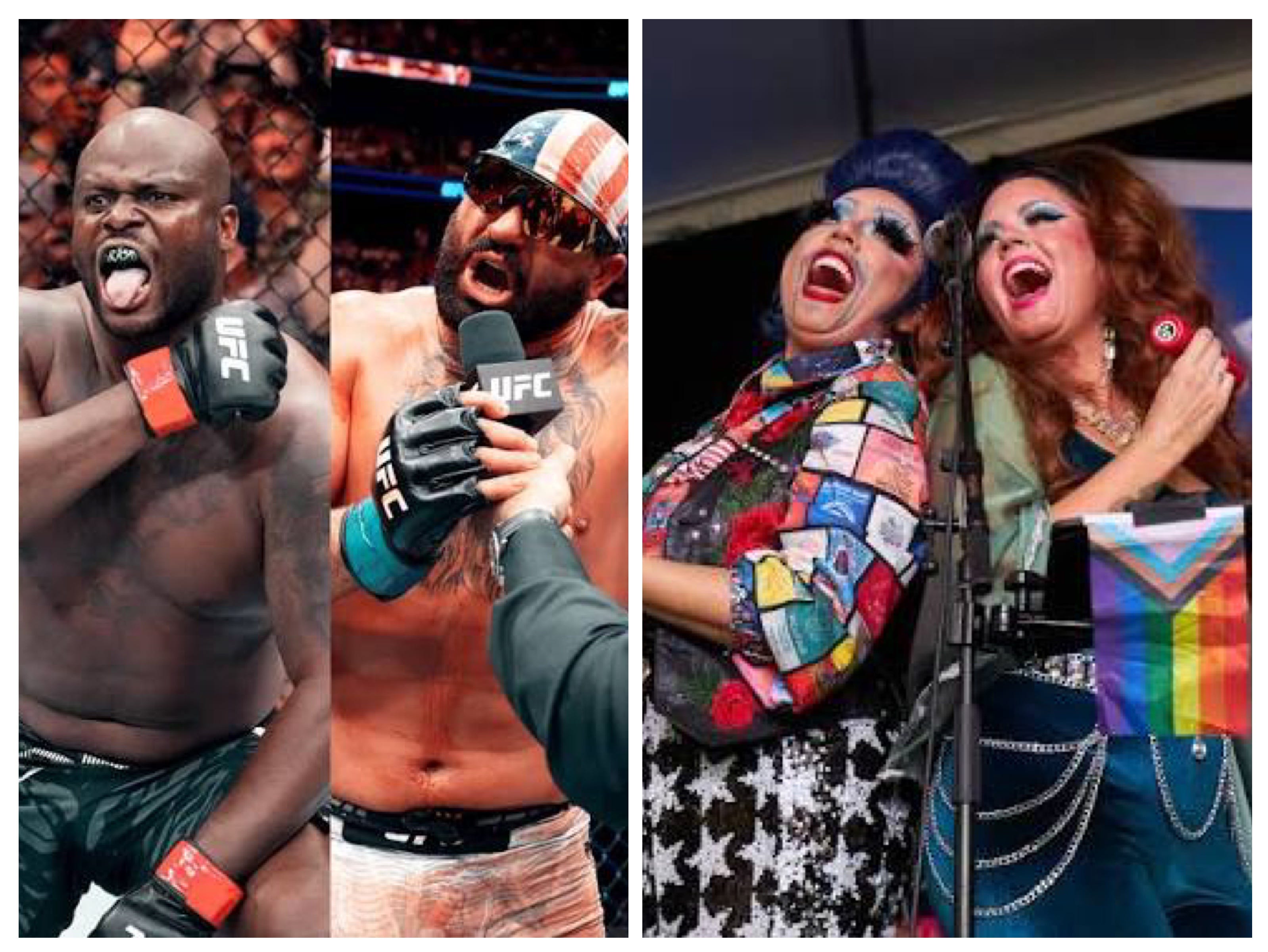
Left image: Sean Strickland vs Anthony Hernandez, UFC Fighters. Right Image: BERTHA: Grateful Drag.
Start with the answer they give, because it is always the same one. Drag bans, abortion restrictions, gender-affirming-care bans, bathroom bills, pronoun laws: every one of them arrives wrapped in protection. Protect the children, the women, the family, the culture. Sometimes the worry is sincere. But urgency is the tell, because urgency shows you what people actually prioritize.
The legislatures that sprinted to regulate what a performer can wear and what a transgender teenager’s chart can say have not sprinted on gun violence, child poverty, or maternal mortality, all of which put real children in real danger every year. The speed clusters around gender, sexuality, and reproduction. Around bodies. That is not a coincidence. That is the agenda.
Which means these are not really separate fights at all. They are all fights about authorship. What connects them is a single premise: that your body is not fully yours to define. Someone else holds the pen. Someone else gets final edit on your identity, your choices, your future.
Here the conversation veered to the Stoics, in part because my friend is reading Meditations right now, but mostly because of what Stoicism talks about as a righteous path.
The Stoics are having a moment, mostly for the wrong reasons, sold as productivity hacks for men who want to feel like emperors. But the actual discipline is the opposite of domination. Its core move is a hard line between what is yours and what is not. Your judgments, your intentions, your actions are yours to work on. Other people’s choices, identities, and lives are not. The Roman senators that historians call the Stoic Opposition resisted tyranny by refusing to cooperate with it, refusing to flatter, refusing to inform, refusing to betray their own conscience. They did not answer a corrupt emperor by writing rules about their neighbors’ clothing.
Which runs straight back to Tennessee, because the people who wrote that drag ban did not reach for Marcus Aurelius. They reached for their Christian God. The lawmakers behind bills like this one almost always describe their politics in the language of faith: defending children, defending the family, defending what they call God’s design.
Let me be clear. Religion is not the villain here.
Judaism, Christianity, and Islam are all, at bottom, stories about what the world is, what people are for, who is in charge, how to live and what happens when we die. At their best, just like Stoic philosophy, they offer depth, belonging, humility, and a vocabulary for justice. At their worst the same stories have justified hierarchy, exclusion, and slaughter. Having a story is not the problem. Everyone has one. The problem starts the moment a group decides its story is so complete that everyone else has to live inside it, and writes that conviction into law.
Pull that thread and the real divide comes loose. It is not religious versus secular, or right versus left. It is between moral systems built to govern the self and moral systems built to govern everyone else.
I learned how early that question arrives in a person’s life from my own daughter. She was ten and she was curious about religious wars. She was trying to understand why people kill each other in part because they hold different religions.
“Isn’t your religion just a story you tell yourself about the world?”
And then, before I could find an answer: “Why do people go to war over their version of the story?”
I did not have a reply fit for a ten-year-old. I am not sure I have one fit for an adult. The closest I have come is this. People go to war with guns or laws over stories when they cannot bear the possibility that another story might hold a life together as completely as theirs holds theirs, might answer who saves us and how we die just as fully, that a stranger could build something whole and good and meaningful on a foundation they would never choose, and the sky would not fall. Certainty mistakes itself for authority.
Tennessee’s drag law is that mistake, localized. A drag queen is not dangerous because of sequins. A woman seeking an abortion is not dangerous because of a procedure. A trans teenager is not dangerous because of a pronoun. What unsettles the people writing these laws is the authorship itself, the sight of someone claiming the right to narrate their own body. The law is the answer they reach for to say no, your story belongs to us.
Sunday morning my first-grade niece showed me some of her schoolwork. One page was titled All About Me: a yellow sun, a blue sky, a smiling figure in a dress, and underneath, in the careful pencil of someone who just learned to write, a sentence the class had clearly worked out together. It’s okay to war dresis (and, yes, I realize the irony of how she spelled wear as war given the subject of this piece).
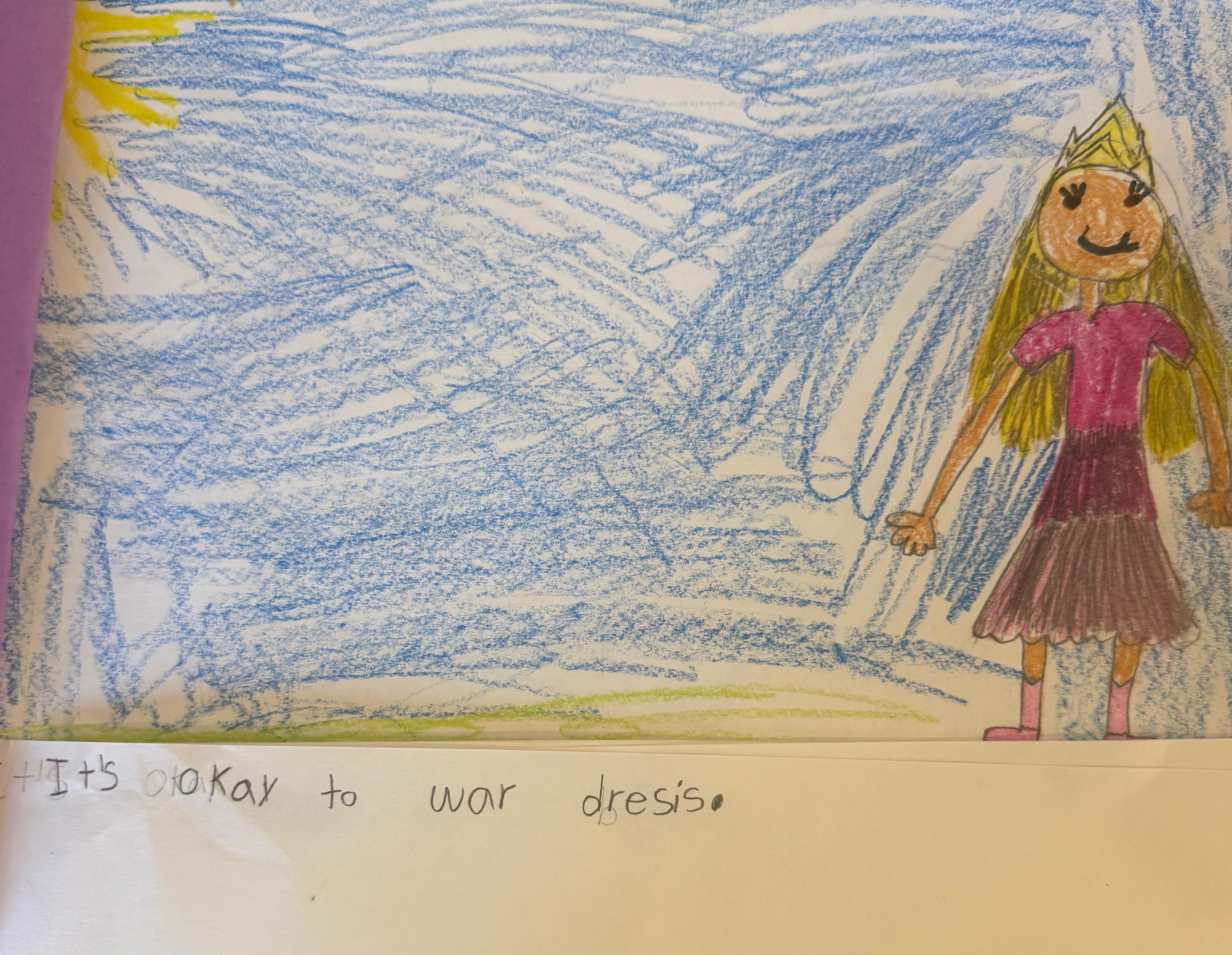
I have read a lot of constitutional analysis about gender and the First Amendment. None of it is clearer than that. My niece was not advancing a theory. She was stating a fact and turning the page to the part about what she wants to be when she grows up. She was not telling anyone else what to wear. She was refusing to be talked out of her own answer. That, in crayon, is the Stoic Opposition. Mind your own life. Let other people have theirs.
In Tennessee, grown adults in suits spent months drafting a felony around that exact sentence.
Trust me, my niece and the first graders everywhere do not care whether people wear dresses. They are afraid of guns. They are afraid of their parents getting sick and not being able to afford to get well. So if you actually want to protect children, let’s protect children. We know where the danger is, and it is not the woman lip-syncing on a Nashville stage.
Tonight the irony writes itself. Donald Trump turns 80, and the White House is throwing him a party that is, structurally, a drag show. It is not billed that way. It is billed as UFC Freedom 250, a seven-fight card on the South Lawn under a towering arched lighting rig the promoters named “The Claw,” timed to Flag Day and the run-up to the country’s 250th birthday, with a championship bout as the main event and the trampled grass set to be replaced afterward at a reported $700,000.⁴
Strip the patriotism off and look at the thing. Men in costumes and personas built for the cameras, walking out to entrance music, performing an amped, theatrical version of masculinity for a paying crowd. The wigs are different. The choreography is different. The transaction is identical: a body performing an idea of gender for an audience.
And consider who is hosting. The movement that treats a drag brunch as a danger to children has organized itself around a man whose friendship with Jeffrey Epstein, the convicted sex offender and child sex trafficker, is among the most documented in American public life, a relationship that ran more than a decade and resurfaces in nearly every batch of files the government releases.⁵ Hold that against the standard these same people wrote into law. Tennessee decided a performer in a wig was a felony-grade threat to children. The same coalition shrugs at the pedophilia adjacency of Trump and builds him a cage on the people’s lawn for his birthday.
So a drag queen in a Nashville bar is a civilizational threat requiring legislation, and masculinity performed at full volume in a cage on the president’s lawn is patriotism. The issue was never performance. It was never spectacle, or children, or propriety. It is whose performance gets to stand in for America, who gets to embody gender in public without punishment, and who holds the pen. It is about control, and about keeping the rest of us in a cage for which only one group holds the key.
Thanks for reading! This post is public so feel free to share it.
SOURCES
Live for Live Music, “Witness the Unveiling of BERTHA: The World’s First ‘Grateful Drag’ Band.”
Reuters, “Tennessee governor will sign bills restricting drag, transgender youth treatment.”
Reuters, “Federal judge rejects Tennessee drag show ban as unconstitutional.”
CNN, “What we know about the UFC fight at the White House.”; NPR, “Trump’s UFC fights bring historic spectacle to White House.”
CNN, “DOJ releases millions of pages of documents in Epstein investigation.” ; Rolling Stone, “Trump, Musk, Lutnick Show Up in Latest Epstein Files Release.”
Comments
Nothing yet. Say the first thing.
Sign in to join the conversation.