
“But who has won?” “Everybody has won, and all must have prizes.”
Lewis Carroll, Alice’s Adventures in Wonderland
Author’s note: Everything here is invented. The firm, the men, the young woman. I usually write non-fiction, but fiction is usually what moves me to think and act differently. I am inspired by Dave Eggers who wrote The Circle and The Every so we could see what no reported piece could make us see. I am borrowing his method, not his talent.
Ada Liddell arrived at The Green on a Monday in February, and the first thing she was given was a mirror.
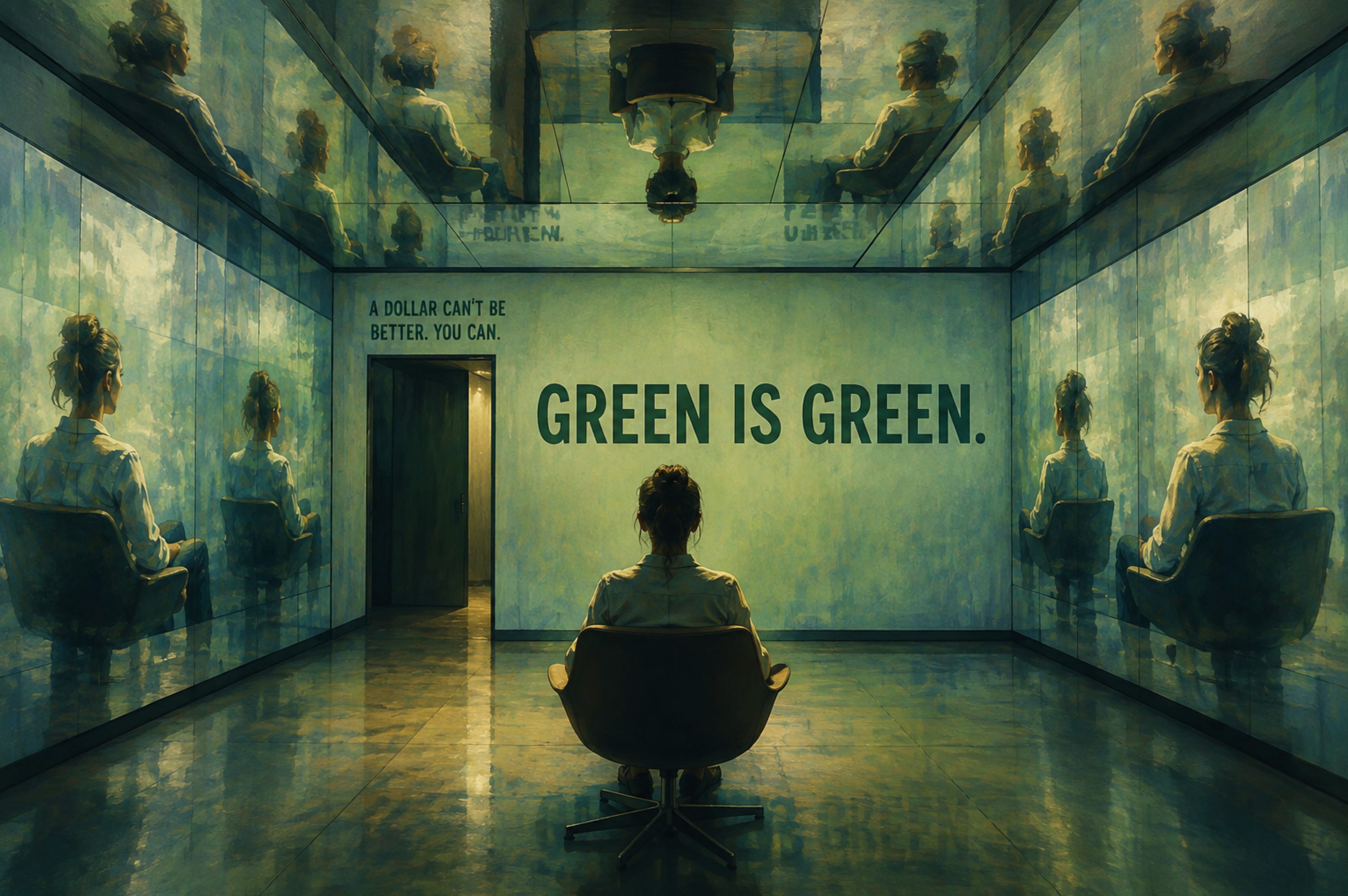
Not a real one. It was the name of the room. The Mirror Room was where new associates were onboarded, and it was called that because three of its four walls were screens, and the screens showed the room. You sat down and there you were, from four angles, in a very good chair.
“You’ll get used to it,” said Kip, who had been at the firm eleven months and said this about most things.
On the fourth wall, in letters two feet high, painted rather than projected, because painted things cost more and therefore mean more:
GREEN IS GREEN.
“That’s the whole thesis,” Kip said. “That’s Brenner’s.”
Ada waited.
“Okay, so.” Kip drew a rectangle in the air. “You make a phone. Somebody else makes a phone. You can make a better phone. Battery, camera, whatever. You compete on the thing.” He erased the rectangle. “We don’t make a thing. We make money available. And here’s the problem nobody tells you in business school: a dollar is a dollar. Our dollar and their dollar are the identical product. Chemically identical. There is no better dollar.”
“So what do you compete on?”
Kip looked at her with real pleasure, the way you look at someone who has stepped exactly where you laid the board.
“Look up,” he said.
Above the door, smaller, in the same hand-painted letters:
A DOLLAR CAN’T BE BETTER. YOU CAN.
“The founder can take a check from anybody,” Kip said. “Money’s a commodity. Access isn’t. So the product is us. The rooms we can get her into. The names we can put on her cap table. The Senator who picks up.”
“And if she doesn’t care about Senators?”
Kip grinned, delighted, as though she’d been slow and had finally caught up. “Then you find another way to be the reason. Brenner does it with power. Ollie...” He shrugged. “Ollie does it by being the guy you actually want in the room. Terms are terms. Ollie’s Ollie. You would not believe how many rounds that wins.”
He tapped the doorframe as they went out, the way people at The Green all did, a little superstition everyone adopted. “Be the reason she picks you. That’s the job. Everything else is spreadsheets.”
Ada wrote it in her notebook that night, in the studio she could not afford, and looked at it for a long time.
The product is the self.
She had thought she was joining a bank. She had joined a personality business.
There were three Principals. There had been, anyway.
Hal Brenner you already know, or you know a man like him. He was the one on the podcasts. He was the one with the manifesto, eleven thousand words published on a Sunday. Adrienne LaFrance, writing in The Atlantic about the men who publish documents like that, catalogued what they actually believe: that anything buildable ought to be built, that privacy is a relic, that friction in the flow of information is a worse sin than falsehood in it. And above all, she wrote, that “their power should be unconstrained.” Brenner’s version ran longer and you didn’t need audio to hear the chest thumping soundtrack.
He was the one who, at a rally in January, standing on a stage he had paid to stand on, made the gesture.
Ada watched it on her laptop, alone, and made a sound she did not recognize as her own.
By the next morning there was a thread. There were eleven threads. There was a post from a man who had once written beautifully about compilers, explaining that the gesture had been a wave. There was a post from a woman on the comms team, whom Ada liked, explaining that it had been enthusiasm. There was a memo. The memo said the firm did not comment on the personal expression of its Principals, and then commented, at length, on the personal expression of its Principals.
By Wednesday the sentence circulating in the group chats had arrived at its final form, polished by repetition until it shone:
You did not see what you saw.
Ada thought about the White Queen, who could believe six impossible things before breakfast, and who had made a practice of it, and had recommended it as a discipline.
Nobody at The Green needed six. One was enough, if everyone believed it at once.
Here is the part Ada did not understand until much later. She had assumed the manifesto and the podcast and the gesture were symptoms of ego, and ego alone. They were. But underneath the ego was a sales strategy. Brenner could not sell a better dollar. So he had spent fifteen years making himself into the reason. The man whose name on the round meant the doors opened, and who therefore had to be seen opening doors, publicly, expensively, in a way that could be photographed.
The visibility wasn’t vanity.
It was the thing he was selling.
Ollie Frame was the other one.
Everyone loved Ollie. This is not a figure of speech and it is not sarcasm. He remembered the name of your mother. He answered emails from nobodies at eleven at night, and the emails were long, and they were kind. When Ada’s first deal fell apart, humiliatingly, in a partner meeting, Ollie found her in the stairwell (the stairwell, which nobody used, which meant he had gone looking) and told her a story about his own first year that made her laugh so hard she had to sit down on a step.
Ollie grew up with less. He said so often. He said it well.
“I know what the other side of that door feels like,” he told a ballroom in April, at a gala for a foundation that funded college counselors in schools that had none. Nine hundred people. Ada was at table thirty-one. “So I’m not here to be celebrated. I’m here to help.”
The applause went on a while. Ollie stood in it, looking uncomfortable in a way that Ada, who had watched him hold that exact expression for exactly that length of time at three prior events, was beginning to be able to time.
On the drive home Ada finally understood Ollie.
The check was real. The counselors were real. The kids were real and would be helped.
But the ballroom was real too. In it were two governors, a media owner Ollie needed, and a man from the administration that nobody would have taken a meeting with three years ago, photographed that night beside Ollie under a banner about children.
Ada had a bit of an ah-ha moment just then.
If you are selling a commodity, and a dollar is the purest commodity there is, then you cannot win on the product. You win on being the one the creator that needs capital to create wants. And the most powerful version of being wanted ever devised is not access, or a manifesto, or a stage.
It’s being good to people. Warm. Available at eleven at night. The one who comes and finds you in the stairwell.
Ollie is good to people. Ollie is also in a business where being good to people is the most valuable thing a man can sell.
Both things are true at once, and there is no way to pull them apart.
Ada couldn’t do it. Neither could the woman whose foundation got the check. Ollie probably can’t do it either. If you spend twenty-five years being rewarded every single time you are kind, you lose any way of knowing whether you would still be kind without the reward. He gets to feel like a good man forever, and the returns keep proving him right.
That isn’t hypocrisy.
It’s something smaller and stickier, and it took Ada a year to say it out loud without hearing herself sound ungrateful.
A true gift leaves you free. What Ollie gave you left you holding something. A debt, small and warm and impossible to name, that he would never call in and never had to, because people who feel indebted volunteer. The stairwell was real. It was also why she said yes that year to three things she should have refused.
And then a thought she kept turning over, the one that made her feel unclean for even thinking it: who doesn’t get the email at eleven at night? Not out of cruelty. Nobody decided anything. The warmth simply pooled where it compounded, and thinned out, politely, where it didn’t.
One more realization came to Ada a bit later.
Ollie Frame had never truly built something.
He would object to that. The Green is a company. It has a lease and ninety employees and a benefits plan, and he raised the first fund himself in 2003, and it nearly killed him.
So ask what The Green makes. Not what it owns. What it makes.
It makes the introduction. Its only real asset is who picks up when Ollie calls. Take Ollie out of it and nothing is left running: no product a stranger could keep selling, no machine that works without the man. He had never shipped a thing. He had never made payroll on a Friday with the money not yet in. He had never had a customer look him in the face and say this doesn’t work.
What Ollie had built, with tremendous skill, over twenty-five years, was Ollie. The man in the middle. The toll booth every made thing had to pass through on its way to becoming valuable. The man you had to see.
And because the world cannot easily tell the difference between a person who makes things and a person who stands where made things must pass, Ollie was called a builder.
And believed it.
Nobody lied. That’s the pattern with Ollie, and it’s why he is so much harder than Brenner. With Brenner there is always something visible to name.
Everyone at The Green claimed to love that big American novel about the architect. The proud one, the one who would rather blow up his own building than watch it be compromised. They quoted him at offsites. Somebody had printed his line about second-handers on the mugs in the kitchen. A second-hander, in that book, is a man with no judgment of his own, who takes his whole sense of himself from what other people think of him.
Ninety people drank coffee out of that mug every morning, in a business whose only product is what other people think of you.
And nobody at The Green ever mentioned the other character in that book. The critic. The one who never designed a single building and made himself indispensable to everyone who did. The one whose whole method was to be needed.
I’m here to help, Ollie said, and meant it. What it (also) meant was I’m here to be needed.
That’s ME-ism in its finished form. Not the crude version, the one that says I built this alone, so can you. The sophisticated version. The one that gets standing ovations. The one that can’t be called out, because look at the check, look at the counselors, look at the kids.
Brenner you can see coming across a room.
Ollie you thank on the way out.
The offsite was in September, at an expensive lodge with no cell service, which was the point of the lodge.
On the second afternoon they ran the Prize.
Nobody could remember who had started it. Every associate, every partner, every operating advisor lined up on the lawn (the actual green, the one the firm was named for, or so the story went) and ran a course that had no start line marked and no finish line marked and no rule anyone could state clearly. People ran in loops. People stopped and started. Ada ran for eleven minutes and then walked, and nobody said anything, and after about half an hour Brenner clapped once and it was over.
Then came the prizes. Everyone got one. Glass, heavy, engraved. Ada’s said INEVITABLE.
At dinner, an operating partner explained the fund’s model of decision-making, which was that Brenner decided, and the memo justifying the decision was written afterward, by a team, sometimes by three teams in competition, and the best memo was circulated as though it had come first.
Sentence first. Verdict afterwards.
And at the bar, late, a man from the growth fund explained to Ada why she should not worry about her carry, which would not vest for years and which had already been restructured twice.
“Trust me,” he said. “The jam’s coming.”
Ada laughed out loud, and had to explain, but he did not think it was funny.
“Jam tomorrow, and jam yesterday. But never jam today.”
There had been a third Principal.
You could find him if you looked at old filings, and Ada looked at old filings, because it was November and she had begun to have trouble sleeping. Three names on the original documents. Brenner. Frame. And a third, scraped off everything after 2019, no press release, no departure post, no gracious thread.
Ed Marrow.
She found him, eventually, at a meeting on a Tuesday night in a strip mall forty minutes south, in a conference room with a dropped ceiling and a whiteboard that had not fully erased since spring. Eleven people. Folding chairs. Someone had brought a sheet cake for a volunteer’s birthday and it sat in its plastic dome, sweating.
The agenda was term limits. Then age limits for federal office. Then a state ballot measure on campaign finance disclosure that had failed twice and was being rewritten a third time, line by line, by a retired county clerk with a laptop from 2014.
Nobody who traded in access was in that room. Every item on the agenda would shut the doors they needed open. The politician needs Brenner’s money. Brenner needs his calls returned. Ollie needs both of them standing under the same banner in April, and all three need the connection to keep looking like friendship.
Term limits end careers that took twenty years to make useful. Campaign finance reform means the greenbacks stop buying elevated status. And age limits, well. Age limits shine a light on the fact that we are all getting a little old, and nobody who has done that much cardio and keto and biohacking wants that spotlight.
Marrow was in the third row. He had funded, she would learn, nearly all of it. Eight years and a great deal of money into the plumbing of self-government, the parts nobody livestreams, the parts that win you no followers and no seat near the throne.
Afterward, while the clerk folded up the chairs, she asked him the only question she had.
“Why have I never seen you in the news for any of this?”
And Ed Marrow laughed.
Not the practiced laugh. Not the one Ada had heard nine hundred times in ballrooms, the warm rueful chuckle that is a piece of equipment. The real one. Surprised, a little too loud for the room. The laugh of a man for whom the question had not once, in eight years, occurred.
“Why would I be?” he said.
Then he asked her whether she knew anything about voter file hygiene, because their guy had moved to Reno.
I have thought about that laugh for a year because it drew everything into sharp relief.
If Hal Brenner lost the podcast, the stage, and the seat inside the government he says he despises, would anyone need him? Or would they need someone with his access, which is a different thing, and replaceable?
If Ollie Frame’s fund closed tomorrow and the cameras went home, would one thing he “built” still stand up on its own? Or was the standing-up always him, in the frame, being needed?
And if Ed Marrow’s name vanished from every document he ever funded, would the work notice?
No. The work would not notice. That is how you know which man is real.
His money is a different story. Take his name off the work and it keeps going. Take his money off and it stops on Tuesday. I wish that weren’t true.
Democracy in the shape we have it right now requires the Ed Marrows. There is too much concentrated money to expect government to un-concentrate money on its own. The reforms that would loosen the grip cost money, and the only people who can pay for them at that scale are people who got rich inside the current game. So we wait on a sentence I have heard very few billionaires utter: I have enough. I want other people to have more. And I want nothing back for it.
That is a fragile way to run a country. Reform that depends on a few rich men choosing to defect is not a system. It’s a hope. It’s also where we are so let’s just not pretend otherwise.
The question was never how generous a man is. Selfish or selfless is Rand’s question, and it is a red herring. This is the better one:
Does the giving require the giver to be standing in the shot?
That’s the whole test. And almost nobody passes it.
I wrote once that technology is neutral and leaders are not. The same thing is true of money, and writing The Green is where I finally saw it:
Money is neutral. What a man turns himself into so that she takes his dollar instead of the identical one down the road is not.
Brenner turned himself into power. Frame turned himself into kindness.
Only one of them gets called a rogue, and he still mints money. Kindness well performed works better. It wins more news cycles and you cannot argue with it at a dinner table. If a kind man bends the knee to corrupt power in order to accomplish a kind act, don’t you dare reproach him. You, asking questions, are the naive one. You don’t understand how the world works. Look at the check. Look at the counselors. Look at the kids.
The gesture is the clumsy version of this. The banner about children is the version that works.
Marrow is the proof that a man can decline all of it. Can stay true to the guiding principle that our time on this earth is not to be served, but to serve. No photo opportunity required, requested, or maybe even allowed.
That’s the WE-ist thing. When it really is not about you, not me, not them. It is about us. All of us here, all of us coming next. And doing the hard thing where nobody can applaud, which is the only place you can ever be sure it’s real.
Ada quit in January, which was stupid as it relates to earning potential and which she does not regret (at least not often).
She kept the glass prize. It’s on a shelf in an office with worse chairs. INEVITABLE, it says, and she has come to find that funny.
Unlike Alice, we don’t get to wake up from this one. The looking glass shattered and we live in the pieces now. But a shard is still a mirror. You can pick one up and see, with terrible clarity, which of the three you are becoming.
Two of them are so easy to become. This whole valley is built to reward the easy two: with money, with microphones, with a permanent chair near the king.
The third is a man in a folding chair, funding a ballot measure that has already failed twice, laughing at the idea that he deserves any praise. Why? Because the work isn’t done yet and he knows his role is one of so many required to get to a place where everyone can really reach their full potential and not the ceiling Brennie and Ollie power requires them to hit for power to stay exactly where it is.
I know which one I want to be. That was never the hard part.
The hard part is that the two who perform get our attention, and attention is what they sell. The one who doesn’t perform gets nothing from us at all.
And in a world with the pieces shattered all around us, can you make the impact that has to be made if you keep yourself out of the glass entirely? His refusal keeps him honest and it keeps him small. There is exactly one of him, in a strip mall, on a Tuesday.
It cannot be that good men stay invisible.
It has to be that we get better at what we look at.
Thanks for getting this far:) I normally write short non-fiction essays about power, people, politics and technology. But fiction felt like a better format for this week’s topic. Thanks for reading, listening, sharing and commenting back!
Comments
Nothing yet. Say the first thing.
Sign in to join the conversation.