
CliffNotes:
My husband read the first version of this after I published it and said, very nicely, “It needs a summary at the top.” He also caught a few places where I’d gotten the financials wrong. So I added the summary, rewrote “The Bet on Tomorrow,” and updated graphic #3.
(Thanks, Corb, for being my #1 thought partner.)
1️⃣ AI is magic, and I’m addicted. Not doomscrolling addicted. Productive addicted. It lets my 14-person company produce what once might have taken 30 people. And the more capacity it gives us, the more ambitious we become.
2️⃣ But the magic has a factory. Every prompt runs through chips, data centers, electricity, water and computing. Old software was expensive to build and almost free to copy. AI costs money to build and money every time we use it.
3️⃣ The factory is being built on one enormous bet: businesses will want much more AI. OpenAI and Anthropic are making hundreds of billions of dollars in infrastructure commitments because they expect companies to put AI everywhere, use vastly more of it, and keep paying for it.
4️⃣ Here’s the problem: businesses love AI, but most still can’t prove what it’s worth. In our survey, 92 percent said they measure AI’s impact. Only 2 percent could point to a specific result in revenue or profit. That is the central tension of the entire AI economy: felt value is running far ahead of measured value, and tomorrow’s trillion-dollar factory depends on closing that gap.
5️⃣ Meanwhile, the money forms a loop, and we’re already inside it. Amazon, Google, Nvidia, AI labs, cloud providers, data centers and investors increasingly finance, supply and buy from one another. Follow the money far enough and you reach pension funds, insurers, electric bills and state tax incentives. You don’t have to use AI to have money somewhere in the bet.
6️⃣ AI can change the world and the financial bet can still be wrong. That’s the fiber lesson. The internet was revolutionary. Demand exploded. But investors built too much fiber too soon and lost fortunes. AI doesn’t have to fail for us to overbuild. It just has to grow more slowly than the infrastructure built for it.
7️⃣ So read the ingredients now. We made the opposite mistake with social media. We adopted first and figured out the bargain later. With AI, we can already see what goes into the machine: our money, data, electricity, taxes and savings. Measure what AI produces. Protect your data. Make public incentives earn their keep. Put infrastructure risk on the people creating it. And if public resources help create extraordinary wealth, the public should share in some of that value.
The whole piece in one sentence
AI is already valuable enough to change how we work. The trillion-dollar question is whether businesses will find enough measurable value to keep buying vastly more of it, fast enough to justify the factory we’re building around them, and whether everyone helping supply the ingredients gets a fair share if the bet works.
It’s not like my relationship with Instagram. I don’t come out forty minutes later knowing more about a stranger’s kitchen renovation and less about my own life. I come out with my work done.
This week I dumped a pile of back-to-school emails into Claude, told it to act like my assistant, and got a filled-in family calendar. That sounds like a personal errand, but getting those dates down first is what lets me build a work schedule around them.
I also gave fourteen presentations last week to investors, customers and partners. The underlying material was mostly the same, but each one needed to be about 25 percent different for the room. Not long ago that would have meant me, a designer, and a lot of back and forth with product, engineering and finance. This time I used AI to research who would be in each room and what they cared about, and then it built each deck with my oversight. Graphs, graphics, consistent branding. Fourteen times.
That’s not a chatbot trick. That’s work.
And it points to something a lot of the AI conversation gets wrong. For businesses, AI isn’t just software. It’s labor. Excel helped an accountant do math faster. AI can now do some of the accounting.
Not all of it. Rarely as well as an excellent person. And in my experience and that of hundreds of companies I work with, never without a person checking the work. But enough that my fourteen-person company produces roughly what I once would have needed thirty people to produce.
That may be a healthier addiction than Instagram. It’s also a bigger dependency. If Instagram disappeared tomorrow I’d get some time back. If our AI tools disappeared tomorrow, our output would drop and our costs would climb. We’d need more people, more time, and more cash.
Multiply that across millions of workers and thousands of companies and you can see what’s actually happening. We aren’t just playing with a remarkable new technology. We’re quietly rebuilding how work gets done around it.
So I went looking for something I knew surprisingly little about.
What, exactly, are we becoming dependent on?
AI feels weightless. Like Magic. It isn’t.
When I type a sentence, it gets chopped into small pieces of text. Those become numbers, and a staggering amount of arithmetic runs to guess what should come next. One piece, then another, fast enough that guessing starts to look like thinking.
That math has to happen somewhere. My back-to-school email went to a building full of specialized computers, cooled with water, drawing enough electricity to matter to an entire region. My family calendar sits at the end of an industrial supply chain.
Here's the scale of that chain. Data centers used about 1.5 percent of the world's electricity in 2024. The International Energy Agency projects that more than doubles by 2030, to just under 3 percent, which is slightly more than all of Japan uses today.¹ And it isn't spread evenly. Nearly half of American data center capacity sits in five regional clusters, which is why this shows up on some people's bills and not others'.¹
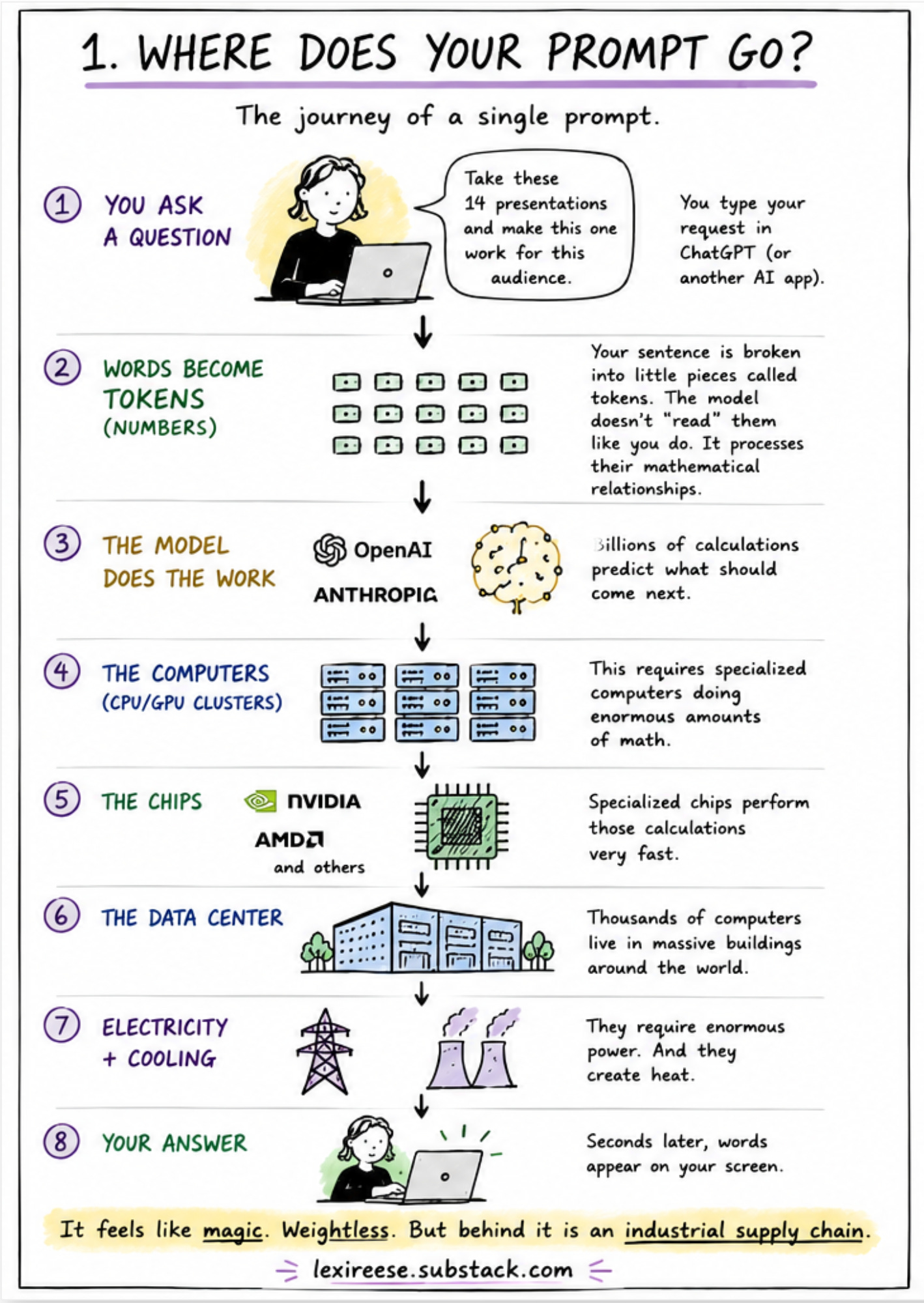
Old software was expensive to build and nearly free to copy. AI is expensive to build and expensive to use. Once Microsoft built Word, selling one more copy cost almost nothing. Every time I ask Claude a question, Anthropic has to pay for the computing power that answers it.
So these companies need enormous amounts of money. Some comes from customers like me and my company. Much of the rest comes from investors betting there will eventually be millions more customers like us, using vastly more AI than we do today.
I can tell you exactly which work AI did for our business last week, which tools contributed, and what it cost. I know because measuring it is my job. My company, Lanai, helps large businesses see all the AI running inside their organization and answer one question: what did you get for what you spent?
Almost nobody can answer that right now.
I kept hearing the same thing on sales calls and I didn’t fully believe it. Executive after executive would tell me AI was transformative, then go quiet when I asked what it had actually produced. I wanted to know whether that was just my sample, so we hired Wakefield Research to ask the question properly. Two hundred people who control the AI budget at companies with 1,000 to 10,000 employees. Not users. The people who sign for it, spending millions and in some cases tens of millions a year. We published the results in an AI Labor Report.
Ninety-two percent said they track AI’s impact. Two percent could name a specific result in revenue or profit.
That gap is why seventy-nine percent of those business leaders said they expect their budget to get cut next year if they can’t close it, because their CFO keeps asking a question they can’t answer: what is all this money we’re spending making better, in dollars we can count?
The technology works. The scorekeeping doesn’t.
And right now, one of the largest building and financial-engineering projects in American history rests on the assumption that businesses will eventually find enough value to keep buying much more.
The revenue itself is real and enormous. OpenAI is running at about $40 billion a year, up 20 percent in a single month.¹ Anthropic crossed $47 billion a year in May, up from $9 billion at the end of 2025.² In August, OpenAI’s finance chief told investors that businesses, not individuals paying $20 a month, now make up more than half of what the company earns. That crossover arrived two quarters early.³ 80 percent of Anthropic’s revenue is already coming from business’ subscriptions and consumption.⁴
So the customer who matters is a company. Small, medium or large, but a company. And that company mostly can't prove the last purchase worked.
This is the tension at the center of the whole AI economy. The companies building AI are planning for vastly more demand. The companies buying AI are still learning how to prove what it is worth.
Which raises an obvious question. If the buyers can't yet show what they're getting, who is confident enough to fund a buildout this size?
Part of the answer is that the people funding this are increasingly the same people selling into it.
Amazon has committed billions to Anthropic while signing Anthropic up to spend more than $100 billion on Amazon’s cloud.⁵ Google has pledged up to $40 billion to Anthropic while supplying chips Anthropic runs on.⁶ Nvidia sells the chips almost everyone uses, owns a stake in a cloud company called CoreWeave, and is obligated to buy $6.3 billion of CoreWeave’s unsold capacity through April 2032.⁷
None of that is illegal. If you make the essential ingredient in the next industrial revolution, helping your customers grow is a reasonable bet. But it means the investor, the supplier and the customer are often the same few companies wearing different hats in the same deal. When everyone’s balance sheet depends on everyone else’s, there isn’t much room for something to go wrong quietly.
The AI companies don’t finance all of this themselves. Increasingly, data centers are being built with outside investment and enormous amounts of debt, sometimes through separate entities created specifically to own the buildings.
Meta is building a data center in Louisiana called Hyperion. Rather than pay for it directly, Meta set up a joint venture with an investment firm called Blue Owl. Blue Owl’s funds own 80 percent of it, Meta owns 20, and together they committed roughly $27 billion in development costs.⁸
Follow that money backward far enough and you reach investment funds, and behind those, pension funds and insurance companies. Ordinary retirement savings are wired into this, invisibly, from the product’s point of view.
There’s a strange twist in that. Pension funds and university endowments put money into venture funds, and some of those venture funds hold stakes in OpenAI and Anthropic. So if you have a public pension or a 401(k), there’s a chance you already own a sliver of two of the most valuable private companies in the world.
Try finding out how much. In any practical sense, you can’t. The holdings sit inside funds inside funds, disclosed quarterly at best and often not at all. If either company ever goes public, it will get written up as a windfall for early investors. Some of those early investors are teachers and firefighters who were never told they were in the deal.
That’s the part I didn’t expect. Draw the whole system and you don’t find yourself at one end of it. You find yourself in the middle, standing in four or five places at once.
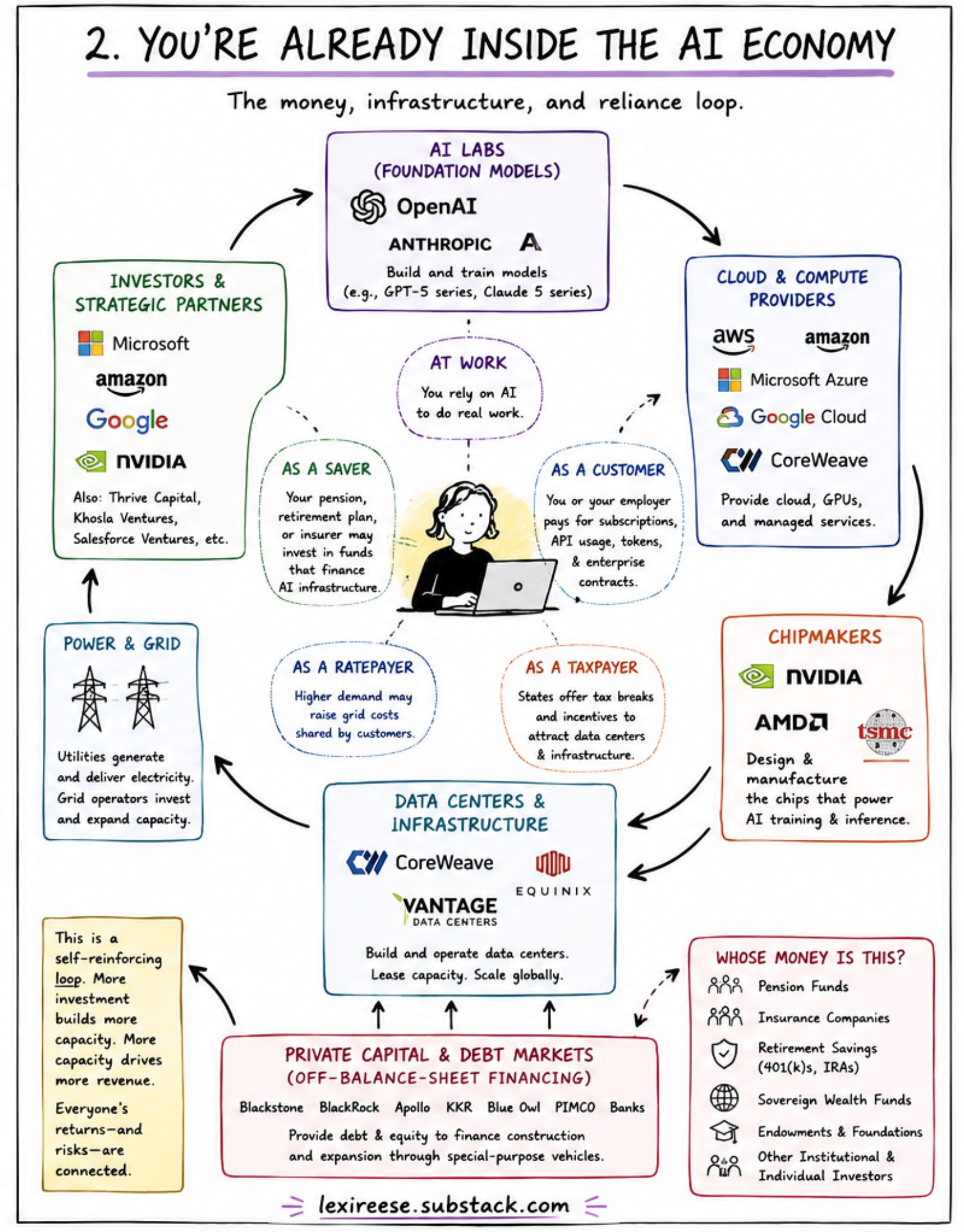
Almost nobody pays for AI just once.
One: the bill. For a company, that’s a charge per employee for access plus a usage charge on top. Think of an old cellphone plan, where the monthly fee covers some amount and “going over” costs more (this is what you may have heard about in the news as token maxxing). This is the payment everyone means when they talk about AI spending, and it’s the only one that shows up as a line item.
Two: your conversations. Here’s the split that matters. Business accounts at both OpenAI and Anthropic are exempt from training by default, because companies negotiated that. Individual accounts aren’t. OpenAI uses chats from ChatGPT’s Free, Plus and Pro plans to improve its next models unless you turn that off yourself.⁹ Anthropic ran the opposite policy for years, then reversed it in August 2025 for Free, Pro and Max users, with business and API accounts carved out.¹⁰ Companies pay the money. Consumers supply the raw material.
Three: your electric bill. PJM runs the power market for 67 million people across 13 states. It has to promise, years ahead, that enough electricity will exist. The price it pays for that promise went from $28.92 to $329.17 per megawatt-day in back to back auctions, and PJM’s own independent market monitor attributed 63% of one year’s increase to data centers. That’s about $9.3 billion, recovered from everyone on the grid.¹¹
Four: your taxes. Thirty-eight states now offer tax breaks to attract data centers.¹² Texas alone is giving up an estimated $1.3 billion this year, up from $1 billion last year.¹³ A watchdog group found four states now losing more than a billion dollars a year each, and 14 states not disclosing the cost at all.¹⁴
Only the first one is a decision anyone makes. Someone who has never opened a chatbot is still paying the other three.
Before you can judge whether that’s a fair trade, you need to understand the size of the bet being made on tomorrow.
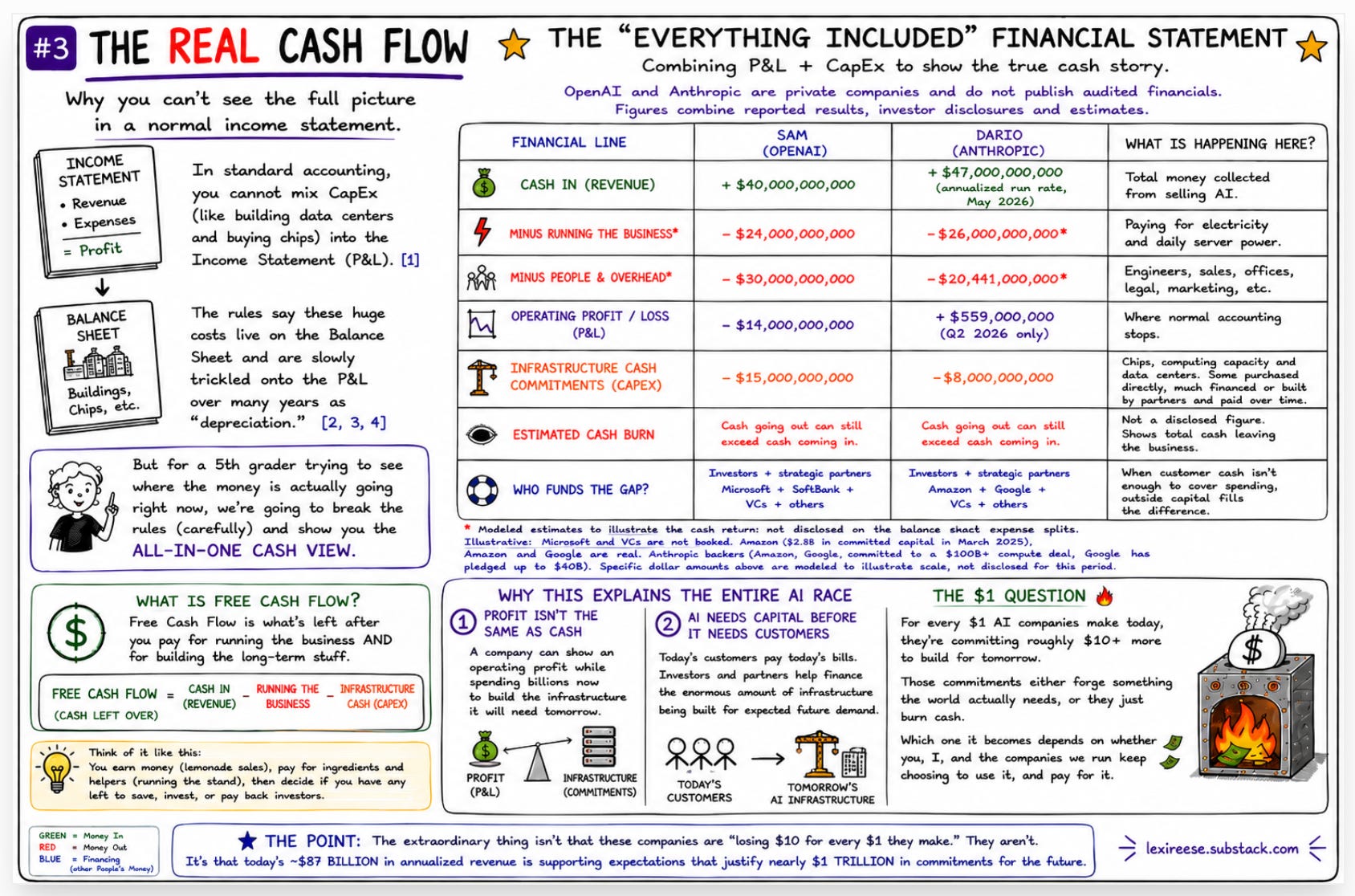
OpenAI and Anthropic bring in tens of billions of dollars from customers today. They are also making commitments measured in hundreds of billions for the computing power they expect to need in the years ahead.
Those are not the same thing as expenses today. If OpenAI signs a contract to buy computing power five years from now, it has not spent that money yet. It is making a bet that future customers will show up to pay for it.
There is a simpler number for judging whether the business eventually works: free cash flow. Forget the accounting jargon. After customers pay you and you pay the cash required to run and build the business, is there money left?
Not yet. Anthropic reportedly expects to become cash-flow positive in 2028. OpenAI expects to get there around 2030.
That does not make either company a bad business. Amazon consumed cash for years while building one of the most valuable businesses in history. Investors will tolerate losses for a long time if they believe those losses are buying something that will produce much more cash later.
So the question is not whether investors will fund losses. They clearly will. The question is what those losses are buying.
There are only a few ways the math gets better. 1) OpenAI and Anthropic can charge us more. 2) We can use much more AI. 3) The cost of producing AI can fall. Or 4) make the product so useful and embedded in our work that leaving becomes painful.
Probably some combination of all four has to happen.
The problem is that competition pushes in the opposite direction. Chinese models such as DeepSeek and Qwen, along with open models and American competitors, are getting better and cheaper.
OpenAI and Anthropic need to make intelligence cheaper to produce, of course. But the race is not just to make AI cheaper. OpenAI and Anthropic have to cut their costs faster than competition cuts their prices.
This is the distinction that matters: AI can become enormously valuable without the companies making the models becoming enormously profitable.
Those future infrastructure commitments either build something the world actually needs, or they build more than the world is willing to pay for. Which one it turns out to be depends on whether companies like mine, and yours, keep choosing to use AI and pay for it.
Which is why the right historical comparison matters.
People reach for railroads when they call this an industrial revolution. Fiber is the better comparison.
In the late 1990s, telecom companies buried enormous amounts of fiber-optic cable across the country, betting internet traffic was about to explode.
Internet traffic did explode.
It just didn’t explode fast enough to cover the loans.
Most of the cable sat dark for years. Global Crossing went bankrupt. WorldCom went bankrupt. The cable eventually got bought for pennies and now carries everything you do online.
The technology was real. The demand was real. The people who financed it still got wiped out.
That is the possibility worth paying attention to with AI. Not that nobody wants it. I want it. I am betting my own company on it.
The question is whether we will want enough of it, soon enough, at prices high enough to justify everything being built around it.
You can watch that math being redone right now. In October 2025, Sam Altman told investors OpenAI had committed $1.4 trillion toward 30 gigawatts of computing power.¹⁵ By February 2026, OpenAI was talking about roughly $600 billion in compute spending through 2030.¹⁶
Those numbers measure somewhat different things, so don’t subtract one from the other. What matters is that the plan changed.
OpenAI can change its plan. The grid can’t change nearly as fast.
An AI company can buy less computing power. A business can cancel Claude. Investors can stop writing checks. A utility cannot unbuild a transmission line. A community cannot take back a power plant once it has been built. Those assets can remain in the system for decades, and depending on how they are financed and regulated, some of their costs can remain with ratepayers even if the expected demand does not arrive.
That’s not a scandal. It’s what it looks like to build a factory before you know how much anyone will buy.
Which is the real risk here, and it isn’t a crash.
Suppose businesses finally measure this properly. Some find the AI is worth far more than they’re paying and buy more. Some find it roughly breaks even. Some find a tool costs more than the work it replaces and shut it off.
Maybe the economy ends up wanting $80 of AI when we built for $100.
AI didn’t fail. We overbuilt.
Those are completely different things.
Fiber did not fail either. The internet won. Some of the companies financing its infrastructure did not.
Look at that list again. Your data, your electric bill, your taxes. Those aren’t purchases. They’re contributions. You’re supplying raw material, absorbing infrastructure risk, and deferring public revenue so a private buildout can happen faster.
That doesn’t make you an investor in the legal or financial sense. But you are contributing something of economic value. Which makes it reasonable to ask whether some of the value created should come back.
I don’t think that’s a radical idea, and it doesn’t require anyone to be angry at Nvidia. It’s a pricing question. We’re contributing three real things to this buildout, often without a clear way to measure what we get back.
We’ve written different kinds of public bargains before, in this exact industry.
In 1936, private utilities wouldn’t run electric lines into rural America. The math didn’t work. Too few customers, too many miles. So Congress lent farmers the money to wire it themselves, and they formed cooperatives to do it. Today nearly 900 electric co-ops serve 42 million Americans across 56 percent of the country’s landmass, and return more than $1 billion a year to their members.¹⁷ Members own them. Members elect the boards. When the system does well, some of the value comes back to the people it serves.
So here’s what I’d build.
Make tax breaks earn their keep. Thirty-eight states offer incentives to compete for data centers. That makes sense. States compete for factories, warehouses and corporate headquarters too. They give up some future tax revenue because they hope to attract billions in investment, construction, jobs and future economic activity that would otherwise go somewhere else.
So measure the trade.
Tie the incentive to what the company promised to bring: investment, jobs, tax revenue or other measurable benefits. If those don’t arrive, the incentive shrinks or disappears.
And states can negotiate for more than jobs. If a giant new customer requires public infrastructure, land, water or other scarce resources, communities can negotiate payments and infrastructure investments too. The goal is simple: if the public contributes value, the public should get value back.
Alaska offers a more aggressive version of the principle, although the economics are different because Alaska owns the underlying natural resource. Oil came out of state land, so the state kept a share of the value and put it into a permanent fund that now pays residents a dividend from the earnings.¹⁹ You can’t simply paste that model onto a privately built data center. But the underlying idea matters: when private enterprise makes money using something the public owns, the public can participate in the value created.
Give ratepayers a way to share in what their bills help build. When PJM raises capacity prices in part because of projected data-center demand, households across thirteen states can end up paying more as the system prepares for that demand. Those payments support infrastructure with lives measured in decades.
The first priority should be making data centers pay the costs they create. But when public or customer money genuinely finances assets that go on producing revenue, there is nothing radical about asking whether some of those returns should flow back through lower rates, credits or customer ownership. Municipal and cooperative utilities already provide versions of that model. Nebraska is the only state where every electric utility is publicly or customer-owned.²⁰
Price the data. This one is harder. Business accounts are exempt from training because companies negotiated that protection. Individuals often have to find the setting themselves. Their conversations can become raw material that improves a commercial product.
At minimum, that should be opt-in rather than opt-out. But eventually we may have to ask the harder economic question: If millions of people’s data contributes measurable value to a commercial model, is privacy control enough, or should some of that value flow back to the people who supplied it?
The machinery for doing that barely exists. That doesn’t make the question ridiculous. Twenty years ago we barely understood that our social-media data had economic value at all.
The objections to all of these ideas are valid. States compete with one another. Make a data center too expensive in Virginia and it may go to Texas. Co-ops move slowly. Utilities have to build before demand arrives. Measuring the value of one person’s data may be nearly impossible.
But those are arguments about how to structure the return, not whether the public should ever participate in one.
Because the arrangement we should avoid is the simplest one: socialize the inputs and privatize all the upside.
If taxpayers give something up, measure what came back. If ratepayers finance something, make sure the costs and benefits are allocated fairly. If people’s data creates commercial value, at least give them meaningful control over the transaction, and keep asking whether control alone is enough.
AI may create an extraordinary amount of new wealth. The question isn’t whether companies should be allowed to make it. Of course they should.
The question is whether the people supplying some of the ingredients can make some money too.
Social media taught us this lesson backward.
We fell in love with the product first. Only later did most of us understand the business underneath it. Our attention generated advertising revenue. Our behavior produced data. Recommendation systems learned how to keep us there.
The lesson was not that social media was fake. It was that we should have understood the bargain earlier.
We have another chance with AI.
I think AI is a better bargain. I’m not trading forty minutes for dopamine. I’m trading money for productivity, and right now I like the trade.
But the little box hides almost everything required to make it work. The money. The chips. The buildings. The electricity. The water. The financing. The tax incentives. Even the question of whether the work it produced was worth what we paid for it.
That is what I mean by reading the label. Not that every cost is bad. That every trade should be visible enough to judge.
Here are four things you can do that don’t require waiting for policy to change:
Buying AI for a company? Stop reporting usage. A vendor telling you “85 percent of your team logged in” is describing attendance, not results. If you’re buying AI to do work, you should know what the work produced so you can decide whether to stop / start / edit your investment strategy. Full disclosure: this is close to what my company sells, so weigh it accordingly and msg me if you want real help on this one.
Using AI at home? Check your training setting. Ninety seconds, no committee, no procurement call. OpenAI keeps it under Settings, Data Controls.⁸ Anthropic calls it the model training setting, under Settings, Privacy.⁹ Business accounts at both companies are exempt by default, because the companies paying real money negotiated that for themselves. Individual accounts are opted in. Getting the same deal takes one click, but only if you know to go looking for it.
Live near a proposed data center? Ask what the community is giving and what it is getting back. What is the tax break worth over its full term, not just year one? What investment, jobs or other benefits did the company promise in return? And what happens if the facility closes early or never delivers what it promised? Fourteen states can’t even tell you how much revenue they are losing to these incentives.¹³ That isn’t a small accounting problem. It makes it impossible to know whether taxpayers got a good deal.
Investing? Watch renewals, not signups. Anyone can post a user count by discounting hard in year one. Signups measure curiosity. Renewals measure whether the tool earned its keep once someone had to approve the invoice again. And watch free cash flow. Revenue tells you people want the product. Free cash flow eventually tells you whether selling it is a sustainable business.
All of this requires one habit: ask what you got for what you spent, all the way down the chain.
I’m going to keep using AI. Tomorrow morning I’ll co-work with Claude and get somewhere faster than I could have on my own. But I won’t use the time I save to stop working. I’ll use it to ask a harder question, test another idea, make the work better, or attempt something I wouldn’t have had the capacity to do before. AI doesn’t just make me faster. It expands what I, and everyone in our company, can take on.
But now I know better what’s underneath that expanded capacity. A data center financed partly by somebody’s pension. A power grid building years ahead of demand. A state giving up tax revenue to win the investment. Each is a bet on the next, and the bets are enormous.
None of that makes the value less real. It just means the value isn’t created by me and Claude alone. There’s a whole chain underneath us, supplying the ingredients that make it possible.
The magic is real. So is the factory behind it. This time, we know the ingredients. The question is whether everyone helping supply them gets a fair share of the value they create.
If you liked this, please share and comment!
¹ Data centers consumed about 415 TWh in 2024, roughly 1.5 percent of global electricity, projected to reach about 945 TWh by 2030, just under 3 percent, and slightly more than Japan’s current total consumption. Nearly half of US data center capacity sits in five regional clusters. International Energy Agency, “Energy and AI.”
² OpenAI’s revenue run rate topped $40 billion in July 2026, an increase of roughly 20 percent from June, ahead of its planned IPO. Bloomberg; confirmed independently by CNBC. CFO Sarah Friar told employees in July that the month’s annualized revenue run rate had already exceeded all of the second quarter. CNBC
³ Anthropic states its run-rate revenue crossed $47 billion in May 2026. Anthropic newsroom; reported by Reuters. The $9 billion end-of-2025 figure is from Bloomberg. Aggregated at Sacra.
⁴ OpenAI CFO Sarah Friar, quoted directly: “We entered the year at 60-40, but enterprise has accelerated much faster than expected and those lines have now crossed... The majority of our revenue is now enterprise.” CNBC
⁵ Approximately 80 percent of Anthropic’s revenue comes from enterprises. CNBC Davos coverage; aggregated at Sacra.
⁶ Anthropic is committing more than $100 billion over ten years to AWS. Anthropic. Confirmed by Reuters and AP.
⁷ Google to invest up to $40 billion in Anthropic in cash and compute: $10 billion now at a $350 billion valuation, $30 billion contingent on milestones. TechCrunch, April 24, 2026.
⁸ Nvidia is obligated to purchase up to $6.3 billion of CoreWeave’s unsold cloud capacity through April 13, 2032. Primary source: CoreWeave Form 8-K, SEC, September 15, 2025. Reuters.
⁹ Meta and funds managed by Blue Owl Capital formed a joint venture to develop the Hyperion campus in Richland Parish, Louisiana. Blue Owl funds own 80 percent, Meta 20, with approximately $27 billion in total development costs. Blue Owl contributed roughly $7 billion in cash; Meta received a one-time $3 billion distribution. Meta investor relations, October 21, 2025. Also CNBC.
¹⁰ OpenAI Help Center, “How your data is used to improve model performance.”
¹¹ Anthropic, “Updates to Consumer Terms and Privacy Policy,” August 28, 2025. Applies to Claude Free, Pro and Max, not to Claude for Work, Claude for Government, Claude for Education, or API use. Existing users had until October 8, 2025 to choose. Also TechCrunch.
¹² PJM’s capacity price rose from $28.92 to $329.17 per megawatt-day between the 2024/25 and 2026/27 auctions. PJM’s independent market monitor, Monitoring Analytics, attributed 63 percent of the 2025/26 auction increase to data centers, or $9.3 billion recovered from ratepayers. Utility Dive. Note: a later 2026/27-cycle auction reported in July 2026 shows a different attribution (38 percent of that auction’s $16.4 billion in charges). The 63 percent figure is accurate for the auction described.
¹³ Anthropic, “Covering electricity price increases from our data centers,” February 11, 2026. Also Reuters and Data Center Dynamics.
¹⁴ Microsoft announced a policy to keep data center electricity costs off residential customers on January 11, 2026; OpenAI made a similar commitment on January 26. Both are documented in TechCrunch’s roundup of ratepayer commitments. (Add the specific TechCrunch URL.)
¹⁶ Texas projects annual losses rising from $1 billion in FY2025 to $1.3 billion in FY2026, with five-year losses potentially reaching $9 billion. Good Jobs First; Texas Tribune, April 8, 2026, citing Texas Comptroller data.
¹⁷ Fourteen states do not disclose revenue lost to data center tax breaks. Four states now exceed $1 billion annually: Georgia ($2.5 billion projected FY2026), Virginia ($1.94 billion FY2025), Texas, and Ohio. Good Jobs First, “Even Cloudier with a Greater Loss of Spending Control.” Reported by Stateline.
¹⁸ Sam Altman told investors OpenAI had committed $1.4 trillion toward 30 gigawatts of computing power. Reuters, October 29, 2025.
¹⁹ CNBC, “OpenAI resets spend expectations, targets around $600 billion by 2030,” February 20, 2026.
²⁰ The Rural Electrification Act was signed in 1936. Today nearly 900 electric cooperatives serve 42 million people across 56 percent of the nation’s landmass, and return more than $1 billion annually to consumer-members. NRECA, “Electric Co-op Facts & Figures.”
²¹ REI Co-op, “About Us.” REI’s February 2025 impact report cited 24 million members; the co-op now reports over 25 million.
²² Alaska voters approved a constitutional amendment establishing the Permanent Fund in November 1976 by a margin of 75,588 to 38,518. Alaska Permanent Fund Corporation. The dividend program was enacted in 1980 and first paid in 1982.
²³ Nebraska is the only U.S. state where 100 percent of electric utilities are publicly or customer-owned. The Nebraska Legislature’s own research office states directly: “Electricity in Nebraska is supplied to consumers by customer-owned not-for-profit entities, including public power districts, cooperatives, and municipalities. We are the only state where this is true.” Nebraska Legislature, Legislative Research Office. Also stated directly by Nebraska Public Power District: “Nebraska is the only state served 100% by publicly-owned utilities.”
Survey data. The AI Labor Report, conducted by Wakefield Research for Lanai among 200 leaders with AI budget ownership at companies of 1,000 to 10,000 employees. Ninety-two percent track impact, 2 percent can name a specific revenue or profit result, 79 percent expect budget cuts absent better measurement.
Comments
Nothing yet. Say the first thing.
Sign in to join the conversation.