
Gm Fintech Architects —
I recently wrote a market view for LPs of Generative Ventures and completed our 2Q review of the entire AI & Robotics financial value chain.
This is a substantial amount of research work to get a sense for where fundamentals are beyond the market stories. A macro view that points to where we should all hunt.
Summary: We review the $25.3T machine economy and find that value is shifting from speculative narratives toward infrastructure and applications with measurable revenue. Physical bottlenecks are driving outsized returns, with Micron up 166%, while AI software increasingly trades on proof that adoption converts into revenue. Financial infrastructure is converging around regulated rails as Stripe, Visa, AWS, Coinbase, and others build the payment and identity stack for autonomous agents, even as related tokens fell 23%. We argue that the next phase of value creation sits downstream in AI applications and services, while crypto increasingly succeeds as invisible infrastructure for programmable money rather than a speculative asset class. Across the stack, the winning businesses are increasingly those that control scarce resources, distribution, proprietary data, or the ability to charge for machine activity.
Thanks as always for your time and attention,
Lex
To support this writing and access our full archive of newsletters, analyses, and guides to building in the Fintech & DeFi industries, see subscription options below.
Generative Ventures | AI Research | Robot Money | Linkedin & Twitter | Sponsors
🚀 Lex is actively meeting teams building machine-native financial companies. If that’s you, reach out here.
🦄 In partnership with InterPrivate, we just launched a $200MM SPAC looking for targets in fintech, digital assets, and AI infrastructure. If you are a late-stage founder or have an idea to discuss, reply directly to this email.
We continue to be in a risk-off regime for speculative crypto assets.
While some financial services and fintech stocks have performed well, generally the category is trading sideways, and is indexed to revenue and fundamentals while the rest of the markets boom in response to the war song of futurists.
For the major crypto assets, BTC has been floating around a $60,000 floor and ETH around $1,800 for a substantial amount of time. This is a function of the macroeconomic drivers of money supply (interest rates continue to be flat or up, thereby constraining speculation), alternative investment categories for high-risk investors (AI stocks, prediction markets, perpetuals), and a hang-over after the boom and bust cycle of digital asset treasuries from last year.
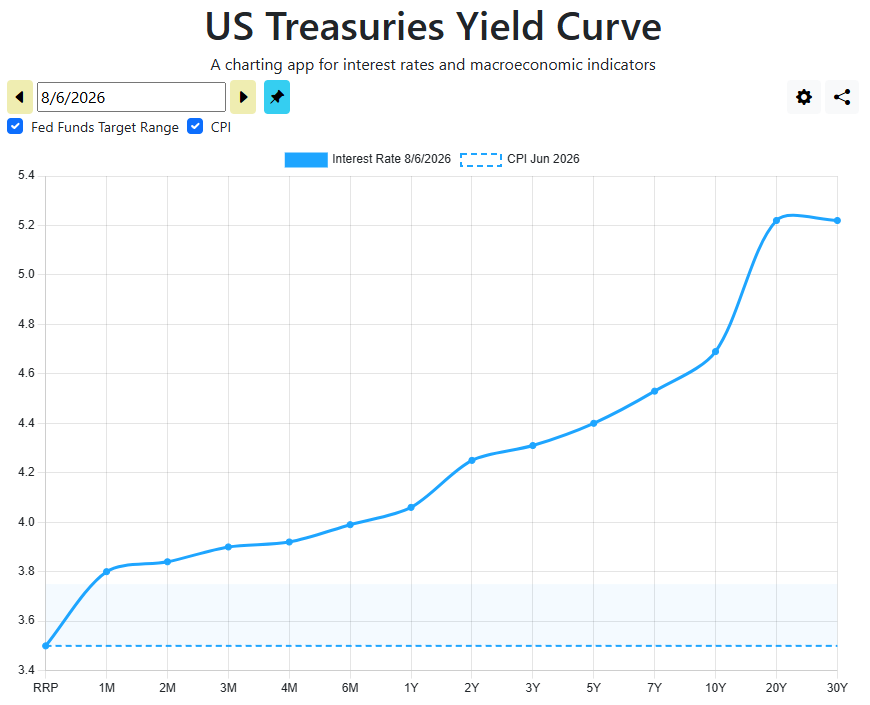
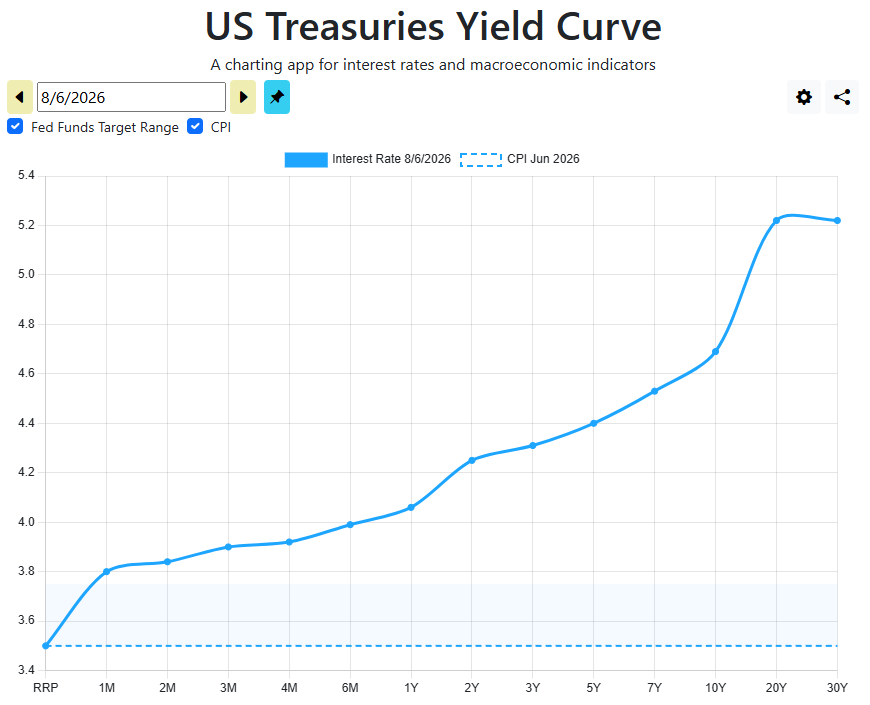
Source. CPI at 3.4% and higher rates expectation in the future implies contraction of economy and asset prices The best crypto-native assets are the ones that most resemble securities with active financing engineering – high revenue companies that perform ongoing buy-backs of their tokens (e.g., Hyperliquid), or projects that project the capability to do so. This creates large embedded regulatory risk, which is for the moment overlooked by the US executive branch, and may be lowered through legislation.
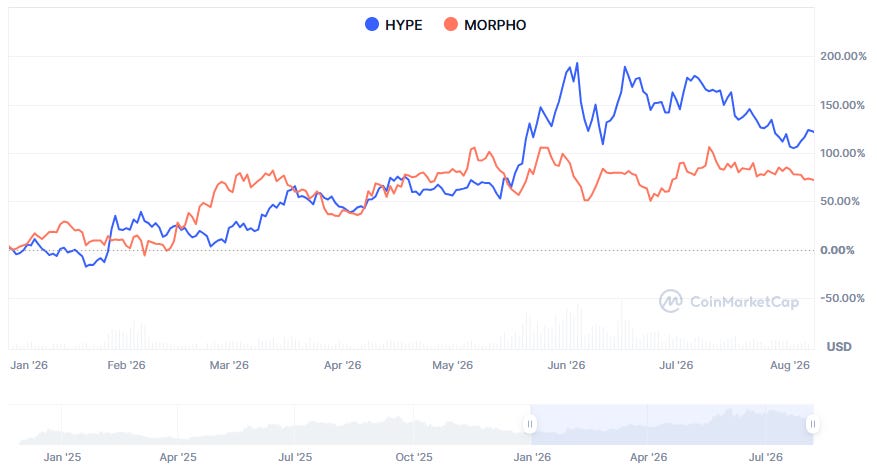
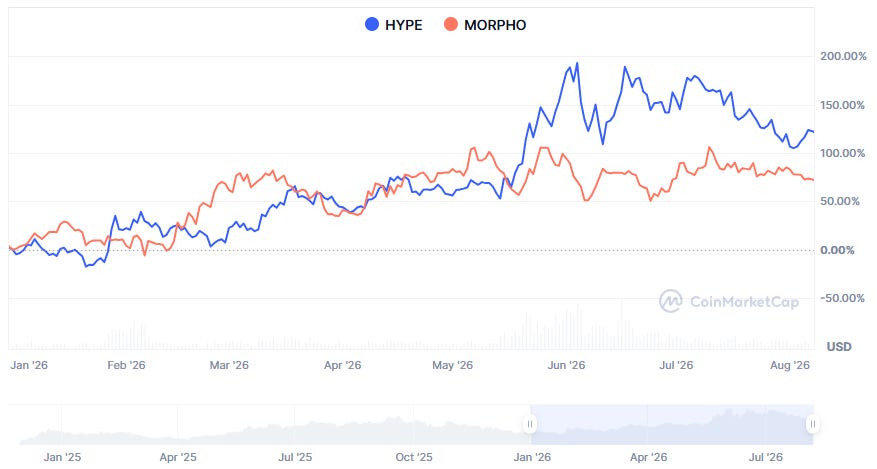
Source. Both Hyperliquid and Morpho generate revenues and are token-first
The positive story lies in the fundamental adoption for programmable money used by machines.
We see Web2 Fintechs distributing tokenized dollars, stocks, and treasuries and abstracting away from anything that feels too crypto-native. Given the last crypto cycle gave us memecoins and pump.fun, that is a pretty good idea.
Enterprise chains are still an attention and resource drag from large public networks. Within payments, there is a continued push from Stripe around Tempo; for digital assets at large financial firms, this function is served by the Canton network. Looking at Web2 fintechs, Robinhood has recently launched its proprietary EVM chain, which brings them further into symmetry with Coinbase and Binance. The positive from this is an increasing flow of tokenized assets and software primitives into these intermediate venues.
Simultaneously, asset managers continue to transition their treasury funds and private credit products into RWAs. There is material demand in the market for access to tokenized stocks and other traditional products. From perpetuals on private pre-IPO companies on Hyperliquid, to GPU-price derivatives on Architect, we are seeing capital markets start to meld together with crypto infrastructure.
The machine economy value-chain continued to become increasingly valuable, with much of the infrastructure trade concluding with Leopold’s spectacular levered blow-up.
People think that other people think that the AI datacenter build-out is expensive and financially irresponsible, which will generate cracks in its circular revenue model. In theory, this will push the industry downstream towards applications – things that users actually buy.
Power (e.g., nuclear, fusion), memory, and chips continue to benefit from the hyperscaler competition to be the best AI lab. Investors who owned public and private assets that were in the AI value chain have already benefitted, and we think current investment is a lagging indicator. The key metrics to watch are around debt and the ability of industry players to make Blackstone and Apollo whole.
We think the long-term meat is in applications, and that those are just in the early innings. Those would be chat from OpenAI, image generation from MidJourney, music from Suno, code generation from Cursor, and now video collateral is next. Additionally, the middleware of harnesses is having its moment in the sun – we think there is incredible potential, but it is a short-term trade. Previously we would have called the category orchestration, and highlighted the fashion churn from Olas, to Virtuals, to OpenClaw, Hermes and so on.
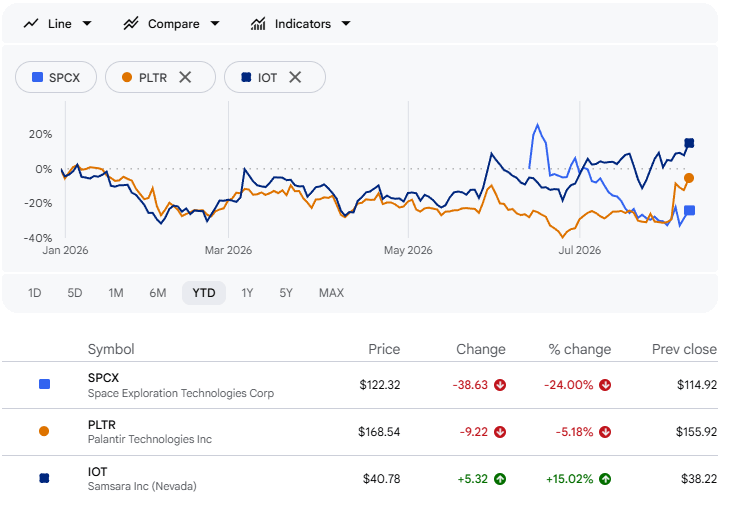
Source. A handful of direct AI application exposure companies. AI services companies are an interesting category, though we think multiples will compress. Both Anthropic and OpenAI have committed hundreds of millions in capital to partnering with private equity firm to deploy AI services digital transformation. Palantir is the success case; whether this is repeatable across the economy is a profound bet that much of the market is making. Anthropic has dethroned OpenAI by following through on this exact premise and emphasizing AI for work rather than AI for each person.
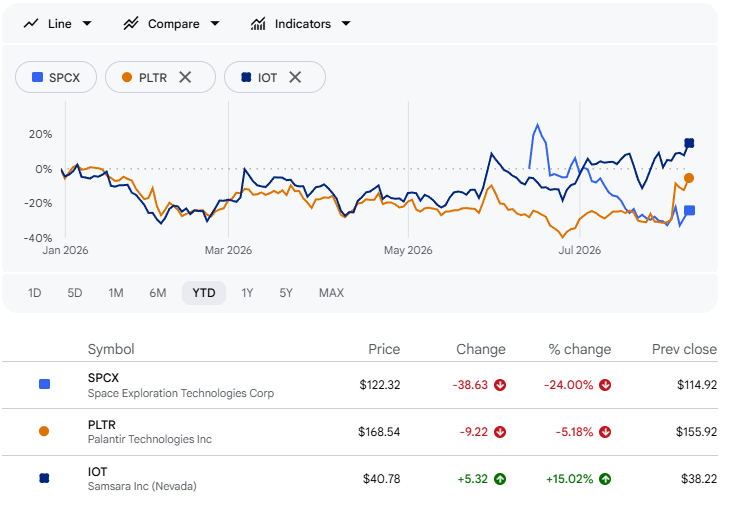
Our portfolio has generated unique barbell strategy exposure: (1) on the one hand, we hold various token-first financial applications and decentralized GPU protocols, and on the other, (2) we have invested in equity-first stablecoin, fintech, and data businesses. This has allowed us to de-risk some of the exposure through early DPI, while still holding material upside to long-duration themes that require digital markets to mature.
We continue to look at deals largely through the lens of commercial demand and fundamental traction, de-emphasizing narratives of retail participation and decentralization until the markets digest the current AI boom. There remains enormous opportunity in designing financial systems in a world with endless high-powered intelligence built into every corner of the Internet, where digital dollars are trivial to summon, program, and spend. This economic shift is too big to ignore or mistake for a short-term tactic, and we continue to back talented entrepreneurs who are able to get things done.
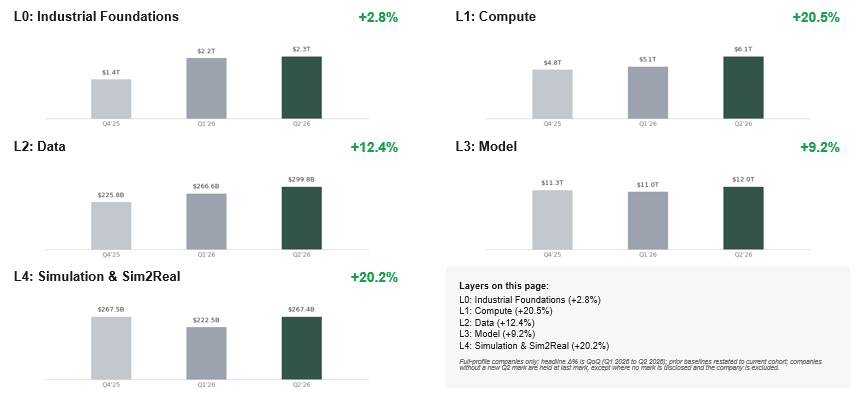
We also crunched the numbers for the third quarterly edition of the AI & Robotics Encyclopedia.
For premium subscribers, we highlight the changes across each layer of the machine economy and provide the report download link.
Comments
Nothing yet. Say the first thing.
Sign in to join the conversation.