
Hi Fintech Futurists —
Elon Musk launched the product he set out to build in 1999.
X has begun rolling out X Money to US Premium and Premium+ subscribers, bundling a 6% APY cash account, a 3% cashback Visa debit card, and free instant transfers between X accounts. The benefits are aggressive and land at an interesting moment for the social media app.
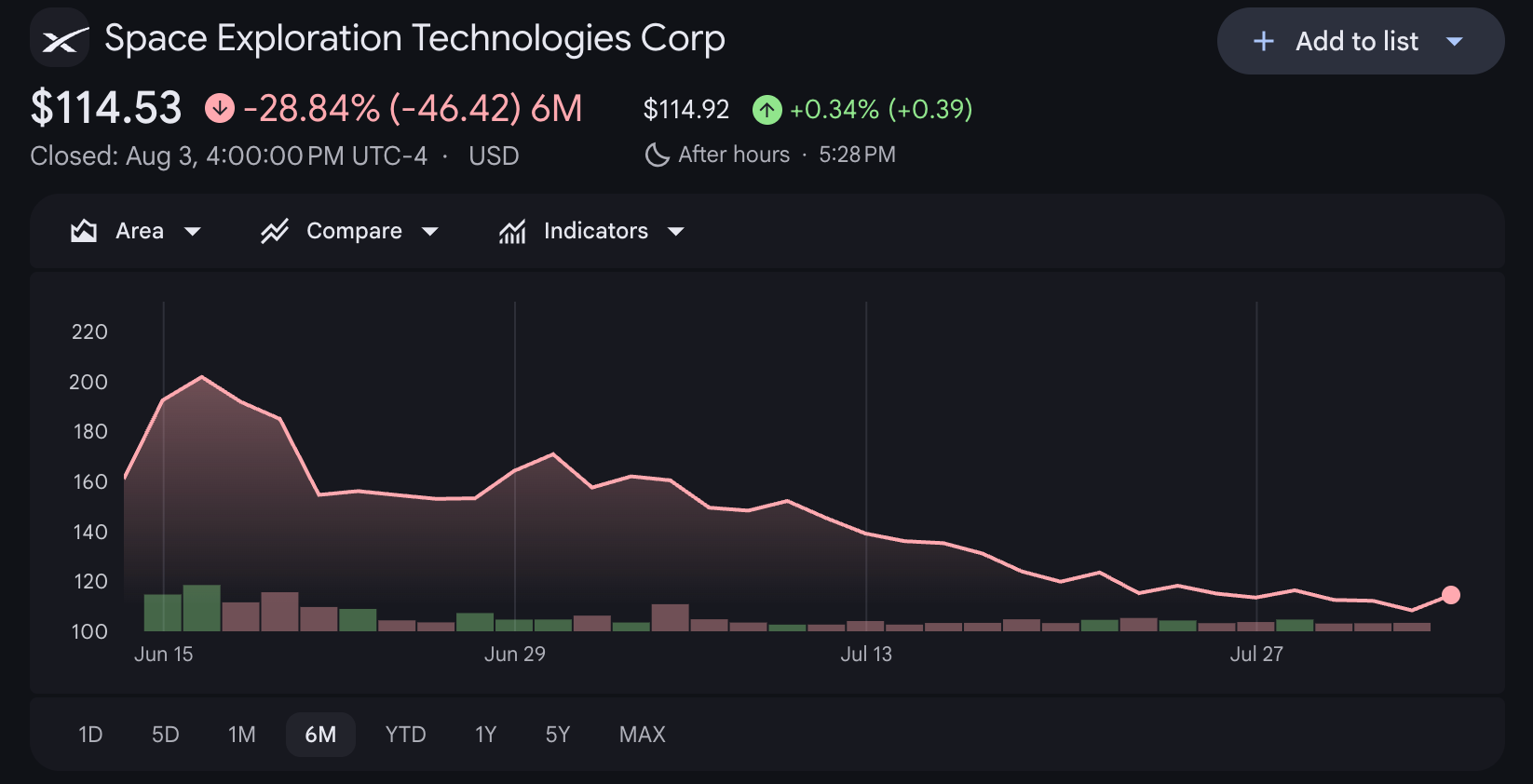
X now sits inside SpaceX, down ~30% since IPO, and valued at $1.51T.
This week we look under the hood of X Money, analysing the opportunity, the chosen financial stack, and the strategy to convert 550M users to banking.
FINTECH: Can Elon Musk convert 550M X users to banking?
ANALYSIS: Stripe’s $10B OpenRouter Bid and the AI Value Chain
CURATED UPDATES: Paytech, Neobanks, Lending, Digital Investing
To support this writing and access our full archive of newsletters, analyses, and guides to building in Fintech & DeFi, subscribe below (if you haven’t yet).
Paired with the MiCAR licence from the AFM, ZeroHash now has the two authorisations required for regulated E-Money Token flows across the EEA.
One integration. Both rails.
Fiat, stablecoin and crypto activity now sit under one regulated roof in the EEA—meaning fewer counterparties and simpler reconciliation. It’s the same regulatory depth that brought BlackRock, Morgan Stanley and Worldpay to zerohash in the U.S., and is now live across Europe with Interactive Brokers.
$65B+ settled. 7MM+ end customers. A DNB authorisation carries weight that a CASP-only licence doesn’t—closing a critical regulatory gap for our customers.
Read the full announcement here. And if you are mapping a digital asset roadmap in Europe, check out more information below 👇
X (formerly Twitter) remains one of the largest social media companies in the world.
The app reported 550MM monthly active users doing approximately 350MM posts every day. But the core business now sits inside Elon’s sister business xAI, which acquired X in March 2025. SpaceX in turn acquired xAI in February 2026, folding the platform into a company now worth a combined $1.5T.
The SpaceX S-1 doesn’t describe X as a media asset at all.
Instead, it’s the “foundational distribution and data engine” for Grok, supplying a real-time stream of daily posts that the company argues sharpens the model’s freshness and contextual awareness. The logic runs as follows: X feeds Grok, Grok makes X more useful, and a more useful X is one users will pay for.
X Money is the newest attempt to increase monetization by molding X into an “Everything App” that the filing explicitly says will span payments, banking, and commerce.
This comes amidst a steady shift away from advertising income and towards subscriptions. In 1Q26, advertising revenue on X annualised to $1.37B down -40% since 2023. Meanwhile, subscriptions (a major part of the AI solutions & infrastructure line item) posted consistent growth in the same period. In 2025, subscription revenues grew by $365M.
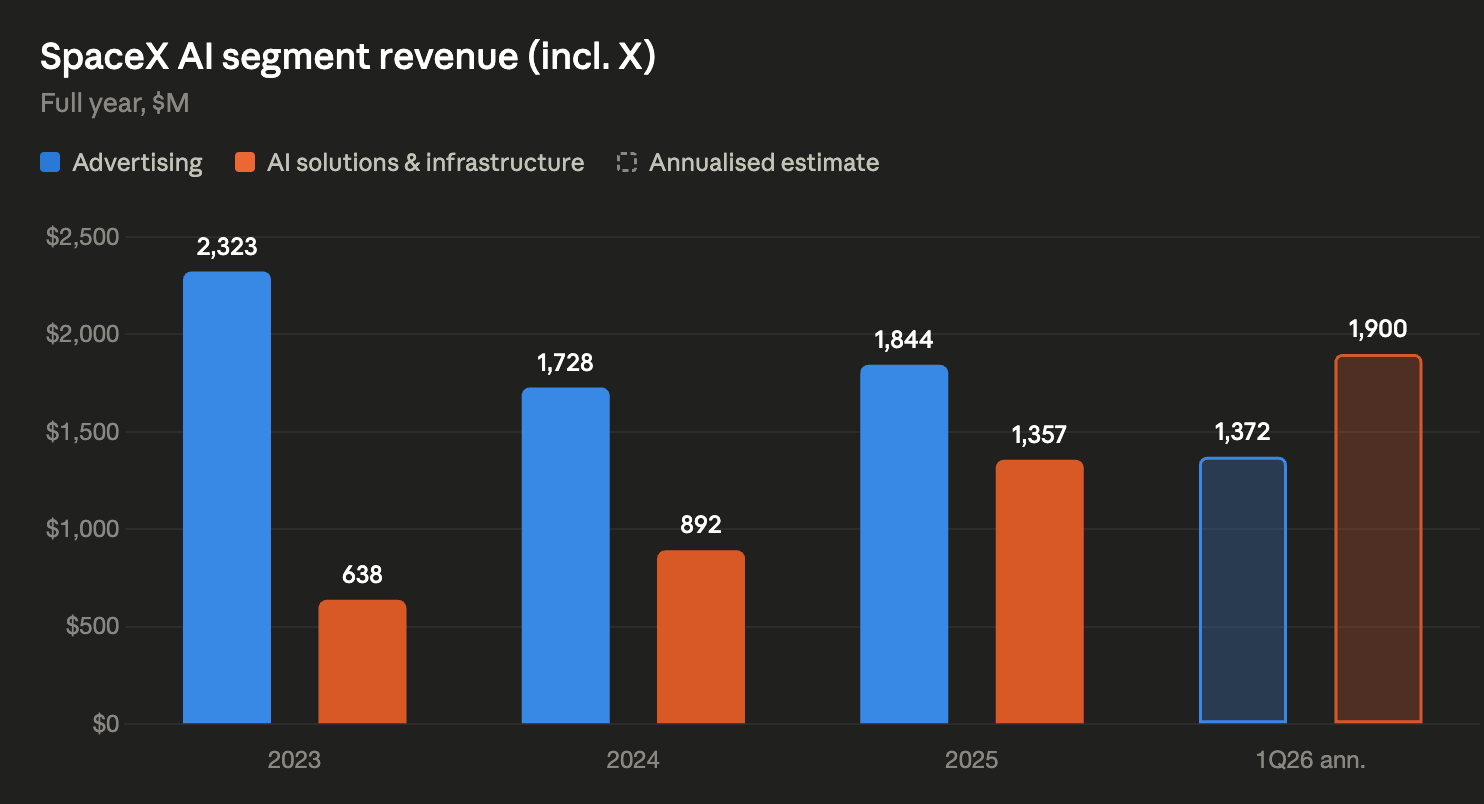
This suggests that the company is replacing the ad business with a subscription-led model; which is where X Money fits in. The service is only available to Premium and Premium+ subscribers, which account for 4.4MM, or 0.8%, of 550MM total users. The strategy is to offer aggressive benefits for X Money that entice more users to subscribe to the Premium and Premium+ offerings.
X Money isn’t a bank itself, but uses Cross River as its partner to hold deposits and provide FDIC insurance. This is the same partner bank model behind Chime, Cash App, and Klarna, and it carries the same trade-off: lighter regulatory obligations in exchange for splitting the economics with the institution that holds the charter.
That makes the 6% yield a particularly expensive benefit. A dollar sitting at Cross River cannot earn much more than the risk-free rate of ~3.5% before anyone takes a cut. Even if X captured the entire spread, it would still be roughly 235bps short of what it has promised depositors. Assume Cross River retains a typical share and the shortfall widens toward 400bps.
The cashback works the same way. Cross River sits below $10B in assets and is therefore exempt from the Durbin cap, which lets it earn unregulated interchange of roughly 1.1-1.2% of transaction value. That’s less than half the 3% X is handing out on cashback.
So the subscription is the likely funding source. The 6% yield is only available for Premium+ subscribers that pay $40 a month, or $480 a year, which covers a 4% yield gap on ~$12K of deposits. But users will run through the budget quickly when accounting for cashback as well.
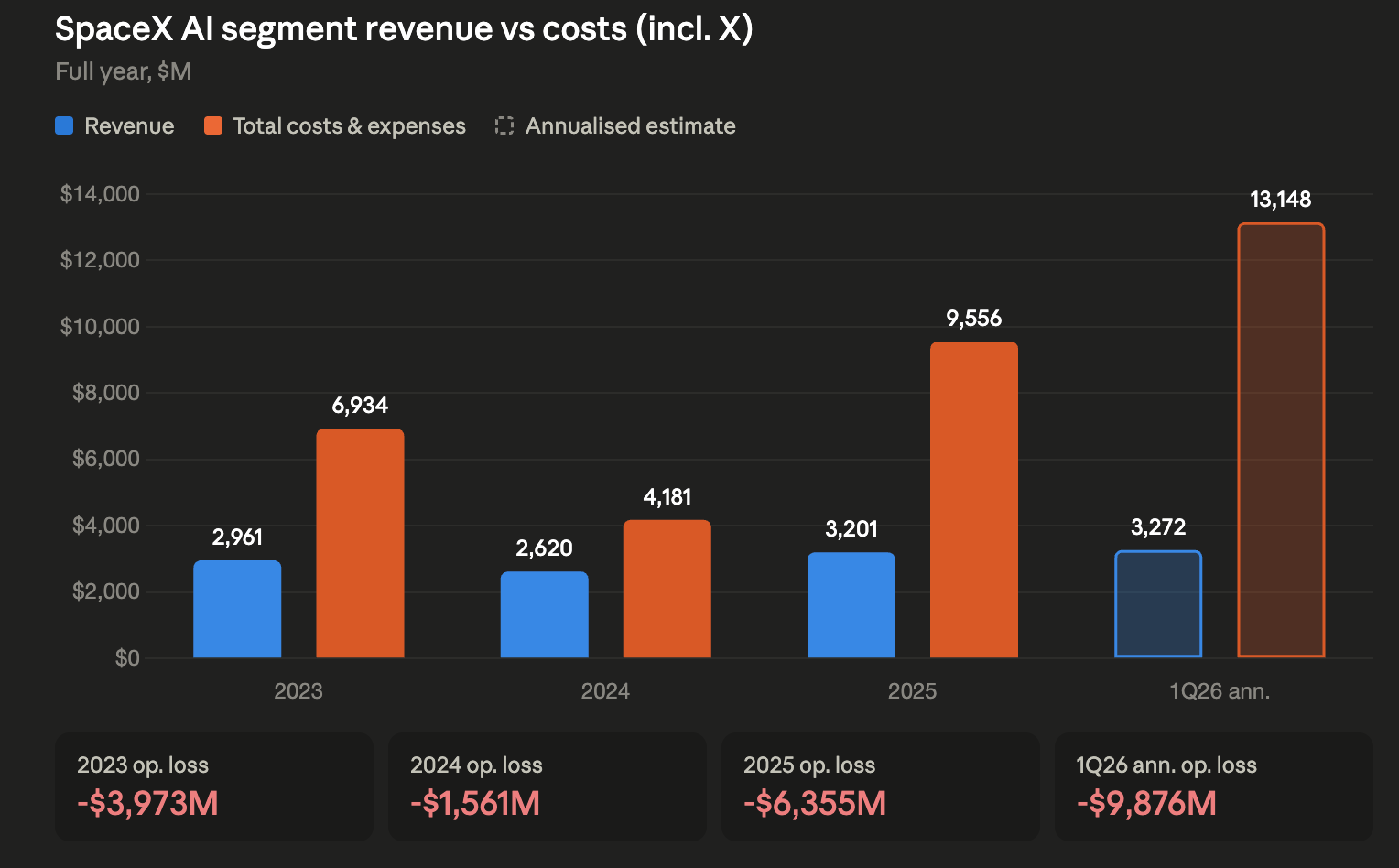
Our guess is that Elon is happy to run this at a loss. Even at $1B in deposits in X Money, a few hundred basis points is a blip in the $2.5B loss the entire AI segment posted in 1Q26.
The economics improve materially if X eventually secures its own charter and makes the full 3.5% risk-free rate. Applications are at multi-year highs under the current administration with Revolut, Klarna, and Nubank applying. Crypto firms like Circle and Coinbase are also pursuing narrower trust licenses.
We covered the boom in detail earlier this year.
Zooming out, X Money is part of a broader trend of technology firms beginning to compete in banking. The increase in global interest rates after the pandemic has significantly expanded banking margins; in turn enabling the frontier neobanks to break out into profitability.
McKinsey’s annual banking review displays this dynamic neatly below.
This has attracted a new type of challenger whose core business is often removed from traditional banking but sits close to idle customer funds. Robinhood is a good example where its core business is retail equities trading but significant idle cash balances first led to the creation of a Cash Sweep program ($45M revenue in 1Q26) and more recently a wider stablecoin banking strategy.
Similarly, crypto firms have begun aggressively pursuing the banking opportunity on blockchain rails following clearer stablecoin regulation. Many of these firms originated as blockchain networks, trading platforms, or staking infrastructure.
One risk for X Money and this new paradigm of neobanks is that they are too removed from a customer’s finances to build durable underwriting engines, which could hinder growth.
In 2019, Apple’s similar foray into credit in partnership with Goldman Sachs, which led to a total of $7B in losses by 2025. Loss rates on loans spiked to 6.2% due to poor underwriting and the portfolio was sold to JP Morgan earlier this year.
Time will tell whether X Money can build a sustainable banking business. But subscribers have ample room for growth and supercharging the trajectory is likely to be a worthwhile goal for SpaceX.
👑 Related Coverage 👑
Generative Ventures | AI Research | Robot Money | Linkedin & Twitter | Sponsors
🚀 Lex is actively meeting teams building machine-native financial companies. If that’s you, reach out here.
🤖 AI & Robotics Industry Encyclopedia: In this 100+ page report, we collate all the meaningful companies across public quities, private equity, and digital assets related to the machine economy. 👉Learn more here
🦄 In partnership with InterPrivate, we just launched a $200MM SPAC looking for targets in fintech, digital assets, and AI infrastructure. If you are a late-stage founder or have an idea to discuss, reply directly to this email.
We connect three seemingly unrelated events — the $7B acquisition of Wealth Enhancement Group by Bain and Carlyle, Mariner’s deployment of 700 AI employees through Humanity Labs, and Stripe’s reported $10B bid for OpenRouter — into a single AI value chain.
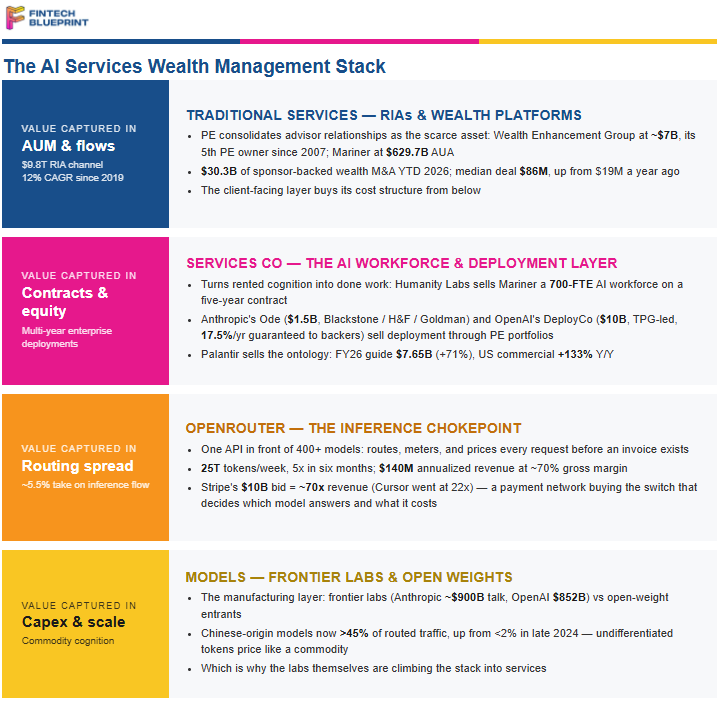
We argue that wealth managers own distribution over $10T of client assets, AI services firms are rebuilding enterprise cost structures through large-scale workflow automation, and inference platforms are commoditizing intelligence by routing demand across competing language models.
Here are the rest of the updates hitting our radar.
⭐ Stripe’s New Stablecoin Bet: Open USD - Forrester
MetaMask launches Money Account - Coindesk
Airwallex hits $11 billion valuation with $320 million raise - CNBC
⭐ Elon Musk’s ‘bank’ is live - American Banker
Revolut to launch in UAE - Bloomberg
Rain Launches Rewards Loyalty Capability - Finovate
Plaid Launches Sequential AI Model - Fintech Finance
Visa Cards for AI Agents - Forbes
Barclays to buy GoHenry kids’ debit card and money app - The Guardian
Coinbase is launching AI tools that give investment advice - Yahoo Finance
SpaceX stock tumbles 16.4%, shaving off most IPO gains - Yahoo Finance
Join our Premium community and receive all the Fintech and Web3 intelligence you need to level up your career. Get access to Long Takes, archives, and special reports.
Sponsor the Fintech Blueprint and reach over 200,000 professionals.
👉 Reach out here.Check out our AI newsletter, the Future Blueprint, 👉 here.
Read our Disclaimer here — this newsletter does not provide investment advice
Comments
Nothing yet. Say the first thing.
Sign in to join the conversation.