
[The well-known bassist Ron McClure is my friend and neighbor on the Upper West Side of Manhattan. He worked for years on a memoir full of candid and entertaining tales of his life and his experiences with Monk, Wes Montgomery, Dave Liebman, Sarah Vaughan, and many, many others. I took on the task of editing the book, and it is now a completed 724-page PDF titled Bass In Time, richly illustrated from Ron’s own photo collection, plus posters and news clippings. Among the many positive responses, guitarist and composer Jarno Kukkonen in Helsinki writes, “I can’t think of any biography as interesting as this!” The PDF is available for $20 by writing to Ron at: mcjolt@icloud.com Please write before sending payment.
Below is a story that is not in the book—kind of a bonus chapter. Based on Ron’s description, this was most likely Davis’s Birdland gig on January 2 through 15, 1958. Coltrane had just rejoined Miles, and Cannonball Adderley is believed to have been there for at least part of this engagement. Also, in those days there was always another group alternating sets with the “headliner.” But Ron has no memory of Adderley or the other band. Here’s Ron:]
Seeing Miles Davis and Meeting Coltrane
by Ron McClure
When I was a teenager, my friends from New Haven and East Haven, Connecticut, saxophonist Tommy Brasile and drummer Mike Marinelli, decided to go to New York City on the New Haven Railroad to hear the Miles Davis quintet at the original Birdland. This was at 52nd Street and Broadway, in the basement. At the door, we were greeted by “Pee Wee” Marquette, the legendary host who was under four feet tall. Being minors, we were escorted to what was commonly known at that time as the “Peanut Gallery,” a designated area to the right of the bandstand, next to the great “Philly” Joe Jones, Miles’s drummer, to Mike’s delight. Tommy was a tenor saxophonist of considerable repute, even at the age of 16. He had mastered the sound and musicality of both John Coltrane and Johnny Griffin, two of the leading tenor saxophonists on the planet at that time.
I honestly don’t remember Red Garland on piano. I was focused on the great Paul Chambers on bass. I had recently started to play in the North Haven high school band after being convinced to put down the accordion and learn to play the bass. I was persuaded that that would be the gentlemanly thing to do, considering the type of music usually performed on the accordion, which was not particularly admired by people of the jazz community. [Lew adds: Ron told me that he was referring to the old joke that “A gentleman is someone who can play the accordion, but doesn't.” This has been traced back to at least 1917, using different instruments—saxophone, cornet, and so on—that the speaker doesn’t like.]
This was my first trip to New York, and I was nervous about going to the Big Apple as well as going to a club to hear the best jazz band in the world perform “live.” We had to order a drink, so I ordered a Coca-Cola. To my dismay, the Coca-Cola that I had been paying a nickel for at the local gas station in my neighborhood in North Haven was $1.25 at Birdland, as I recall. I thought that was outrageous—my first introduction to the economics of the jazz world.
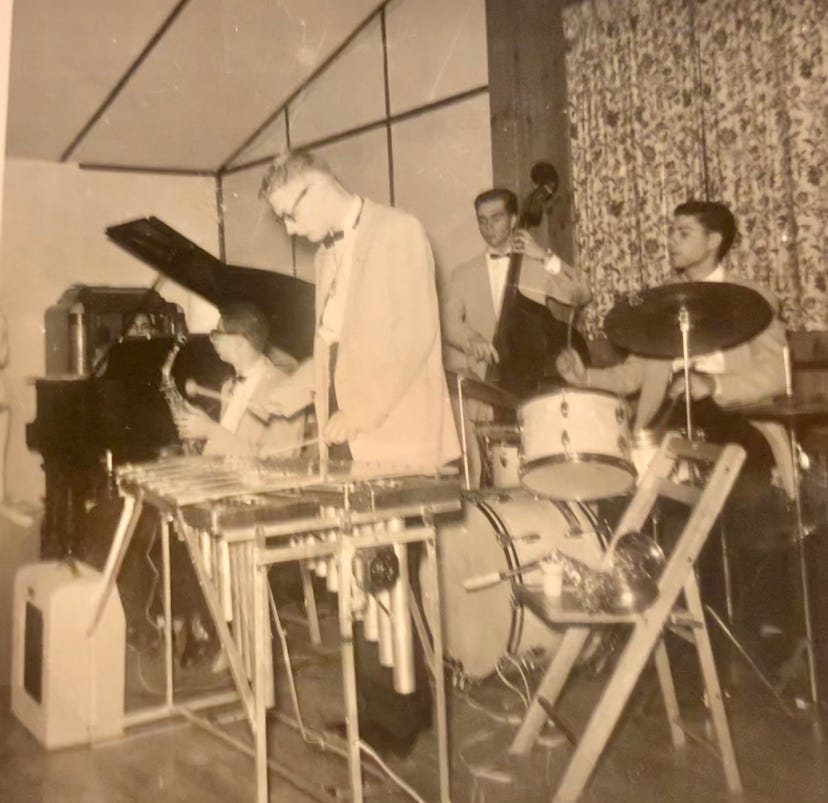
Tommy had been my first mentor in the jazz scene. I was playing with a local New Haven band known as the Kingsmen, a quintet made up of two Yale students, an engineering student at R.P.I. in upstate New York, and our drummer who was a student at Hartt College of Music. We played at soccer and fraternity parties at Yale, along with some bar mitzvahs around town, so we were a working band. I have one black-and-white photograph, taken by my mother, of the Kingsmen playing somewhere in the New Haven area in 1956 or ‘57. If it were in color you’d see that our suits were powder blue:
Tommy happened to sit in one night on one of our gigs and he blew me away with his prowess on the tenor saxophone. I had never heard anything so totally hip before in my life, being all of fifteen years old. Being the curious person that I am, I asked Tommy where he learned to play like that. His response was that I had to get the brand new John Coltrane LP, Blue Train. The very next day I went to Cutler‘s record shop in the middle of Yale University and purchased this album for three dollars. It completely changed my mind about jazz, having only heard Art Van Damme, the jazz accordionist, Van Damme’s quintet had the same instrumentation as George Shearing, with the exception of the piano being the keyboard instrument. [Lew notes: During his early years Shearing sometimes played accordion as well.]
Blue Train was also my introduction to Paul Chambers on the bass, and I later found out that the Miles Davis Quintet had also recorded four albums with Chambers: Cookin’, Steamin’, Workin’ and Relaxin’. As it turned out, these five magnificent jazz records were a breakaway from the bebop era, a warmer and to me a more listener-friendly style of music, along with much improved recording techniques. Chambers’ bass sound was magnificent and clear and his Time (with a capital “T”) was the best thing I’d ever heard from a bassist. I had discovered “Mr. P.C.” as my new hero of the bass, who had set the tone for how jazz bass was to be played from then on.
Back to Birdland: Tommy, being the boldest of the three of us, approached Coltrane after the first set, introduced himself and asked if he would be so kind as to write out the chord changes to “Namely You.” [Lew adds: The song was popular at the time because it was featured in the musical Li’l Abner, inspired by the comic strip, which was then running on Broadway. Coltrane never recorded the song but it’s possible that he played it with Miles that night.] Mr. Coltrane was kind enough to join our table in the Peanut Gallery, and on a paper napkin he wrote the chord changes. He even explained that sometimes he would use one chord rather than another, depending on his mood at the time. John was very parental towards us. Of course he didn’t have to be, but he obviously appreciated that we were serious and wanted to be jazz musicians. He even took the time to ask each of us what instrument we played and he encouraged us to continue our pursuit of the miraculous miracle of jazz. He was smoking a cigar and spoke very softly. I was very impressed by his demeanor towards us, and I will never forget that moment.
The next set had begun as we sat in the Peanut Gallery sipping our Coca-Colas, and listening to this marvelous band of jazz icons. Suddenly and most unexpectedly, Philly Joe fell from his drums in the middle of a tune, literally into our laps, as we sat there, too stunned for words! The dude was probably a little bit too high, and lost his balance or passed out mid-tune. The next thing we knew, we were helping him back on the stage to finish the set, which he did. We were too astonished to know what to say about it. Of course, we were also too young to have even thought about experiencing mind-altering substances, which I later learned were quite commonplace in the world of jazz.
I don’t know what happened to the napkin with the chord changes to “Namely You.” Tommy never shared it with me. Tommy could’ve been and should’ve been one of the most highly respected tenor saxophone players on the jazz scene, but he had emotional problems and basically never left East Haven, Connecticut for any considerable length of time. So he never got the recognition that he deserved, as well as never getting fully involved with the music that he played so well, and initially taught me about. Mike, on the other hand, was kind of a rich kid. His parents owned an Italian restaurant, and although he was a very talented drummer, he wasn’t overly ambitious. Mike did go on to bigger and better things, more so than Tommy, but I haven’t been in touch with him in many years.
Eight years later, in 1966, I found myself in a position to actually replace the one and only Paul Chambers in the Wynton Kelly Trio, featuring the legendary Wes Montgomery on guitar. You probably know our radio broadcast from Seattle that was issued many years later. That’s another story, and you can read it in my book.
[THANK YOU RON! Again, the PDF is available for $20 by writing to Ron at: mcjolt@icloud.com Please write before sending payment.]
All the best,
Lewis
Comments
Nothing yet. Say the first thing.
Sign in to join the conversation.