
Last time we heard the first half of this hour-long interview. It was recorded on October 18, 1966 for a DownBeat article that was published in the December 1st issue. (Last time, Paying Subscribers received that complete magazine issue. Please go back to download it if you haven’t yet done so.) Among many other topics, Hubbard talked about his beginnings in music, and stressed the importance of being able to play in any situation. I’ve repeated the last minute here, for continuity:
At the start, Freddie is saying that he wants to check out everything—as his current employer Max Roach suggests with the title of his recently released album, Drums Unlimited. Rollins was his inspiration in that respect. He worked with him (in 1959). He notes that when he was playing French horn, he hadn’t heard it used as a jazz instrument, for example by Julius Watkins. At 2:30 he stresses that even if you’re an avant-gardist, you have to have a good tone quality. For example, (at 3:00) Clifford Brown had a depth in his sound that not even Dizzy achieved. Hubbard was influenced by Brown’s tone and attack (his tongueing). He was also influenced by a local trumpeter in his native Indianapolis, Charles “Diz” Hummel, who made no recordings. At 5:10, Freddie says that he’d like to lead his own group, but was currently having a good experience with Roach:
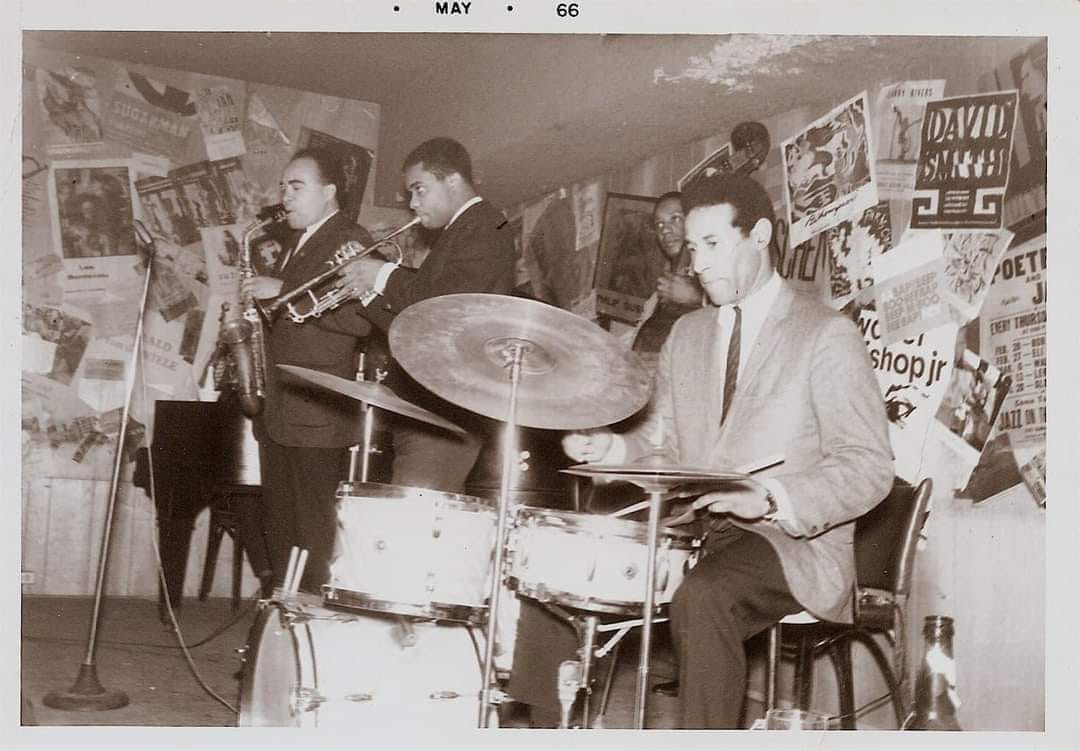
He enjoys playing in different settings, including with Austrian classical and jazz piano virtuoso Friedrich Gulda (with whom he’d recorded the previous year). In Quincy Jones’s big band (7:10) he worked with trumpeter Benny Bailey. He had great technique, including the ability to reach very high notes like Maynard Ferguson.
At 9:15, Hubbard says that he gets ideas for composing from the piano. (That makes sense, especially for a song like “Little Sunflower” which is very pianistic.) He would love to study with Monk, who once told him (10:30), ”Everybody’s playing chords, but Sonny Rollins is playing ideas.” Freddie explains that it’s one thing to run through the chords, but another to work with melodic ideas that work with the chords. At 12:15 he related how trombonist and composer Slide Hampton helped him to become a better reader.
At 13:25, Dan brings up the issue of freedom. Hubbard is very clear that freedom has to have a basis, something to work off. He notes that Coltrane’s Ascension was based on scales, and that even his own “Breaking Point” had a mode to work from. At 15:20 he sings notes starting on F, going up, and they are at the correct pitches. That’s because he had perfect pitch, the ability to hear pitches in one’s head. At 22:20 Dan asks where music is going. Hubbard suggests that with all kinds of music now on TV, there will be a mix of things. Again he stressed the importance of being able to play in any context. At 25:00, Dan brings up one of his favorites, Roy Eldridge. Hubbard had seen Roy in Berlin and liked his growl effect. At the very end, Hubbard asks about a poster on the wall—probably the DownBeat office. It’s a drawing of a generic jazz pianist. Finally Dan says, “I think we got enough.” Let’s listen:
0:00
-28:42
All the best,
Lewis
Comments
Nothing yet. Say the first thing.
Sign in to join the conversation.