
There is a substantial website, by Stuart Varden and our friend James Accardi, devoted to the beloved saxophonist Wardell Gray (1921-1955). If you click on the discography tab there, you will see an annotated listing of every recording of Gray. A number of items, mostly isolated numbers from radio broadcasts, are marked “unissued.” Today you will get to hear a complete broadcast that has never been issued. Here are the details as reported in that discography:
BILLY ECKSTINE’S BAND FEATURING AL KILLIAN “The Billy Berg Show,” radio broadcast from Billy Berg’s Supper Club, Hollywood, California, Wednesday, April 23, 1947
DownBeat, April 9, 1947, announced that Eckstine would “take over and front a new band formed here recently by Al Killian.” Personnel are listed as follows:
Al Killian (tp); Billy Eckstine (v-tb, voc); Sonny Criss (as); Wardell Gray (ts); Warren Bracken (p); Shifty Henry (b); Tim Kennedy (d).
Eckstine was a very good valve trombonist, which is why he is listed for “v-tb” in addition to vocal. Killian and his bandmates Criss and Gray are well known of course, and they were recorded together with Eckstine two days before this broadcast, and later at the Hollywood Jazz Concert on July 6, 1947 as well as in Portland, Oregon that October. The rhythm section members are not as well documented. According to a Facebook post, Warren Bracken, pianist and vocalist, “honed his band-leader chops” in the Navy during World War II before moving in the late 1940s to Portland, Oregon, where he became a popular performer and mentored many younger players. Here is a photo posted by his daughter, Lorna Bracken Baxter:
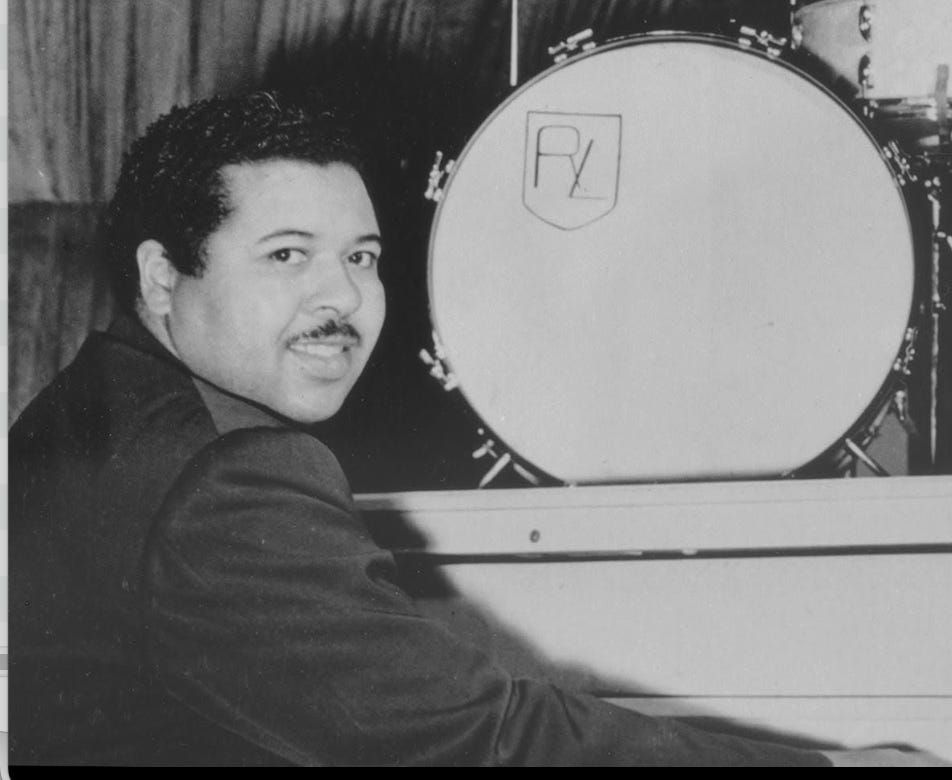
My research on John “Shifty” Henry shows that he was born in Edna, Texas in 1921 and moved in the mid-1940s to Los Angeles, where he died in 1958. Between 1945 and 1950 he played bass on about a dozen bebop and blues recording sessions as both sideperson and leader, including with blues singer Big Joe Turner. And Tim Kennedy is a fiery, interactive drummer, as you can hear throughout. He sounds something like the legendary Ike Day, whose work we heard when he was praised by Sonny Rollins in a previous interview post. Kennedy was the regular drummer in the Killian group and was on the sessions mentioned above. Later he showed up on about ten other recording dates with Milt Buckner, Zoot Sims, Mary Lou Williams (in 1963, his last date), and others.
The sound quality of the broadcast is very good, and our friend Accardi has done some additional work on the audio quality and pitch of the instrumental numbers. The band plays nice written passages throughout that are not credited. I wonder if trombonist Gerald “Jerry” Valentine, who was also an arranger associated with Eckstine, created them? Here is my track-by-track summary of what you will hear:
A short theme song is played while Billy Berg introduces the program. It’s called “The Creep,” and according to modern jazz historian Mark Gardner, it was composed by Gray. (See the notes and credits of the Sonny Criss Memorial Album. There are other, later songs with the same name that are unrelated.) Berg has evidently coached the audience in the club, because they loudly whistle and yell “Yay,” and Billy says, “See what I mean? Sounds like we got a big house.” Evidently, there weren’t that many people in the club, and he asked them to make a lot of noise to make the crowd sound bigger. Berg introduces Eckstine, who says they will play “You Came Along.” Those are the first words of what they actually play, which is:
“Out of Nowhere.” Gray has a short solo, then Criss solos, followed by Gray again with a longer outing, then Killian. At the end, Eckstine gives the correct song title, and he introduces the next piece:
3:30: “What’s New.” Eckstine says they recorded this “a few days ago”—it was actually just two days earlier, on April 21, with a similar but not identical personnel. This is a vocal feature.
6:30: Next is the trio of Gene Phillips (1915-1990), a popular “rhythm and blues” vocalist and guitarist. His regular pianist was Lloyd Glenn, a somewhat amazing, almost Tatum-esque player who is well known among fans of blues and R&B but deserves to be better known in jazz circles. Phillips used several bassists and I’m not certain which one is on this broadcast, or in this photo with Glenn on piano:
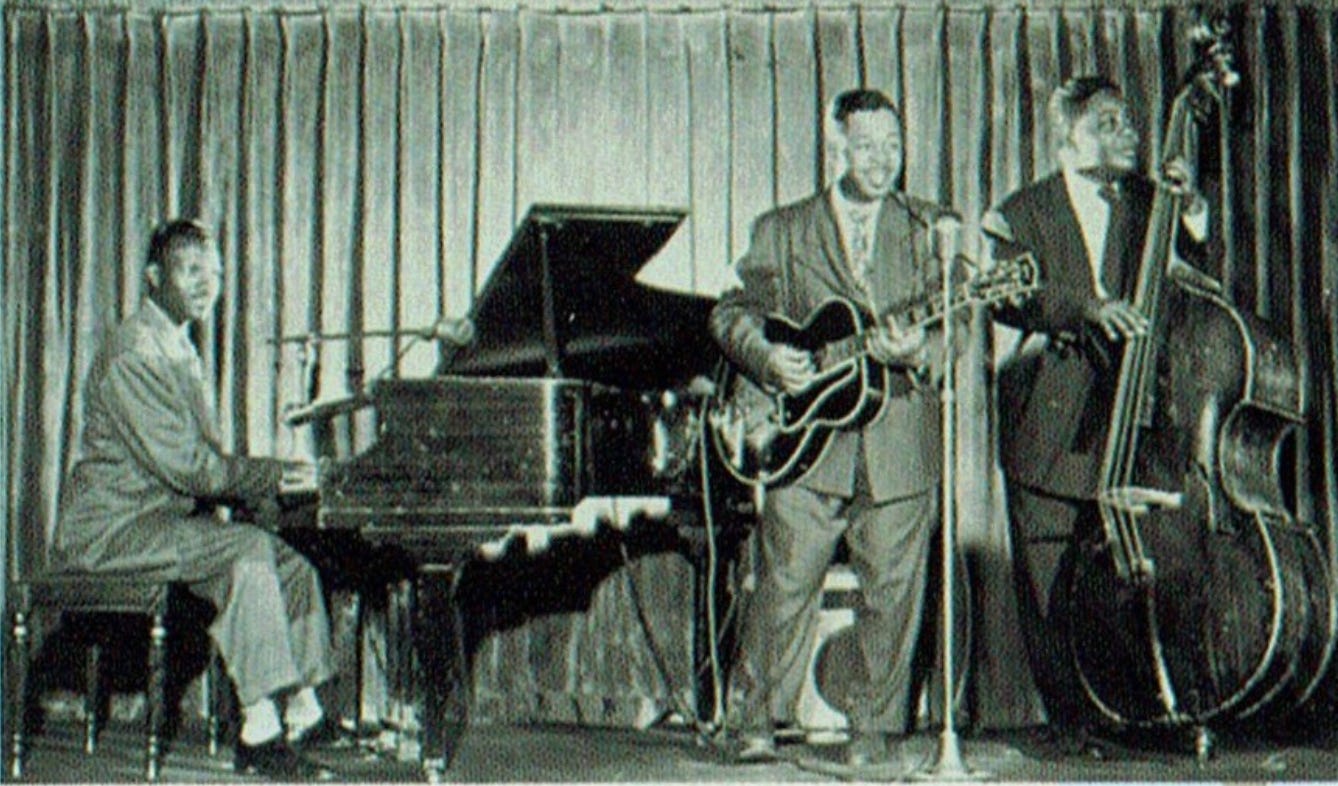
The microphone makes a loud feedback squawk right at the start, but everything else is fine about the B-flat blues that they perform. The song is “I Could Make You Love Me,” a then-current Phillips original, recorded in September 1946 and released in 1947.
9:20. Berg comes back and announces that the next number is “for Tijuana.” Evidently somebody requested that he dedicate the next piece, “whatever it is,” to “Tijuana.” Eckstine sings another number that they had just recorded two days before:
“Serenade In Blue,” a vocal feature. Next, Eckstine introduces:
12:44. Mabel Scott, a noted singer. She was on the bill with Eckstine during that engagement. Backed by the Killian group, she sings “Good Lookin’ Fella,” her own original blues that she later recorded around December 1947.
A new voice announces the upcoming schedule for the club. Then Eckstine thanks him—it sounds like he says “Dan”—but at the end of the broadcast it sounds as though he called himself “Ted.” Go figure! Anyway, next is an instrumental version of:
15:50. “Just You, Just Me.” For one of many examples of Kennedy’s dynamic drumming, listen to him during the opening theme statement! Then each of the wind soloists gets two choruses each: First is Criss. He inserts a quote from Charlie Parker on “Sepian Bounce” at 16:50 (at 2:10 on the original recording; thanks to Loren Schoenberg), and at 17:25 he recalls “September in the Rain.” Next is Eckstine’s valve trombone. Gray starts at 19:07 with a quote of “It Could Happen to You.” Notice Bracken’s fine piano comping behind him. Next is Killian, whose wild solo displays why he was known as a high-note specialist. Bracken gets one chorus, and behind him is a good place to hear “Shifty’s” walking bass. Another good written arrangement completes the song.
22:50. “Prisoner Of Love. ” Eckstine describes this vocal feature as a “revival,” because although he says he had recorded it “recently,” that was back in September 1945, so it was far from current. We discussed this song in depth in an earlier post.
25:50. The program ends with Dizzy Gillespie’s blues riff that he called “Emanon” (“No Name” backwards). Gray is up first for five great choruses, with very lively backing from the rhythm section! Eckstine is next on his valve trombone. During his solo, just when he really gets going impressively, the other announcer—it sounds as though he says “This is Ted Lens”— comes on to close the broadcast, followed by Berg. They mention that Butch Stone will be coming. Berg’s was an integrated club and featured Black and white performers. Stone, a white artist, is best known today for some forty years as a singer and musician—mostly baritone sax—with the Les Brown band, but at that very time in 1947 he was trying to succeed leading his own small band.
Here now is the complete broadcast—Enjoy it!:
0:00
-29:48
All the best,
Lewis
P.S. Big thanks for help with this essay to Fred Cohen, Jeff McMillan, and James Accardi.
Comments
Nothing yet. Say the first thing.
Sign in to join the conversation.