
Thanks for reading Let the Dead! This post is public so feel free to share it.
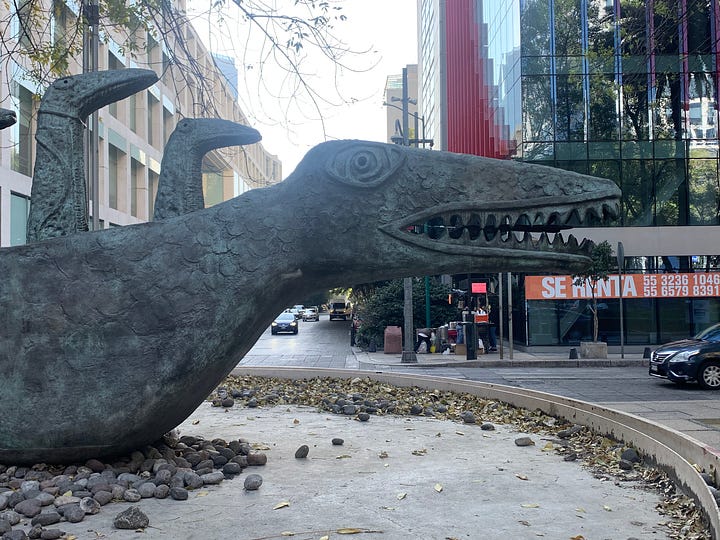
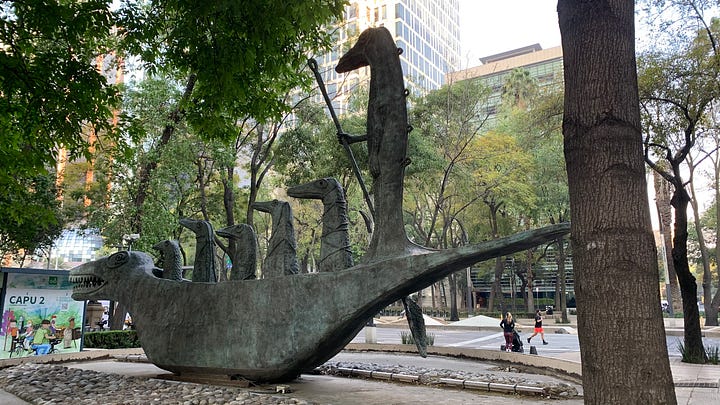
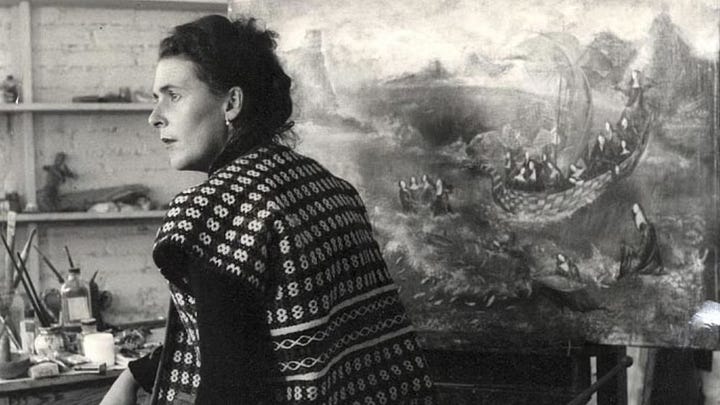
I walk past Cocodrilo at least once a week. Sometimes referred to by using its full name How Doth the Little Crocodile (from the Lewis Carroll poem), this large bronze Leonora Carrington sculpture of a crocodile, whose body is being used as a boat by smaller fantastical reptiles, has occupied a prominent position on Avenida Reforma since 2006, when it was moved there from Chapultepec in accordance with the artist’s wishes. In addition to the playful magnificence of the sculpture itself, this “new” location surely contributed to it being one of the city centre’s most recognisable and admired pieces of public art. I see it so often, it’s become part of my life. And so Leonora’s work is always there, flittering around in the back of my mind.
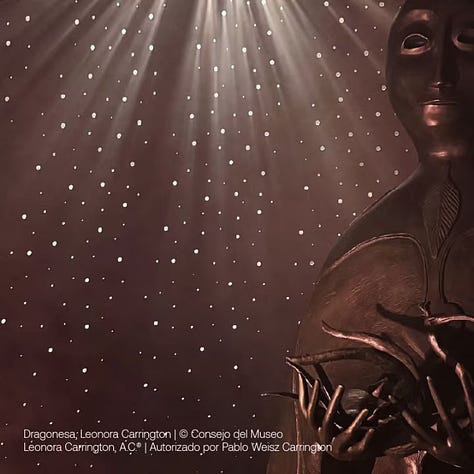
Recent events, however, has pushed the artist and her work a little bit further to the front of my consciousness. The resurfacing of a painting from her time in a sanatorium in Spain, a couple of recent exhibitions during Mexico City art week and, at the time of writing, a multimedia Carrington extravaganza in which one can “Explore an immersive labyrinth where surrealism comes to life through monumental sculptures, art, and immersive spaces inspired by the artist” have all served to keep Carrington’s work even more visible and present that normal.
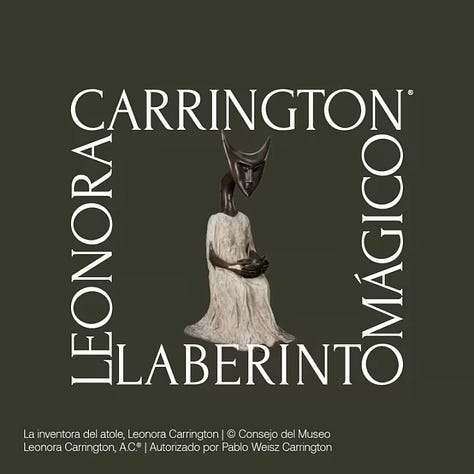
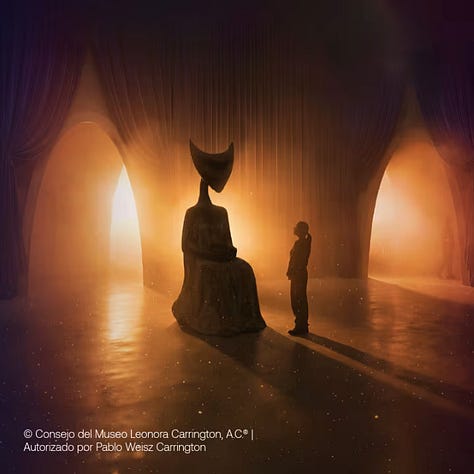
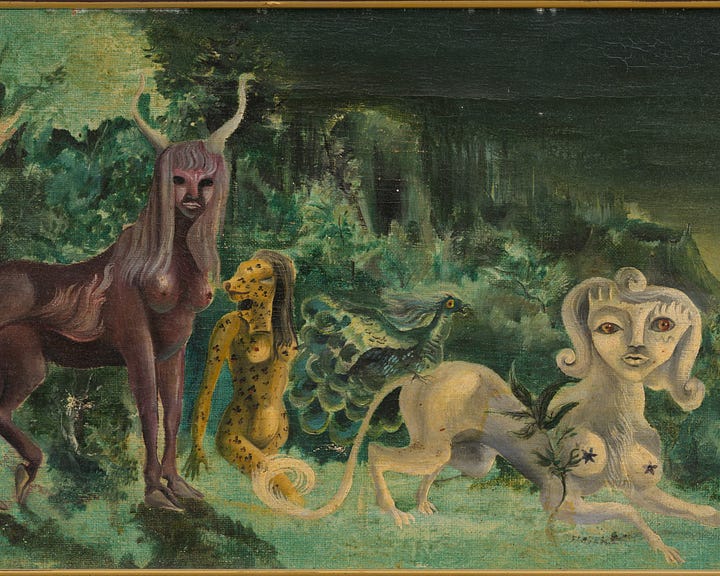
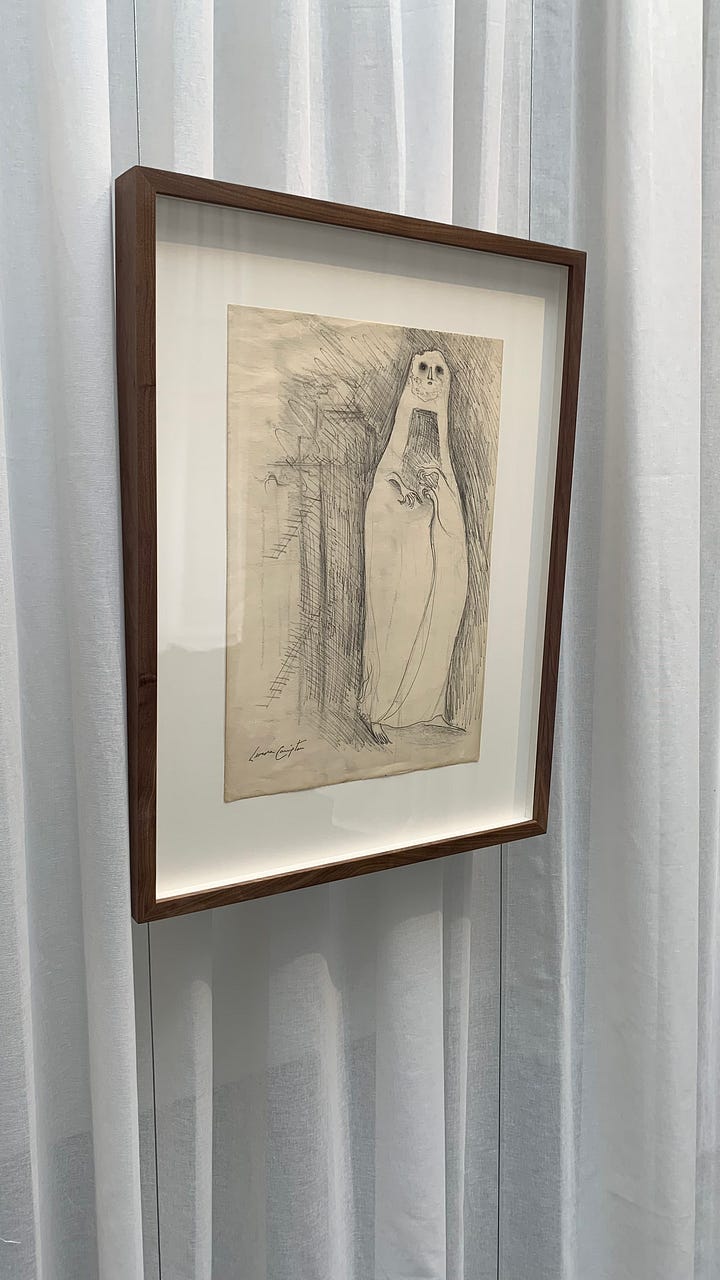
But the most important factor is that we are neighbours, sort of, just not at the same time. After a hiatus of two years outside of Mexico City, I moved back to the San Rafael neighbourhood in August. San Rafael began in 1859 as la Colonia de Los Arquitectos and is the oldest neighbourhood in Mexico City outside of the Centro Histórico. And it was to this area, famed for its cultural life and abundance of theatres, that Leonora Carrington arrived with her then-husband, the poet Renato Leduc. In addition to his poetry, we have Leduc to thank for helping Carrington avoid having to choose between becoming the mistress of her cousin, a Madrid-based doctor, or having to travel to another sanatorium in South Africa. Carrington tells the story of what led her to Mexico in the postscript to her short and astonishing memoir Down Below:
*
Text within this block will maintain its original spacing when published
One night it was very windy–this was winter, remember, and it's very cold in Madrid then–I went with him to a very expensive restaurant, and he said, "Your family have decided to send you to South Africa, to a sanatorium where you'll be very happy because it's so lovely there."
I said, "I'm not sure about that."
He added, "I have another idea, personal, of course: I could give you a lovely apartment here, and I could see you very very often." And he grabbed my thigh.
So I was then in front of a huge decision. Either I was shipped to South Africa, or I was going to bed with this appalling man.
[...]
Text within this block will maintain its original spacing when published
Later, in Lisbon:
I nipped out, got a taxi–I must have had a bit of money for buying the gloves–and I told the driver, in Spanish, “Mexican Embassy”.
I’d met Renato Leduc, again, in Madrid, I’d run into him at a thé dansant. I was allowed to watch the other people dancing, though I wasn’t allowed to dance, of course. I was with my keeper, Frau Aseguardo–I knew Renato from Paris. He was a friend of Picasso–I told him what had happened, and I asked, “Where are you going, for God’s sake?” We had to talk in shorthand in French, which she didn’t speak. Renato told me then, Lisbon.
Text within this block will maintain its original spacing when published
So I landed at the Mexican consulate and there were a bunch of Mexicans I’d never seen. I asked them if Renato was there, and they said, No, they didn’t know when he’d be in. I told them I was going to stay and wait. They protested, “Señorita, but…” This and that. So I said, “The police are after me.” Which was more or less true. So they said, “In that case…” Wink, wink. “You can wait for Renato.”
Text within this block will maintain its original spacing when published
Text within this block will maintain its original spacing when published
The ambassador was wonderful with me later. I must have gone into see him, and he said, “You’re on Mexican territory. Even the English can’t touch you.” I don’t know when Renato appeared. Eventually, he said, “We’re going to have to get married. I know it’s awful for both of us, as we don’t believe in this sort of thing, but…” At that time I was as frightened of my family as of the Germans. I’d found Renato attractive when I first met him, and I still found him very attractive. He had a dark face like an Indian’s and very white hair. No, I felt perfectly sane. I was just feeling that I would do anything not to be sent to Africa, not to fall in with my family’s plans.
Text within this block will maintain its original spacing when published
Text within this block will maintain its original spacing when published
Then Max appeared, with Peggy [Guggenheim] and we were always together, all of us. It was a very weird thing, with everybody’s children, and ex-husbands and ex-wives. I felt there was something very wrong in Max’s being with Peggy. I knew he didn’t love Peggy, and I still have this very puritanical streak, that you mustn’t be with anyone you don’t love. But Peggy is very maligned. She was rather a noble person, generous, and she never ever was unpleasant. She offered to pay for my airplane to New York, so I could go with them. But I didn’t want that. I was with Renato, and eventually, we went by boat to New York, where I stayed for almost a year, until we left for Mexico.
Text within this block will maintain its original spacing when published
Text within this block will maintain its original spacing when published
That was the story.
Text within this block will maintain its original spacing when published
*
Carrington stayed married to Leduc for only around two years. When first arriving in Mexico City they squatted at the former Soviet embassy that was then functioning as a kind of hostel for artists. It is at this point that she, according to Marina Warner, begins to relate the version of the memoir that we know “on the third anniversary of the events she recalls”. It turns out that the very location in which she began to re-compose Down Below (having lost a previous manuscript), the former embassy, is on the same block as my building and is visible from the roof.
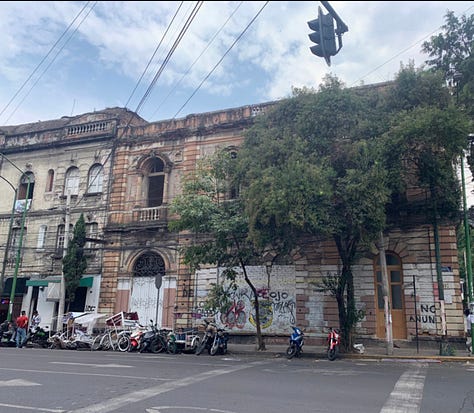
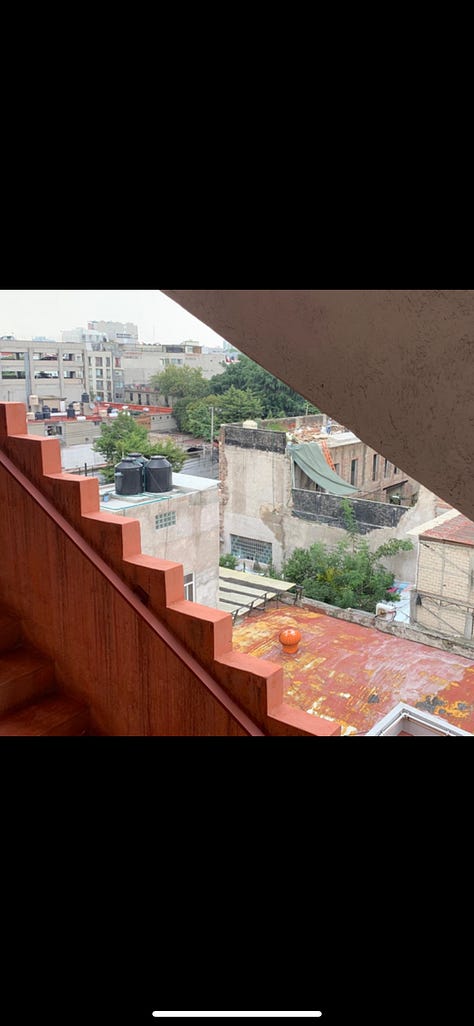
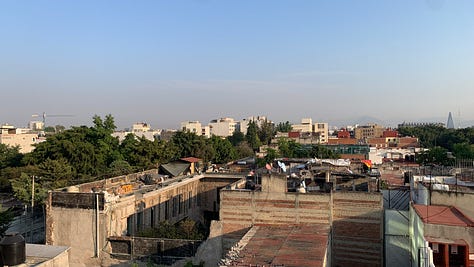
I’d lived in the San Rafael before, around seven years, and had often wondered about this large old abandoned husk of a building that clearly had been an important structure at some time. Graffiti on the walls warned passers-by to look out for falling tiles or bricks. Recently, however, it seems to have been remodelled somewhat. It turns out that it now is rented out as an events space for weddings or other parties. The website states that ‘a place with more than 100 years of history is now beginning a new chapter’.
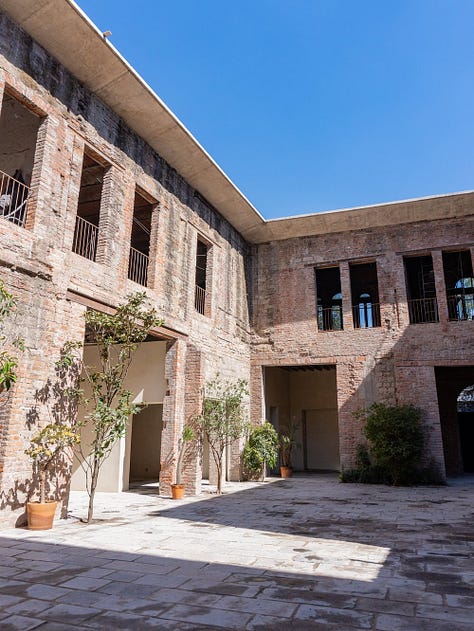
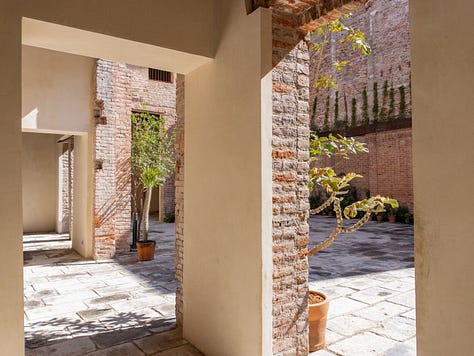
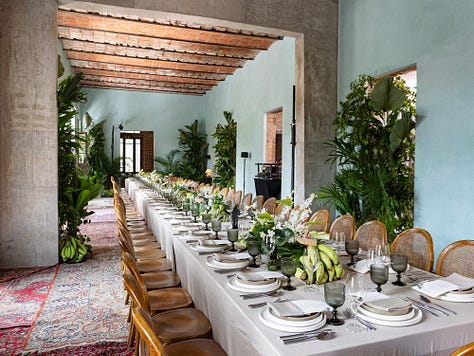
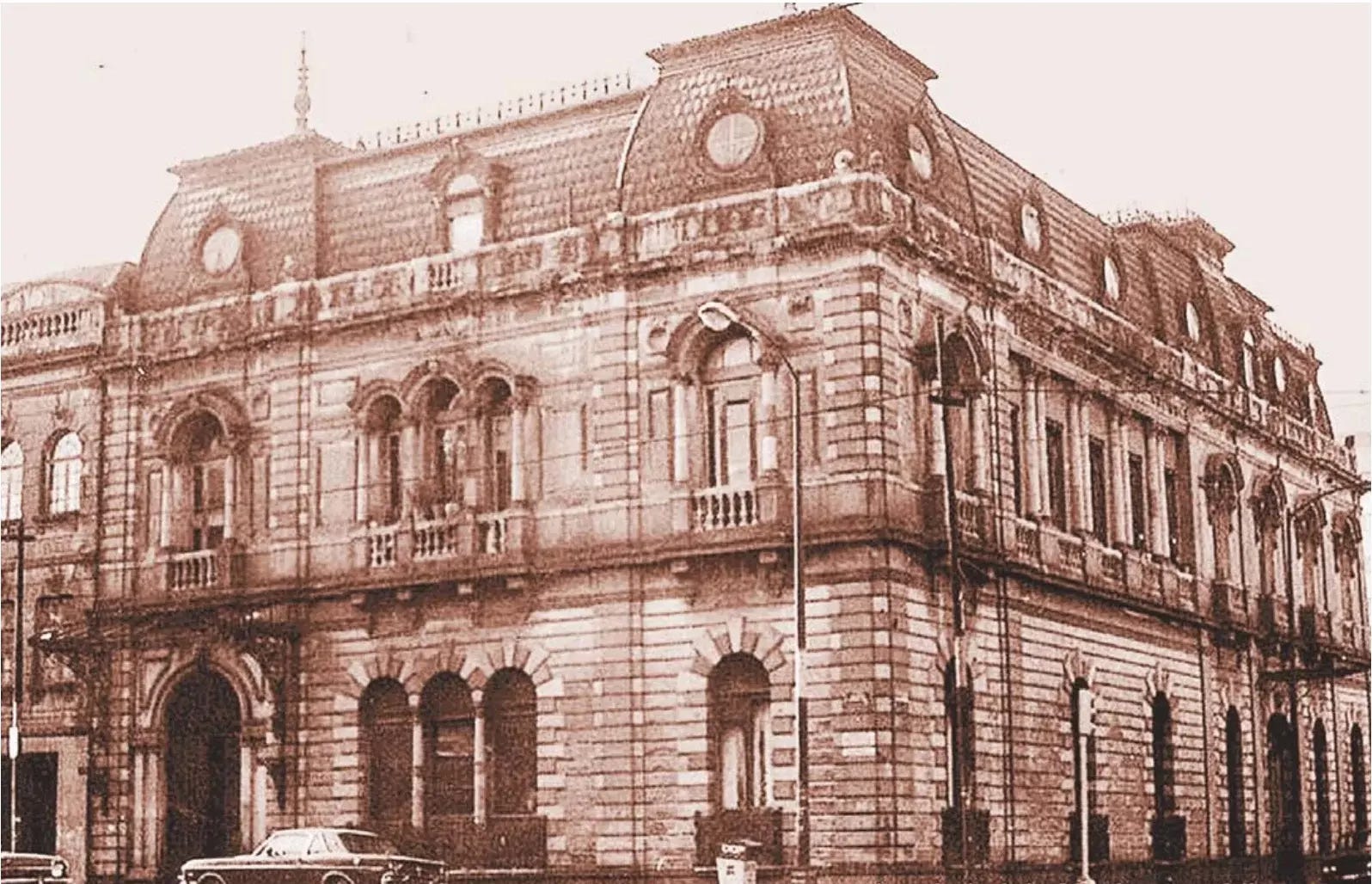
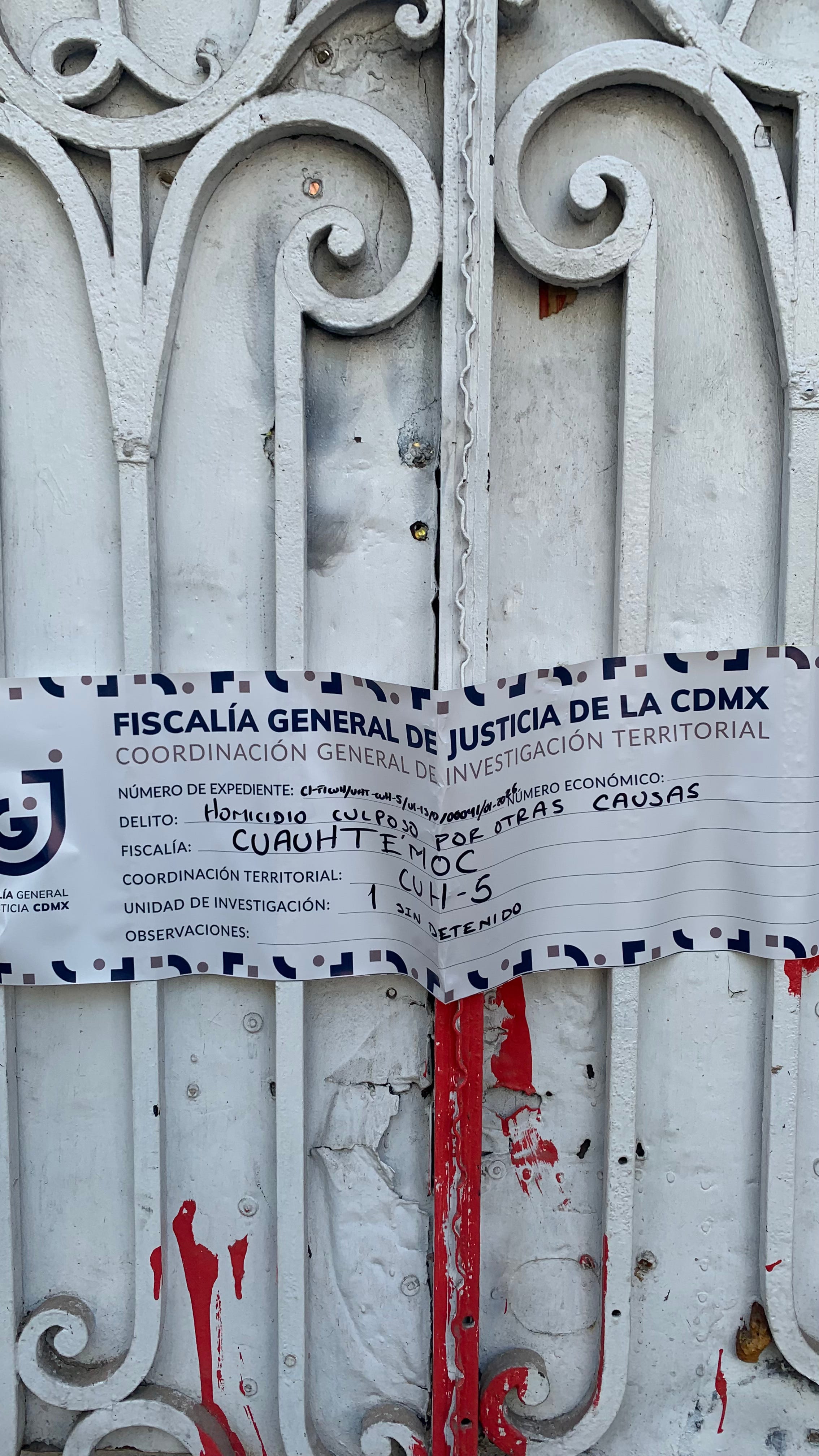
A few months back I approached the building to see if I could walk around it or even peer through a gap in the wall. However, the gate was closed and a sign had been pasted to it by the local authorities stating that the building was closed due to an ongoing investigation into a case of manslaughter.
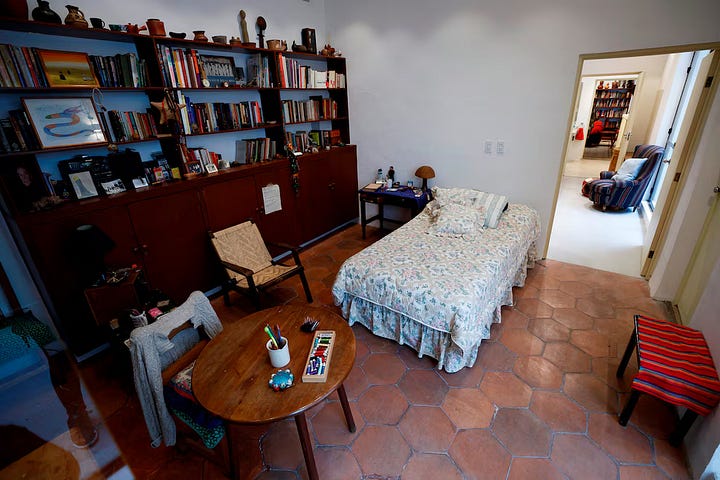
Though this building played an important role in the story of Leonora Carrington in Mexico City, the residence with which she is most associated is located in the Roma neighbourhood, a couple of kilometres away at, Calle Chihuahua, 194. At this location she lived with her Hungarian photographer husband Imre ‘Chiki’ Weisz. A few years ago there was some excitement at the announcement that this house, where she lived from 1948 until her death in 2011, would be refurbished and opened as a museum. If you visit you will, unfortunately, be disappointed. Due to a dispute between the UAM university and associated trade union, the museum-residence remains permanently closed. You can, however, visit the website and take a virtual tour here. Though not open to the public the museum-residence has some interesting reviews on Google Maps. A year ago someone wrote the following: ‘It’s 2:29 a.m. and the museum has loud music playing and women shouting and laughing. This isn't the first time; they don't let anyone rest.’ The same person also left the following review: ‘Please control the security guards. They play music in the early hours of the morning, shout constantly, and don't let anyone sleep. They cause all this chaos mainly during the week.’ While I wish this house were open to the public, these security guards might have the right idea. I can think of few better ways to spend a night in Mexico City than drinking and singing the darkness away in Leonora’s kitchen. The thought brings some strange comfort (to me, not to the poor neighbour whose Google Maps complaints go unheeded).
It’s been a long time since I’ve posted anything here. My apologies. What can I say, life, work… I do, however, hope to post again with more regularity. If you enjoy this or any other posts please do like and subscribe for free. You can also become a paid subscriber if you like. The other way to support me is, of course, by buying my most recent book, Let the Dead. It is available here from Banshee Press and various other shops and websites easily found online.
More from me very soon…
No posts
Comments
Nothing yet. Say the first thing.
Sign in to join the conversation.