
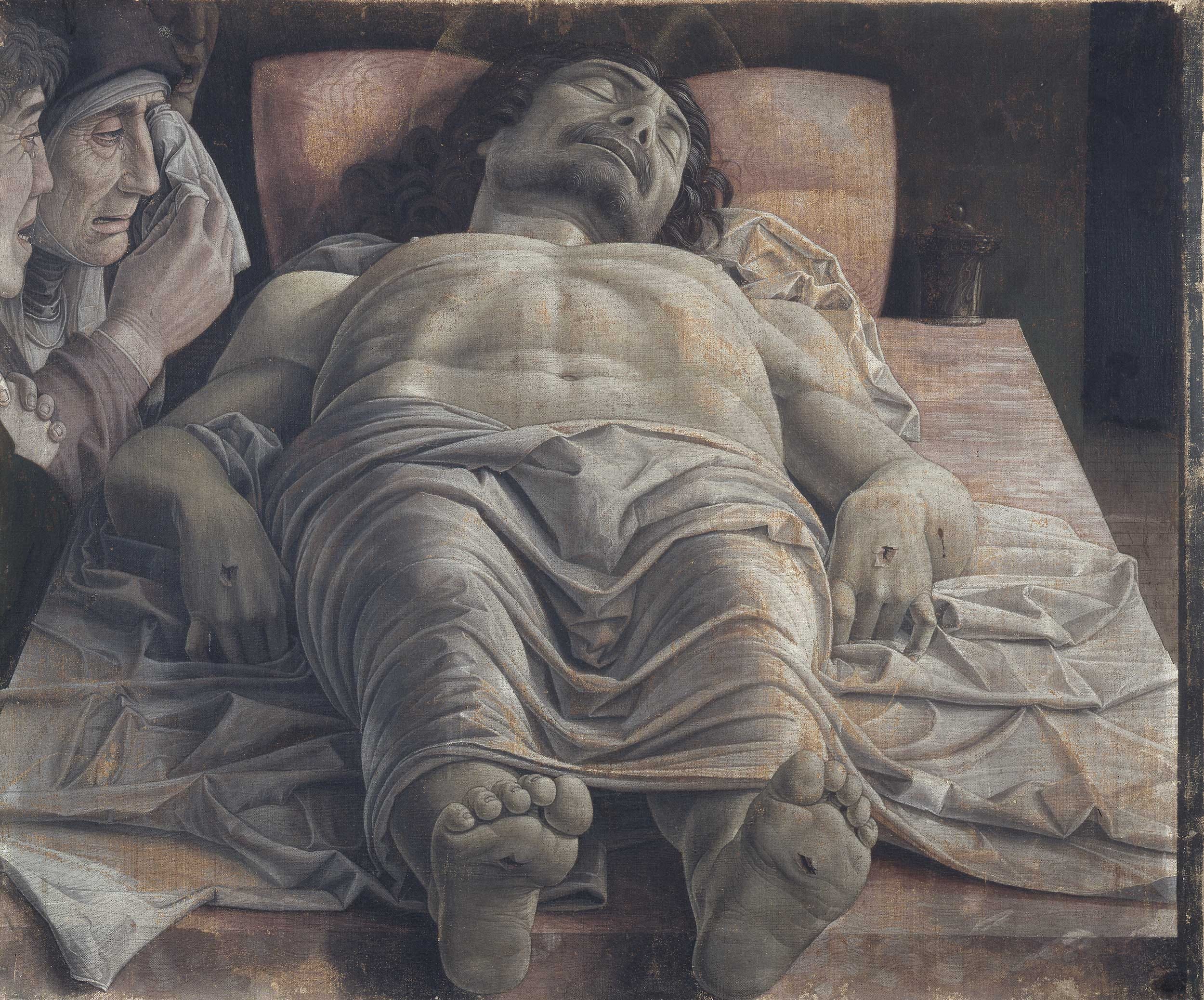
The Lamentation over the Dead Christ, Andrea Mantegna (1431–1506)
“It is quite remarkable that John Adams—who, even before the outbreak of the Revolution, had insisted on ‘the rights prior to any earthly government […] which derive from the great Lawgiver of the universe,’ and subsequently played a key role ‘in maintaining and emphasizing that [natural law] was like a recourse to which we would be brought by Parliament much sooner than we thought’—believed, it must be emphasized, that ‘according to the general opinion of the ancient countries, only the Divinity was appropriate to give laws to men.’ The fact is that Adams was mistaken: neither the Greek nomos nor the Roman lex was of divine origin; neither among the Greeks nor the Romans did the concept of legislation require divine inspiration. The very notion of a divine legislator implies this: the legislator must be external and above his own laws, but in Antiquity, it was not the characteristic of a god but of a tyrant to impose on the people laws to which he himself would not be bound.”[1]
On Revolution, Hannah Arendt
We live in a decapitated[2] world where the very idea of divine grandeur has been replaced by human megalomania. It would therefore be unthinkable for an “Enlightenment thinker’ to reintroduce a dose of spirituality, or even a “foundational” natural order, into the human equation; and we might question the meaning of this sectarian secularism that seems to attack only one particular doctrine: Catholicism.
What are we trying to prove with our “flawed theories”[3] that ruthlessly dismiss—the modus operandi of brutes—a philosophical tradition spanning millennia and a “rational theological”[4] grandeur from human existence? But when this same secularism becomes tribal or even genocidal, seeking to impose a New World Order based on an Old Testament that denies true historical facts in favor of vengeful propaganda, one can certainly question the mental health of its actors or the fanaticism of its promoters.
The secularism of the “Age of Enlightenment” is always referred to in order to suppress any criticism of modern revolutionary movements, while the Abrahamic heritage is imperiously brandished in order to exonerate a sadistic horde that constantly projects its desire for permanent revenge onto all of humanity in order to appease its sense of guilt.
Thus, this “return of the repressed” manifests as a nihilistic behavior that steadily grows within us until it compels us to destroy the other (from masochism to sadism) as a form of confession. This act is implicit and remains violent until it can no longer be suppressed through therapy, lies, or propaganda. Therefore, no compassion is possible on the part of the individual who refuses all responsibility or who destroys the foundations of natural or divine laws. As Hannah Arendt described it, “the very notion of a divine legislator implies this: the legislator must be external and above his own laws.”
We can better understand why Zionism seeks to destroy Christianity and Islam by pitting them against each other. Only one “World Order” must exist; and what better way than a spiritual war between two “enemy factions” that will destroy each other—a nuclear war would destroy both sides—in order to make way for a field of ruins conducive to the advent of the Talmudic Messiah—a political domination without spiritual grandeur.
The essence of words (their etymology) does not change over time; but when they are used as a tool of propaganda or as a political weapon, we better understand the nihilists’ irrepressible desire to eliminate the origin of a word in order to empty the intellect of its substance. Words must be “incarnated,” that is, “inhabited” by breath (from the Latin pneuma, from the Ancient Greek πνεῦμα). Inhalation and exhalation are “movements” that we can neither explain nor observe “scientifically,”[5] because observing phenomena requires “political curiosity.” Human beings are not mature enough (sufficiently tested and ready to face the ordeal of death with courage and serenity) to experience “incarnation,” because they forget their own immortality by venerating progress—the revolution that erases the very idea of God. Incarnation requires meditation, revelation, and the realization of the disappearance of the Self—of the Ego. There are lower minds and higher minds. The ego is a barrier of the “lower mind” that prevents humanity from reconnecting with its “compassion.”
The idea of “incarnation” thus stands in opposition to our modern conception of an empirically observable world. It has been stripped of its repetition (reincarnation). The phenomena that we do not want—or cannot—observe because of our materialistic constraints or ideological obstinacy are the path to our salvation. We fear our death (which is normal) because we have been conditioned to imprison ourselves within our own determinisms, in the decline of courage, as Alexander Solzhenitsyn so accurately put it.
To fully grasp the meaning of our existence, it would be helpful to watch Andrei Tarkovsky’s film ”Solaris.” For even if we live in a dream, we must understand that simply catching ourselves in meditation is essential for reconnecting with the Being that exists simultaneously in the past, present, and future. It is only in darkness that we can discover the light.
Thus, contrary to the fallacious consensus born of psychological manipulation inherent in tribal betrayal, an insurmountable trauma that imprisoned a people—the Jewish people—within their own contradictions, a “death drive” (the expression is Sigmund Freud’s) that hypnotized all of humanity, God was born at Auschwitz. We can therefore imagine “Смутное время”[6] as the apocalyptic opportunity to challenge all the fallacious Enlightenment Theories that have never been truly tested by genuine rational inquiry, in order to expose their intellectual aporias and shortcuts.
It is certainly unimaginable for anyone to be betrayed by God. But what should we expect from the Divine, who nevertheless gave us free will, the very essence of the possibility of criticizing power? If we do not use our free will and our reason—our language, Aristotle’s epideictic discourse which praises or blames but does not condemn—to debate while mostly avoiding excessive condemnation, we inevitably sink into vengeance, which is never redemption. Thus, Tikkun Olam is neither an act of indulgence nor an eschatological outcome, but rather a revolutionary project that subverts morality for the benefit of a small group of individuals:
“The twisted logic of Jewish moral reversal had reached new levels of refinement over 2,000 years of existence. [...] Jewish guilt began building when the Jews killed Christ, but it reached the point of no return when the Temple was destroyed in 70 A.D., leaving them without the priesthood, the Temple, and the sacrifice which were necessary to expiate the guilt of the Jewish nation. Beginning with Simon bar Kokhbar, Jews attempted to expiate guilt by participation in revolutionary movements, a decision which finds expression as diverse as tikkun olam, Zionism, communism, gay marriage, abortion, and Reichian[7] sexual revolution.”[8]
The Holocaust Narrative, E. Michael Jones
Rather than engaging in debate—the logos—about an idea or concept, the proponents of subversion overturn Aristotelian logic in order to trap the individual in a contradiction that they will internalize (the expression is E. Michael Jones’s), generating a permanent guilt impossible to expiate. One could certainly multiply examples demonstrating that revolution is not an escape or a solution but a mechanism of destruction used to establish a new social order. Western societies were ensnared by progress, by the Enlightenment, by the headlong rush toward a totalitarian world where the instigators of perpetual violence as a mechanism for controlling the masses first eliminated the inconvenient witness (Christ) in the manner of the MOSSAD[9]. Then, they established a permanent dialogue under the banner of victimhood. Western societies were thus feminized, men being castrated of their rational force—debate and combat—in favor of a stateless and cosmopolitan sect.
Many contemporary cowards have succumbed to this masochistic emasculation. Consider Donald Trump, whose entire existence is nothing but an uninterrupted series of lies, self-congratulations, and failures—financial, moral, and existential; and whose only way to assert himself in a feminized world where victimhood reigns is through a substantial narcissism.
Some claim that Donald Trump is a strategist and a genius. They present him as the Master of Chaos, the one who will annihilate the “Deep State.” That his exacerbated narcissism conditions all his political actions are certainly evident today. However, we see that the mirror in which he contemplates his own reflection—let us remember Oscar Wilde’s The Picture of Dorian Gray—is cracked and that his lack of culture, his perversity and his total absence of moral sense risk leading the world towards an Armageddon which is desired by the proponents of a modern totalitarianism – a desperate fanatical Zionism.
Most political leaders are, in fact, controlled by their impulses and appetites. They have succumbed to this revolutionary stratagem which has unleashed the vital forces of destruction, and imprisoned them in permanent contradictions:
“Jews have always seen revolution as Tikkun Olam or the fulfilment of the biblical promise of deliverance from bondage for people who have given up on waiting for the Messiah.”[10]
The Holocaust Narrative, E. Michael Jones
First, chaos must be created in order to replace the existing order with a new one. And suffering (obviously the suffering of the masses, not the sacrifice of the “elites”!) is absolutely necessary to give birth to a “new civilization.” But how can we give any credence whatsoever to these sadists who torture individuals to mold them to their own perversions? These narcissistic behaviors are extensively explained by Sigmund Freud when he analyzes the rituals of primitive peoples. This animistic period (the omnipotence of ideas) is conducive to the emergence of narcissism:
“The person behaves as if they were in love with themselves; egotistical tendencies and libidinal desires are not yet sufficiently distinct in our analysis. […] The person remains, to a certain extent, narcissistic, even after they have found external objects for their libido.”[11]
Totem and Taboo, Sigmund Freud
Now, let’s analyze Donald Trump’s behavior. Not only does his entire argument revolve around himself, but the “President” remains a prisoner of his own self-love—his own reflection. It must be noted, however, that when the image deteriorates, when the object of desire crumbles, the libidinal drive is externalized and leads the subject to believe he can dominate the world:
“Nothing, therefore, seems more natural than to link to narcissism, as its essential characteristic, the fact that we have discovered concerning the great value (exaggerated value, in our view) that both the primitive and the neurotic attribute to psychic actions. We will say that in the primitive, thought is still strongly sexualized, hence the belief in the omnipotence of ideas, and hence also the conviction of the possibility of dominating the world—a conviction that remains unshaken by easily conducted experiments capable of informing mankind about its exact place in the world.”[12]
Totem and Taboo, Sigmund Freud
We can therefore link the Jewish concept of Tikkun Olam (the restoration of the world) and Donald Trump’s primitive narcissism to demonstrate that the Death of God is a pure fabrication by revolutionary and occult forces seeking to atone for a crime by shifting the burden onto all of humanity.
But the facts remain. This psychological fabrication is a stratagem that destroys all rational thought in favor of emotions characterized by matriarchal societies. A more elaborate explanation would certainly be necessary to show that the behavior of Western peoples is comparable to that of primitive hordes; and that the concept of revolution was created to mask violent acts perpetrated continuously in the name of progress and human rights. We thus observe that lies inexorably drag individuals into a downward spiral from which they can never escape; every anarchy eventually wears itself out through repeated use.
Several geopolitical commentators constantly refer to the famous—or perhaps nebulous—Fog of War. Perhaps we should instead speak of the Fog of Information[13] that saturates the already myth-poor and cognitively limited psyche of the masses, in order to show that the ambient noise of thought pollutes the soul and annihilates the silence inherent in a singular encounter, not only with the divine, but with life and the beauty of the world.
And recent political history demonstrates that the lies of contemporary politicians are unraveling, revealing only a tattered fabric through which the most unimaginable perversions are revealed (necrophilia, pedophilia, cannibalism, sadomasochism, etc.). Rediscovering the meaning of the divine is tantamount to returning to the scene of an “imaginary crime” in order to discover that God was born in Auschwitz.
[1] Hannah Arendt, On Revolution, Translate from English by Marie Berrane with the collaboration of Johan-Frédérick Hel-Guedj, Paris, Gallimard, coll. « folio essais », 1985 [1963], page 286.
[2] The execution of Louis XVI was not merely a revolutionary act; it also served as the foundation for a new religion—the Revolution and the Terror—which would culminate in the Holocaust. We could certainly compare the assassination—a political and religious murder—of the King of France and the ensuing bloodbath to the massacres perpetrated by the Judeo-Bolsheviks during the 1920s. No revolutionary movement, always based on arbitrary power (rape, assassination, summary executions, anonymous denunciations, mass surveillance, imprisonment without charge, etc.), on the complete absence of any political objectives other than perpetual terror, liberates either the mind or the body. Only faith and reason serve as a unifying force among people.
[3] A theory is not a truth but an “assertion” validated by a community of thought. For our theories to be valid, they must be honest, modest, and above all, falsifiable—that is, open to questioning and criticism. Since the Enlightenment and the advent of “modern science,” “theories” have become dogmas and peremptory assertions supported by a traumatic nihilism—an endogenous reaction fueled by its own neurosis (a closed circle). To claim that Being is “abandoned” presupposes that it is aware of its own solitude. This “romantic” stance, however, is irrational and overlooks the measured nature of mankind; thus, passions are created to be realized, harnessed, and transformed into beauty, grandeur, and wisdom. Our era seems to have forgotten that the concept of “divine grandeur” is the very reflection of our capacity to create our own humanity. Faced with the defeated warrior, the victor has only one stance: grace, clemency, and gentleness.
[4] Contemporary fanatics, worthy heirs of a fearful tribalism who have replaced reason with emotion, will hasten to denounce the irrationality of this expression, without, however, providing any reasonable or documented explanations. This is because they are incapable of freeing themselves from their ancient prejudices stemming from the revolution—the permanent destruction of the concept of Creator. They believe themselves invested with a “divine mission”—while, at the same time, they hammer home the obligation of a haughty secularism to mask their intellectual deficiency—which they project onto all of humanity without realizing that their unipolar materialism confines them to wander for eternity in search of a Promised Land that lies in the hearts and compassion of mankind, not in the vengeful minds of the Masters of the World. The more they lock themselves into their messianic megalomania, the more they will draw down upon themselves the wrath of God.
[5] According to some exegetes, the heart is not a “pump” (mechanistic interpretation) strictly speaking, but an “incarnate” organ that “functions” but cannot be reduced to a purely physical energetic process.
[6] The Time of Troubles (Russian: Смутное время) refers to a period of open conflict beginning with the death of Feodor I (the last representative of the Rurikid dynasty) in 1598 and lasting until the accession of Michael I Romanov in 1613. The absence of political power or “spiritual restraint” condemns humanity to hubris, sadism, and madness. Beyond a certain point, the individual is consumed and destroyed from within.
[7] Wilhelm Reich (1897–1957) was an Austrian physician and psychoanalyst, a member of the second generation of analysts after Sigmund Freud.
[8] E. Michael Jones, The Holocaust Narrative, South Bend, Indiana, Fidelity Press, 2023, page 111.
[9] Assassinations, summary executions, aggressive interrogations, kidnappings and torture are mechanisms used to externalize an impossible-to-channel hatred, hence the importance of the permanent aggression inherent in the strategies of intelligence agencies.
[10] E. Michael Jones, The Holocaust Narrative, South Bend, Indiana, Fidelity Press, 2023, page 346.
[11] Sigmund Freud, Totem and Taboo, Translate from German by Serge Jankélévitch, Paris, Petite Bibliothèque Payot, 2001 [1912], page 128.
[12] Ibid., page 129.
[13] I try, as best I can, to uncover the unspoken character traits of our time by offering personalized interviews with “eclectic participants” who are generally not “publicized” by the noise of rumor. My interventions are dedicated solely to them.
Aucun post
Comments
Nothing yet. Say the first thing.
Sign in to join the conversation.