
The Anglo-Saxon world is not a clean model in which liberal democracy created industrialization. Britain was a parliamentary oligarchy. The United States was a white male republic. Canada, Australia, and New Zealand were white settler democracies. Their later transformation into mature liberal-democratic states does not mean they were already fully inclusive liberal democracies during the early stages of industrialization and high-income transformation.
This essay is part of State Governance and Capacity series.
Today’s liberal-democratic narrative often presents industrialization, market economy, rule of law, liberal democracy, and developed society as one natural continuum: countries supposedly released market dynamism because they had liberal democracy; they completed industrialization because markets became dynamic; and they became rich because industrialization followed. The real historical sequence was more complex, and much less comfortable. Most industrializing countries that later entered the ranks of developed economies were not mature liberal democracies in the modern sense during their industrial takeoff and early-to-middle industrialization stages.
South Korea’s industrial takeoff occurred under Park Chung-hee’s military-authoritarian regime; democratization came only after 1987. Taiwan’s rapid industrialization occurred under Kuomintang one-party authoritarian rule and long-term martial law; the lifting of martial law and direct presidential elections came after export manufacturing, electronics, and semiconductor policy had already taken shape. Singapore became a high-income economy without first becoming a competitive liberal democracy in the Western textbook sense. Japan’s first industrialization took place under Meiji oligarchy, the emperor system, imperial bureaucracy, and expanding military power; postwar constitutional democracy inherited a country that had already industrialized, while the high-growth era itself unfolded under the long dominance of the Liberal Democratic Party’s one-party-advantage system.
Continental Europe does not support the simple narrative that liberal democracy created industrialization either. German industrialization took place inside a Prussian-led monarchical, bureaucratic, and military empire. It had a Reichstag and male suffrage, but not modern parliamentary democracy. French industrialization was deeply shaped by the central administrative state, Second Empire railways and public works, state engineers, and Paris finance. Belgium, one of the earliest industrializers on the European continent, industrialized while suffrage remained highly restricted. Italy and Spain modernized through limited elections, authoritarian rule, state intervention, and postwar reconstruction. Nordic welfare democracy was not a precondition for industrialization; it was a political result that emerged after industrialization, urbanization, labor organization, fiscal capacity, and state capacity had matured. Switzerland, often treated as a democratic model, did not grant women federal voting rights until 1971.
The same applies to the Anglo settler societies that appear closest to the liberal-democratic narrative: Britain, the United States, Australia, Canada, and New Zealand. Britain’s Industrial Revolution took place under parliamentary oligarchy and limited suffrage; the suffrage expansions of 1832, 1867, 1884, 1918, and 1928 all came after the core phase of the Industrial Revolution. America’s rapid nineteenth-century industrialization unfolded inside a white male republic, alongside slavery, Indigenous land dispossession, protective tariffs, railroad land grants, and the expansion of state capacity during the Civil War. Women gained national voting rights only in 1920, while effective protection for Black voting rights in the South required the 1965 Voting Rights Act. Australia, Canada, and New Zealand were closer in their early stages to white settler democracies than to fully inclusive liberal democracies; their high-income development long coexisted with Indigenous exclusion, racialized immigration regimes, imperial markets, and colonial land orders.
This essay does not argue that liberal democracy cannot govern developed societies. Mature liberal democracy can protect rights, constrain the state, manage distributional conflict, organize welfare states, and provide industrial societies with more stable legitimacy. The myth this essay challenges is stronger and more common: the claim that liberal democracy was the precondition for most countries’ first industrial takeoff. The historical record points in another direction. Early-to-middle industrialization required high efficiency, fewer veto points, strong state capacity, fiscal concentration, and policy continuity. In most cases, those conditions existed only under authoritarian rule or limited liberal-democratic political systems. When low-income societies enter highly fragmented mass democracy too early, state capacity often has not yet formed, while veto power has already arrived. Long-term industrial investment becomes trapped by short-term distributional politics, local resistance, interest groups, and electoral cycles. This is also one of the institutional reasons why many countries in South Asia, Latin America, Africa, and Southeast Asia have struggled to industrialize or have remained stuck in the middle-income trap.
Of course, authoritarian politics is not a sufficient condition for industrialization. Many authoritarian states have repression without construction; protectionism without productivity growth; concentrated power without technological learning or professional bureaucracy. Authoritarianism is, at most, one common necessary political condition in the early-to-middle stages of industrialization. I will address this more fully in future essay series. The conclusion of this series is narrower, but also harder to refute: modern liberal democracy was not the precondition for most countries’ industrial takeoff. The developed world did not industrialize because it was already liberal-democratic. The more common historical sequence was that countries industrialized first, and only later gradually became liberal democracies.

Spring Mountains and Misty Trees (春山烟树), Zhang Daqian (张大千), 1967.
A calm spring landscape softened by mist — a fitting image for the Anglo-Saxon liberal-democratic myth: the mature democratic garden appears serene from a distance, but Britain, the United States, Canada, Australia and New Zealand industrialized earlier under parliamentary oligarchy, white male citizenship, settler colonial orders, empire, and restricted political inclusion.
In the first essay of this series, I argued that Asia’s most successful industrialization stories were not cases of liberal democracy creating industrialization. South Korea, Taiwan, Singapore, Japan, and Hong Kong all show a different sequence: industrial capacity, export manufacturing, state organization, and high-income transformation emerged before mature liberal democracy, or outside a Western-style competitive liberal-democratic framework.
The second essay then tested Europe, where the liberal-democratic myth feels most comfortable. The result was the same. Germany, France, Belgium, Italy, Spain, Portugal, Switzerland, the Nordic countries, Austria-Hungary, and Russia did not industrialize as mature mass democracies. Europe’s present-day liberal-democratic identity cannot be projected backward as the institutional condition of its industrial takeoff.
The final test is therefore the Anglo-Saxon world — Britain, the United States, Canada, Australia, and New Zealand — the place where the liberal-democratic story appears strongest, but where the historical timeline is also more complicated than the myth allows.
Britain is the core case most often used in the liberal-democratic narrative of industrialization. It had parliamentary tradition, common law, property-rights protection, financial markets, the Bank of England, the national-debt system, the navy, imperial markets, and commercial capitalism. All of these factors mattered.
But when Britain’s Industrial Revolution occurred, Britain was not a modern mass democracy.
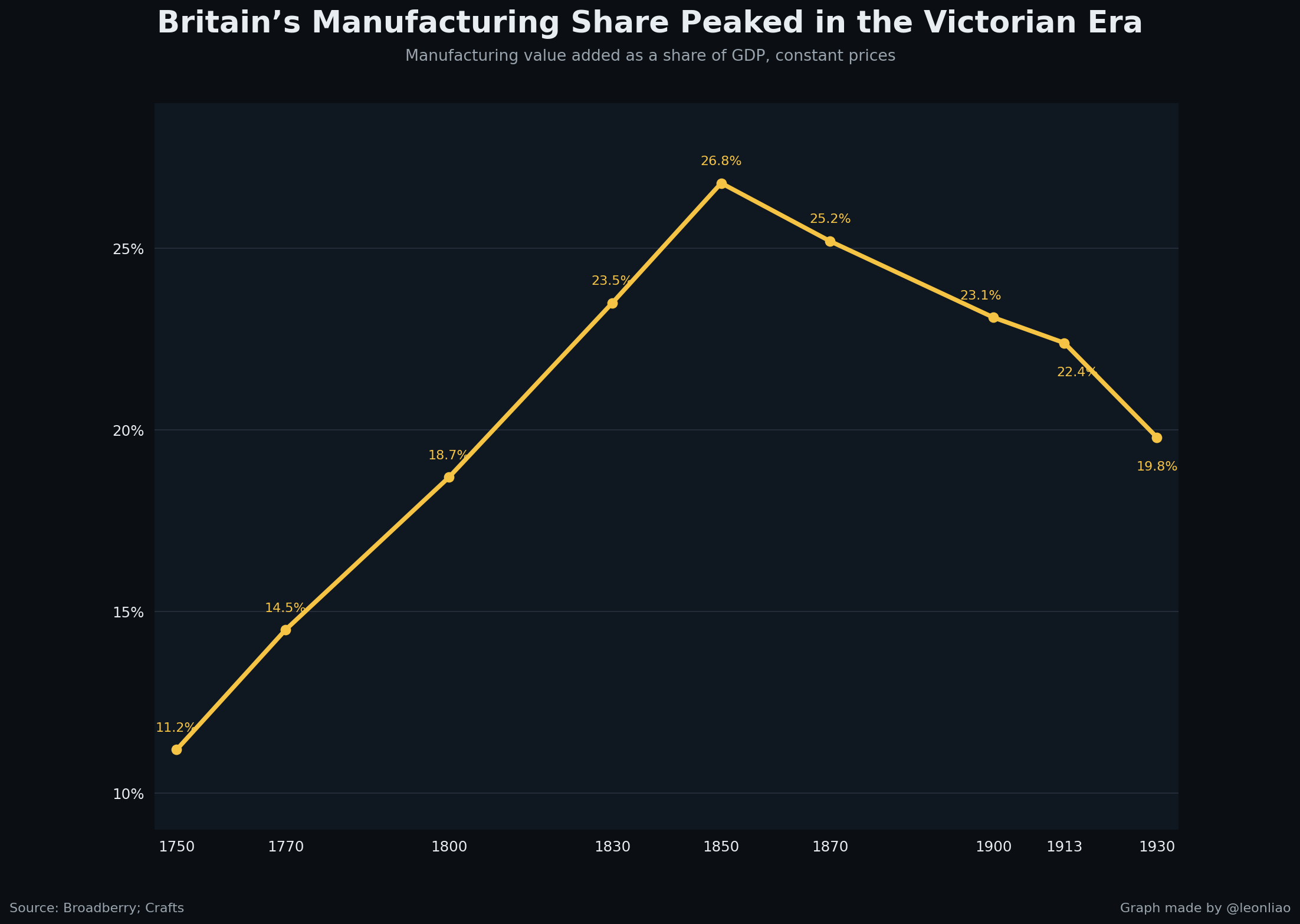
In the late eighteenth and early nineteenth centuries, Lancashire cotton mills were already operating. Manchester was becoming the world’s first modern industrial city. Coal, iron, steam engines, canals, ports, banks, and imperial trade were already reshaping the British economy. When the Industrial Revolution began around 1770, Britain’s manufacturing value added accounted for only 11.2% of GDP. By 1800, the manufacturing share had risen to 18.7%. Relying on steam power, coal resources, and overseas colonial markets, it expanded rapidly and reached 26.8% in 1850, making Britain the world’s first economy with manufacturing as its core pillar. After 1850, manufacturing’s relative share gradually declined: 25.2% in 1870 and 22.4% in 1913. The main reasons were the rise of London as a global financial center, the rapid growth of ocean shipping and overseas investment income, and the continued increase of services in GDP. At the same time, U.S. and German industrialization accelerated, narrowing Britain’s advantages in traditional textiles and crude steel.
At the same time, British politics was still controlled by property qualifications, landed aristocrats, commercial and financial elites, corrupt boroughs, and local influence.
Before the 1832 Reform Act, many industrial cities were underrepresented, rotten boroughs still existed, and suffrage was highly restricted. The 1832 reform expanded the middle-class male electorate, but most of the working class remained excluded, and women were excluded as well. The reforms of 1867 and 1884 further expanded male suffrage. Only in 1918 did Britain establish broad male suffrage and partial women’s voting rights. Only in 1928 did women receive voting rights equal to men.
By 1928, Britain had already completed the Industrial Revolution.
Britain’s real institutional advantage was the combination of liberal constitutionalism, property-rights protection, parliamentary finance, the Bank of England, the national-debt system, the navy, colonial markets, and the fiscal capacity created by excise taxes and tariffs. Britain was liberal first and democratic later. It had parliament, property rights, finance, empire, and the Industrial Revolution before it had mass suffrage.
Britain does not prove that mature liberal democracy created industrialization. It proves that a highly liberalized, rule-of-law-based, financialized parliamentary oligarchy could complete the Industrial Revolution before mass democracy arrived.
Britain’s factories came before Britain’s mass voters.
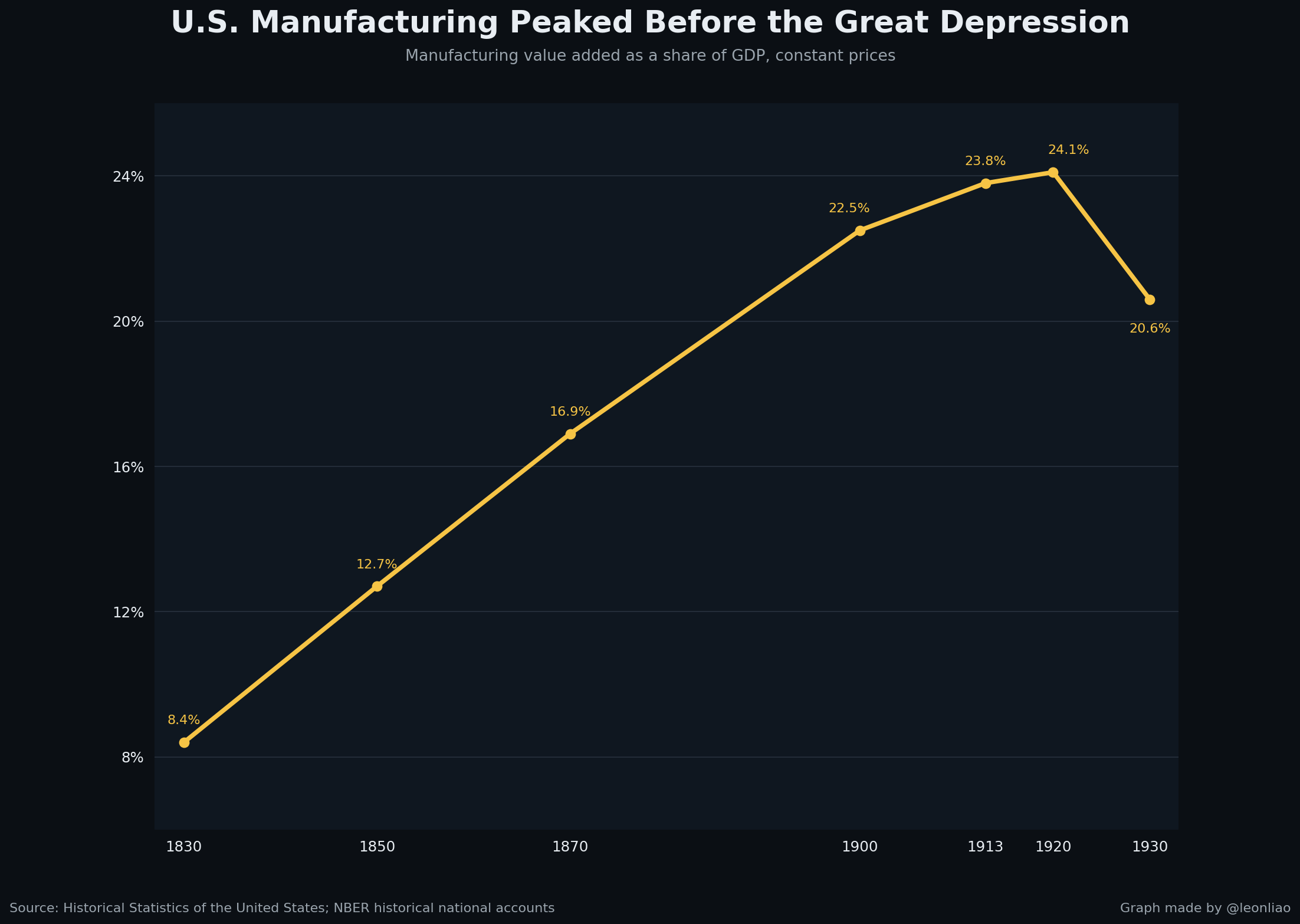
From 1830 to 1860, the United States went through its First Industrial Revolution. In 1830, manufacturing value added accounted for only 8.4% of GDP. The economy was still dominated by agriculture. Early northern textile industry depended heavily on cotton supplied by southern slavery. At that time, only white men possessed limited political rights, while slavery, racial exclusion, and the absence of women’s suffrage all coexisted. By 1850, manufacturing’s share had risen to 12.7%, while the dual economic structure between North and South continued to deepen. The federal government used protective tariffs to support northern manufacturing.
The Civil War from 1861 to 1865 was the key turning point in American state capacity and industrial transformation. Through national debt, legal tender, progressive taxation, military procurement, the Pacific Railway Acts, and the Morrill Land-Grant Acts, the federal government comprehensively strengthened its capacity for economic coordination. It connected continental infrastructure, finance, and industrial support into one system. The war abolished slavery, dismantled the old southern slave-based agrarian economy, released a unified national labor and commodity market, and cleared institutional obstacles for the explosion of heavy industry.
From 1865 to 1913, the United States entered the core golden age of high-speed industrialization. This was the Second Industrial Revolution, historically associated with the Gilded Age and the Progressive Era. Manufacturing’s share of GDP climbed from 16.9% to 23.8%. Through westward expansion and the seizure of Indigenous land, the United States obtained vast mineral, timber, and agricultural resources. Through federal land grants, it built a national railway network. Steel, electricity, oil, machinery, and heavy industry expanded on a massive scale. By 1894, the United States had become the world’s largest industrial power.
This decisive modernization process that established America’s industrial position unfolded throughout within an exclusionary limited-democratic system. After Reconstruction ended, the South systematically stripped Black Americans of effective voting rights. Women and Indigenous peoples long lacked full national voting rights. The so-called republican tradition covered mainly white men, and was far from a modern, equal, inclusive, mature liberal democracy.
World War I military-industrial demand briefly pushed industrial scale higher. In 1920, manufacturing’s share reached 24.1%. In the same year, women only then gained national voting rights, while racial voting discrimination in the South remained unresolved. The global Great Depression in 1929 then struck the industrial system, and by 1930 manufacturing’s share had fallen back to 20.6%.
The overall historical sequence is clear: American industrialization and the formation of the United States as an industrial power came far earlier than a complete liberal-democratic system covering all races and both sexes. America’s industrial rise depended on mechanisms that were neither purely free-market nor equally democratic: slave-produced raw materials, the seizure of Indigenous land, federal industrial support, protective tariffs, railways, land grants, and wartime state capacity. The claim that liberal democracy spontaneously generated industrial development does not fit the real American historical path. Inclusive universal democracy was a later reform, gradually completed only decades after industrialization had already taken shape.
Australia, Canada, and New Zealand are among the most easily overlooked cases in the liberal-democratic narrative. They inherited British rule of law, parliamentary tradition, and colonial self-government. They developed white electoral politics relatively early and entered high-income status relatively early. Today, all three are developed liberal democracies.
But in their early stages, their more accurate identity was white settler democracy, not modern inclusive liberal democracy.
Canada’s state-building and economic modernization took place inside the framework of the British Empire, colonial self-government, railway construction, protective tariffs, western settlement, and Indigenous exclusion.
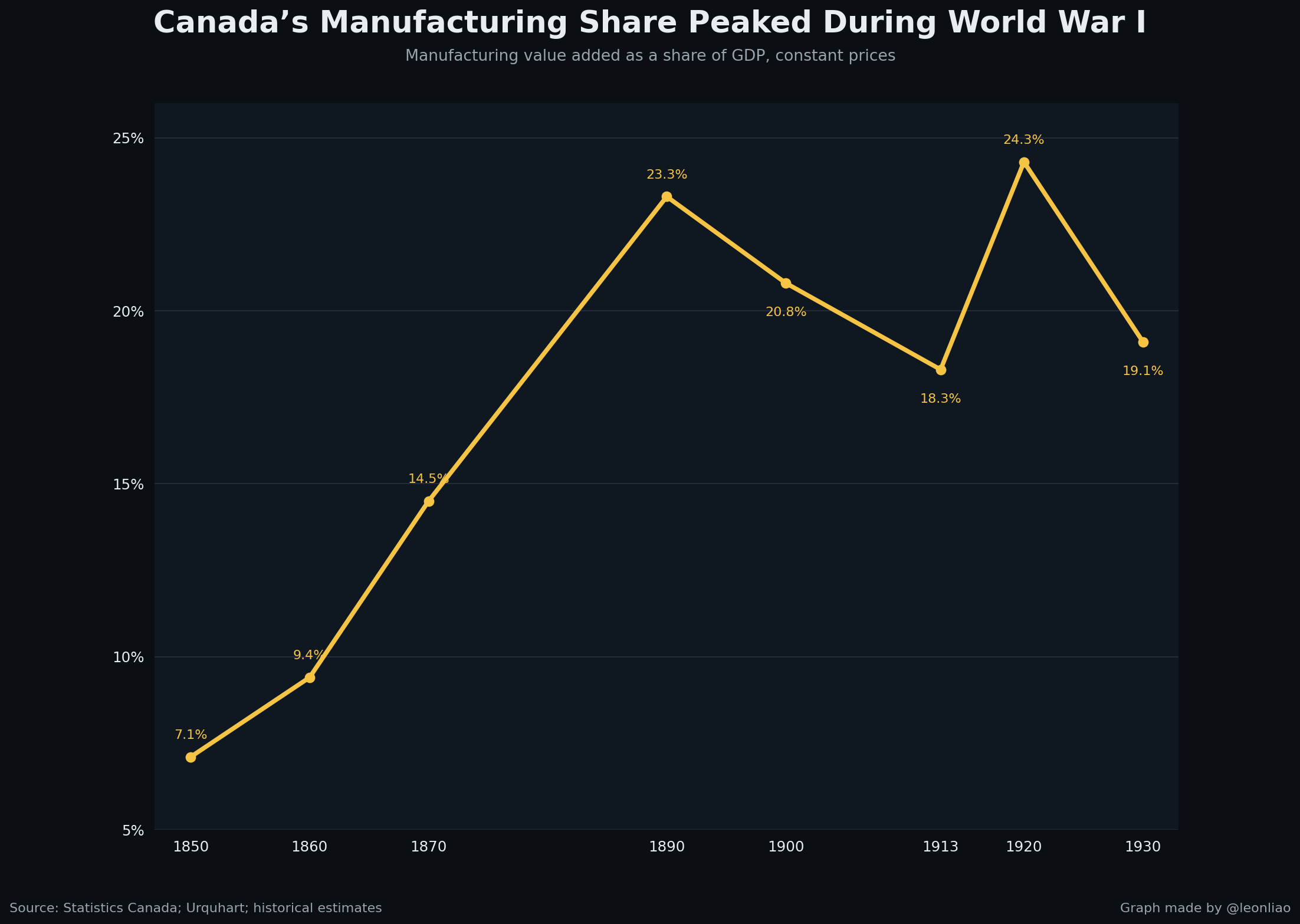
The Canadian Confederation was established in 1867. Internal trade barriers were removed, and a unified domestic market took shape. By 1870, manufacturing accounted for 14.5% of GDP. In 1879, the federal government implemented the National Policy, using a three-part strategy of high protective tariffs, transcontinental railway construction, and western immigration and settlement to strongly support domestic industry. From 1870 to 1890, manufacturing’s share rose rapidly to 23.3%. Large-scale factories in flour milling, steel, agricultural machinery, and textiles became widespread, marking the completion of Canada’s First Industrial Revolution.
From 1890 to 1914, Canada entered the golden high-growth phase of its Second Industrial Revolution. Relying on abundant hydropower, forests, and mineral resources, it developed high-value resource-processing industries such as pulp, non-ferrous metals, and heavy equipment. U.S. and British capital continued flowing in to support industrial upgrading. At the same time, wheat agriculture on the western prairies expanded rapidly, while manufacturing’s share of GDP remained broadly stable in the 18%–21% range.
This full process of modern industrialization took place under property-restricted suffrage. Women, Indigenous peoples, and Asian communities long lacked full political rights. The federal state promoted industrial development through strong intervention — tariff protection, land grants, and the dispossession of Indigenous land — rather than through spontaneous free markets and fully inclusive democracy. Before 1960, First Nations peoples could not participate unconditionally in federal elections. In many cases, if they wanted federal voting rights, they had to give up Indian status. This shows that Canada’s high-income transformation and state-building were not completed inside a fully equal civic community. They advanced through white settler self-government, imperial markets, resource development, railways, and Indigenous exclusion.
Australia was similar.
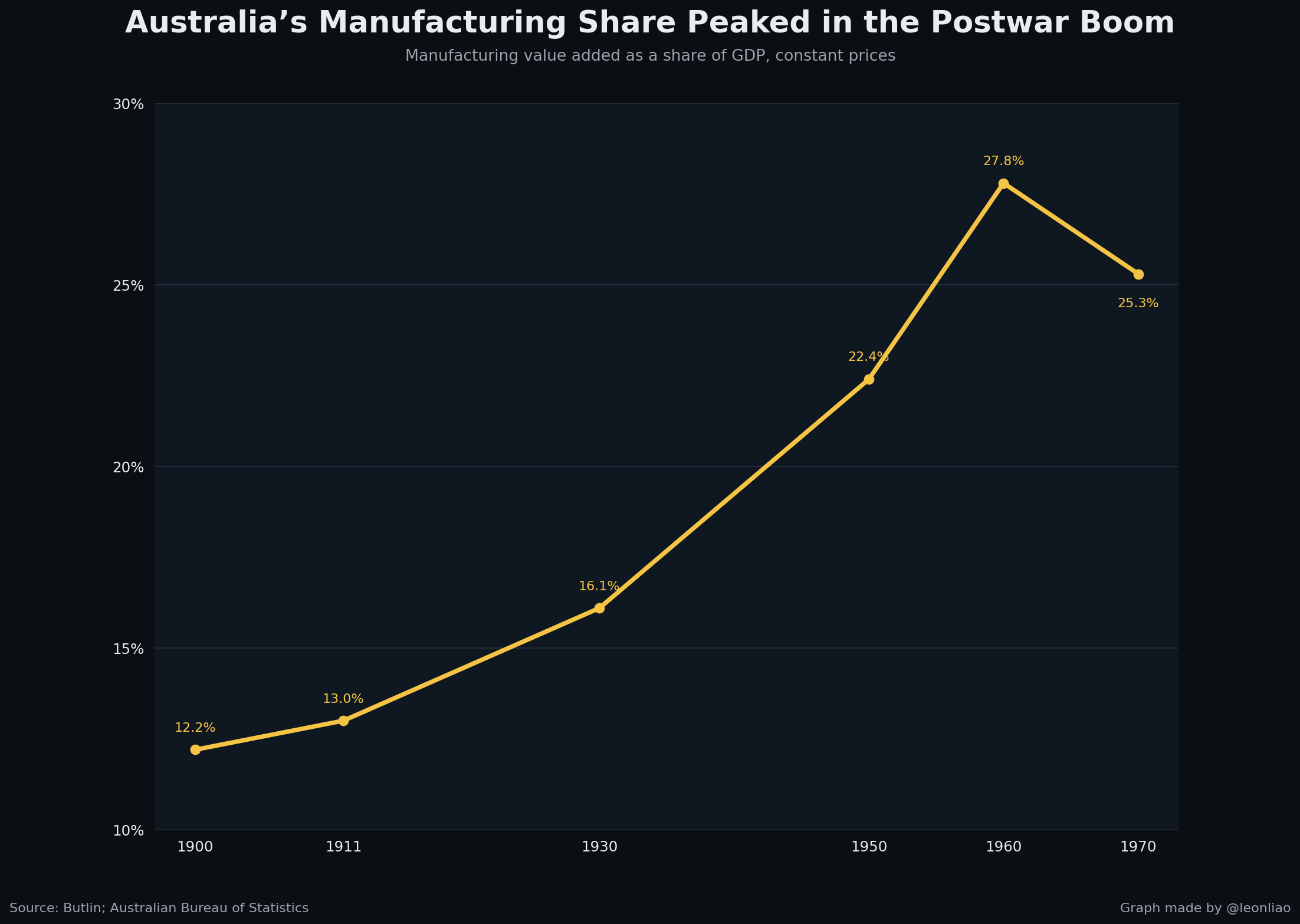
In 1901, Australia had not yet completed federal integration. Manufacturing value added accounted for only 12.2% of GDP. The economy relied overwhelmingly on primary-resource exports such as wool and gold, with only basic wool and food-processing industries. After the Australian Federation was established in 1901, interstate trade barriers were removed. In 1908, the federal government implemented protective tariff policies to support domestic light industry. By 1911, manufacturing’s share had edged up to 13.0%. World War I cut off the supply of overseas manufactured goods and forced the creation of domestic steel and military industries. The launch of the large Newcastle steelworks marked the formation of basic heavy industry. Under continuously rising tariff protection, manufacturing’s share of GDP increased to 16.1% in 1930, completing the basic chain of Australia’s domestic Second Industrial Revolution.
From 1939 to 1960, Australia entered its golden phase of high-speed industrialization. During World War II, government coordination of military production cultivated a complete engineering-manufacturing system. After the war, large-scale immigration supplied industrial labor, while long-term high tariffs continued to shelter import-substitution industries. Manufacturing’s share climbed all the way to 27.8% in 1960. Automobiles, metallurgy, chemicals, and heavy machinery all matured, and Australia decisively moved beyond a single economic structure based on primary-product exports.
During this deeper industrialization process, Indigenous peoples were long deprived of federal voting rights, and the political rights of some Asian minorities were restricted. Full political rights belonged mainly to the white mainstream population. This was an exclusive limited-democratic framework. The Commonwealth Franchise Act of 1902 gave women over twenty-one the right to vote and stand for federal office, which was very early by global standards. But the same political order also excluded large numbers of non-Europeans and Indigenous peoples. First Nations men and women did not receive voting rights in federal elections until 1962. Australian state-building was also closely tied to the White Australia policy. The Immigration Restriction Act of 1901 was one of the earliest laws after Federation, and its core purpose was to restrict non-white immigration, especially Asian immigration. Only in the 1970s was the legacy of White Australia fully dismantled.
At the same time, industrial expansion depended heavily on federal tariff protection, wartime administrative coordination, and the forcible extraction of land and resources from Indigenous peoples. It was not the spontaneous result of free-market evolution. Inclusive modern mass democracy covering all ethnic groups, genders, and minorities was a post-industrial institutional outcome, gradually completed only after industrial modernization had already taken shape.
New Zealand is equally complex. Women gained national voting rights in 1893, very early by global standards, and this was indeed an important milestone in democratic history. But New Zealand was a white settler colonial society. Its high-income transformation long depended on agriculture, land, imperial markets, colonial state-building, and the restructuring of Māori land ownership. Early democratic progress does not erase the colonial land order or the question of Indigenous rights.
Australia, Canada, and New Zealand together show that the early democracy of Commonwealth settler states was first and foremost settler democracy. Their liberal institutions and parliamentary self-government long coexisted with racialized citizenship, Indigenous exclusion, white immigration orders, and imperial markets.
Their later transformation into liberal-democratic states does not mean they were already fully inclusive liberal democracies during the early stages of high-income transformation and modernization.
Most developed countries today appear on the world stage as liberal democracies, high-income societies, or successful Western institutional models. From this, a very convenient historical explanation emerges: these countries became rich because they had liberal democracy, open markets, rule-of-law traditions, and civic politics.
The greatest problem with this narrative is that it turns outcomes into causes.
Britain today is a mature parliamentary democracy, but when Britain’s Industrial Revolution occurred, it was still a parliamentary oligarchy with limited suffrage. The United States today is seen as one of the core modern democracies, but nineteenth-century American industrialization took place inside a white male republic, alongside slavery, Indigenous land dispossession, and exclusionary citizenship. Germany today is a liberal-democratic state, but German industrialization occurred inside a Prussian-led monarchical, bureaucratic, and military empire. Japan today is a constitutional democracy, but Japan’s first industrialization took place under Meiji oligarchs, the emperor system, imperial bureaucracy, and the expansion of military power. South Korea and Taiwan today are successful democratization cases, but their industrial takeoffs occurred under military authoritarianism and one-party authoritarian rule.
The liberal-democratic narrative projects these countries’ later institutional forms back onto the early stages of their industrial takeoff. It describes political outcomes that matured only after industrialization as if they had already existed as institutional preconditions before industrialization.
This error is especially obvious in the Anglo-American settler world. Britain was a parliamentary oligarchy. The United States was a white male republic. Australia, Canada, and New Zealand were white settler democracies. They did contain many liberal institutional elements: common law, property rights, parliament, local self-government, commercial freedom, and relatively early white electoral politics. But these elements were not the same as modern inclusive liberal democracy. Slaves, women, Indigenous peoples, colonial populations, minority groups, and the proletariat were long excluded to varying degrees from full political membership.
Continental Europe followed the same pattern. Belgium industrialized early under restricted suffrage. Germany had a Reichstag, but executive power was not controlled by parliament. French industrialization was deeply shaped by the central administrative state and the Second Empire. Italy and Spain modernized for long periods through limited democracy, authoritarian rule, and state intervention. Swedish and Nordic welfare democracy was a political result formed after industrial society had already emerged. Switzerland achieved full adult democracy very late. Russia and the Soviet Union pushed non-liberal-democratic industrialization to its most extreme form.
So the key question is not what these countries are today. The key question is what political systems they had when their industrial takeoff began.
The historical record is clear: most successful industrializing countries were not mature liberal democracies during the early-to-middle stages of industrialization.
What early-to-middle industrialization needs most is not the efficiency of political expression, but the efficiency of state execution.
At this stage, countries are usually poor. Fiscal capacity is weak. Infrastructure is insufficient. Education levels are limited. Firms are small. Technological capabilities are thin. Capital accumulation is inadequate. Local society is powerful. Vested interests are dispersed. To push industrialization, the state must complete a series of high-intensity tasks in a short period of time: raise taxes, concentrate fiscal resources, build railways and ports, develop electricity and urban infrastructure, expand basic education, promote manufacturing, compress inefficient agricultural structures, reorganize land, absorb foreign technology, expand exports, and maintain policy continuity.
Politically, none of these tasks is popular.
Taxation generates resistance. Land acquisition generates resistance. Lowering consumption, raising savings, and expanding investment generate resistance. Changing land systems generates resistance. Building industrial zones generates local resistance. Pushing capital into higher-risk industries generates resistance from capital. Controlling wages and labor conflict generates resistance from workers. Protecting domestic industry generates resistance from consumers. Opening to foreign capital and technology generates resistance from domestic vested interests. Every industrialization policy creates short-term losers.
The core feature of mature mass democracy is precisely that it institutionalizes these voices of resistance.
In already industrialized high-income societies, this is extremely important. It protects rights, restrains state abuse, disciplines capital, expands welfare, reduces political violence, and channels social conflict into institutions. But in the early-to-middle stages of industrialization, a country often does not yet have enough fiscal, bureaucratic, educational, corporate, and social-organizational capacity to bear such a dense veto mechanism.
The greatest obstacle mass democracy creates in early-to-middle industrialization is low efficiency.
It turns every long-term construction task into a short-term distribution problem. Railway construction becomes a local compensation problem. Land reform becomes a vote problem between landlords and peasants. Industrial protection becomes a consumer-price problem. Export orientation becomes a wage-suppression problem. Fiscal concentration becomes a local-interest problem. Infrastructure investment becomes a debt-and-tax-burden problem. Education and industrial investment require ten or twenty years to show returns, while electoral cycles demand faster, more direct, and more visible distributive benefits.
Early-to-middle industrialization requires policy continuity. Mass democracy naturally produces policy swings. Industrialization requires the central state to concentrate resources. Mass democracy tends to strengthen the bargaining power of localities, departments, and social classes. Industrialization requires the state to suppress short-term consumption and expand long-term investment. Mass democracy tends to reward immediate distribution. Industrialization requires the state to resist social opposition for a period of time. Mass democracy rapidly converts social opposition into party competition, parliamentary obstruction, local vetoes, and policy reversals.
The more fundamental problem is this: in low-income countries, mass democracy often expands political participation before state capacity has been built.
State capacity has not yet formed, but veto power has already formed. Fiscal extraction remains unstable, but distributional demands have already risen. The bureaucracy is not yet professional, but party politics has already begun penetrating administration. Infrastructure has not yet been completed, but local interests can already block projects. The industrial system has not yet taken shape, but labor, capital, localities, and consumers can already mobilize politically around short-term interests.
This is why many countries have elections but remain unable to industrialize. Elections can generate legitimacy, but they do not automatically generate state capacity. Voting can organize political competition, but it does not automatically build railways, develop electricity, improve education, train engineers, concentrate fiscal resources, or maintain long-term industrial policy.
What early-to-middle industrialization fears most is not insufficient political noise, but the state’s inability to act efficiently.
If a low-income country enters highly fragmented mass democracy too early, it can easily fall into a low-level equilibrium: the government must please too many voters, accommodate too many regions, balance too many coalitions, compensate too many interest groups, and avoid too many short-term pains. The result is weak fiscal concentration, discontinuous policy, slow infrastructure delivery, difficult land reform, unstable industrial policy, and insufficient long-term investment.
Industrialization needs time. Mass democracy cuts time into electoral fragments. Industrialization needs concentration. Mass democracy disperses power. Industrialization needs the ability to bear pain. Mass democracy immediately politicizes pain.
This is the point the liberal-democratic industrialization narrative most avoids: in the early-to-middle stages of industrialization, mass democracy is often not an accelerator, but a source of resistance.
Authoritarian politics can reduce veto points, improve execution efficiency, concentrate fiscal and administrative power, and make it easier for the state to suppress short-term opposition while pushing long-term industrialization tasks. In this sense, authoritarian or quasi-authoritarian structures are often important political conditions in the early-to-middle stages of industrialization.
But authoritarianism is only a necessary condition, not a sufficient condition.
Many authoritarian countries did not industrialize. Many authoritarian countries had repression without construction; rule without organization; resource control without technological learning; bureaucratic commands without industrial efficiency; protectionism without productivity growth. Authoritarianism can reduce opposition, but it can also reduce correction. It can increase execution speed, but it can also execute bad policies more thoroughly. It can concentrate resources, but it can also concentrate those resources in palaces, armies, corrupt groups, and inefficient state-owned enterprises.
Argentina had high income early on, but later fell into long cycles of protectionism, inflation, debt, political swings, and inadequate industrial upgrading. Many Latin American countries had authoritarian rule and import-substitution policies, but failed to build sustained manufacturing competitiveness. Many postcolonial authoritarian states had strongman politics, but lacked professional bureaucracies, basic education capacity, industrial learning capacity, and stable policy execution. Republican China had markets, banks, entrepreneurs, universities, railways, and modern cities, but it did not form a fiscal and organizational state capable of penetrating the whole country. India has mass democracy, but has long been constrained by state capacity, land systems, basic education, infrastructure, and insufficient manufacturing organization.
These cases show that the absence of liberal democracy does not automatically produce industrialization. Authoritarian systems can drive industrial takeoff only when several other conditions are present at the same time.
They must have at least a minimal developmental objective, rather than pure predation. They must have a relatively professional bureaucracy, rather than a fully privatized ruling network. They must be able to concentrate fiscal resources, rather than being hollowed out by localities and privileged groups. They must maintain policy continuity, rather than falling into palace struggles and coup cycles. They must be able to learn foreign technology, rather than locking the country inside ideological fantasy. They must be able to correct mistakes, rather than turning every error into an untouchable political line.
So the conclusion of this essay is very limited, and precisely because it is limited, it is harder to refute:
Modern liberal democracy was not the precondition for the industrial takeoff of most countries.
This sentence does not mean that authoritarianism inevitably produces industrialization. It simply states a historical fact: most industrialization cases that eventually led to developed-country status were not mature liberal democracies during the early-to-middle stages of industrialization. Early-to-middle industrialization requires high efficiency, low veto points, and strong state capacity. Mature mass democracy usually becomes more stable only after industrialization has already taken place.
Read more:
A like, restack, comment, or share also helps this work reach more readers.
For a full guide to the publication and its main research series, start here: China as a System: Publication Map.
No posts
Comments
Nothing yet. Say the first thing.
Sign in to join the conversation.