
👋 Hey, Leo here. Antifragile Intelligence is where I explore how leaders think, decide, and build in uncertain environments shaped by technology and change.
Each edition is a reflection, a principle, or a field note from the work itself.
Hey Friends,
Welcome to the 166th edition of Antifragile Intelligence.
On Wednesday evening, I delivered an AI Second Brain workshop. Twenty-five people from the community stayed for a three-hour Zoom, which wasn’t without “A-ha” moments. It ended at 21:00, and I closed the laptop with that specific kind of exhaustion that means something actually happened.
The next morning I was reading about how Cerebras, a major AI hardware company, built their internal knowledge base. Their employees ask it more than 15,000 questions every day. No Obsidian graphs. No colorful network maps. Just a reliable pipeline that indexes Slack messages, Confluence pages, GitHub commits, and internal databases, and lets any employee ask questions in plain language and get answers from the company’s own data.
I had just spent three hours teaching individuals how to manage their own knowledge. And here was a company showing what it looks like when you try to do that at scale.
They are not the same problem.
In edition 158, one of the most popular articles on this Substack, I wrote about how notes compound: how the right architecture turns captured information into something that gets more useful over time rather than just accumulating. I described the vault, the slash commands (Claude skills), the moment when a note from six months ago surfaces exactly when you need it.
What I did not write about is what happens when you try to move that system one level up. From personal to organizational. From “my knowledge base” to “the company’s institutional memory.” From one person with a consistent system to five hundred people who each have a different system, or more often, no system at all.
That transition is not a scaling problem. It is a different problem entirely.
Most knowledge management inside organizations today works the same way most personal note-taking worked before anyone discovered second brains: people collect, clip, and dump things into shared drives and wikis and Slack channels that nobody can search efficiently. The information exists somewhere. The ability to retrieve it when you need it is mostly luck. And the more people contribute to the system, the less useful it becomes, because there is no organizing principle other than “put things in folders.”
We built filing cabinets and called them knowledge bases.
Let me explain a term you are going to hear increasingly: RAG (Retrieval-Augmented Generation)
When you talk to an AI model, it knows what it was trained on, and nothing else. It knows about the world up to some cutoff date. It does not know your internal processes, your Slack history, your Q3 strategy document, or what your best salesperson learned last month from a difficult client.
RAG is the technique that fixes this. Instead of relying only on what the model was trained on, you build a system that first retrieves the relevant context from your own data and then feeds that context to the model alongside your question. The model answers using your data, not just world data.
That is the whole thing, really.
The “augmented” part is the retrieval step sitting between the user and the model. And the way retrieval works in most modern implementations is through something called a vector database, which I find easiest to explain like this: instead of storing documents on a shelf organized by category, you store them organized by concept, so that when you search, you are searching by meaning rather than by keyword. “What was Paul talking about regarding embeddings last Tuesday?” finds the relevant Slack threads even if none of them use the exact words from your question.
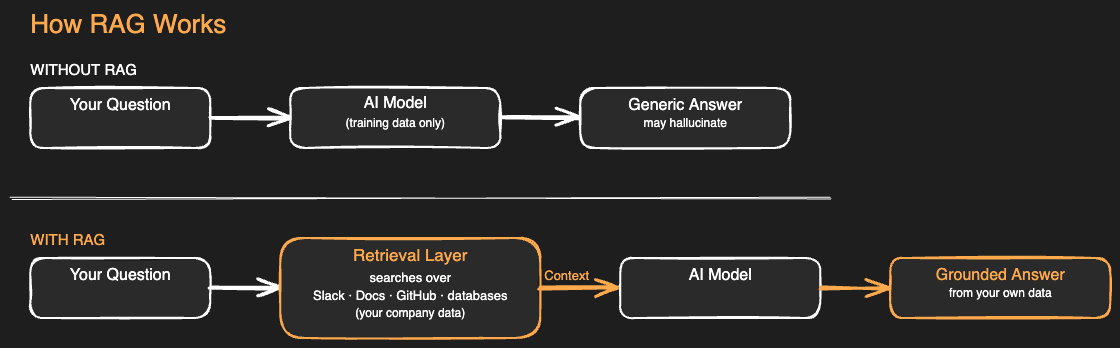
This is what Cerebras built, and many other companies are following through. Their engineers indexed Slack, Confluence, GitHub, internal databases, and more to build a query layer on top so any employee can find institutional knowledge in natural language, instantly, regardless of where it was originally created or by whom.
The result: Fifteen thousand questions a day, three months after launch.
Here is what most organizations are sitting on: years of accumulated knowledge, almost none of it accessible, in fact.
Your most experienced engineer knows why the payment system was built the way it was. Your best salesperson knows which clients look reliable but consistently pay late. Your senior consultant knows which approach failed spectacularly in 2021, and why the post-mortem that was supposed to capture it was never actually written.
That knowledge exists.
But it lives in someone’s head, or in an email thread nobody can find, or in a document last updated when the project closed and never touched again.
When those people leave, the knowledge leaves with them.
A personal second brain solves an individual knowledge management problem. An enterprise RAG system solves something different: organizational memory that does not depend on any specific person staying. The company gets to remember what it learned, not just the people who were there when it happened.
This is especially important right now, when AI adoption is moving fast enough that teams learning in January are ahead of teams starting in September. The teams that capture what works (which prompts, which tools, which workflows) compound that learning. The teams that do not are starting from scratch every quarter, and wondering why adoption feels slow.
Most of the content you will see on enterprise AI knowledge management is either vendor marketing or the hype-adjacent variety. So let me try to be honest about what actually makes this hard, because the technology part is, relatively speaking, the easy part.
Data quality is brutal at scale. If your Slack contains a lot of noise, which most Slack workspaces do, the retrieval layer will surface noise. RAG does not magically improve low-quality inputs. It just makes them queryable. The Cerebras approach works partly because they have engineers who understand what they are indexing. Most organizations do not have that person, and are not yet thinking about hiring one.
Trust is the more serious obstacle. People will not contribute honestly to a system they suspect is being monitored. If employees feel their Slack messages, their draft documents, their honest assessments of a project could be retrieved and used in ways they did not expect, they will write differently. The same candor that makes institutional memory valuable is exactly what disappears once people know it is being indexed. You have to think through governance before you build, not after.
Maintenance is real work. A vector database does not update itself. Someone needs to own the ingestion pipelines, manage what goes in, handle edge cases, clean out what has become stale or misleading. This is a function that does not yet exist in most organizations, and “we will just have IT manage it” is not a plan.
And hallucination does not go away; it just changes shape. RAG significantly reduces the problem of a model making things up, because the model is working from real data. But it can still synthesize confidently in a direction that is wrong, especially if the underlying data is incomplete or contradictory. For anything compliance-related, you need human review in the loop.
None of these are impossible to manage. But every one of them is an organizational problem, not a technical one. Buying a RAG tool does not solve them. It just makes the gaps visible faster.
The fragile organization stores its knowledge in its people. When the people leave, the knowledge leaves.
The resilient organization documents its knowledge in processes. The processes survive turnover, but they calcify. They capture what was true when they were written.
The antifragile organization builds systems that get more useful the more the organization generates: more projects, more decisions, more failures, more conversations. The knowledge base grows stronger under load, not weaker. Each new question improves the next answer.
That is the frame. And the gap between understanding it and actually building it is enormous.
Most organizations are still at the shared-drive stage: four competing wikis, a Confluence that nobody updates, a SharePoint that someone once ‘organized’ and that now nobody trusts to be current.
The personal second brain taught me that the biggest obstacle is never the tool. It is the discipline of ingesting honestly and retrieving intentionally. I suspect that is exactly as true, maybe more true, for organizations. The technology is available. The harder decision is treating institutional memory as something worth investing in before the person who carries it hands in their notice.
The question I will leave you with:
if the person in your organization who knows the most about how things actually work left next month, what would remain?
Until next time,
Leo
The article on how Cerebras built their Second Brain.
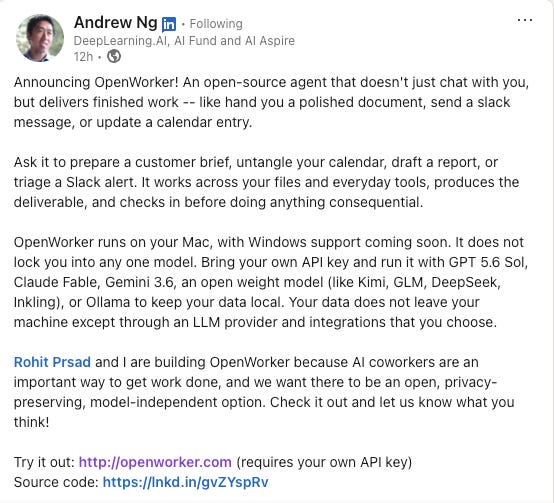
Andrew Ng, one of the persons I admire most in the AI space (also one of the pioneers in the field) just released an open-source agent which seems to be a Cowork clone which you can use with any other LLM, not just Anthropic. I’ll give this a try soon.
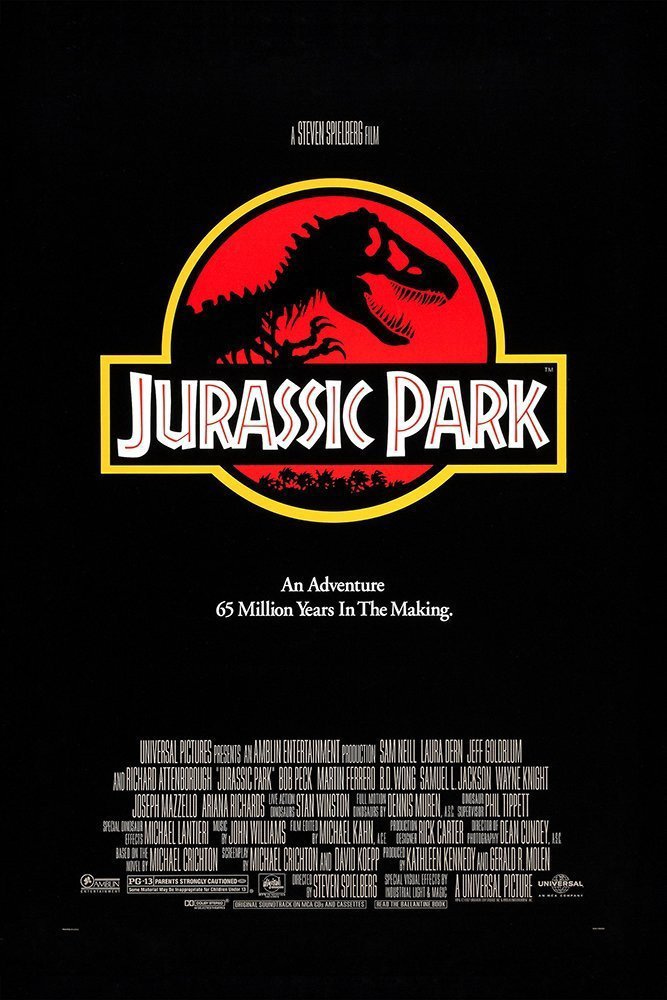
I saw the movie Jurassica Park, the original one, after more than 20 years and it still delivered a very pleasant experience. No wonder many people consider it Steven Spielberg’s best movie.
Thank you for reading.
If this resonated, forward it to someone who might benefit from it.
Stay antifragile.
Leo
If you enjoyed this piece and want to support my writing, please consider sharing it and becoming a paid subscriber.
Comments
Nothing yet. Say the first thing.
Sign in to join the conversation.