
👋 Hey, Leo here. Antifragile Intelligence is where I explore how leaders think, decide, and build in uncertain environments shaped by technology and change.
Each edition is a reflection, a principle, or a field note from the work itself.
Hey Friends,
Welcome to the 165th edition of Antifragile Intelligence.
I have spent four editions building a case against current organizational structure.
I told you the data on flattening: that middle managers went from a fifth to a third of corporate layoffs in four years, that middle-management hiring is down 43%, that the org chart you grew up with is being quietly dismantled while everyone argues about return-to-office.
I walked you through three companies, Haier, Block, Nvidia, that have already restructured around radically different org models, and I made the case that what was previously reserved for extreme founders like Zhang Ruimin and Jensen Huang is now available to the rest of us, because the coordination infrastructure they built by force of personality is now buildable in software.
Then I took half of that back. I gave you the counter-evidence almost nobody quotes: Korn Ferry’s “megamanager hangover,” Gartner telling CFOs out loud to reset expectations, BCG and MIT finding that even the heaviest agentic-AI adopters mostly don’t expect to cut middle management, the 77% of EU workers asking for more management involvement, not less. I argued that the consensus is not wrong but partial, and that the difference between strong flattening and fragile flattening is whether you redesigned the role before you cut the people doing it.
Then I gave you a diagnostic. Two lists: the five categories of management work AI genuinely replaces, the five categories it genuinely does not. A routing fraction. A way to look at your own management layers and tell, with reasonable precision, where each role sits on the obsolescence curve.
Today I close the series.
Five decisions, one frame, and what it actually takes to make your organization stronger from this disruption rather than weaker.
Let me give you the frame first, because the decisions only make sense inside it.
There are three kinds of organizational response to a disruption like this one.
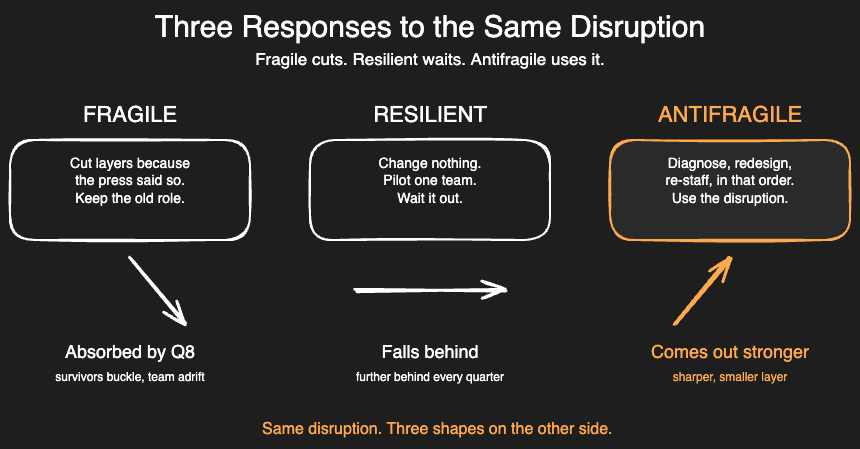
Fragile organizations cut layers because the press told them to. They flatten without redesigning the role. They survive the first quarter. By the second year, they look like the Korn Ferry data: a team of executives carrying expanded scope they privately doubt they can deliver, a workforce that feels directionless, an HR function watching it happen with no leverage to fix it. The fragile org has bought short-term margin by giving up long-term capability. Eventually, a smaller competitor with sharper management eats their lunch.
Resilient organizations cut nothing. They watch the disruption happen and decide to wait it out. Maybe they pilot AI in one team. Maybe they ask consultants to write a strategy deck. They preserve the organization they have. They survive longer than the fragile ones, but they fall further behind every quarter. Eventually they get absorbed by something smarter, usually a company that did the work they didn’t.
Antifragile organizations do something different.
They look at the disruption and ask:
What does this make possible that wasn’t possible before, and how do we end up stronger?
That is the antifragile frame. The disruption is not avoided nor survived. It is used.
The shape of the organization on the other side is more capable than the shape going in.
Every decision below sits inside that frame. The decisions are not “how do I survive AI?” but “how does my organization use AI to become a version of itself that could not have existed before?”
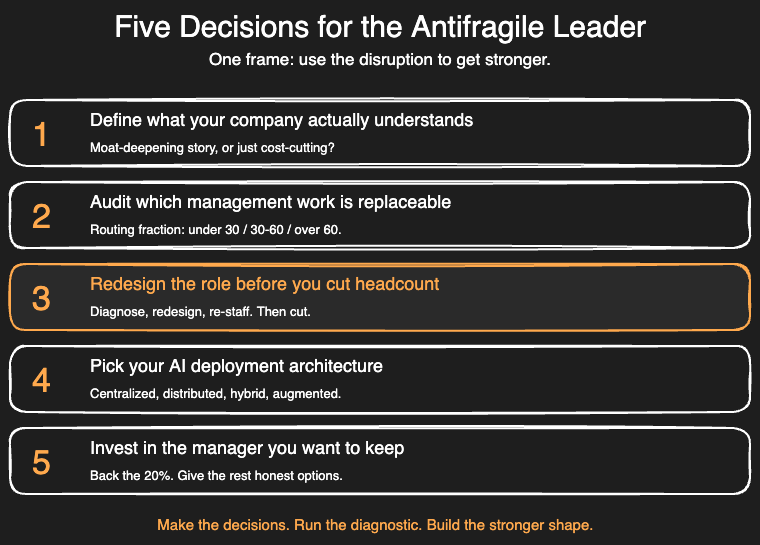
Define what your company actually understands.
Go back to Dorsey’s question, the one I asked you to write down in the first edition. What does your company understand that is genuinely hard to understand, and is that understanding getting deeper every day?
If the answer is “nothing in particular,” AI is a cost-cutting story for you and your competitors will eventually absorb you. Stop reading this newsletter and start having that conversation with your board.
If the answer is something concrete, then AI could be a moat-deepening story, and the entire conversation about flattening reframes around how AI can deepen what your company already knows.
This decision precedes every other decision. Make it explicitly. Write the answer down. Disagree about it with your senior team until you have something sharp. “We’ll figure it out” is not the answer you are looking for.
Audit which management work is replaceable.
Run the routing-fraction diagnostic from last week. Take the top three management layers. Map the five replaceable categories against actual time use. Get a number.
Under 30%: invest in upskilling, hold the layer. Between 30% and 60%: redesign the role. Over 60%: the role is structurally obsolete, redesign it before you cut anyone.
This audit takes a week, and most companies have never done it. The fact that they have not done it is exactly why so many of the layoffs from the previous years were so badly executed.
Redesign the role before you cut headcount.
This is the decision I most want every CEO and CHRO reading this to internalize. The Korn Ferry data is unambiguous: companies that cut layers before redesigning the role end up with the megamanager hangover. Companies that redesign the role first and let some layers fall out as a consequence get the strength without the fragility.
The sequence matters: Diagnose. Redesign. Then re-staff. Then, if cuts are still needed, cut, surgically, individually, with honest options for the people not making the transition.
Reverse this sequence and you have chosen the fragile path.
Pick your architecture.
Flattening is non-monotonic and depends on deployment architecture. That’s not me; that’s a 2025 working paper modelling four different GenAI deployment patterns. The result it found: span of control contracts first and then expands, and the curve depends entirely on which architecture you build.
You have to pick yours. The four real options are:
Centralized: one shared world model for the whole company. High cost, high payoff, requires sophisticated data infrastructure. A Block, if you have the transaction signal to feed it.
Distributed: each team has its own model. Lower cost, faster to start, harder to coordinate across teams later.
Hybrid: a composite of the two. Most realistic for large companies.
Augmented hierarchy: existing managers get AI assistants and nothing structural changes. Lowest cost, lowest payoff, lowest risk.
There is no universally correct answer. There is a correct answer for your company, which depends on the maturity of your data infrastructure, the type of customer signal you have, and your operating cadence.
The wrong move is to not pick anything and let the architecture emerge accidentally from whichever pilot is most visible inside the company. That happens by default. Don’t let it.
Invest in the manager you want to keep.
The companies that win the next decade are not the ones with the fewest middle managers. They are the ones with the best middle managers, the ones who learned to become context-setters, AI-system designers, validators, and coaches.
Identify the 20% of your current managers who can make that transition. Tell them you are investing in them.
Train them. Pay them more. Give them more scope.
For the rest, the other 80%, give them honest options. Either invest seriously in upskilling them (with the shared understanding that not everyone will make it), or help them transition out before they get cut by the next budget cycle.
Stop assuming the system will sort the talented from the obsolete. It won’t. The market for the upgraded manager is already tight and getting tighter. Whoever invests in their managers first ends up with a structural advantage that will not be available three years from now. And remember the European data: 77% of workers are asking for their managers to be more involved in this, not less. The demand for the redesigned manager is already there. The supply is what’s missing.
Let me bring this back to where the series started.
Two thousand years ago, the Romans figured out the limit of human coordination. A leader can manage between three and eight people. So large organizations need layers. Each layer adds span of control. Each layer slows information flow. Eight, eighty, four hundred eighty, five thousand.
For two thousand years, the layers were the only option. Every coordination technology we built, from Roman roads to Prussian general staffs, American railroads, the telegraph, the fax machine, email, Slack, was built as a tool for humans to do the routing better. None of them replaced the human.
AI does. Not perfectly. Not in every context. Not all of the routing. But enough of it that the org chart you grew up with is no longer the optimal shape for what comes next.
That is the threat. It is also the opportunity.
The threat is that companies that respond fragilely, cut layers because the press told them to, end up worse than before. Survivors who can’t carry the load. Workforces that feel directionless. AI tools half-deployed because nobody has the time to design them properly.
These companies look efficient in quarter one and are absorbed by quarter eight.
The opportunity is that companies that respond antifragilely, diagnose, redesign, re-staff, in that order, end up with a sharper management layer, a clearer architecture, a workforce that knows where the company is going and why, and an AI substrate that genuinely makes the company understand more than it did before.
The shape of your company in 2030 will not be the shape it has today. That is now certain. The shape it takes, and whether the version of your company that exists in the future is stronger or weaker than the version that exists today, that is up to you.
This newsletter is called AI = Antifragile Intelligence because the only useful response to disruption is to get stronger from it.
Not to survive it. Not to manage through it. Not to wait it out. To get stronger.
The five decisions I gave you above are how that happens in practice. They are not easy. They are deeply uncomfortable. They will require you to have conversations you have been avoiding for two years.
But the alternative is the Korn Ferry hangover. Or worse, absorption by a smaller competitor who took the disruption more seriously than you did.
Make the decisions. Run the diagnostic. Pick the architecture. Invest in the people who can do the new work.
That is what an antifragile organization looks like.
That is what I want you to build.
Until next time,
Leo
P.S. I am turning this series into a two-hour talk delivered live to your executive team or board. Contact me if you’re interested.
This was Edition E, the close of a five-part series on how AI is reshaping organizations. Thank you for reading the whole arc with me.
As I said several times in the past, I think people who want to get seriously into AI need to go beyond prompt engineering (which is more or less obsolete) and need to understand how agents work and run. As someone who is a Claude Certified Architect, I cannot stress the quality of the free courses from Anthropic enough
Vercel launched an easy and intelligent way of building AI agents
One of the funniest things online, revisited after a few years.
Thank you for reading.
If this resonated, forward it to someone who might benefit from it.
Stay antifragile.
Leo
If you enjoyed this piece and want to support my writing, please consider sharing it and becoming a paid subscriber.
Dorsey, J. & Botha, R. (March 31, 2026). From Hierarchy to Intelligence. Sequoia Capital. https://sequoiacap.com/article/from-hierarchy-to-intelligence/
Live Data Technologies. Middle managers rose from about 20% of US corporate layoffs in 2019 to 32% in 2023, a fifth to a third. https://www.livedatatechnologies.com/layoffs-by-job-level
Revelio Labs. US middle-management job postings down about 42% from their April 2022 peak (as of late 2025). Reported by Bloomberg, “Why Companies Are Cutting Middle Managers in the AI Era” (June 17, 2026). https://www.bloomberg.com/news/articles/2026-06-17/why-companies-are-cutting-middle-managers-in-the-ai-era
Korn Ferry. Workforce 2025 research: 44% of US employees report manager-level cutbacks, 40% feel a lack of direction, and 72% of US executives (47% of global peers) say they are stretched beyond their capabilities. “Megamanager era” is Fortune’s framing of these findings. https://www.kornferry.com/about-us/press/korn-ferry-reveals-workforce-2025-research
Gartner. “CFOs Should Reset Expectations About AI’s Impact on Workforce Productivity and Headcount” (March 25, 2025). https://www.gartner.com/en/newsroom/press-releases/2025-03-25-gartner-says-cfos-should-reset-expectations-about-ais-impact-on-workforce-productivity-and-headcount
BCG × MIT Sloan Management Review. The Emerging Agentic Enterprise: How Leaders Must Navigate a New Age of AI (November 18, 2025). Only 45% of agentic-AI leaders expect a reduction in middle-management layers; the report frames adoption as running ahead of organizational readiness. https://sloanreview.mit.edu/projects/scholars/the-emerging-agentic-enterprise-how-leaders-must-navigate-a-new-age-of-ai/
CEC European Managers, citing the European Commission Eurobarometer survey (April–May 2024), Managers and AI: 77% of EU workers want managers actively involved in AI design and execution. https://www.cec-managers.org/managers-ai-eurobarometer-commission/
Hoffmann, M., Boysel, S., Nagle, F., Peng, S., & Xu, K. (2025). Generative AI and the Nature of Work. Harvard Business School Working Paper 25-021. https://www.hbs.edu/faculty/Pages/item.aspx?num=66593 (SSRN: https://papers.ssrn.com/sol3/papers.cfm?abstract_id=5007084)
Xu, F., et al. (2025). Generative AI and Organizational Structure in the Knowledge Economy. arXiv:2506.00532. Models four GenAI deployment architectures; span of control contracts before expanding (non-monotonic). https://arxiv.org/abs/2506.00532
Comments
Nothing yet. Say the first thing.
Sign in to join the conversation.