
👋 Hey, Leo here. Antifragile Intelligence is where I explore how leaders think, decide, and build in uncertain environments shaped by technology and change.
Each edition is a reflection, a principle, or a field note from the work itself.
Hey Friends,
Welcome to the 167th edition of Antifragile Intelligence.
“Keep your options open” is one of those phrases that sounds like wisdom and functions like an excuse. I’ve said it to myself more times than I want to admit, about the courses I haven’t finished, the workshop I keep meaning to scale, the conversations I kept postponing “until I have more data.” Every one of those postponements got dressed up as optionality. None of them were.
Real optionality has a name; Nassim Taleb calls it the barbell.
I wrote about this in more detail in this piece:
Picture an actual barbell: weight on one end, weight on the other, nothing in the middle.
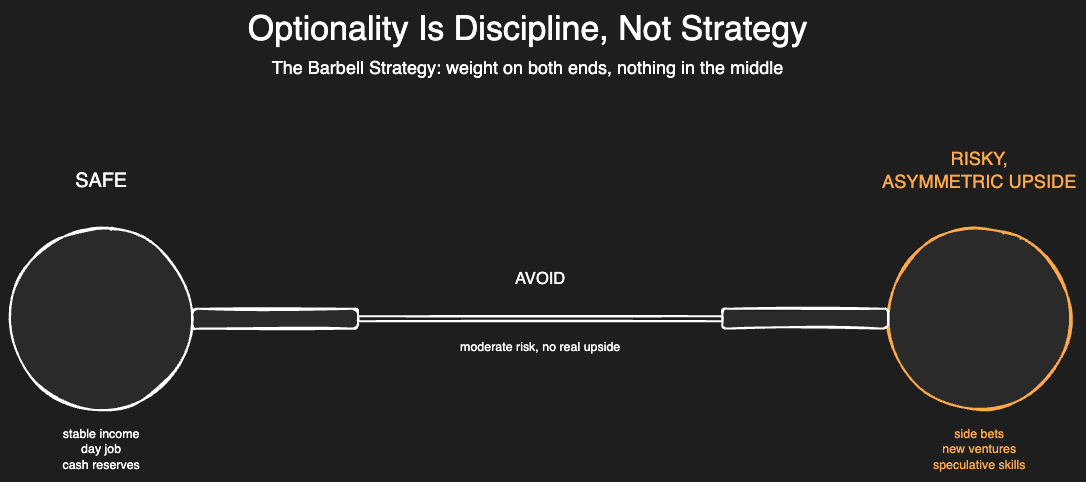
Applied to a life or a career, it means putting most of your resources somewhere very safe (a stable income, cash reserves, a job that pays reliably) and a small amount somewhere very risky with real upside (a new venture, a skill nobody’s paying you for yet, a bet that could fail completely and cost you little because you sized it that way).
What you deliberately avoid is the middle: the moderately risky, moderately safe choices that feel balanced but actually expose you to real downside without real upside.
Safe plus a few bold swings beats cautious-in-the-middle almost every time.
That’s the theory, and it’s a good one.
The part people skip is that both ends need actual weight on them. I noticed the gap in my own week. I started a course. I said yes to another workshop. I’ve been telling myself that counts as feeding the risky end of the bar. Some of it does. But if I’m honest, more of it has been consumption than commitment, watching, subscribing, reading, without the harder step of putting something out that can fail in public and cost me something if it does.
Three examples, because the idea is easy to nod along to and easy to not actually do.
The financial version is the cleanest: most of your savings in something boring and safe, a small slice in something with real asymmetric upside, and nothing in the mushy middle of “moderately risky funds” that carry real downside for mediocre reward. Most people get this one right without thinking about it, because a bank statement makes the imbalance obvious.
The career version is where most people live right now: a stable job as the safe end, and a handful of side bets, a course, a workshop, a piece of writing, as the risky end. The trap isn’t taking the safe job. It’s calling the mere existence of the side bets “diversification” while never actually pushing any of them hard enough to find out if they work. A side bet you’re not feeding isn’t the risky end of the barbell. It’s just a hobby with better branding.
The skills version is the quiet one. Most of your learning time should go toward getting excellent at the thing that already pays you. A smaller, deliberate slice should go toward something genuinely speculative, a tool, a domain, a way of working that might be worthless in two years or might be the thing that redefines what you do. What kills people here isn’t picking the wrong speculative skill. It’s spreading that slice across six half-started things instead of committing real hours to one or two.
None of that is comfortable. Comfortable is always the sentence that sounds like patience but is actually just delay with better branding.
Optionality only pays off for the people who treat it as work, not as a mood. The barbell doesn’t protect you because you built it once. It protects you because you keep feeding both ends of it, on purpose, on a schedule, especially in the weeks it would be easier not to.
I don’t have this fully figured out. I’m writing this edition partly to hold myself to it.
The question I’ll leave you with:
Which of your open options did you actually feed this week, and which one have you just been quietly not closing?
Until next time,
Leo
This official Anthropic guide on prompting Opus 5.
This website shows the performance of several AI agents.
Very interesting interview with one of the people I admire most, Ray Dalio.
Thank you for reading.
If this resonated, forward it to someone who might benefit from it.
Stay antifragile.
Leo
If you enjoyed this piece and want to support my writing, please consider sharing it and becoming a paid subscriber.
Comments
Nothing yet. Say the first thing.
Sign in to join the conversation.