
Dear Lennard,
Your article on premature beats was very timely for me. I’m at a weeklong cycling event (the French ‘Semaine Fédérale’). I have a history of premature beats but haven’t had them much in recent years. Two nights ago, lying in bed, I noticed I was having frequent premature beats. A little while later, my pulse, normally around 50 at rest, rose briefly to 120, then 100, and settled at 80. My pulse was strong and regular, so I don’t think I was in fibrillation, and getting up and walking around I felt just fine. By morning everything had returned to normal; I had my blood pressure checked, and it was normal; and on my rides yesterday and today my speed and heart rate on the bike (on the flat and up hills) were the same as always. I’m 74 years old and have no history of heart trouble. What do you think was going on? Could the fact that I was feeling stressed on the way to the event (we couldn’t find charging stations for our electric car) have been a contributing factor ?
Geoffrey
Dear Geoffrey,
It’s possible that the travel and the stress you experienced on your way to the event could have contributed to the premature beats and the elevated nighttime heart rates you noticed. I understand what range anxiety can be like, as we’ve had electric cars ever since 2016, with the first one only having a range of 85 miles!
That said, riding 50-150km a day for a week at age 74 is also a lot for your heart and could be enough to account for your experience right there. After a hard ride—defining this at my age now as anything from riding in high heat to riding lots of elevation gain to riding many hours on the bike—I notice my heart being more sensitive. I feel more PVCs, more moments feeling out of sinus rhythm, and generally of my heart acting up and creating weird feelings in my chest.
I think if this happens more often at non-stressful times, it’s worth consulting a cardiologist.
― Lennard
Dear Lennard,
For years I had occasional PVCs on my checkups and they were ruled benign. Three years ago I noticed the frequency had increased and it felt like someone was poking me in the chest. My HR monitor started showing weird spikes even when I was resting, and I thought it was defective. Asked my cardiologist if it could be real, and he said maybe.
Did the Holter monitor, and it was recommended I get an ablation. I asked Dr. what I could do to reduce the PVCs in lieu of the ablation. He said alcohol and caffeine. I cut back from 4 cups to one cup of coffee and reduced wine from two drinks a night to one a week. In a year, the PVCs dropped to 2%, and in two years to less than 1%, which is in the normal range. You really can help yourself.
Great article, Lennard.
David
Dear David,
Thanks for sharing that. Did more long-term ECGs with a Holter monitor allow you to document those improved percentages?
You have a wise doctor, and you have the wisdom to listen to the advice. It’s outstanding that you got that result without having to resort to medical intervention.
Incidentally, we have a graph in The Haywire Heart that shows a direct linear relationship between alcohol consumption and incidence of AFib.
― Lennard
Dear Lennard,
Your recent column on PVC’s/PAC’s was very timely for me.
Two years ago, my cardiologist noted that I had infrequent premature contractions and said to continue life as normal unless I see significant change. Follow up in two years.
After nearly 2 years of no issue, I started in mid-May to have more frequent PC’s, with a longer duration before the rhythm reset back. These were most notable when I was doing longer threshold/tempo level intervals.
I was surprised, as I had trained extensively at comparable/higher levels without issue, from Dec though April, preparing for an ultra-distance ride the first weekend in May. As I had my 2-year checkup on the calendar, I dialed back on the efforts but still had more frequent instances of the PC’s with longer duration.
In parallel, I have been seeing a sleep specialist since last fall for insomnia issues. The latest treatment was low dosage of an anti-anxiety medication intended to reduce the “racing thoughts” I experience when trying to sleep. After several months, I decided to stop the medication, as the side effects outweighed the benefit. The same day I met with the sleep specialist to stop that treatment, I read your column on PVCs and wondered if my medication (generic Seroquel) had an effect.
While a general search on Seroquel side effects did not indicate any issues, a search on Seroquel and PVC/PAC was highly illuminating.
Summarized from an NIH paper (citation below), “Seroquel (quetiapine) can occasionally trigger or worsen premature ventricular contractions (PVCs) and cardiac rhythm changes, though it is more widely known for causing QT interval prolongation and rapid heart rate. While benign ectopic beats like PVCs and PACs (premature atrial contractions) often occur without a clear cause, starting or changing the dose of an antipsychotic can influence heart rhythm stability.”
This information came to me between my Cardiologist visit and the placement of a Holter monitor for longer term evaluation. I plan to further discuss medication impact with him at my follow up. I’m also tracking PVC frequency and duration to see if there is a change as the medication works out of my system; initial indications are positive.
As a cautionary tale, anyone with PVC’s on anti-psychotic medications might want to follow up with their Cardiologist.
Here’s the paper:
Deguchi A, Nakamura M, Hayashi T, Sano A. Quetiapine-induced frequent premature ventricular contraction. Gen Hosp Psychiatry. 2012 Mar-Apr;34(2):211.e1-3. doi: 10.1016/j.genhosppsych.2011.11.003. Epub 2012 Jan 13. PMID: 22245024.
Robert MacKenzie
Dear Robert
Wow. That’s good to know. And quite sobering. Thanks for the reference to the paper.
I hope your sleep issues resolve and the Holter monitoring shows the premature beats decreasing in frequency. For whatever it’s worth, my friend Lou Morgan told me at the Texas A&M wind tunnel in the early ‘90s before I’d written any books that, “Lennard, you should write a book. It would be great for insomniacs, because that s__t you write in VeloNews is so boring that it can put anybody to sleep.”
― Lennard
Dear Lennard,
I’ve had PVC’s for a long time, first noted around 2012. They show up at rest and while exercising and have been present on formal medical stress tests with my heart rate at maximum. I had paroxysmal AFIB following a STEMI in 2023 but haven’t to my knowledge had an AFIB incident since an ablation in 2024. I haven’t experienced a connection between my PVC’s and AFIB.
I find it interesting that you can feel PVC’s, as even when I observe them on a live ECG, I don’t feel them. My heart rate is typically low 40’s, perhaps dropping to mid 30’s overnight. I also find it interesting that my PVC’s don’t seem to concern my cardiologists. They seem to see them as benign. I’ve seen three cardiologists in the past three years, and they seem to view these PVC’s as rather routine and not a major concern.
I appreciate the detailed science you provided. It helps to understand root causes. Though I haven’t known the correlation, I’ve experienced that electrolyte balance is essential to life function. I’ve evolved into an electrolyte routine that seems to sustain balance.
Greg
Dear Greg,
Glad you survived your STEMI. It could have triggered your AFib (atrial fibrillation).
As you know but might be unknown to other readers, a STEMI (ST-elevation myocardial infarction) is a life-threatening heart attack caused by a complete blockage of a coronary artery, stopping blood flow to the heart muscle. It exhibits an “ST elevation” pattern on an ECG tracing: what should start as a low, flat line from the QRS wave (the big spike indicating when the ventricles contract) and becoming the rounded T wave (which indicates the repolarization—electrical resetting—of the ventricles so they relax and prepare for the next beat) is instead above the normal baseline. Paroxysmal AFib following the heart attack affects around 5% to 14% of STEMI patients.
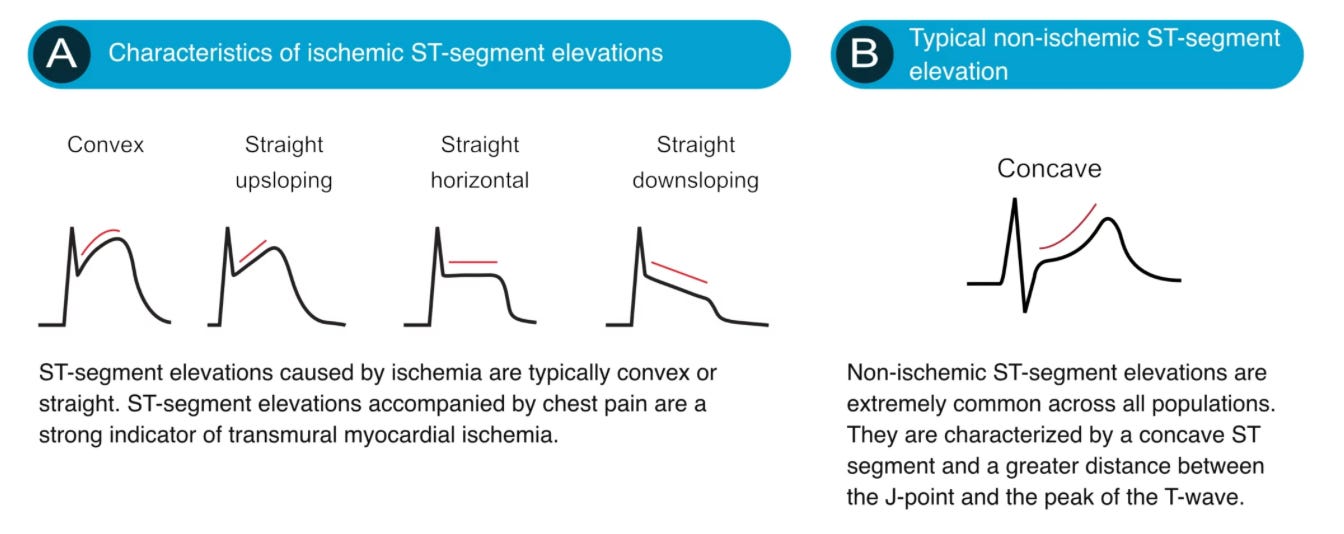
STEMI ECG tracings from ecgwaves.com (“non-ischemic” means no heart attack—no restriction of blood flow)
Not everyone feels PVCs. I and many other people I know who have them notice them as pauses. My friend whose experience we documented in the case study on PVCs in The Haywire Heart was getting over 30,000 of them a day (out of about 80,000 daily heartbeats). He said, “Sitting around, I could feel like my heart was working quite hard. I’d have one, two, or maybe one, two, three heartbeats and then nothing—there would be a pause and then it would start over: one, two, pause.”
I’m glad you mentioned electrolyte balance, as it’s critical to proper heart function. The sodium-potassium pump I mentioned in my post on PVCs requires ionic (electrolyte) balance to function properly. It pushes three sodium (Na+) ions out of the cell for each two potassium (K+) ions it pulls into the cell. Called the sodium-potassium ATPase (Na+/K+-ATPase), cardiomyocytes (heart muscle cells) run that pump constantly to maintain an electrical potential (membrane voltage) as well as a concentration gradient across the cell membrane, consuming a lot of ATP in the process.
At rest, about 25% of our energy goes into maintaining our Na+/K+-ATPase pumps. Those pumps work hard to keep a low concentration of sodium inside the cell in order that the calcium within the cell does its part. It’s the release of calcium into the main part of the cell that causes the depolarization that starts the heartbeat (and causes any muscle cell to contract). The muscle cell doesn’t need to bring calcium into the cell, because it stores calcium in a sack inside the cell called the sarcoplasmic reticulum. It merely needs to pull it out of the sack to inspire the contraction and then push it back into the sack immediately afterward to relax the contraction. Proper sodium gradients are required to make that happen.
In modern society, we have an overabundance of sodium in our diets. No problem getting enough of it—it’s in overabundance in practically all processed foods. And if you go out to eat often or snack on tortilla chips, potato chips, crackers, pickles, even salted chocolate, etc., your daily sodium intake will always easily exceed the RDA of 2,300 milligrams.
However, if we do not have sufficient potassium, our Na+/K+-ATPase ion transporters won’t work properly. A diet that would have come fairly naturally to humans before the advent of salt processing would have been about 5 to 1 potassium to sodium, even up to about 10 to 1, because potassium is abundant in vegetables, like potatoes and sweet potatoes (with skin), spinach, and beet greens, in fruits like bananas, avocados, melons, and oranges, in beans and lentils, and in meats and fish like salmon, chicken, and beef. And salt (NaCl) was often hard to come by (which is why humans evolved the response to crave it).
That potassium/sodium ratio is flipped on its head in today’s world. Processed foods are often low potassium, being low in green leafy vegetables, fruits, and potato skins. Furthermore, makers of processed foods know that you’ll eat more of the foods they sell you if there’s a lot of sodium in them. Even our go-to SKRATCH hydration drink from local sports physiology guru and elite cycling coach Allen Lim is around 8 to 1 sodium to potassium. It’s intended to match the ratios that an athlete sweats out, and we sweat far more sodium than potassium. However, most people are already getting sodium bombs with every meal.
If the sodium-potassium ATPase transporters fail for lack of potassium, then NHE (sodium-hydrogen exchangers) can kick in. They are counter-transporters to sodium-potassium transporters, because instead of pushing sodium ions out of the cell, NHE moves sodium ions (Na+) into cells while pushing hydrogen ions (H+) out. The net effect is to have too high a sodium concentration inside of the cell for proper depolarization and contraction of the cell to occur and the inability to push calcium back into the sarcoplasmic reticulum for full muscle relaxation. One result is “ectopic beats” of which PVCs and PACs are two types, others being DADs (delayed after depolarizations) and EADs (early after depolarizations), which can trigger arrhythmias.
― Lennard
Dear Lennard,
Been bicycling again for three years, age now 77. I bought a Kardia-6 a few weeks ago; been using it to get an idea of what my heart’s doing on a daily basis. Yesterday I enjoyed a 32 mile ride, some of the route on roads new to me, that took 2 hours 20 minutes to complete. Longest (ever) ride was a few weeks back, 38 miles. I think I’m probably in the best physical shape I’ve ever been in at this point.
After I’d been home from yesterday’s ride for maybe ten minutes I grabbed my Kardia, took an ECG. First time I’ve seen a PVC noted in the five weeks I’ve been tracking ECG’s twice a day. That label caught my attention, so I immediately ran another ECG that came back normal.
I’ve read that PVC’s can be precipitated during recovery so I’m taking note of the first time appearance and the timing. Kardia’s also telling me pretty often that Bradycardia’s evident from the under 50 HR numbers I can claim upon waking then testing each morning. Low HR seems to follow closely on my biking activities but as the only tell I’ve received is from the Kardia device, I’m simply taking it as a result of the improved cardiac function my biking’s brought to my body.
SpC
Dear SpC,
Yes, I think you can take it that way. The app flagging a sub-50bpm HR as bradycardia is literally coming straight out of the dictionary; bradycardia means a relatively low heart rate. The question is, relative to what? Relative to the population of endurance athletes, a resting heart rate in the 40s is common and generally not cause for concern.
― Lennard
Dear Lennard,
Very interesting article as well as slightly uncanny. In my twenties I would happily cycle 50 miles without a thought, commute 18 miles to college and rode competitively. My mother (born 1920) warned me in the late 1960’s that I would end up with an enlarged heart.
Surely, she couldn’t have read your newsletter 😂
Anyway hasn’t stopped me cycling yet.
Thanks for all the insights,
Stefan
Dear Stefan,
Interestingly, my dad often told me that I was using up my heartbeats too fast with all the bike and ski racing I did. His theory was that we were allotted a certain number of them at birth, and you wanted to be careful not to burn through them early. He lived to be 97.
― Lennard
Dear Lennard,
Mine was corrected 3 times w/ cardioversion. The last time didn’t take. Now I’m bionic!! Got a pacemaker running the show.
Buck
Dear Buck,
Bionic! Right on!
― Lennard
Subscribers can send brief technical questions to Lennard at: veloqna@comcast.net.
Lennard Zinn has been designing and building custom bicycles for over 45 years; he founded Zinn Cycles in 1982 and co-founded Clydesdale Bicycles in 2017 and Tui Bikes in 2022. His Tech Q&A column on Substack follows his 33-year stint as a technical writer for VeloNews (from 1989 through 2022). He is a former U.S. National Cycling Team member and author of many bicycle books including Zinn and the Art of Mountain Bike Maintenance, Zinn and the Art of Road Bike Maintenance, and The Haywire Heart. He holds a bachelor’s degree in physics from Colorado College.
Follow Lennard Zinn on Substack, Strava, X, Instagram, LinkedIn, or Facebook.
No posts
Comments
Nothing yet. Say the first thing.
Sign in to join the conversation.