
Dear faithful readers,
I now have a definitive answer to RF’s questions from this post. RF said, “I’m surprised that the coating of undiluted Dawn (even after it dries) doesn’t prevent latex in the sealant from bonding the tire bead to the stripper.”
RF was referring to the prior week’s post to that one, in which I had said, “I coated it with (undiluted) dishwashing liquid (Dawn). Worked great. When the stripper got scrunched underneath the tire bead, I easily pulled it back out. And mounting a Maxxis gravel tire and a Challenge 4 Stagioni (both vulcanized tires), was a snap. Once inflated with sealant in each tire, I trimmed the excess latex strip off close to the rim on either side.”
Well, on a rainy “shakeout ride” that I was leading the evening before the Enchanted Circle Century in Red River, NM last Friday afternoon, I punctured my rear tire. It was a 700x40C Challenge Strada Bianca Pro TLR “open tubular” tubeless-ready clincher. That tire is made in the same way as a high-end racing tubular—unvulcanized, supple casing, hand-glued tread, with clincher tire beads in the casing folds rather than stitching to retain a tube inside it like a tubular. As they are flat in cross section, in contrast to the C-cross section of standard, vulcanized clinchers, and have super tight beads, Challenge Pro handmade clincher tires are very hard to get on (and off) a rim. Here’s how I manage to mount them. To mount this tire onto a stripper, I had coated the stripper with undiluted liquid dish soap (using the same mounting method).
I had a similar concern to RF’s that the Dawn liquid soap might have prevented the latex sealant from adhering the stripper to the tire bead as it was intended to do. Turns out, those concerns were unfounded. That tire was completely stuck to the stripper, and it took some serious effort to peel it off the tire so I could install an inner tube. It had indeed done what I had intended—to form a tubular shape with a seal along the bottom of the tire beads that would prevent tire burps! You can see that in these photos.
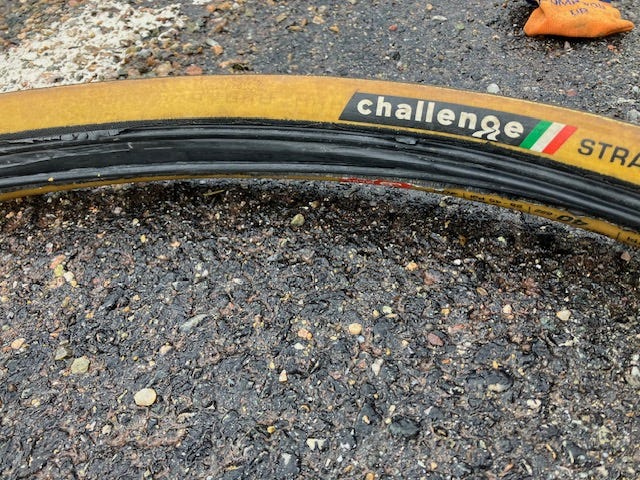
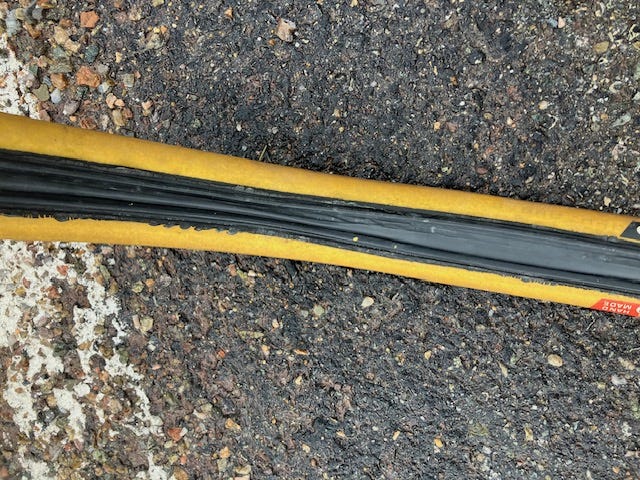
That stripper has an airtight seal with the tire beads.
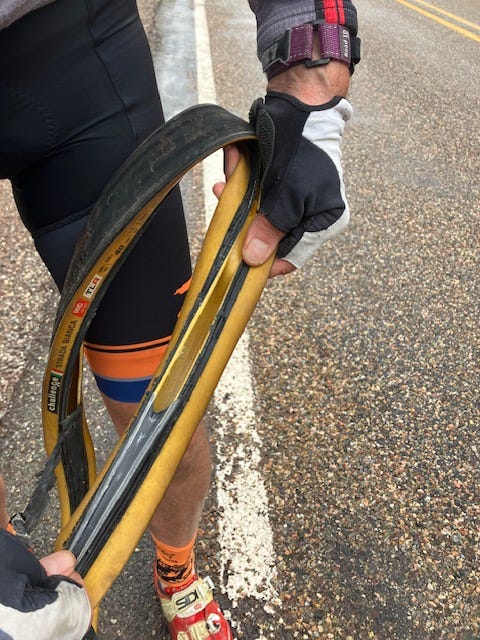
It was HARD to peel this stripper off. Clearly, Dawn did not prevent that.
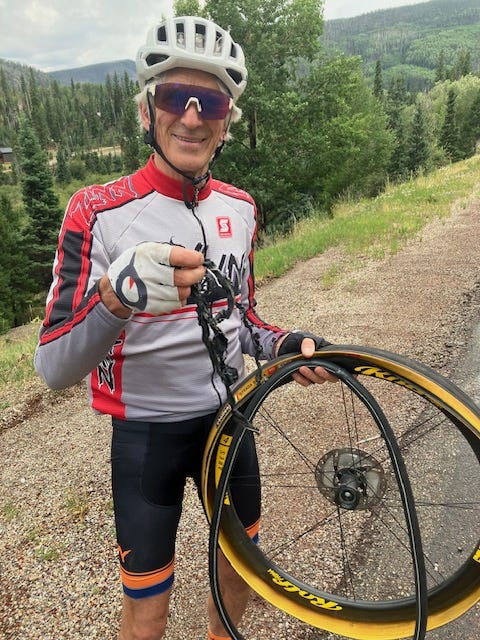
The torn-up remains of the stripper. You can see that there is no liquid sealant left in the tire.
You may wonder why I didn’t just put more sealant in and why it punctured in the first place. I didn’t put more sealant in because I didn’t have any with me. All I had was an inner tube. And the reason it flatted was apparent when I had peeled off the stripper—the sealant had hardened inside, and there was no liquid sealant left to seal the puncture.
I had mounted that tire in early June. While two months seems like a short time for all the liquid sealant to harden, I imagine that it might have to do with the unvulcanized casing of the Challenge Pro tire. I have mounted lots of these tires tubeless over the years, and it takes a lot of gyrations to get them to finally seal and stop producing soap bubbles when coated with soapy water. Maybe the sealant had all hardened both in that process and under so much repeated pumping of the tire (blowing compressed air across sealant hardens it). At least the hardened sealant was beautifully evenly distributed around the inside of the tire casing—no hardened lumps or puddles. On a daily basis (when I am not traveling), I rotate all my tubeless wheels a little bit so that sealant puddles won’t form and harden in the tires.
― Lennard
Dear Lennard,
My problem is with my SRAM Force D2 front brake caliper. Every few months I’ll start out for a ride, and the pads will be contacting the rotor, and the lever pull is stiff within a few millimeters of pull. I’ll remove the wheel and spread the pads, but after only a few pulls, it’s back to dragging the pads. If I remove the pads and retract the pistons fully then remove the top bleed screw, a small amount of brake fluid will squirt out. I replace the pads and recenter them to be safe, and they work great for a few months. Then it’s back to the pads dragging. I’ve also fully bled the system with fresh DOT 5.1 fluid a couple of times to be safe. I know that DOT 5.1 absorbs moisture from humid air, but I live in Las Vegas and it’s very dry here. My bike is also kept in a fairly hot garage, with temps in the low 90’s during the summer. Any thoughts on what causes this and how to prevent it? No need to forward this to SRAM as their customer service has become completely useless.
Stan
Dear Stan,
I suggest you clean the outside of each of your pistons frequently. If under normal usage, the pads don’t retract fully and rub on the rotor, this can indicate contamination. You’ll have to remove the pads and fully clean the sides of the pistons to get this to stop. That dry, fine, Las Vegas dust can sneak into nooks and crannies around the pistons.
On most hydraulic disc brakes, each piston (ceramic, for heat-management purposes) is retracted after braking by a square-cross-section O-ring seal surrounding the waist of the piston. This square seal (a.k.a. “quad ring”) sits in a groove running around the bore of the piston cylinder. Pulling the lever forces fluid in behind the piston, the piston moves outward, and the square seal twists out into the tapered section of the groove. Releasing the lever relieves the hydraulic pressure, and the square seal untwists back to its original configuration, bringing the piston back with it, unless contamination or damage prevent it or the seal leaks.
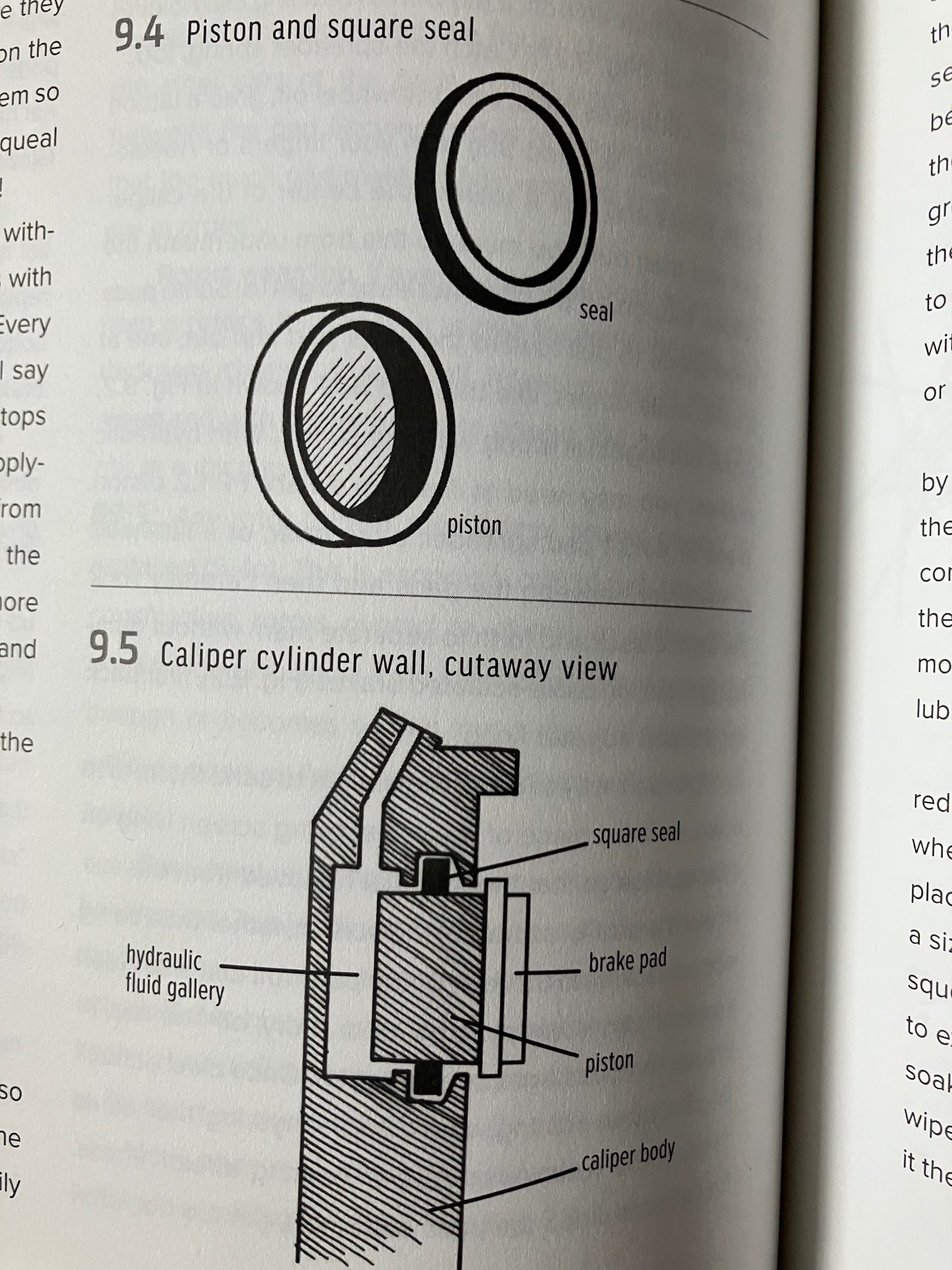
These illustrations from my maintenance books will hopefully clarify my description of the retraction function.
If dirt is present, it can inhibit piston retraction, either by breaking the seal or by creating more friction around the sides of the piston than the square seal can overcome. In this case, simply forcing the pistons back into their bores exacerbates the problem by pushing even more dirt under or against the square seal. So cleaning around the pistons and lubricating them is required to regain normal function.
Again, remove the wheel and pads. While holding one piston in place with
Comments
Nothing yet. Say the first thing.
Sign in to join the conversation.