
In the spring of 1907, when the fertile soils of Brittany were once again experiencing rebirth, a young Sergeant in the French Army’s 7th Artillery Regiment deserted and fled to the coast for reasons lost to history. He had joined voluntarily two and a half years earlier at the age of nineteen, likely thinking he would make a career out of military service, a path taken by many of his peers and one that would guarantee a steady income, as well as a certain amount of prestige.
All of that was forfeit now, as he swiftly made his way to the port of Le Havre and hired on as a seaman aboard a cargo ship. Before anyone in the north learned of the warrant for his arrest, the ship set sail for the Far East and the young man left France forever, leaving behind his mother and brother, cousins, friends, and country.
His name was Joseph Yves Louis Lehardy, Louis to his friends. He was my grandfather.
There must be a monumental story hidden in those bare facts; I wish I knew what it was. Maybe it’s better that I don’t; maybe there are certain things we aren’t meant to know. I never met my grandfather, which I’m sure has made the desire to understand this man of legend even stronger. From the time he left France, he seems to have never again spoken in any detail about his French upbringing. Family mythology claimed that he had come to America after losing his fortune gambling in Monte Carlo, an unlikely story Louis himself may have encouraged.
I think it’s important for children to learn their parents’ stories, preferably to hear them in their own words and voice. When that isn’t possible, we can still make the attempt to learn what we can from others who knew them and lived life with them. To learn about our parents is to honor them (the fifth commandment) and to understand them as full, three-dimensional human beings instead of flat, cardboard cutouts labeled Mom and Dad.
Shipboard life was a jarring experience for Louis. He was frequently seasick and could only regain his stomach when he was on deck focused on the horizon. The compartments smelled of bunker oil and sweat, the air was stale and humid, the ship vibrated with the slow-speed thrum of the engine and propeller, the crew spaces were claustrophobic.
But the rigid routines of life aboard ship were familiar to this soldier, and though he missed the farmlands of his native Brittany, he nevertheless found something restful in the infinite vistas of the rolling waves. And, as a practical matter, if escape was your aim, you couldn’t be in better company than you’d find on a working ship, where most of the crew had things they would rather leave in the past.
After six months sailing the globe, his ship docked in the Port of Baltimore, Maryland. There is much about Baltimore Harbor and the beautiful and fertile Chesapeake Bay that may have reminded Louis of the shores of Brittany along the English Channel. He’d heard that a man like himself could live as he pleased in America. He’d heard there was money to be made if one worked hard enough. He’d grown tired of endless sea journeys and the cramped confines of a tiny steel coffin floating in an endless ocean. He was ready to settle down.
In testimony given years later before a U.S. Immigration official, my grandfather admitted that after he’d collected his wages, he had stepped off the ship (illegally) and set up residence in Baltimore.
Louis was unafraid of hard work. For the next two years he crewed on a variety of coastal sailing boats that transported goods up and down the Atlantic. Later, he left off working on the water and found a job in the city, first in a factory, later as a motorman on the Baltimore streetcar system. My only photo of him is this one, in his uniform.
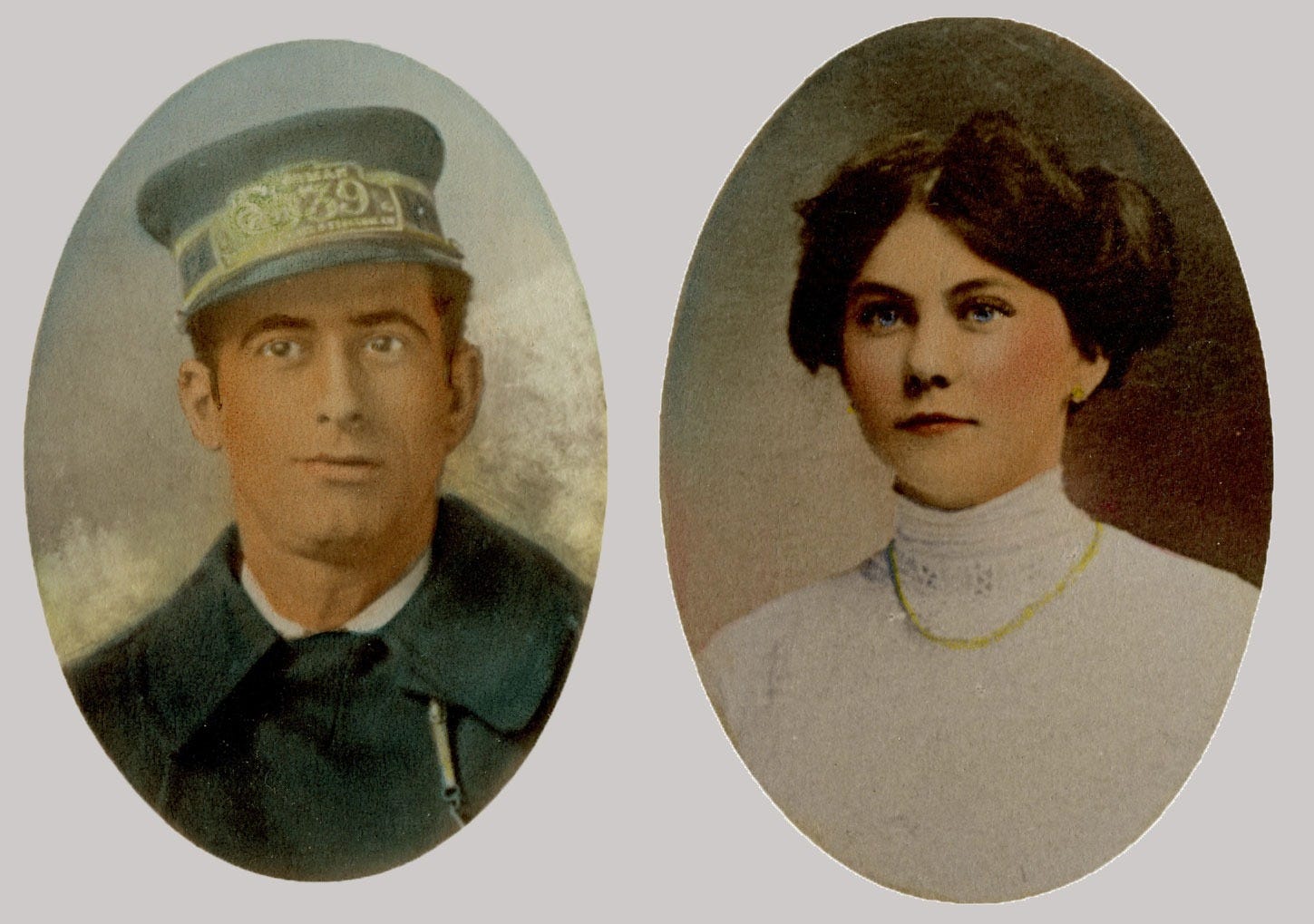
Soon he went to work for the Baltimore Gas and Power Company as a cable splicer. In the years that followed he moved up the ladder to the position of foreman. I’m sure his experience as an Army Sergeant had taught him how to organize and lead a team of men. Baltimore was growing and modernizing rapidly, so he found himself in a secure career with lots of opportunities for advancement.
But I’ve gotten ahead of myself, neglecting the most important part of Louis’ story. Sometime in 1912, under who knows what downright strange circumstances, Louis met nineteen-year-old Edna Josephine Arnold and fell deeply in love.
We tend to meet the ones we will marry through mutual friends or at church or in college or because we’re members of the same motorcycle gang. I just can’t see these two running in the same social circles. Another mystery!
Edna Arnold was born in Baltimore to German immigrant parents. Germany and France had never been on good terms, and Edna’s father was very unhappy that she was seeing this Frenchman.
Carl Arnold was an educated and proud man, a university graduate. By contrast, Louis was a blue-collar laborer with a mysterious history, a coarse man-of-the-world who sported a sinister-looking star tattoo on his right hand.
And as to religion, the Arnolds were solid Lutherans, Protestants from the land where Martin Luther himself had started it all. Louis Lehardy was a lapsed Catholic.
Her father tried to discourage the relationship, but despite his strong opposition, Edna and Louis were married in June of 1912. It’s said that Carl refused to attend the wedding and never permitted the couple into the Arnold home. According to family memories, Edna’s mother, Johanna, kept up a connection with the family by meeting her daughter and the grandchildren at a park. It was a rough start for the newlyweds.
Some fourteen months after they were married, they were blessed with their first child, Rudolph, named for Edna’s paternal grandfather in what might have been an attempted peace offering to her father. Five more children would be born over the next ten years, all sons except for a single daughter.
The couple lived in one of Baltimore’s famous Federal-style row houses. Two stories plus a basement, three bedrooms, nine-hundred square feet with a postage-stamp back yard.
Edna gave birth to their last child in the summer of 1926. He was Charles, my father. Nine people now crowded into that tiny space and Edna took care of them all. It was loud, it was demanding, it was exhausting.
In the months that followed, Edna found she wasn’t regaining her strength as she had with the other births. She was older, of course. All of a sudden, climbing the stairs and chasing the little ones was leaving her panting for breath.
What no one understood (and would it have made much difference if they had?) was that her heart was failing. She grew weaker, thinner, more pale, until nine months after my father was born, Edna collapsed and was hospitalized. She died in March of 1927 at the age of 34.
Louis was distraught. He blamed the doctors for not doing enough to save her. He was consumed by grief. He was alone, now, with seven children to care for and no family ready to help. Over the months that followed, the stress and grief gradually broke him down.
He began drinking heavily. He neglected the children. He lost his job. At some point, Maryland children’s services stepped in and took the kids away, placing some of them in foster homes and some in group homes.
In the years that followed, my dad never seems to have found a permanent home. He was in and out of foster care, group homes, and training schools. The lack of a real home and a committed family harmed him in ways that he likely never understood.
Traumatic events during childhood can create damage that endures into adulthood. Psychologists term these Adverse Childhood Experiences (ACE) and they encompass such things as abuse (physical, emotional, sexual), neglect, trauma (death, violence), family instability (divorce, addiction, abandonment), and mental health crises.
Children thrive when they’re loved, when they feel safe and secure, when they experience consistency and predictability in their environment. If they lose those things they can stop trusting, they will experience fear and uncertainty, and they will begin to feel vulnerable. And if the circumstances of these adverse experiences become the norm instead of the exception, those insecurities will become ingrained; fear and distrust can become habits of the mind.
We hear counter arguments that children are resilient and tough and can learn to adapt. Some do, it’s true, but the data shows that many are wounded by these experiences and remain so unless the adults in their lives take deliberate steps to help them heal.
We don’t get to choose when or where or in what circumstances we will grow up. Our parents are fallible human beings, at best, neglectful or even abusive at worst. The study of Adverse Childhood Experiences has boomed because childhood and youth are such fragile periods of life. There are so many things beyond our control that can destabilize a family, from illness to poverty to death, not to mention volitional things like abuse or addiction or neglect or divorce. Children are caught up in these events by virtue of their dependency on the adults in their lives. They see, they feel, they respond and react, they adapt and cope as best they can, and then they grow up and live with the aftereffects, for better or worse.
I’m certain that my father wanted to turn over a new leaf in his life. I think he was a good man who had the best of intentions and that he very much wanted to create the loving, tight-knit family that he’d never experienced himself. I imagine he thought that with a good career, a loving marriage, and a home full of children he could leave his painful childhood behind. It wasn’t to be.
Comments
Nothing yet. Say the first thing.
Sign in to join the conversation.