
[W]e cannot change what happened to our fathers, nor are we responsible for what our fathers have done to us. That is not our responsibility, but theirs. [W]e are responsible for how we deal with our pain—since that is not their responsibility, but ours. —Finding My Father: How the Gospel Heals the Pain of Fatherlessness, Blair Linne
I felt responsible for my father’s death; I couldn’t tell you why—most likely because I was nine years old at the time, and because concepts like responsibility and choice get very muddled in families where mental illness and substance abuse rule. I could see how troubled he was, but I couldn’t explain it—I just wanted him to laugh again.
Toward the end of his life, my dad was distant, disconnected, even absent from our home for days at a time. Mom assured us that he’d be fine, but I could tell she didn’t believe it. She wasn’t afraid of him, but she was afraid for him. She knew things were bad but didn’t know how to help.
When he finally took his life, it just made some kind of sense to me that if I’d been a better son, he would still be alive to be my dad.
I remember my father as a kind man, a man who laughed easily and made others laugh, a man who’d wanted to be the sort of father he’d never had, a father who would provide all the very best for my mother and us children.
Toward that end, he had moved us out of the city to a brand new home in the suburbs, with a two-car garage that sheltered a red 1959 Chevy Impala for the family and a sleek silver Porsche 356 for himself. He liked spending money on his friends and family—we lacked for nothing in those days.
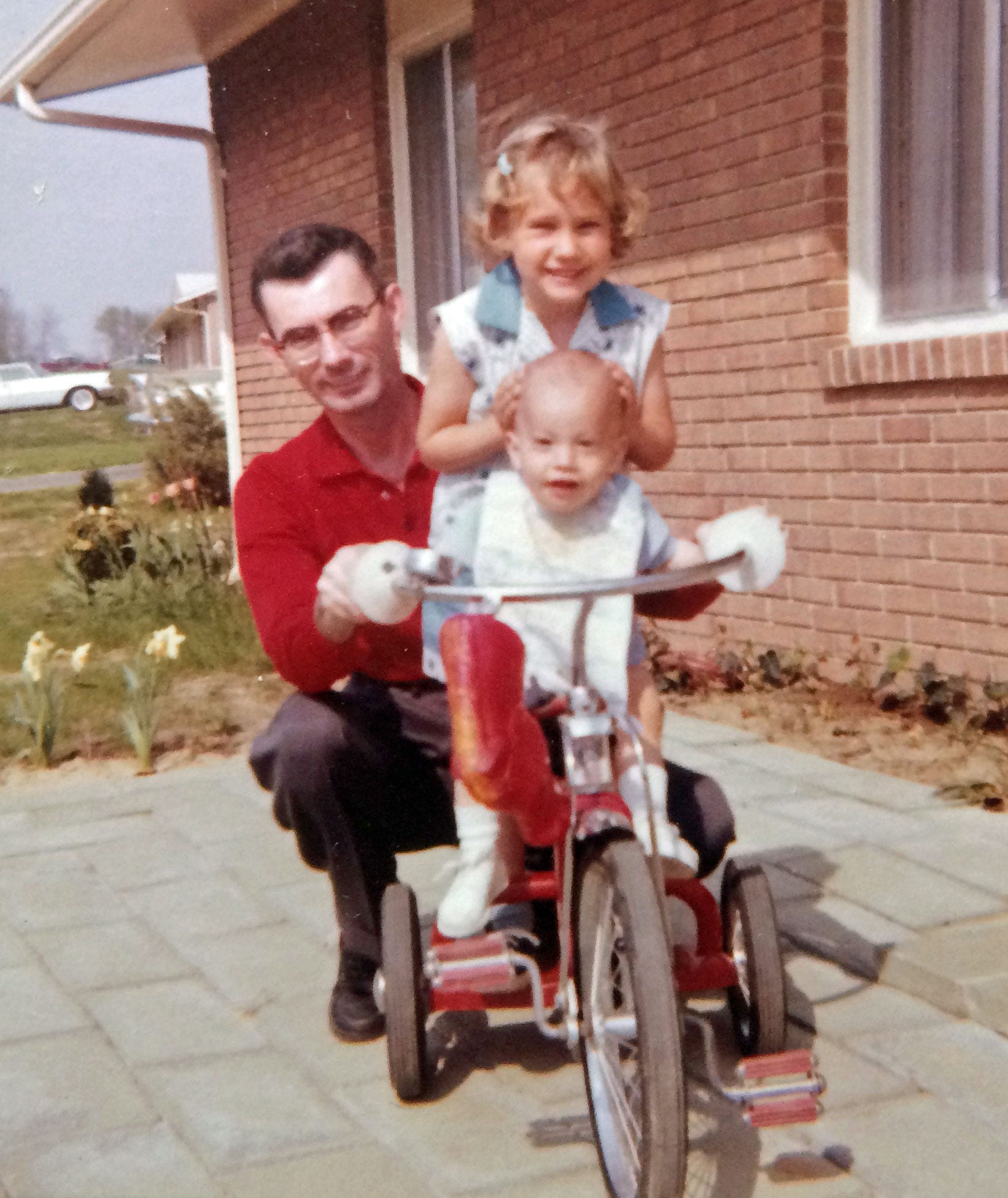
I don’t remember him as an affectionate man. Memories are tricky things, so perhaps I’m wrong. I remember him as reserved, bottled up, distant at times, perhaps less secure in himself than he let on. He showed his love not through words or physical gestures but by doing things for us, buying things for us, taking us on trips, throwing parties, entertaining, and by working hard so that we could live in all the comfort and security that he himself had missed growing up.
After serving in the Army toward the end of World War II, my dad attended college where he earned a degree in accounting. He and my mom met through mutual friends, a crew of dating and married couples who would come to be known as our aunts and uncles, though none of them were blood relatives.
They married in 1950 in the optimistic, post-war boom years. I came along two years later.
One of my uncles told me that while Dad was the most successful of all of his brothers, he was always looking for their approval. He took his brothers on trips to Vegas and Atlantic City. He bought them tickets to see the Baltimore Colts and Orioles when they were in town. He ate with them at fine restaurants. He spent money faster than he was making it and couldn’t seem to stop himself.
Mom’s desires were simpler: she wanted to raise a family and create a loving home. She did that very well.
There came a point where my dad’s high living put him into a financial bind. He was in a trusted position at work and began “borrowing” money without permission, at least, that’s how I imagine it must have started. He surely knew the risks he was running. Like his father before him, Dad dealt with the mounting, self-inflicted pressures by drinking.
Mom once told me a story from the days before they were married that almost seems like a foreshadowing of things to come. The two of them had taken mom’s mother and father out for a drive in my dad’s old Model A Ford. As they were tooling down a steep Baltimore city street, Dad pumped the brakes and got no response. The car gathered speed as they approached a red light at the bottom of the hill, with Dad pumping the brakes and trying frantically to slow down. Mom looked at Dad, he gave her a silent shrug, and the car blew through the intersection against the red light, somehow missing the crossing traffic.
Dad’s life was like a runaway car speeding downhill with no brakes. He was hoping against hope for an opening at the bottom where he could slip safely through. When his company decided to audit their books, he could see the crash coming. He saved himself the public scrutiny and humiliation by taking his life.
In that place, at that time, alcoholism, mental illness, and suicide were all so shameful that families found ways to cover up the truth. They hid behind euphemism or outright silence. Our family chose the silent route, but the shame was real and it attached itself to me like a remora.
In my teens I became angry, depressed, self-loathing. Mom was doing a heroic job keeping us together, learning new job skills, finding work, loving and caring for us, pushing through so many challenges and difficulties as a single mom. Despite her best efforts, I was quietly drowning.1
One day, George and Johnny, high school friends, invited me to a youth Bible study. I started attending, skeptical but curious. One of the things that struck me as I heard the Gospels for the first time was how often Jesus refers to God as Father.
At some point, I read this:
For all who are led by the Spirit of God are children of God. So you have not received a spirit that makes you fearful slaves. Instead, you received God’s Spirit when he adopted you as his own children. Now we call him, “Abba, Father.” —Romans 8:14-15 (NLT)
Child of God. Adopted. Abba (Daddy), Father. God was declaring his love for his people—for me—with the most intimate and personal of words. He was inviting me into his household, his family, and seemed to be addressing me as his child. In those promises, in that invitation to draw near, I saw love trying to reach out to me and I heard value being attached to my life.
The damage done by Adverse Childhood Experiences is real, but it isn’t destiny. Over the decades I’ve found healing and renewal through a holistic approach that has included psychological counseling, group therapy, pastoral counseling, medication, prayer, reading (I highly recommend Blaire Linne’s book), writing, attending conferences, speaking about my experiences with trusted friends (and especially with my family), Bible studies, and the faithful immersion of myself in the unconditional love of my local church and my heavenly Father.
No doubt there are many whose childhood experiences cause them to recoil at the suggestion that God is like a father. The harm sometimes done by parents can make it difficult to trust anyone, including God, maybe especially God. It’s not unusual for damaged children to hold God responsible for failing to rescue them from terrible circumstances.
I get it. There are questions I have no answers for. There are things about life and the world we live in that are too tragic for words. I can only speak for myself and tell you that I have found welcome and love and purpose and healing, a release from shame, and a very good Father at the heart of the Christian faith.
Whether you’ve grown up in an idyllic family, a dysfunctional family, an abusive family, or no family at all, the Christian Father-God, his Son Jesus, and the always-present Holy Spirit declare that you were created to be part of God’s eternal family, to be dressed in his finest clothes, and to bear his name forever.
I’ll finish with this passage from Paul’s letter to the Ephesians:
For this reason I kneel before the Father, from whom every family in heaven and on earth derives its name.
I pray that out of his glorious riches he may strengthen you with power through his Spirit in your inner being, so that Christ may dwell in your hearts through faith. And I pray that you, being rooted and established in love, may have power, together with all the Lord’s holy people, to grasp how wide and long and high and deep is the love of Christ, and to know this love that surpasses knowledge—that you may be filled to the measure of all the fullness of God. —Ephesians 3:14-19 (NIV)
The most recent US census reported 89 million family households in our country. About 11 million of those are single-adult households with children under the age of 18, of which 80% are households headed up by single mothers. Eleven million households where a single parent is trying to raise, feed, shelter, and clothe their children, while holding down at least one job and depending on SNAP, WIC, and Medicaid to cover the inevitable shortfalls. Christians are operating food and clothing banks for families in need, they provide childcare, financial assistance, even job placement help. The need is greater than the supply. Every church in America, and every American neighborhood, has families where a single adult carries the entire burden of raising and caring for children. James 1:27 says: “Pure and genuine religion in the sight of God the Father means caring for orphans and widows in their distress….” How should the church respond to this great need?
Comments
Nothing yet. Say the first thing.
Sign in to join the conversation.