
François padded quietly across the cold, wooden floor and pulled on his winter robe. His breath came in clouds as he made his way down the moonlit hallway to the stairs, walking more by habit than sight, until he stopped beside the stone fireplace in the rectory’s modest sitting room. He uncovered the previous evening’s still-glowing coals and, after a few minutes’ effort, kindled the first flame of the first Sunday in November, the year of our blessed Lord 1885.
Lifting a silver candlestick from the mantle, he lit the fresh taper in the crackling flames, then carried it to the little three-legged table beside his leather reading chair where, as was his morning habit, he sat, opened his Bible, and began to read.
Louise was still asleep. She had awakened in the depths of the frigid night to comfort Marie when she had cried out in a nightmare. Heavily pregnant with their third child, Louise had finally returned exhausted to the warmth of their bed, hoping the children would let her sleep until sunrise.
François opened his father’s Bible to the thirty-seventh Psalm and read first the small but elegant script of the notes his father had penned in the margins. Then he began reading David’s plea to be unshaken by the follies of evil men, imploring his listeners instead to live in faithfulness and to delight in God’s goodness.
Trust in the Lord, and do good;
dwell in the land and befriend faithfulness.
Delight yourself in the Lord,
and he will give you the desires of your heart.
He would repeat this ancient exhortation later in the morning as he led his flock in worship and the celebration of the Eucharist, that blessed moment when they would receive into themselves the body of Christ and the hope of the resurrection. He would adhere to the traditions he had learned as a small boy from his father, Toussaint, himself a priest—gone some 20 years now—who had served faithfully in the grand church of Matignon.12
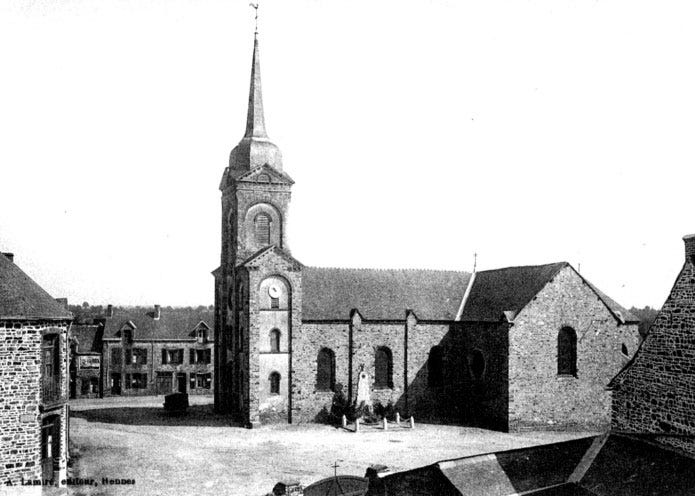
His own flock was small, but their need was great. Tresboeuf was an insignificant village of tenant farmers and barely-subsisting shopkeepers, of families and orphans, of babies in need of the church’s blessing, widows in need of care and comfort, and the dying, always the dying, so many of all ages standing near to the gates of glory. He tried to give them hope, of course, but also food when it was scarce, and warm clothing to take them safely through winter. The church had created a place of refuge for the sick with caring sisters to bind up their wounds and bring them safely through the fevers. He did his best to meet the needs of their bodies as well as their souls, helped greatly in the former by the generosity of Madam L___, a widow herself but one left with means beyond her own needs by her wealthy husband.
Footsteps in the hall pulled his thoughts away from his reading.
“Bennozh deoc’h, Mestr,” came the woman’s familiar voice as she brought in a tray of hot tea, bread, and honey.
“Bennozh deoc’h, Yvonne,” he replied to the young Breton housemaid. “Comment allez-vous ce matin?” he inquired.
“I am well, thank you, Monsieur. The lady still sleeps?”
“She does. She was awake in the night with the children but sleeps soundly now. I will be off soon to prepare for Sabbath Mass. I’ll leave it to you to get the children dressed and fed, as usual. What would we do without you, Yvonne?”
“You’re very kind, Monsieur. I’ll leave you to your studies. The Lord bless you.”
“And you, Mademoiselle.”
The blessed time arrived on a gray and bitter morning in December. The midwives were attending to Louise while François paced and prayed and listened downstairs. The children were in Treguier visiting their cousins in the home of Louise’s sister, Marie. It was an anxious time. The couple had lost three children in childbirth and infancy. They both dearly wanted a third child, but it was in God’s hands.
That day she bore them a strong and healthy boy. They agreed to name the child for Louise’s father, Joseph. He was to be Joseph Yves Louis Lehardy, my paternal grandfather. (He preferred to be called Louis.)
My paternal ancestors were from Brittany in the extreme northwest corner of France, a land originally settled by Celts who migrated from the British Isles. The Bretons were a people with their own distinctive customs and language. They spoke Breton in daily life but learned French as their ticket to the wider world. They were proudly French, but proud as well of their ancient roots from across the English Channel.
One might imagine that my great-grandfather François had hopes that his son would follow him into the priesthood, and perhaps he might have done just that. This was a difficult time for the church. The French Revolution had severely weakened the Catholic church and had encouraged citizens to put their faith in the State rather than God, a message popular among the young.
But as the years passed and young Louis grew, the unthinkable happened: not long after he celebrated his ninth birthday, François died, followed less than a year later by Louis’ fifteen-year-old sister, Marie. The Bishop would have stepped in quickly to appoint a new shepherd for the flock, and the grieving family would have been expected to pack up, move out of the parsonage, and find a new home. One can imagine that so much grief and change, the loss of income and friendships, would have been difficult to bear.
Hardship and trials and griefs are woven into the tapestry of every human life. Sometimes, when the storms assail us and knock us to the ground, we wonder if it will be possible to stand up again, to walk again, to find joy again. Children who experience such things are often wounded invisibly. They stand up again, but perhaps with less confidence ever afterwards. They walk again, but perhaps with a halting gait that they carry into adulthood.
My grandmother, Louise, left Tresboeuf sometime after the death of her husband and settled in the city to the north, Rennes. She opened a store and became a shopkeeper, supporting her children and herself, living out the rest of her life in that city.
Fast forward ten years. My grandfather enlisted in the French army at the age of nineteen and began training with the artillery. This was 1904, well before the first world war, a time when Europe was at peace. His military service is unremarkable, until, two and a half years later, something happens—the circumstances are unknown. What is known is that Louis deserted from the Army and fled to the port city of Le Havre, where he hired on as a crewman on board a British cargo ship.
He never returned to France.
He eventually built a new life for himself in America. He settled down. He prospered. Life was full of all that a man could hope for—until it all came crashing down around his feet.
One of the humanistic aims of the French Revolution was “de-Christianization” and removing the power and societal influence of the Catholic church. To accomplish this, nuns and priests were required to marry if they wanted to continue to serve the church, as celibacy was seen as antithetical to the egalitarian aims of the new French State. “In September 15, 1793, Fouché, representative on mission to the department of Nièvres, forced all local priests to ‘get married, adopt a child, or take care of a poor, old person’ if they wished to continue to receive their salary. A few months later, representatives on mission throughout France went even further, exiling priests from their parishes or imprisoning those who did not renounce their vocation and marry.” https://ageofrevolutions.com/2017/07/31/married-priests-in-france-1789-1815/
As a Christian believer myself, I have a bias that leads me to hope that those who serve as pastor of a church are themselves authentic in their commitment to love God and follow Christ. One successful goal of the French Revolution, unfortunately, was to replace priests who were faithful to God with a priesthood loyal first of all to the State. Many French priests after the Revolution were not much more than civil servants charged to be custodians of church properties. My great-great-grandfather Toussaint seems to have been a man of faith. Deported from France during the revolution, during which time he was ordained, he returned to France, was held and jailed for a time by the revolutionaries, escaped, then ultimately was appointed priest in Dinan and later at Notre-Dame de Matignon, where he served until his death. https://www.infobretagne.com/evran-revolution.htm
Comments
Nothing yet. Say the first thing.
Sign in to join the conversation.