
Happy Birthday today to Jeff Hamilton. Here’s my 2020 conversation with the great jazz drummer.
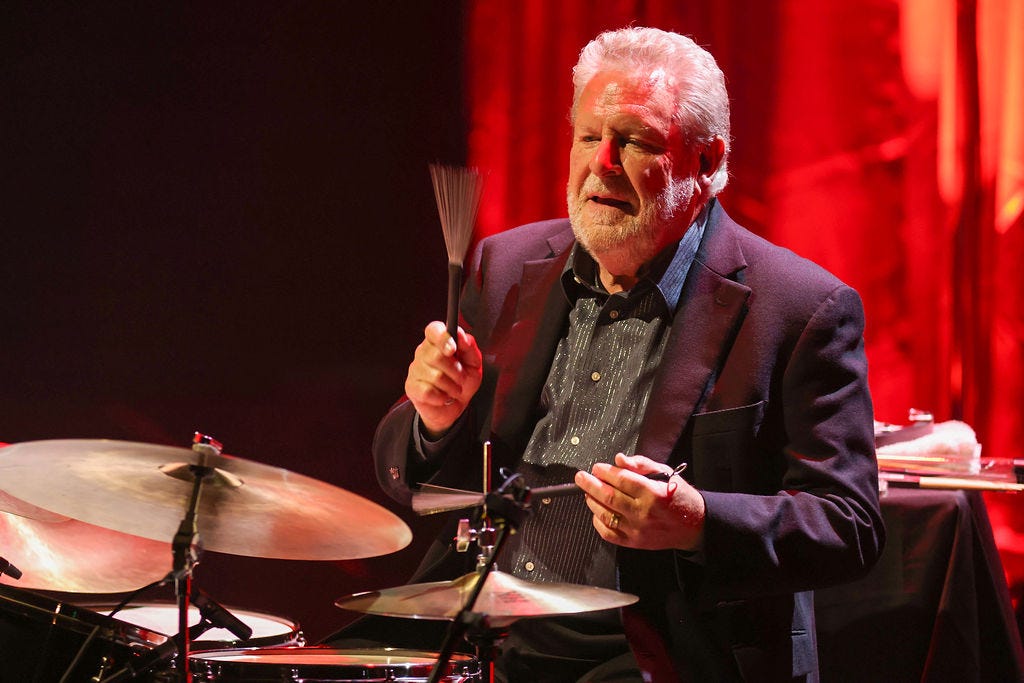
Photo of Jeff Hamilton by John Abbott #abbottphoto
In a video pulled together by Kendrick Scott and posted on social media during the pandemic, 39 top-notch jazz drummers play along, one by one, with Thelonious Monk’s “Evidence.” It seems entirely appropriate that Jeff Hamilton starts the video off with a typically impressive use of brushes on a snare. Hamilton has a reputation for both enviable technique and complete devotion to making everything swing. He developed that reputation quickly while apprenticing with several of the great bandleaders of swing and bebop, including Woody Herman, Count Basie, Oscar Peterson, Monty Alexander, and Ray Brown; the latter nicknamed him “The Hammer,” a moniker by which he’s still affectionately known to his fellow musicians and fans alike.
Settling in Los Angeles, he drew on all that sideman experience when forming his own groups. In 1985, with his lifelong friend John Clayton, he founded the Clayton/Hamilton Jazz Orchestra, a big band that has set the gold standard for large jazz ensembles. In 1995 he created a piano trio that now features pianist Tamir Hendelman and bassist Jon Hamar, with whom Hamilton recorded Catch Me If You Can, released by Capri earlier this summer. Just a few years ago, he formed an organ trio with Akiko Tsuruga and Graham Dechter, whose most recent album was Equal Time (also on Capri).
Over the years, Hamilton has also been a first-call studio musician for countless instrumentalists and singers, from pop stars looking to make their jazz statement, including Paul McCartney and Barbra Streisand, to legendary jazz singers like Ernestine Anderson and Rosemary Clooney seeking a swinging rhythm section. And if all that weren’t enough, he can claim more than a little credit for mentoring a certain young Canadian pianist who became one of the music’s most popular performers. As you’ll read in this freewheeling conversation, Diana Krall owes quite a large debt to the Hammer.
Lee Mergner: Do you remember falling in love with drums?
Jeff Hamilton: Yes, I remember seeing Gene Krupa on TV when I was five years old. That did it for me. I said, “I want to be just like him.” I was taking piano lessons at the time like everyone else in my family, but I hated it. So the teacher let me quit. He said, “He hates this, but he has good rhythmic ability and he should play an instrument.” They asked me what I wanted to play. “Drums or trumpet, but drums really.” At eight years old, I got into the fifth-grade summer band. They got me with a private drum teacher in Richmond, Indiana, my hometown, right after that.
A few years back, you told me a story about the Red Sparkle drum set that captivated you, and that you later named an album after [2012’s Red Sparkle].
Yes, it was an “a-ha” moment. Gene played Slingerland, and there was a Slingerland Red Sparkle set in the window of Hood Music on Main Street [in Richmond]. I kept walking by and thinking, “If we could just afford those, that would be great.” The drum teacher wouldn’t let me have a drum set until I won my first contest at 12, so I had to wait that long to get one. My father and mother surprised me with that Red Sparkle set that had been in the window. They got the full set for, I think, $462. They threw in a 22-inch cymbal because rock & roll guys weren’t playing bigger cymbals. And a pair of Gene Krupa signature Red Rubber brushes.
That was a lot of money then. It had to be thousands in today’s dollars.
They would second that opinion. More than would have been in our budget, I’m sure. I had proven to them that I wanted a drum set because, one Christmas when I was really young, they got me a toy drum set from Sears. You could break those things real easily. I was determined not to do that, and I even dusted it off and kept it clean. They knew I was serious about it. I did the same thing when I got the new drums. My mother always said, especially about the brushes, “Now those were a gift, just don’t let them lay in your closet … you make something of that—don’t just throw it away.” That always stuck with me. That’s the way we were raised. I thought, “Yeah, it was free, I’m going to see what I can do with this.” That was the love of brushes.
That love is something you’re known for to this day. Did you do the usual school bands and camps during junior high and high school?
The camps were marching-band. I didn’t go to any jazz camps and our high school didn’t have a jazz program. I was invited to be in the Earlham College jazz ensemble when I was 15, because they didn’t have any Quaker drummers. It’s a Quaker school. The college director came over to my high-school band director, who said, “Take this kid out of my hair, he’s driving me crazy—I don’t know anything about jazz.” That was my first opportunity of being in a jazz ensemble.
When I graduated, I went to Indiana University. I was accepted at Eastman but I didn’t have enough money to go there. I really didn’t want to go to IU, because my sights were set on Eastman. Lo and behold, Peter Erskine is a freshman that year and Ken Aronoff is there and John Clayton shows up and we become best friends. You never know what destiny has in mind for you.
While you were at Indiana you started studying with John Von Ohlen, who was well-known around Indianapolis but less so nationally.
He played with Billy Maxsted’s band and Ralph Marterie’s band around Indianapolis before joining Woody Herman in 1967. Those bands he was in were more territorial, but insiders knew them. He came to fame with the Kenton band in the late ’60s and early ’70s. That’s who laid the moniker “The Baron” on him [Von Ohlen], because he looked like it and he sounded like it. He looked like he owned the band. I left IU after two years because I had been driving up to Indianapolis three or four nights a week to see him play in this club, and then making an 8 a.m. theory class the next morning down in Bloomington, an hour away. I thought, “You know, I think I can learn more from this guy than I am at Indiana University,” because the focus for my education there was tympani and marimba. And I didn’t make the jazz ensemble my freshman year. In eight months [after leaving IU] there was a huge turnaround and I was on the Tommy Dorsey band after studying with John.
John never taught at IU, though, correct?
No, he spent a few weeks at North Texas State as a student, and said, “Baby, that’s enough for me, I gotta get out of here.” He landed back in Indianapolis after the Kenton band and he started a couple of big bands there and they were as successful as big bands could be at that period without traveling. He moved to Cincinnati, where he started the Blue Wisp Big Band. He was a homebody, definitely.
What did you learn from John?
To not play everything I know in four bars. To relax when I played. To focus on the ride cymbal and on making the band comfortable with my beat. If I had to tighten up to play anything, then don’t play it. Those are all just things he would throw by me. He said, “I’m not a very good teacher, so you’re going to have to ask me questions.” That was what I needed. He said, “Just let the limbs flail, baby.”
Do you use that advice with your students?
That’ll be on my headstone, definitely.
How long did you play with Dorsey?
Nine months. I would have stayed on, except that Lionel Hampton hired me off that band. Then the Dorsey band for another month and then Monty Alexander, through John Clayton. John had played with Monty after being put together with him by Ray Brown. When Monty wanted John to join, he said, “I don’t have a drummer. Do you have a drummer you’re comfortable with?” In June of 1975, that’s when we started with Monty.
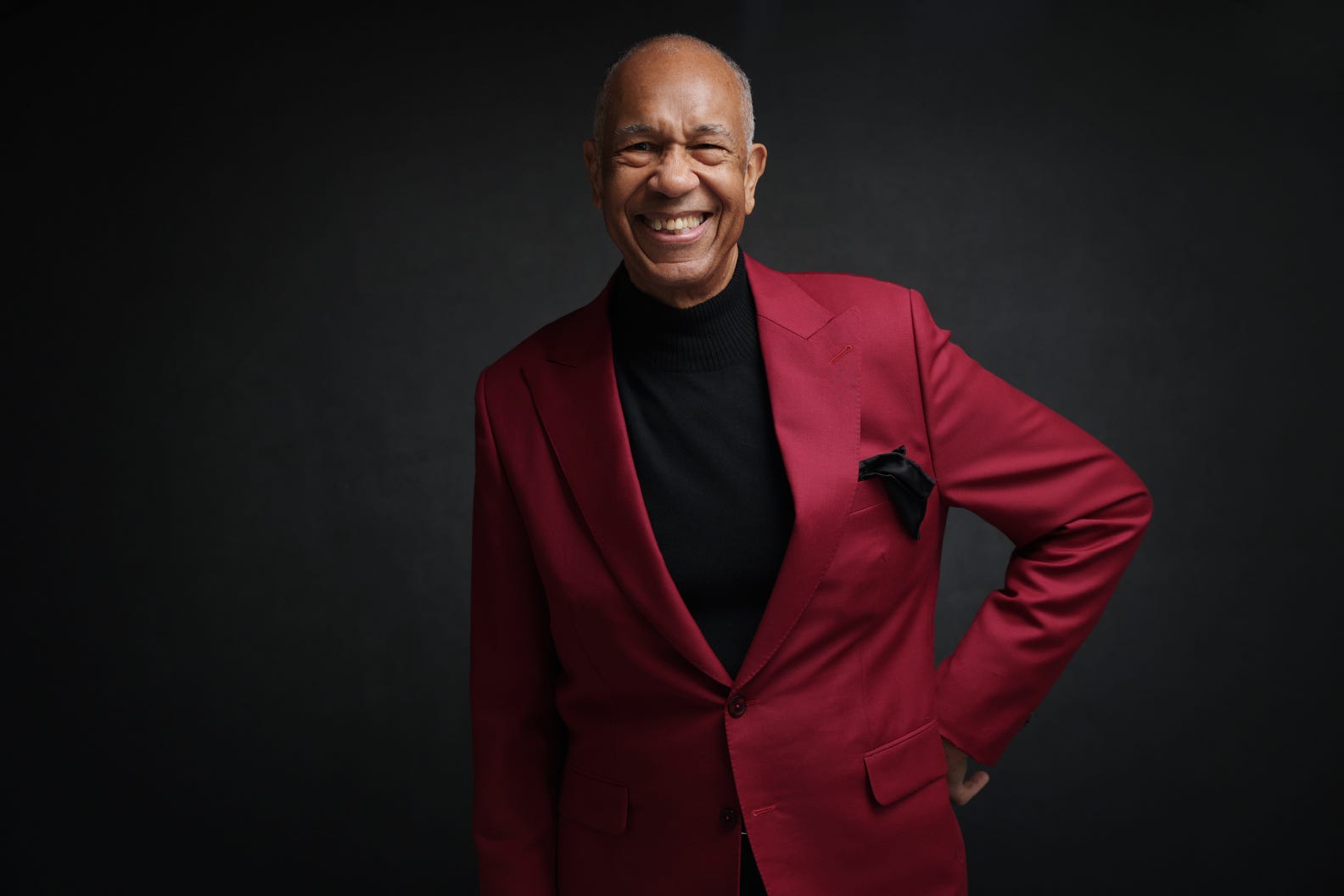
Photo of John Clayton by John Abbott #abbottphoto
It’s incredible how long you and John have known each other and played together. What was your initial meeting like?
In 1972 I was in the second band at IU and he waltzed in. Ray Brown had sent him to Indiana to get his classical chops together. David Baker was thrilled with him because he was the star of the jazz program at the time. Everybody went to the rehearsals to hear John Clayton. I just walked up to him after a couple of weeks and said, “You know, I have a quartet that I’m in and the bass player is busy on the weekends, and it’s standards, and we’ve got a singer”—who was the third-string quarterback on the IU football team! We did five nights a week for the whole year at this resort, playing standards. John did the gig and we connected. I talked to him about my own direction. I said, “You’ve got so much experience, what do you think I should do?” He seemed like a wise old sage, even though he was just one year older than me.
Last year while crate-digging for vinyl, I found one of those early records with Monty and the two of you [1977’s Montreux Alexander] and I honestly don’t know whose Afro was biggest then.
Well, it was definitely a contest because we were on the road 50 weeks a year for two years and we didn’t trust anybody to cut our hair. I’d wait until we’d get a break and come home and have the guy cut my hair there. They just kept growing over time.
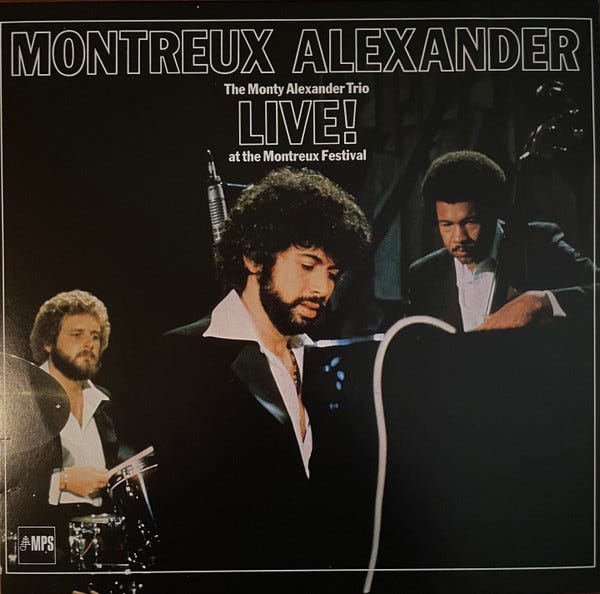
That was an interesting transition, going from the Dorsey band to Monty.
I actually had a vacation from the Dorsey band to play a week with Monty and John at the King of France Tavern in the Maryland Inn in Annapolis. I took my big-band drums, with my 24-inch cymbal and a 22-inch bass drum, and I got the gig. I knew that if I could get the gig with that equipment that Monty knew I had the touch to play in that trio.
Monty has such a unique rhythmic sense because he mixes swing with island rhythms.
Back then, in 1975, it was more geared to Oscar Peterson, and of course I knew every arrangement of Oscar’s. I was then hoping that one day I’d get to play with Oscar. Monty was in that same category and I thought, “I’ll never get to play with Oscar, so this is my Oscar Peterson dream gig, playing with Monty and John.” Fifty weeks a year for two years. I always wanted to go on Woody Herman’s band, because of those great drummers like Dave Tough, Don Lamond, and Jake Hanna. I wanted a shot at that band. There was an opportunity for me to go on that band, so I left after two years with Monty to go on Woody’s band. I would have stayed out for a year, but Ray Brown had heard me with Monty, Milt Jackson, and John Clayton and had remembered me and he hired me to take the void left by Shelly Manne in the L.A.4. I was only on Woody’s band for six months in 1977.
What an incredible series of gigs you had after leaving IU: Hampton, Monty, Woody, the L.A.4 with Ray, Laurindo Almeida, and Bud Shank, Oscar … I think it might be hard for people now to appreciate just how great those gigs were.
They might appreciate them more now because they don’t exist anymore! What I’ve always lived by is that you love the music and you do your homework. I know where Oscar Peterson is from. I know where Woody Herman is from. I know their wives’ names. You’ve got to learn everything about the person you want to play with going into the gig. That’s what I did with Monty. I got all of his recordings and I had listened to all of them before I got the job. I waltzed in and I knew most of the music. Players appreciate when you walk in and nail their music. That shows them that you want to be there.
What was it like for you to follow Shelly Manne into the L.A.4, since Shelly was a major influence on you?
Shelly was a good friend too. The first night I met him I asked him what I was doing wrong, and he put his arm around me and said, “Youngblood, you’re doing just fine, just keep doing what you’re doing.” He was one of a kind. At that time there weren’t that many around who were as versatile, holding orchestras together and then going in and playing music for The Love Boat and then hitting the bandstand with a trio and blowing it up with the brushes.
When I interviewed Sonny Rollins about Way Out West, his trio record with Ray Brown and Shelly, Sonny said that it was a magical moment with those two guys that couldn’t be replicated.
He’s absolutely right. André Previn came up and apologized to me after a concert he heard of Ray, Benny [Green], and I in his hometown. He walked up to me and said, “I think I owe you an apology.” I said, “But we’ve never met.” He said, “Well, I know you’re aware that Ray recommended you for these Telarc things that we don’t have drums on, and you would be great on them, but after Shelly Manne, I just can’t play with another drummer.” I said, “Mr. Previn, I understand that more than you know.” You weren’t just getting a drummer with Shelly, you were getting the whole package.
So was it difficult to follow him into that group?
With all due respect, Shelly and I had different concepts. I didn’t look at it as following him because I figured he was irreplaceable. This was an opportunity for me to tip my hat to him, but do the best I could to be Jeff Hamilton and see if it was going to work. The first rehearsal we did, I started doing more Shelly-isms, playing triangles and shakers, which was part of the repertoire of that group. Ray stopped the rehearsal and he turned to me and—remember, I was 24 years old then—he said, “Look, we hired you for you … we know what Shelly Manne sounds like, we want to hear what you sound like.” The lightbulb went on. He said, “We’ll tell you if something doesn’t work.” That relieved the pressure of trying to “follow Shelly.” Sometimes there can be a little too much respect going into a group like that. Ray said, “I want this group to go where you think it should go, that’s why I brought you in, so what do you want to do in this group?” They wanted me to write, they wanted me to arrange.
Is that when you started writing tunes?
I did. And you’ll never hear them again, except one was on a record, and I tried to buy every copy of it so no one can hear it. They liked it, but I didn’t. You learn by experience. The first thing I took in was when Ray wanted to do Chick Corea’s “Spain.” He said, “You [arrange] that, you’re in that age group of young guys.” I thought, “Well, I’ll do the best I can.” I take the charts in and it’s going really well. And at some point in the rehearsal, Ray just stops playing. I thought, “Oh no, I did a bad copying job with his part.” He says, “Hammer, come here.” I go over and he puts one arm around me and the other arm is around his bass. He points to the page and he says, “What’s that note?” I say, “It’s a low D.” He says, “Uh-huh.” I say, “No!,” realizing then that the E string is the lowest note on the bass. He grinned and he said, “Hammer, I’m good, but I’m not that good.” Lessons learned in a loving way.
Was that your first time playing with Ray?
When I joined the group in 1978, I was invited to be a replacement for Jake Hanna at the Dick Gibson Jazz Party and I played with him there, but just one set. So the L.A.4 was really the first time, and it felt exactly like I knew it was going to feel—like I was walking in a good old pair of shoes. I had the same experience with Oscar Peterson. He brought back that group with Herb Ellis and Ray Brown. I was the drummer that got to play with those old trio records.
When did you and John start the Clayton/Hamilton Jazz Orchestra?
We had talked about it for quite a while. When we were with Monty, everything was location work, so we’d set up an apartment for a couple of weeks. We carried a portable turntable with us. We’d be listening to Thad Jones/Mel Lewis, Quincy and Basie, and Ellington. The bug hit us. I was a natural big-band drummer from growing up and he wanted to explore the writing. We left Monty about a month apart. I went with Woody and John went with Basie. He stayed a couple of years and ended up in Holland. When he lived there he started writing and experimenting. He’d have student bands play his material and he’d send cassettes to me, asking me, “What do you think?” I said, “Yeah, it’s sounding good, let’s start our own band.” In 1985 he came back to L.A. and we started the big band, along with his brother Jeffrey [the saxophonist].
Did you originally envision it as a band in residence there in L.A. or as a touring group?
In 1985, it was hard to travel with a big band. Not many were doing it and if they were, they weren’t very successful. We started out by saying, “We want to play this music with people who love to play it and let’s see where it goes.” That was the only thing we were thinking about. Jeffery Clayton, who’d been living in L.A., knew all the personnel that we should get. When you start with Snooky Young as your lead trumpet player, you can’t lose. Our first gig was the Hyatt on Sunset and we had 19 pieces in the band, and we outnumbered the audience on our opening night.
It kept growing and the popularity kept growing until 1998, when we were made the house band for the Hollywood Bowl summer jazz series. We had all these guests come in and perform with us every Wednesday. It was fantastic. Oscar Peterson, Diana Krall, Take 6, and so many others. John was the music director and he had free rein to bring in who he wanted. The nice part is that he would write one piece that would be new to the guest artist and we would play it on the concert. That’s jazz: Come in, learn it and do it. It ended after three years, but it goes to show you where you can go: from a band that plays for 15 people on its opening night to one that plays for 18,000 at the Hollywood Bowl.
You and John also played a pivotal role in the emergence and development of Diana Krall.
She came to the jazz camp at Port Townsend [in Washington] to study with me because she loved that record Montreux Alexander that you referenced. She wanted to know the inner workings of that trio. I talked to her about it. I later heard her play but I didn’t know it was her. It was a dark room and I was in the back. I heard her play “My Foolish Heart.” She was 19. I thought it was George Cables, the pianist who was teaching at the camp. When it was over, I had tears in my eyes and I applauded involuntarily. I hear this shriek from the other end of the room. I reached for the light switch and it was her. I said to her, “Come here and sit down. You’re really serious about this, aren’t you?” She said, “Yes.” I said, “What do you want to be?” She said, “I want to be a jazz piano player.” She had dabbled in singing, but I didn’t know it at the time. I said, “Who do you want to study with?” She said, “Jimmy Rowles.” I said, “He’s in Los Angeles, how serious are you?” I told John about her—he was tighter with Jimmy—and I introduced her to Ray Brown. She moved to Los Angeles and she house-sat for my wife and I when we’d go on vacation. She baby-sat for Gerald and Gina Clayton and lived with the Claytons for a while. Ray said, “I want you to train her as a trio piano player and I’ll produce the record, but Jeff, this is your project.” That’s how Stepping Out [Krall’s 1993 debut] came about.
Given her popularity as a singer, sometimes it’s forgotten what an excellent pianist she is.
She can really play. The focus has been on other things in recent years, but she was a helluva piano player even at 19. People’s mouths would hit the floor. She’d play in that swinging Nat Cole and Oscar style, with the block chords. She was doing that at a young age.
Did you also see her unique gifts as a vocalist?
When we did that record date, she asked for a boom microphone stand and I said, “Look, I’m seven feet from you, I can hear you talk.” She laughed because she thought I knew that she sang. She started singing “Frim-Fram Sauce” and I almost stopped playing. Afterwards, I said, “What the hell are you doing?” She said, “I’m going to sing a few tunes on this.” I said, “Well, thanks for the warning!”
It must be a source of pride for you and John to see her succeed as she did. Are there others whom you’ve mentored and seen rise to some success?
I do try to help younger players. I don’t know if there are any who have done it to the extent that Diana has done it. Nobody saw that meteor rising. When [artist manager] Mary Ann Topper came in to hear Ray’s trio at the Blue Note, she said, “I need a female artist.” I said, “Well, John and I did this record with a piano player that sings a little bit.” She said, “Have her send me an 8×10 and a CD.” I did, and that’s how she ended up on GRP and Impulse!
Look, if you play your butt off and there’s a connection there and we can play music and agree on things and be compatible on the bandstand and off, I’m all in. Recently Akiko Tsuruga is someone that Howard Stone [of Vail Jazz] put me together with. He said to her, “I’ve got a drummer for you,” and he told me, “I’ve got an organist for you.” Within eight bars at the Vail Jazz Party, I knew we had to start working together.
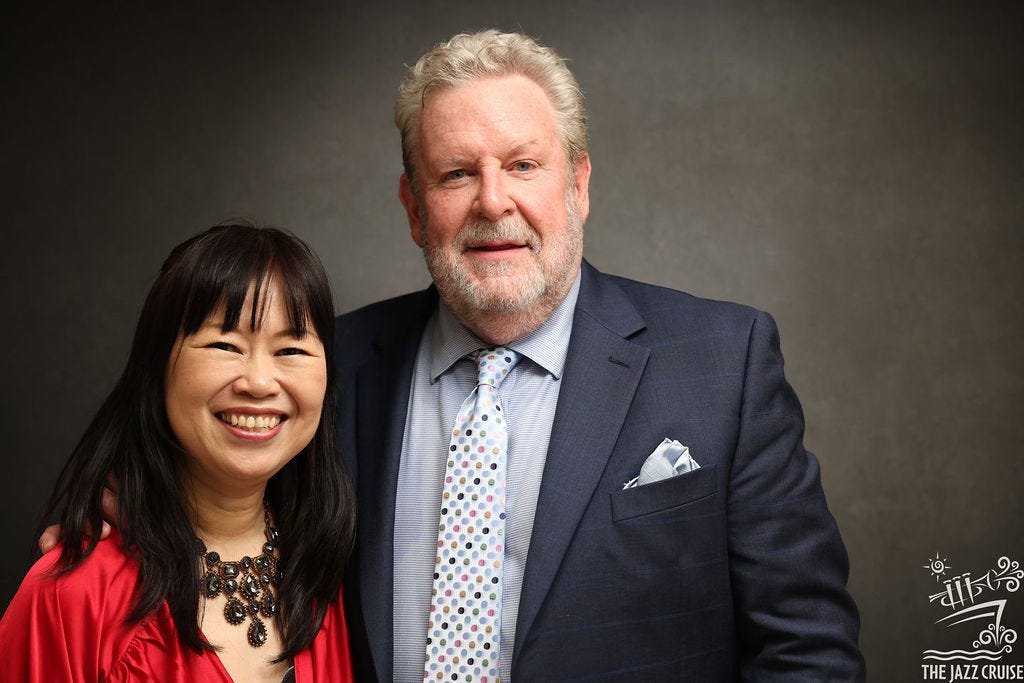
Photo of Akiko Tsuraga and Jeff Hamilton by John Abbott #abbottphoto
Also Graham Dechter, the guitarist in that organ trio.
Yes, I produced his CD that’s coming out [Major Influence]. He grew up wanting to be in the Clayton/Hamilton Jazz Orchestra. At 19, he came in and he didn’t even open the book on the first rehearsal, because he had it memorized. These are people that eat, sleep, and breathe the music and you want to help them because you know they’re serious. People helped me, so I’m turning that around and helping them as best I can.
Another of your great working relationships is with Tamir Hendelman, with whom you’ve played for more than 20 years. How did you meet?
I went to hear him with a vocalist at a club in Los Angeles. I was mesmerized by what he was doing. After the set he walked by the table, and I said, “My name’s Jeff Hamilton, what’s yours?” He told me, and I don’t think he knew me, but I said, “I’d like your phone number,” he said, “Okay,” and that was it. About two months later, Ray Brown hired Larry Fuller out of my trio and it was the day before Christmas. I had to go to Japan with my trio the next month. I called Tamir and I said, “Are you up to this task?” And he said, “Sure.” I gave him about six CDs and told him, “Listen to six tunes off these, whatever you want, and let me know which ones you want to do.” He called me in about two days and said, “I’m ready.” I said, “What tunes do you want to do?” He said, “We’ll just play when I get over there.” He came over and both he and [bassist] Christoph Luty had the entire book memorized. These are the kind of people you want in your band. That was 21 years ago.
Was the piano trio something you always wanted to lead?
My first love in jazz was the big band, because there were a lot of big-band records in the house and because the drumming captivated me at such an early age. I was listening to Jo Jones and Gene Krupa before the Beatles hit. My generation went that way and I stayed in the big-band realm. The bands were getting hipper at that time with Woody and Maynard, playing a little more modern music, and I thought, “Well, I can hang with this without an electric guitar and amps next to me.” I noticed that the trios had the same format as the big bands: There was an introduction, melody, solos, sendoff, shout chorus, melody, and outro. I could relate to that. To this day piano trios and big bands are my favorite settings in jazz.
There is something very special about the jazz piano trio.
If you have the right people and everyone is thinking how to make it sound like more than a trio. “Does this cymbal work in this situation?” Or “Is this drum tuned properly?” Or “If the piano player is in the middle of the keyboard, am I going to be playing the tom-tom?” You orchestrate so if somebody’s low, I go high, and vice versa. What sounds complement what you’re hearing?
Was there any method to the song choices on the new album?
Songs that I love and that I’d played with other folks, and tipping my hat to John Von Ohlen with [his composition] “The Pond,” because so many people didn’t know that he could play piano. He was such a harmonic genius and he doesn’t get credit for it. He actually has a piano CD called The Pond that one of his colleagues made him record about two years before he passed. I wanted to pay tribute to him and put our treatment of that on the CD. With “Catch Me If You Can,” we needed an up-tempo bebop kind of thing that Tamir does so well. I turned him loose on it. And of course it took us forever to learn the impossible tune, hence the title.
Not a cover of the Dave Clark Five hit, though. You also tip your hat to Thad and Mel, and Woody Herman.
That’s right. I used to wake up every morning and play Thad and Mel’s “Big Dipper” before I’d go to school. If I did that, then the whole day was going to be cool and I didn’t care about history or flunking chemistry or any of that.
Looking back now, have you had the career that you dreamed of or has it gone beyond that?
It’s gone beyond that. When I was 19, I set my goals: I wanted to play with Oscar Peterson, Ray Brown, Woody Herman, and the Count Basie Orchestra. When I was able to play with all four of those people that I had dreamed of, I realized, “Oh, I’m not 40 yet, so I guess I get to die when I turn 40.” The only person I didn’t get to play with was Duke Ellington, but he died when I was 20 years old and on the Dorsey band.
I’m quite happy with where I am musically now. With the Clayton/Hamilton Jazz Orchestra I have my big-band fix. And with my piano trio and with Akiko and Graham, I have three groups that I work predominantly with. I don’t want for anything more. I love playing great music with great people. I’m quite content. I know that sounds weird for a jazz musician to say, but it’s true.
Note that Jeff’s latest trio features Tadataka Unno on piano and Jon Hamar on bass. Sadly, the organist Akiko Tsugura died in September 2025. She was just 58 years old.
The ‘Mergner He Wrote’ logo is by Nan Parati, the Queen of Music Festival Signs. For a custom sign of your own, contact her at Nan@nanparati.com
No posts
Comments
Nothing yet. Say the first thing.
Sign in to join the conversation.