
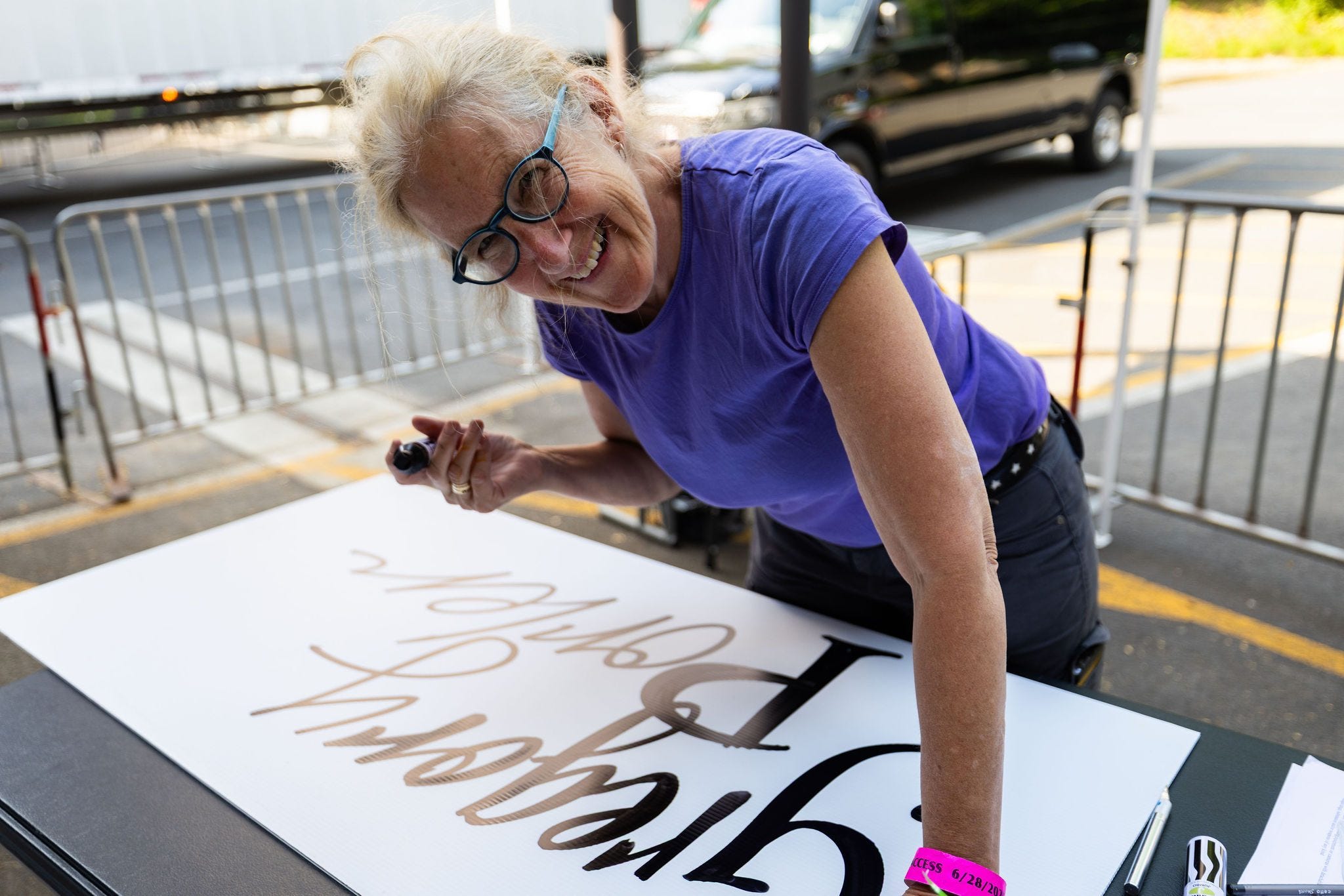
If you’ve attended New Orleans JazzFest, Saratoga Jazz Festival, Montclair Jazz Festival, the Newport Folk Festival or Newport Jazz Festival, you are surely familiar with the art of Nan Parati. But it’s just as likely you don’t know her name. That’s because Nan makes the distinctive and ubiquitous signs for those festivals and several others. They’re everywhere, providing instructions, directions and titles to or for just about anything and everything—from where to stand, sit or dance to where to find drinking water. And of course, the names of the performers. All with a dash of both wit and style.
It’s no small undertaking. For JazzFest in the Crescent City, she creates more than 3,000 signs for those two weekends in late April and early May. During the recent Newport Folk Festival, I conducted a poll asking more than 30 longtime workers and fans at the festival how many of Nan’s signs were posted at the festival this year, with the winning answer getting their own custom sign from Nan. Their answers varied from 65 to 3,500. Interestingly, Nan herself had trouble coming up with the correct final figure, but we asked her friend and colleague Seth, who actually puts up the signs at the festival, for his best estimate. His answer for Newport Folk was 900. The winner was a woman named Meg who was working with the Green Team at the festival, ensuring that recycling protocols were being followed by attendees. She still has not decided on her custom sign. I told her mine would be two-sided: “I’m listening” on one side and “I’m done listening” on the other.
Nan’s path to this unique role began in her childhood growing up with her parents and three siblings in Charlotte, NC. Her father was a graphic designer back in the day before computers and desktop publishing, when everything was done by hand. “When we were kids, his office was in our house,” she explains. “Our play area was on Dad’s floor. We would sit on the floor and draw things. He would give us paper and everything, and he taught us about drawing all the time.”
She describes her parents as hippies, although they were more of the beatnik type given the era. “When we were growing up in the early 60s, we had a Volkswagen van and we would be driving around,” she recalls. “And Dad would say, ‘Okay, kids, is that a good billboard or a bad billboard?’ He’d pull over and we’d go, ‘That’s a bad billboard, Daddy.’ And he’d go, ‘Alright, good, why?’ And we’d say, ‘Not enough contrast, too many words, bad font…’ You know, whatever.”
Billboards on the road weren’t the only opportunities for learning. “When our family would go to see movies, at the end we would sit there and we would discuss the credits,” Nan says. “It wasn’t just him making us do it. We were all interested. I understand now that’s really where I learned about lettering. It was all from him.”
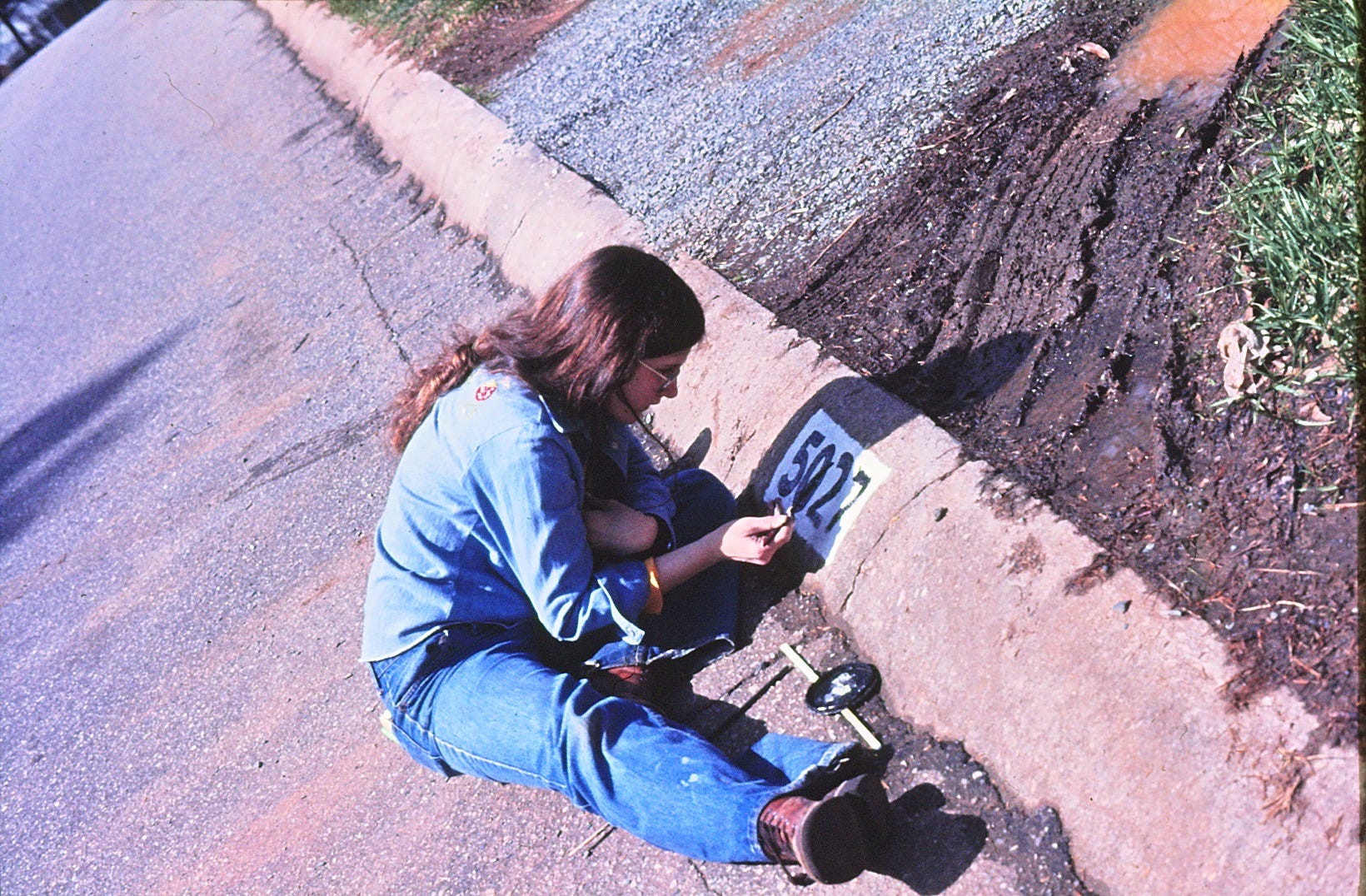
Despite that early indoctrination, those skills went largely unused as Nan went to UNC at Chapel Hill as a German, English and Education major. It wasn’t until years later, when she was living in New Orleans in 1983 and got a job at a grocery store called Whole Foods Company (one of the forerunners to Whole Foods Market), that she stumbled onto her career path. Her first position was in the produce department. “I was really bad at doing produce stuff,” she recalls, laughing. “I got fired about two weeks later. I said, ‘But you complained that I talked to people too much…you need somebody in the cheese department, so you should put me in the cheese department so I can talk to people.’ They said, ‘Alright, go work in cheese.’ I worked in cheese for about two weeks. I got fired again.”
By a stroke of luck, the same day that she got fired a second time, the sign writer was leaving. Nan said that she knew THAT was her real job. “I promised them I knew to do it even though I had never done it professionally,” she says. “They said, ‘Okay, this is your last chance.’ So I got the job writing signs for the store. Within just a couple months, I also became the creative director and the head of advertising.” Two years later, in 1985, the New Orleans Jazz & Heritage Festival (known as JazzFest), came calling and asked her to make signs for them. She had found her calling. Or it found her.
Nan says that her style evolved over the years. “I’ve been thinking about this a lot lately,” she explains. “Back in the early days, I didn’t have my own signature style. I was kind of doing different things, but essentially Helvetica. In 1983, there was a guy, Wire Dog, who I made signs for. That first year his was the only artist name I did. Then the second year he said, ‘Could you do me some parking signs too?’ And I said, ‘Sure.’ That’s how that started. Over time I came back and did more and more signs and they started to look more like my own thing.”
However, her signature style of lettering was dramatically rebooted during COVID. “I didn’t know what I was going to do for money because there were no festivals,” Nan says. “I posted on Facebook, offering to do a sign for anyone. I was in New Orleans at the time and somebody came over and requested a sign for a [clothing and accessories] shop called Fleurty Girl. She just wanted it to say Fleurty Girl. So I made that sign for her and gave it to her. The next day, a woman came over and said, ‘Hi, I’m Lauren Haydel. I own Fleurty Girl. And here’s what we’re going to do: I’m going to start taking orders for you and I’m going to pay you this much.’ It was way more than I was actually charging. She started advertising and it went crazy with people ordering signs. That business really blew up during COVID because of Lauren.”
With that custom business, she naturally has had to keep some guardrails. “I have rules about signs,” she explains. “No obscenity. No politics. No unintentional bad grammar. I was an English major, so I know my grammar.”
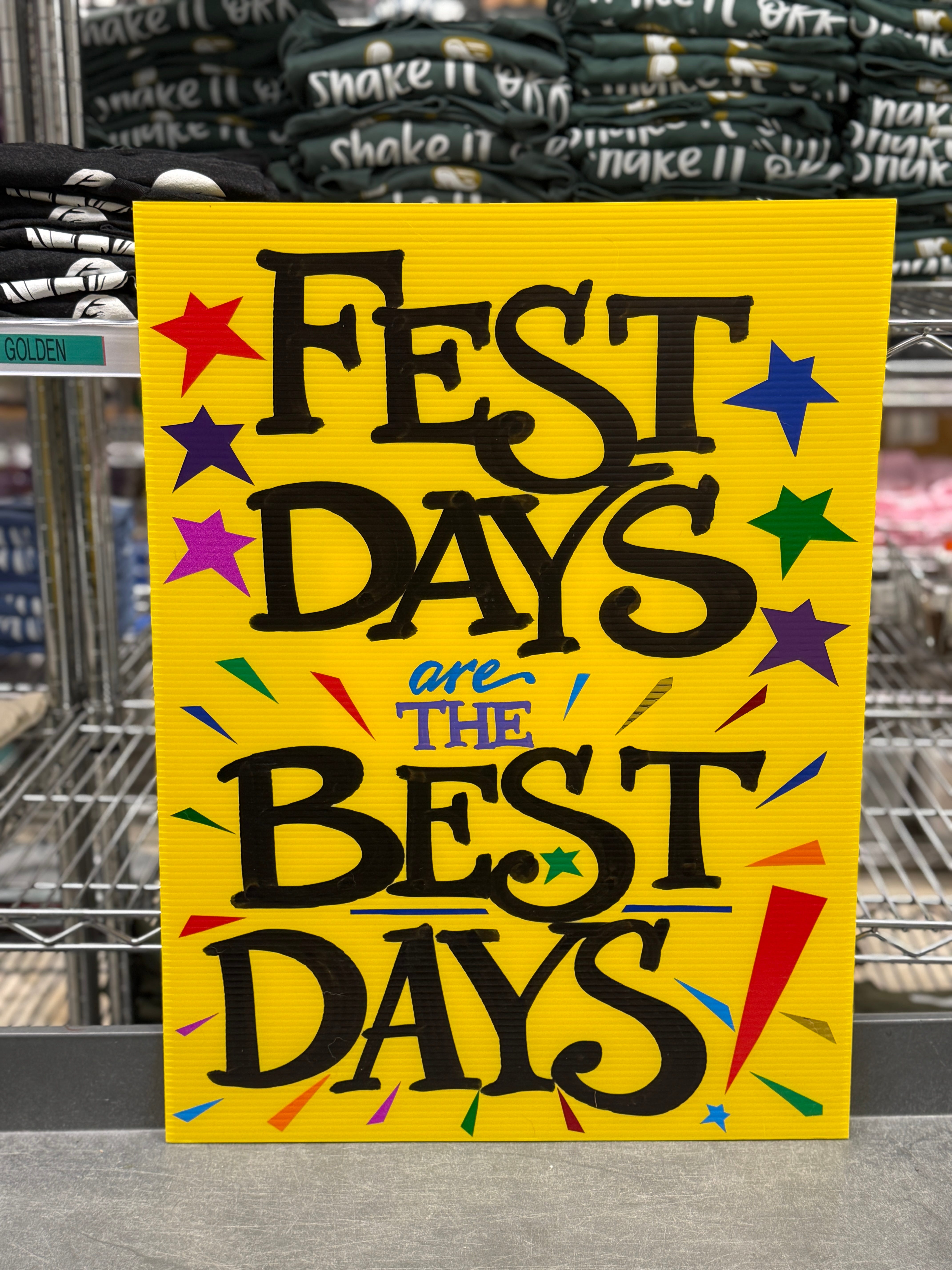
Nan says that as a result of the custom business she was able to take her time and be more mindful of her work. “Here at festivals, I’m always just in a hurry, hurry, hurry to make the sign and get it out there,” she says. “I really had to think about these signs because they were for people’s houses. That’s when my style fully developed to where it is now with the stars and the swirls. Then when I came back to festivals, I brought that same style back. Now this is where we are. The previous style was similar, but it was much more hurried. It wasn’t as refined.”
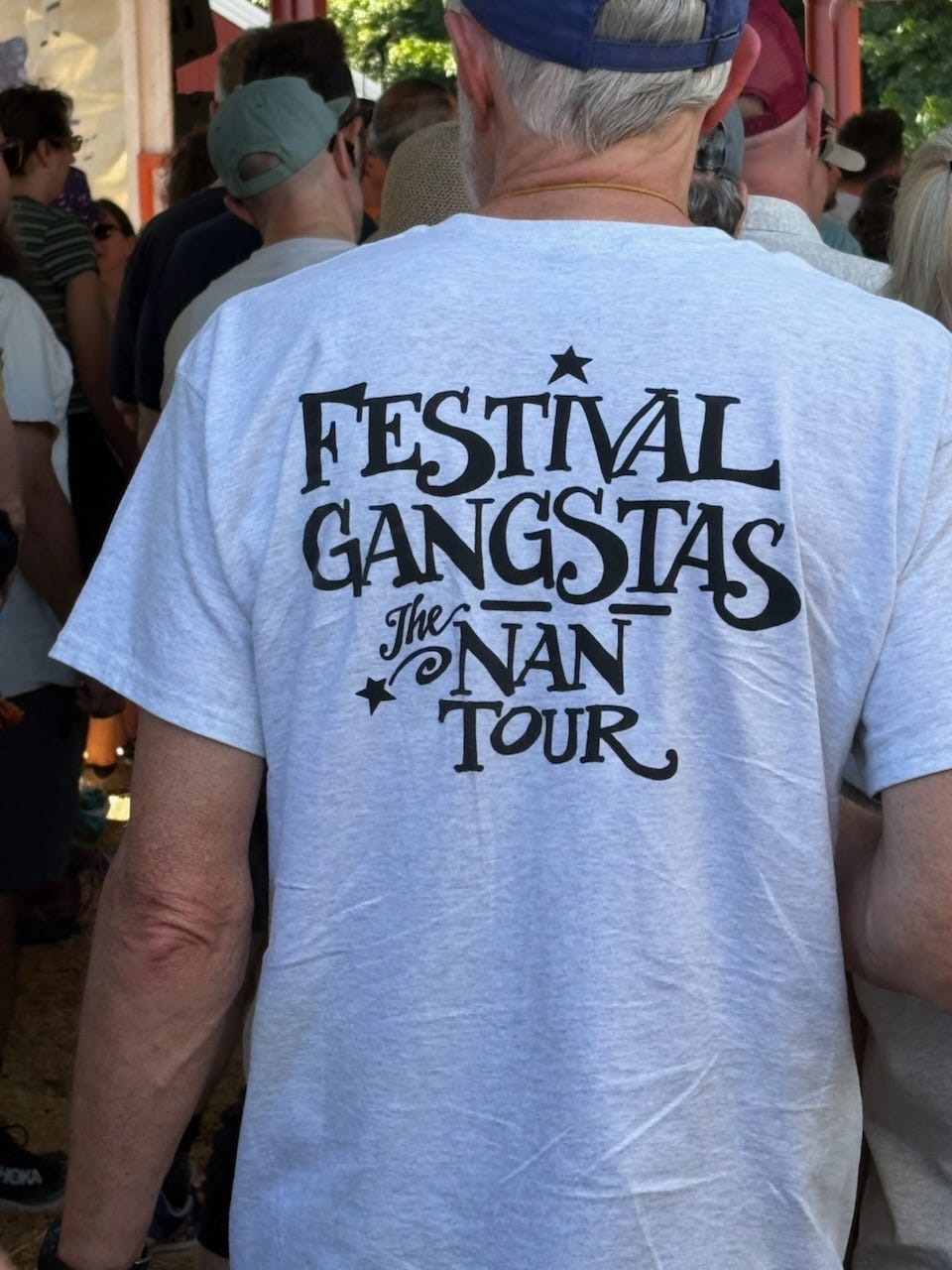
That style is very distinctive and accordingly she has applied for a copyright and trademark. In recent years, she’s even seen festival and event signs that are clearly influenced by her prodigious output. “People will tell me, ‘Oh, I saw your signs at a certain festival.’ But I know those are not my signs. On one hand, it’s like, ‘Well, okay, I turned into a thing.’ On the other hand, ‘No, this is MY thing. I developed it myself.’ I pretty much invented it, I really did. There was nobody doing this before I came along. To be clear, I don't mind at all, people making signs for festivals or anything else. I just want them to come up with their own fonts in their own right and not copy mine.”
I asked Nan if she’s ever done any clunker signs that she regretted. “No, absolutely not,” she answers quickly. “The signs talk to me and they will say, ‘Are you really going to send this out?’ I say to myself, ‘No, I’m not going to and I’ll make it over.’ I always say that it takes me 42 years and five seconds to write a sign because I’ve been doing it for 42 years. I can do them pretty fast now and I don’t have to do too many of them over again.” Indeed, it’s fascinating to watch her quickly turn a phrase into a colorful image, often while she’s conversing with you about something entirely different.
Unsurprisingly, the artists themselves love their signs and often request to take them home from the festival. Nan remembers one recent incident at the Saratoga Jazz Festival where the person changing out the artist signs was approached by a fan who asked for Lakecia Benjamin’s sign after her performance there. “I always say to the staff, ‘Give it to the fans if they want’” Nan explains. “Lakecia told me later on that she saw a guy with HER sign and went after him. She told him, ‘That’s MY sign.’ He said, ‘No, it’s my sign now.’ She said, ‘No, that’s MY sign.’ They got into it, but she won.”
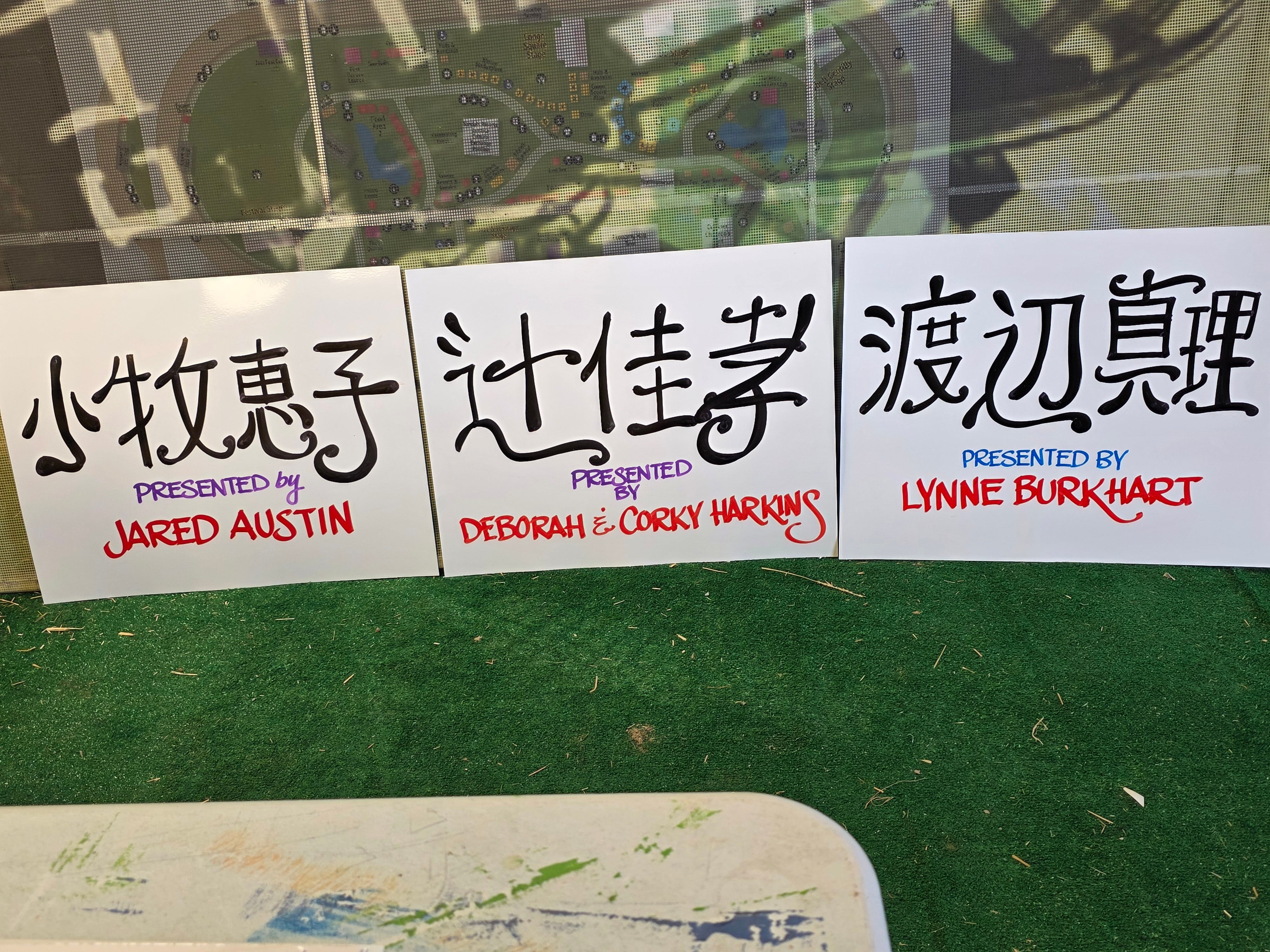
Although she does signs for several different genres of music, her approach doesn’t change. “No, I do the same thing…my thing,” she says. You can ask her about the tools of her trade but you won’t get any farther than that she uses a variety of markers. She keeps the source of the signs’ material a trade secret, which given the volume of work is understandable. “I make signs for people all over the world,” she says. “I just shipped some signs off to Iceland not too long ago. I do make them for an awful lot of festivals. And even for the festivals I don’t attend, I make a lot of signs and ship them to them.” Including to Japan as you can see here:
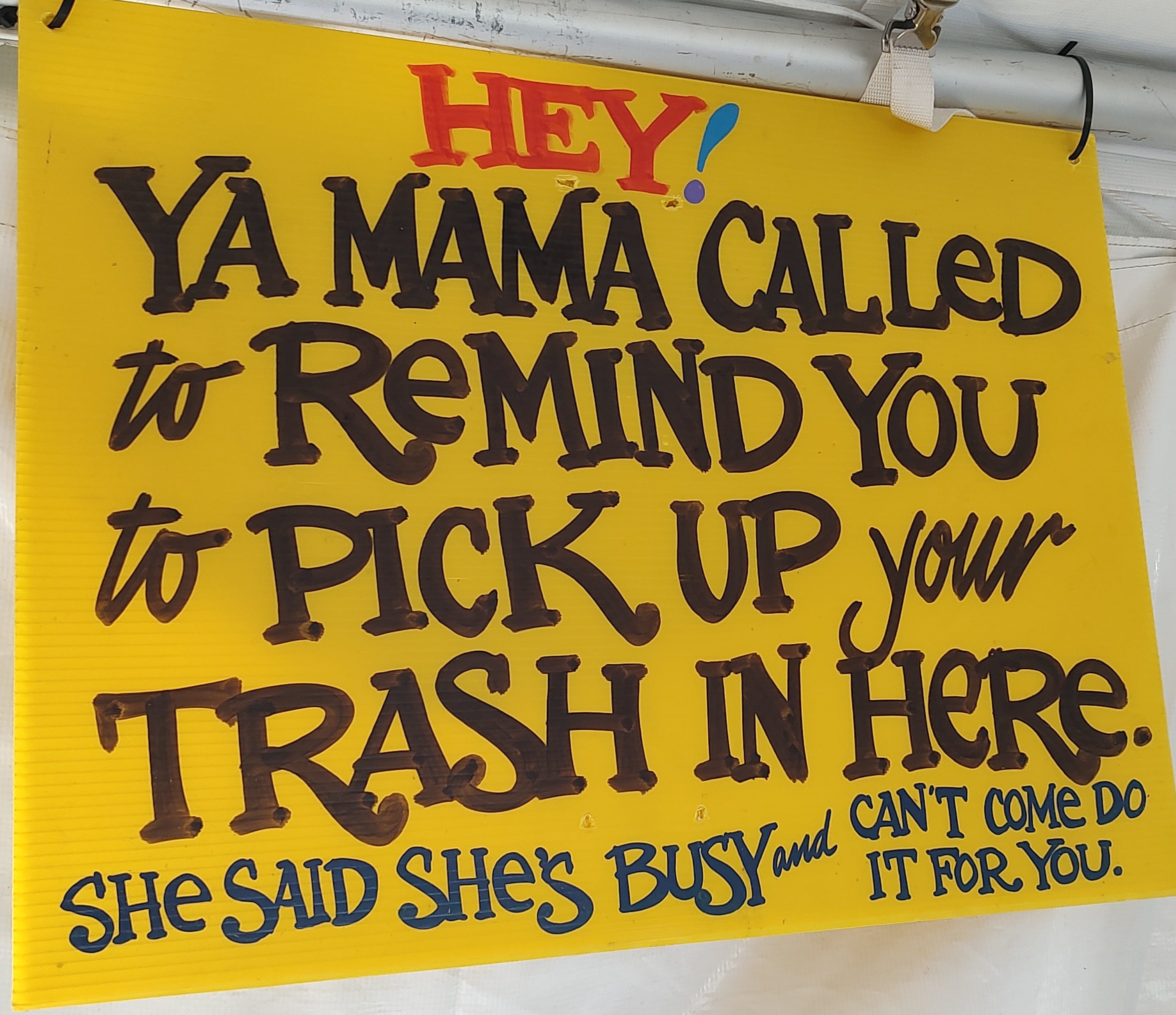
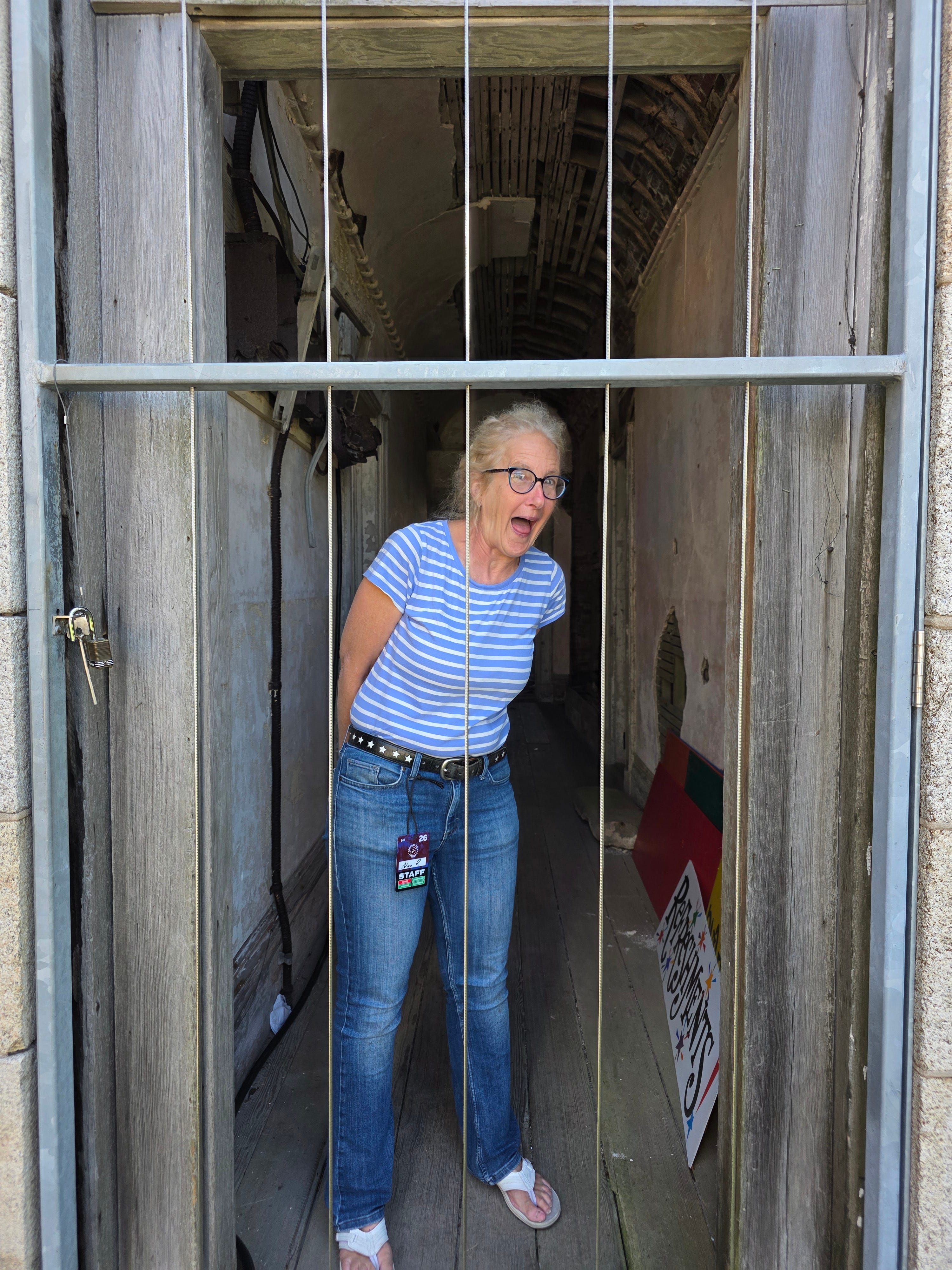
In addition to those “mail order events, she does about a dozen festivals in person, working like Santa’s elf on-site, but calmly, not feverishly. At Newport, she takes over a few rustic rooms inside the Fort, where she plies her craft in that makeshift workshop from morning to night. Even as I interviewed her on the morning of the last day of Newport Folk, multiple staff members interrupted to request signs for, well, just about anything. For example, my wife Irene works with our friend Casey providing hospitality to accredited writers and photographers, who are not always careful in cleaning up after themselves. Here’s the sign that Nan made for them (Note that the wording was Nan’s alone):
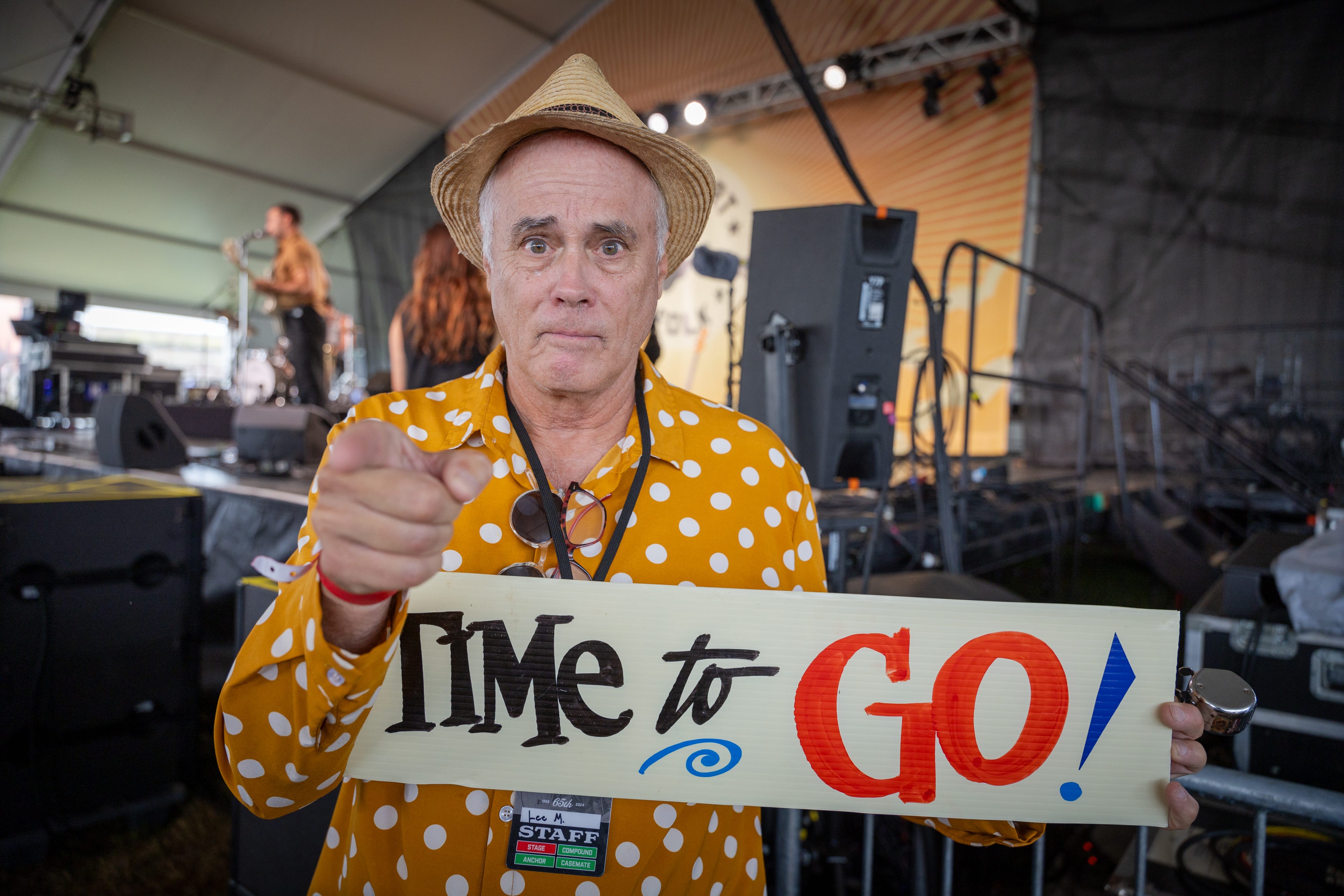
I too have asked her to do signs for me in my position as a supervisor of the photo pit for the Quad Stage at the Newport Folk and Jazz Festivals, in order to inform the dozens of photographers of any instructions without having to yell it out during the artists’ performances. Here are a few of my favorites for letting the photographers know that their time in the pit has ended:
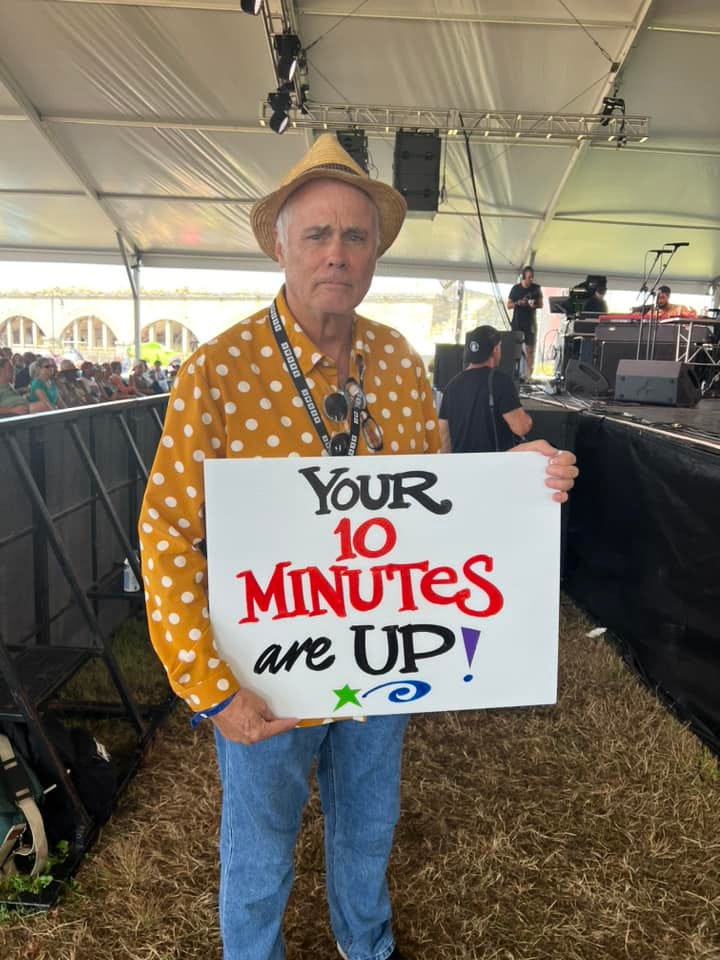
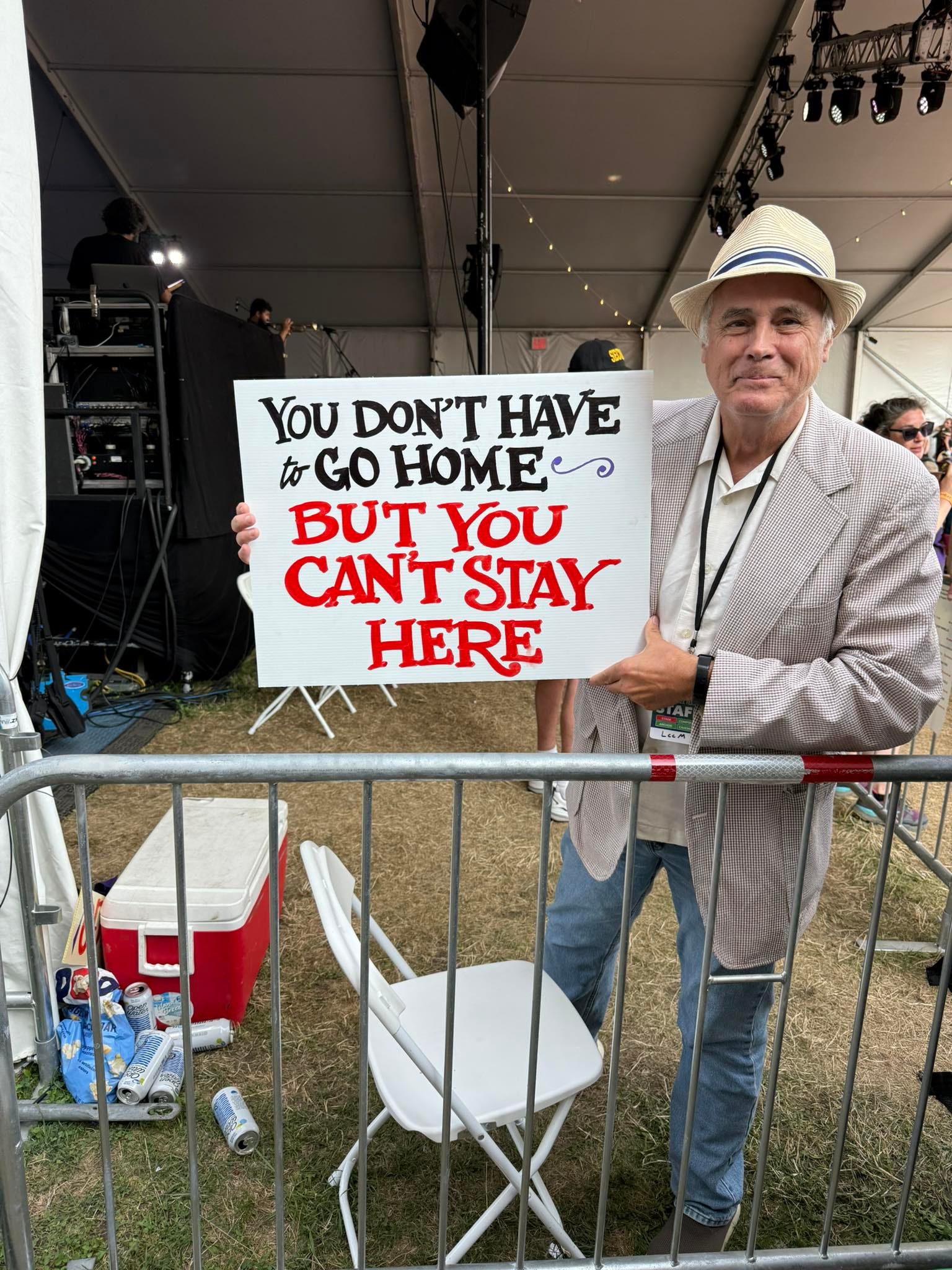
That young girl who critiqued billboards and movie credits under her father’s tutelage still has a voice inside Nan’s head, as she casts a discerning eye at graphic design today. “People who do this kind of work now are always on the computer, where everything is backlit,” she says. “They don’t know about contrast, because everything is up close on their screen. All the time I see billboards that you can’t read at all. I say, ‘That’s a bad billboard, Daddy.’ We just moved our art department for JazzFest in New Orleans from one building to another. I was going through stuff that had been there forever. And I found a booklet that my dad had given me probably in the early 70s, which is all about contrast and fonts and things like that. Apparently I had shown it to somebody and then left it at the studio. I still have that. It’s really cool.”
If it all sounds like a lot of work, it’s true. But to Nan, all that work is truly a calling. “I have the best life possible.”
To have your very own custom sign made by the great Nan Parati, you can email her at Nan@nanparati.com.
You can see more of Nan’s handiwork and learn more about her life at her website here.
She also has a podcast called Nanlandia.
No posts
Comments
Nothing yet. Say the first thing.
Sign in to join the conversation.