
What is one part of your own learning or working process that you might move back to paper before bringing it to AI?
Jason Schock and I had a conversation in Substack Chat about feeling overwhelmed by the amount of information available today, and how artificial intelligence has intensified that feeling.
There is always more to read, watch, summarize, compare, and respond to. AI can help us process some of it, but it can also create even more possibilities. Before long, we may find ourselves asking a machine what we think before we have taken the time to think for ourselves.
I have also noticed something interesting. The more digital our lives become, the more some people seem to be returning to analog habits. We read physical books, write in notebooks, underline passages, and make handwritten lists.
It is slightly amusing that AI dominates so many online conversations, while it rarely becomes the central topic when I’m talking face-to-face with friends or family.
Online, we are constantly analyzing the future of artificial intelligence. In person, we are usually talking about work, food, school, family, or whatever happened that day.
Still, the question matters: Why not return to analog thinking before turning to AI?
AI did not invent passive thinking. It simply makes passive thinking easier to produce.
We could already copy ideas from books, repeat someone else’s language, search for ready-made answers, or skim information without understanding it. AI has made those behaviors faster and more polished.
The danger is not that AI will suddenly destroy our minds. A more precise concern is skill decay through disuse.
If we repeatedly outsource the first act of thinking, the forming of questions, making of connections, explaining of ideas, and deciding what matters, those abilities may become less practiced. Like any skill, they need regular use.
This is one reason analog tools remain valuable. A notebook does not instantly produce a polished answer. A physical book does not summarize itself. A handwritten page may be messy, incomplete, and difficult to organize.
Friction gives us time to notice what we actually think and really helps us to learn!
When I write by hand, I cannot generate ten perfectly worded alternatives in a few seconds. I have to stay with one idea for a little longer. I have to decide what deserves to be written down. I have to encounter my own uncertainty instead of immediately covering it with fluent language.
That process can feel slower, but it is often where the thinking begins.
I am not arguing that we should abandon digital tools or pretend that AI is not useful. In fact, I think AI can amplify our thinking in remarkable ways when we bring it something of our own first.
The important question is not whether we use AI. It is where AI enters the process.
If I ask AI to generate an article before I have developed an idea, its starting point can easily become mine. I may accept its structure, language, assumptions, and examples simply because they appear quickly and sound reasonable.
But if I first write down my own observations, questions, examples, and possible arguments, the conversation changes.
Now I have something to examine.
I can ask AI:
What assumptions am I making?
What is missing from this argument?
What would someone who disagrees say?
Which claims need evidence?
What connections can you see between these ideas?
Can you ask me questions without rewriting my work?
What would be a practical way to test this?
Those questions position AI as a thinking partner rather than an automatic author.
The machine is no longer deciding where the thinking begins. It is responding to a record of human attention.
The process does not need to be complicated.
Begin with a physical book, a printed article, a lesson idea, a problem, or an experience. Before searching for an explanation or asking AI for a summary, write down your first reactions.
What surprised you?
What confused you?
What connections came to mind?
What examples from your own life or work relate to this?
What might you want to do with the idea?
These notes do not need to be organized. They are not supposed to look intelligent. They are evidence of your first encounter with the material.
Next, return to the strongest ideas and explain them in your own words. This is where a quick reaction becomes something more useful. Add context. Give an example. Connect the idea to something you already know. Explain why it matters. I wrote about this in The Art of Elaboration.
If you cannot explain an idea without looking back at the source, you may recognize it, but you probably do not understand it deeply yet.
Only then should you bring the developed material into a digital space or an AI conversation. AI can help you compare ideas, find gaps, challenge assumptions, reorganize notes, or suggest possible directions. You still have to decide what to accept, reject, adapt, or verify.
Finally, give the thinking somewhere to go. Turn it into an article, lesson, decision, experiment, conversation, product, or next step.
Thinking becomes more valuable when it leaves the notebook and enters the world.
This framework is what I call The CARE Note-taking Method which goes into much further depth in my Starter Kit you can download here. Or become a paid subscriber and download the Starter Kit as a perk!
This workflow is especially important in education.
Students should not begin every assignment by asking AI to produce a polished response. They need opportunities to encounter a text or problem, form their own questions, articulate their understanding, and make their thinking visible.
A teacher might ask students to begin with a handwritten “My Thinking First” page. Students could record observations, predictions, questions, uncertainties, and possible connections before using any outside assistance.
After that, they could develop one or two ideas in their own words. AI might then help them identify a counterargument, test the strength of their reasoning, or suggest questions for further investigation.
The final work would still belong to the student because the student’s thinking existed before the tool entered the process.
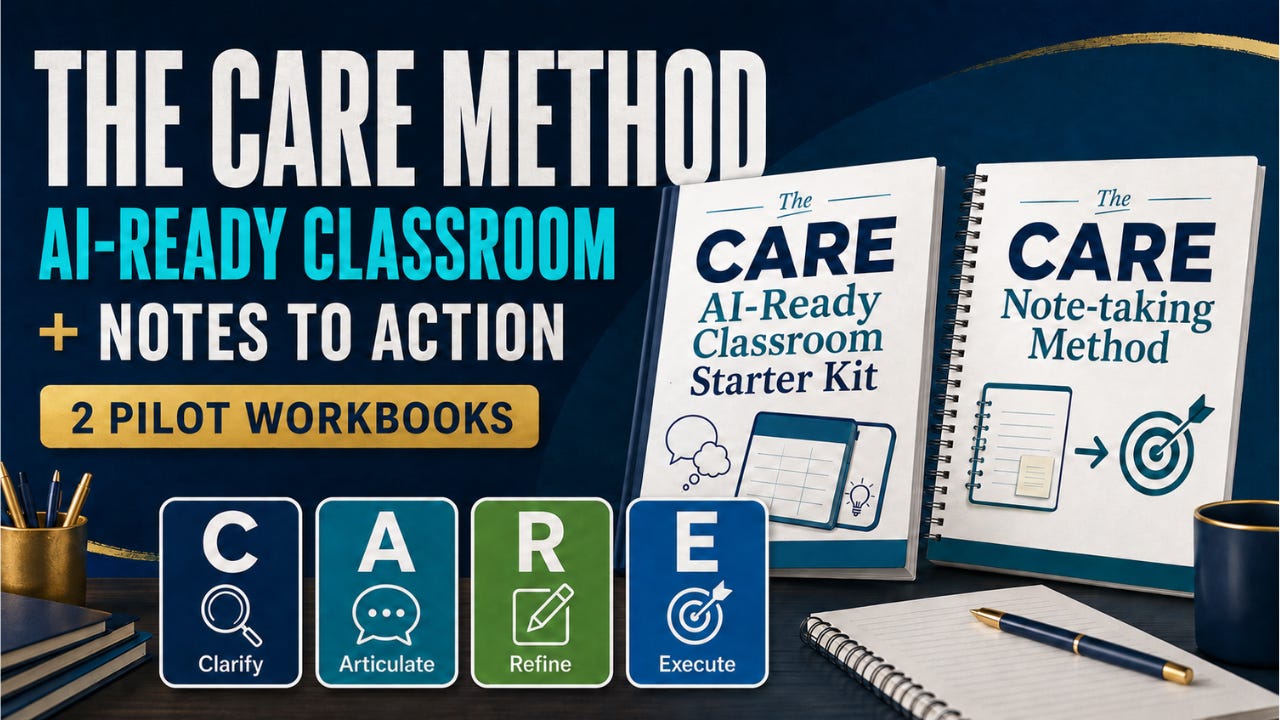
This is the basic logic behind the CARE method: Clarify, Articulate, Refine, Execute.
The notebook helps us clarify what we are trying to understand or create. Writing in our own words helps us articulate our thinking. AI and other tools can support refinement. Then we execute by creating something meaningful and carrying the learning forward.
AI gives us access to more information. A thinking process teaches us what to do with it.
We do not have to choose between analog and digital, books and AI, handwriting and productivity tools.
The stronger approach may be to give each one an appropriate place.
Use analog tools to slow down, notice, capture, and begin. Use digital tools to preserve, connect, retrieve, and develop. Use AI to question, challenge, compare, and expand—but do not let it become the place where your thinking starts or ends.
For me, the most useful sequence is simple:
Think first.
Write first.
Then invite AI into the conversation.
The goal is not to protect every thought from technology. The goal is to make sure that technology is working with our thinking rather than quietly replacing it.
What is one part of your own learning or working process that you might move back to paper before bringing it to AI?
Thanks for reading Learning to Learn Well! This post is public so feel free to share it.
Comments
Nothing yet. Say the first thing.
Sign in to join the conversation.