
There is a sentence in my notebook that I wrote while reading Roland Allen’s The Notebook: A History of Thinking on Paper:
Every mind works differently, but the common thread is that we all need a way to externalize our thoughts.
I did not write it as a polished thesis. It was one of those sentences that appears while you are still trying to understand what you think. The handwriting is uneven. There are arrows around it. The wording may change before this essay is finished. It might even change because I am writing this essay.
That is part of the point.
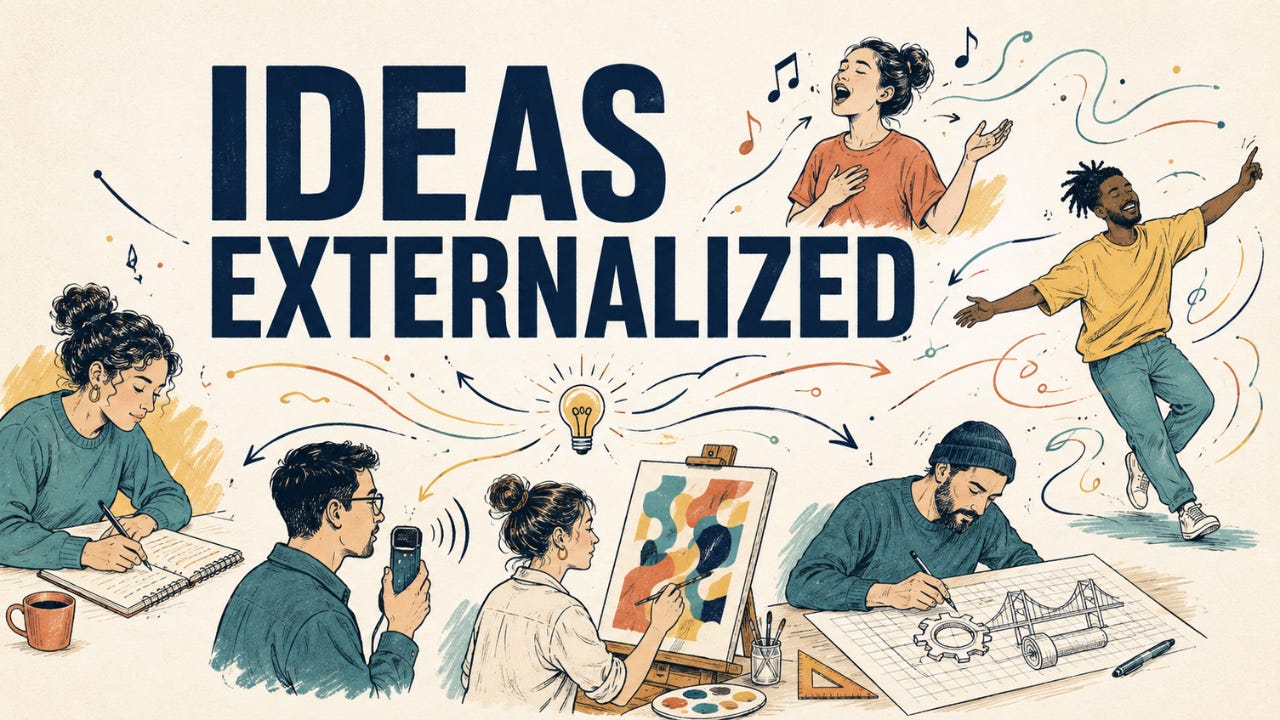
I have spent years writing in notebooks, but I do not think the lesson is that everyone should become a journal keeper. Not everyone likes writing. Not everyone has a natural relationship with the blank page. Some people discover what they think by speaking. Some need to draw. Some need to walk, dance, sing, build, design, or make something with their hands before the idea becomes clear enough to explain.
The medium is not the most important part.
The important part is finding a way to move thought outside yourself so you can work with it.
A thought that remains entirely inside your head can feel complete simply because it is familiar. You can circle around the same idea for hours and experience the movement as progress. But until the thought becomes a sentence, sketch, sound, movement, model, conversation, prototype, or some other visible or audible form, it is difficult to examine it closely. You cannot easily compare it with another idea, invite feedback, notice its weaknesses, or decide what to do next.
Externalization is what gives thought a surface.
It turns an experience into something you can revisit. It turns a vague intuition into something you can question. It turns an imagined possibility into something you can design, test, revise, and eventually share.
This is why I have come to believe that externalization is one of the basic conditions of improvement.
If you are trying to learn, create, solve a problem, understand yourself, or develop a craft, you need some way to make your thinking available to your own attention.
You do not necessarily need to write.
But you do need somewhere for the thought to go.

The sentence in my notebook appeared near the end of Allen’s book, in the chapters about modern notebooks, diaries, and Ryder Carroll’s Bullet Journal. I had been reading about the many forms notebooks have taken over time: places for lists, observations, experiments, sketches, calculations, memories, plans, and private reflections.
The objects were different, and the people who used them were different. Some notebooks were carefully organized. Others were full of fragments. Some were used to keep track of business or scientific observations. Others preserved personal experiences that might otherwise have disappeared.
But a pattern kept returning: people were using external marks to help them do something their unaided minds could not easily do alone.
They were trying to:
notice
organize
remember
make sense of what had happened
and develop something that did not exist yet
The notebook is not simply a container for finished thoughts. It is part of the thinking process itself.
That realization connected with my own experience so strongly that I stopped reading and began writing. I did not want to summarize Allen’s argument. I wanted to understand why the idea was affecting me.
I wrote about how every mind works differently. I wrote about writing, painting, speaking, and dancing. I added lists, poems, and narrative as different ways of shaping experience. I wrote that ideas often need to be externalized before they can be revised, sharpened, and materialized.
The notes were not elegant, but they were alive. They were connected to my experience, and because they existed on the page, I could return to them later.
That is one of the reasons I keep notebooks. They allow me to encounter my own thinking at different times.
The person who writes a note in the morning may not fully understand it. The person who returns to the note a week later may see a connection that was there before but they needed time to process it. A sentence that felt ordinary may suddenly become the beginning of an article, lesson, business idea, or decision.
The notebook creates continuity between versions of yourself.
This has become particularly important during the past year of my life.
I spent fourteen years living and teaching in Indonesia. During that time, I developed a professional identity, a network of relationships, a sense of place, and a rhythm of life. I taught English and humanities, worked with students, wrote curriculum, developed lessons, read books, and gradually became the person who could recognize what he cared about and what he wanted to contribute.
When I moved back to the United States in 2025, I knew the move was necessary for my family, but necessity does not make transition simple. Returning to a country you call home can be strangely disorienting. Even though it’s where you came from and recognize many things before your move, you do not necessarily recognize your place within them.
Professionally, I sometimes felt as though I had been returned to a blank slate. I had experience, qualifications, and years of work behind me, but the context that had made those things visible was gone. I had to rebuild a working life, understand a new environment, and figure out what parts of my previous identity still belonged.
There were practical problems to solve, of course. There was work to find, family life to establish, and a new routines and networks to create which is truly a never-ending process. But underneath those practical tasks was another question: What matters most to me now?
I did not answer that question in a single moment. I answered it gradually by writing and I found that, ever since elementary school, writing has been my way of figuring my own thoughts out.
I wrote about the move. I wrote about teaching. I wrote about the kind of work I wanted to do. I wrote about the books I was reading and the ideas bubbling inside my head, begging to be set free.
I wrote about uncertainty, frustration, ambition, gratitude, and the strange feeling of rebuilding a life while still carrying the previous one inside you.
Journaling did not solve the transition. It did something more modest and, in the long run, more useful: it gave the experience a form I could examine.
When everything remained in my head, the transition felt like one enormous and indistinct problem. On the page, it became a collection of smaller questions.
What kind of work do I want to do?
What do I want to teach?
What do I still believe about learning?
What did I gain from my years in Indonesia that I do not want to lose?
What am I building now?
What would meaningful progress look like this week?
The questions did not always produce immediate answers, but they gave my attention somewhere to land.
Over time, those entries helped me recognize that the work I wanted to continue was not separate from my previous life. My teaching, writing, reading, curriculum development, and interest in artificial intelligence were all connected by a common concern: how do we turn what we learn into clearer thinking and meaningful action?
That question became the center of Learning to Learn Well. It also became the foundation for the CARE Teaching Method.
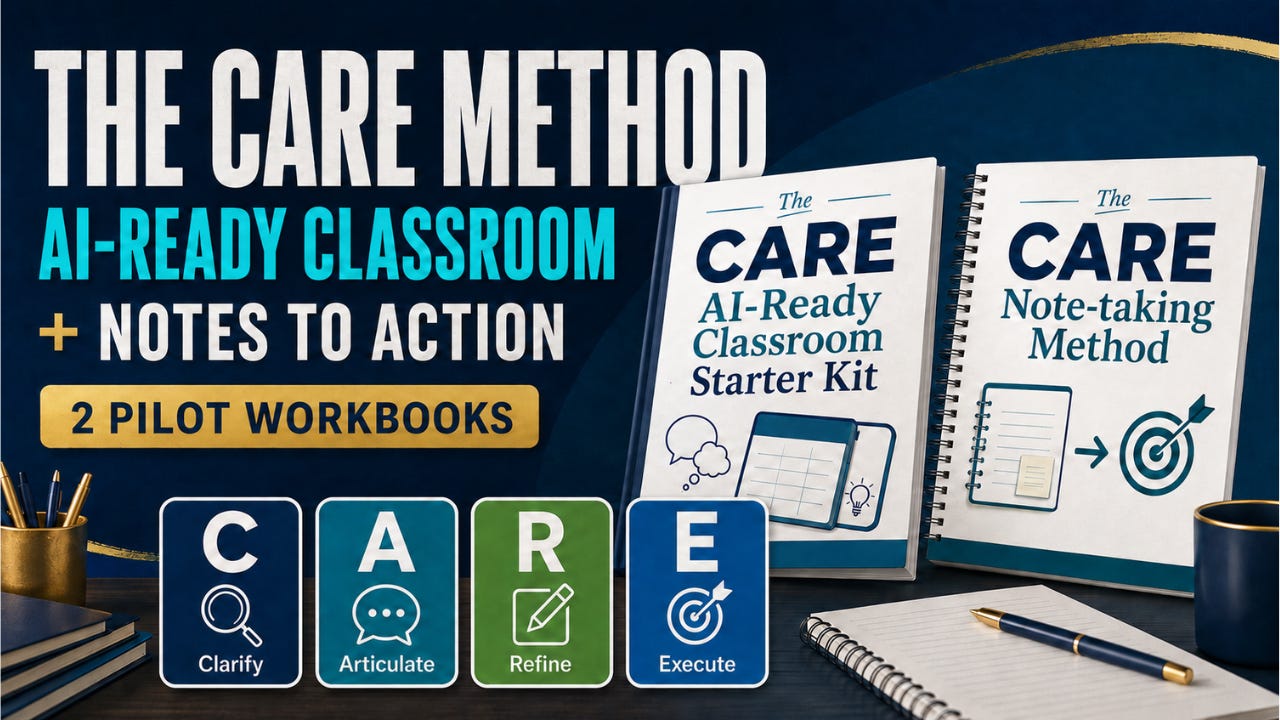
The method did not appear fully formed. It emerged through years of teaching, reading, journaling, experimenting, drafting, revising, and noticing what helped students and adults move from information toward action.
The framework eventually became:
Clarify what you are trying to understand, solve, question, notice, or create.
Articulate the idea in your own words or in a form that makes it available to you.
Refine it through elaboration, feedback, comparison, questioning, and revision.
Execute by turning the refined idea into something real.
The word “articulate” is especially important here. It does not have to mean writing a formal paragraph.
It could mean giving an idea a form that allows it to be expressed and examined.
For one person, that form may be a journal entry.
For another, it may be a diagram, a spoken explanation, a song, a dance, a design, or a prototype.
CARE is not a method for making everyone think in the same way. It is a way of helping people move their own thinking forward.
Externalization can sound abstract, but we use it constantly.
When you set an alarm, you externalize an intention.
When you write a grocery list, you externalize a memory.
When you draw a map, you externalize a spatial relationship.
When you create a prototype, you externalize a possible solution.
When you explain a problem to a friend, you externalize a line of reasoning.
When you rehearse a movement, you externalize a sequence through your body.
When you hum a melody, you externalize a feeling or idea that may not yet have words.
Researchers often describe part of this process as cognitive offloading: using an external resource to reduce the mental demands of a task. Writing down a phone number, drawing a diagram, or recording an appointment means you do not have to hold every detail in working memory at once.
The research on cognitive offloading shows that external tools can improve performance, especially when a task requires us to keep several pieces of information active at the same time. Risko and Gilbert’s review of the field describes how people use external representations to alter the information-processing demands of a task (Risko and Gilbert, “Cognitive Offloading”). Their review is a useful reminder that thought does not occur only inside the head; it often depends on the interaction between a person, an artifact, and an environment.
But “offloading” can make the process sound more passive than it needs to be. We are not simply removing information from the mind and placing it somewhere else. The most valuable forms of externalization create something we can think with.
There is a difference between storing a thought and developing one.
A note that says “important” may preserve a reminder, but it does not necessarily help you understand the idea. A screenshot may save an image, but it does not necessarily tell you why the image mattered. A voice memo may capture a feeling, but you may still need to listen again, name the pattern, and decide what it means.
The external object is not the end of thinking. It is an invitation to continue thinking.
This distinction also matters because externalization has trade-offs. Studies of memory offloading have found that relying on an external store can improve access to information while sometimes reducing the effort people invest in remembering it internally. Kelly and Risko’s research, for example, found evidence that increased reliance on an external store can compromise memory when the store is not available (Kelly and Risko, “Revisiting the Influence of Offloading Memory on Free Recall”).
The implication is not that we should stop using notebooks, calendars, diagrams, or digital tools. It is that we should pay attention to what the tool is helping us do.
Are we using the representation to avoid thinking, or to make thinking possible?
Are we collecting material, or are we developing it?
Are we creating a record that will help us act, or merely building a larger archive of things we once found interesting?
Externalization is powerful when it creates a feedback loop.
We put something out into the world. We look at it. We respond to it. We change it. Then we try again.
That loop is the beginning of learning.
Writing is my most familiar form of externalization because it is the medium through which I have spent much of my life teaching and thinking.
I began Learning to Learn Well in 2022, but my relationship with notebooks goes back much further. I have used them to record ideas from books, plan lessons, process difficult experiences, capture possible projects, and work through questions that were too large to answer immediately.
The most important thing my notebooks have taught me is that writing is not only a way of communicating what I already know. It is a way of discovering what I know, what I do not know, and what I may be able to understand if I keep going.
This is why a first draft often contains ideas that I did not consciously plan to include. The act of writing forces me to choose words. Choosing words forces me to notice distinctions. Distinctions reveal relationships. Relationships expose gaps.
Sometimes I begin with a sentence that sounds reasonable and end by realizing that it is too broad. Sometimes I begin with a vague discomfort and discover that it is actually a useful question. Sometimes I think I am writing about a book and realize I am really writing about a decision in my own life.
The page is changing the conditions under which thought can happen.
There is research behind part of this intuition. A meta-analysis of 48 school-based writing-to-learn programs found that writing had a small positive effect on conventional academic achievement (Bangert-Drowns, Hurley, and Wilkinson, “The Effects of School-Based Writing-to-Learn Interventions on Academic Achievement”). The effects were stronger when students received metacognitive prompts and when the writing occurred over a longer period, while longer assignments were not automatically better.
The value of writing does not come simply from producing more words. Writing helps when it makes the learner explain, question, connect, monitor, or apply something.
A page of copied notes may be longer than a paragraph of original thinking, but the paragraph may be doing more intellectual work.
This is also why I have become cautious about treating journaling as a daily streak or a personality type. You do not need to write three perfect pages every morning, an expensive notebook, or turn every experience into a profound reflection.
You need a form that helps you notice what is happening and gives you something to respond to.
Sometimes that may be a long entry. Sometimes it may be five words in the margin.
The notebook is allowed to be unfinished because you are unfinished while using it.
I also continue to write by hand because the slower pace changes my relationship with the idea.
When I type, I can produce language quickly. That is useful when I am drafting an article, developing a lesson, or working with a large collection of notes. But speed can also allow me to move past an idea before I have really encountered it.
Handwriting creates a small amount of friction. I cannot record every sentence exactly as it appears. I have to select. I have to shorten. I have to decide what seems worth keeping.
I wrote on a similar topic referring to writing in the margins.
Mueller and Oppenheimer’s well-known study compared students taking lecture notes by hand with students taking notes on a laptop. In their experiments, students who wrote by hand performed better on conceptual questions, and the researchers proposed that laptop note-taking encouraged more verbatim transcription. (Mueller and Oppenheimer, “The Pen Is Mightier Than the Keyboard”)
The study should not be turned into a simplistic rule that handwriting is always superior. Later discussion and replication have complicated the original conclusions, and the effect depends on how people use the tools. The more useful lesson is that the act of taking notes can shape the kind of attention we give to information.
If a tool encourages us to copy without processing, it may create the feeling of learning without the work of learning. If it helps us select, explain, connect, and revisit, it can become part of a productive thinking system.
This is why my own notebook often comes before the computer and before AI.
I want the first reaction to exist before a polished summary arrives. I want to know what I noticed before another system tells me what is important. I want to preserve the rough version so that later refinement has something personal and specific to work on.
AI can help me question a developing idea, identify gaps, compare possibilities, or suggest ways to organize an article. But if I ask it to generate the thinking before I have encountered the material myself, I may receive a polished answer without knowing whether it represents my understanding.
The notebook is upstream.
The AI system is downstream.
That order protects the learner’s agency.
Thanks for reading Learning to Learn Well! This post is public so feel free to share it.
The rest of this essay explores how externalization helps us think, learn, and improve—whether or not we enjoy writing.
You’ll discover how:
Speaking can reveal gaps in our understanding
Painting and drawing can make relationships visible
Engineering and design can turn imagined ideas into testable forms
Dancing and movement can help us think through the body
Singing and music can give ideas rhythm, memory, and emotional form
Prototyping can turn vague possibilities into something we can revise
The CARE method helps move ideas from Clarify to Articulate, Refine, and Execute
Other techniques—including voice notes, mind maps, lists, diagrams, conversation, and AI-assisted refinement—can help you discover the form your thinking needs
If you want to explore how externalization can help you turn private thoughts into clearer ideas and meaningful action, consider becoming a paid subscriber.
Comments
Nothing yet. Say the first thing.
Sign in to join the conversation.