
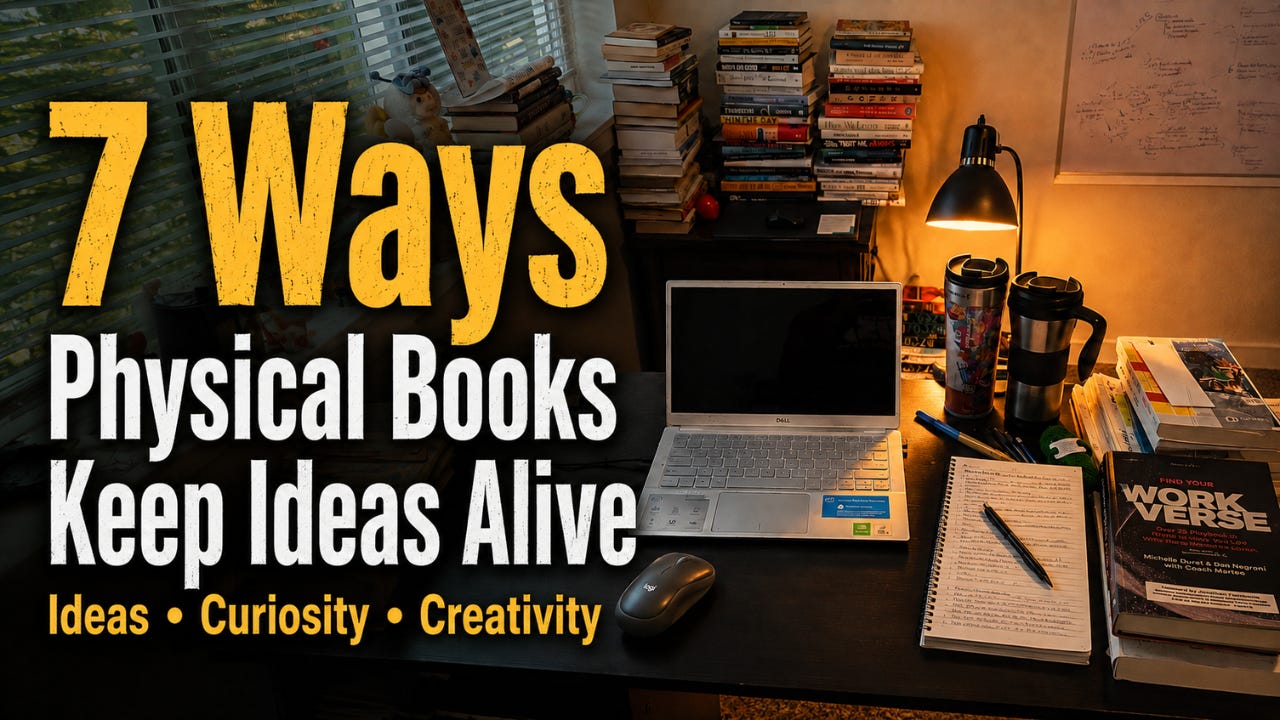
Can a book continue teaching you even when you are not reading it?
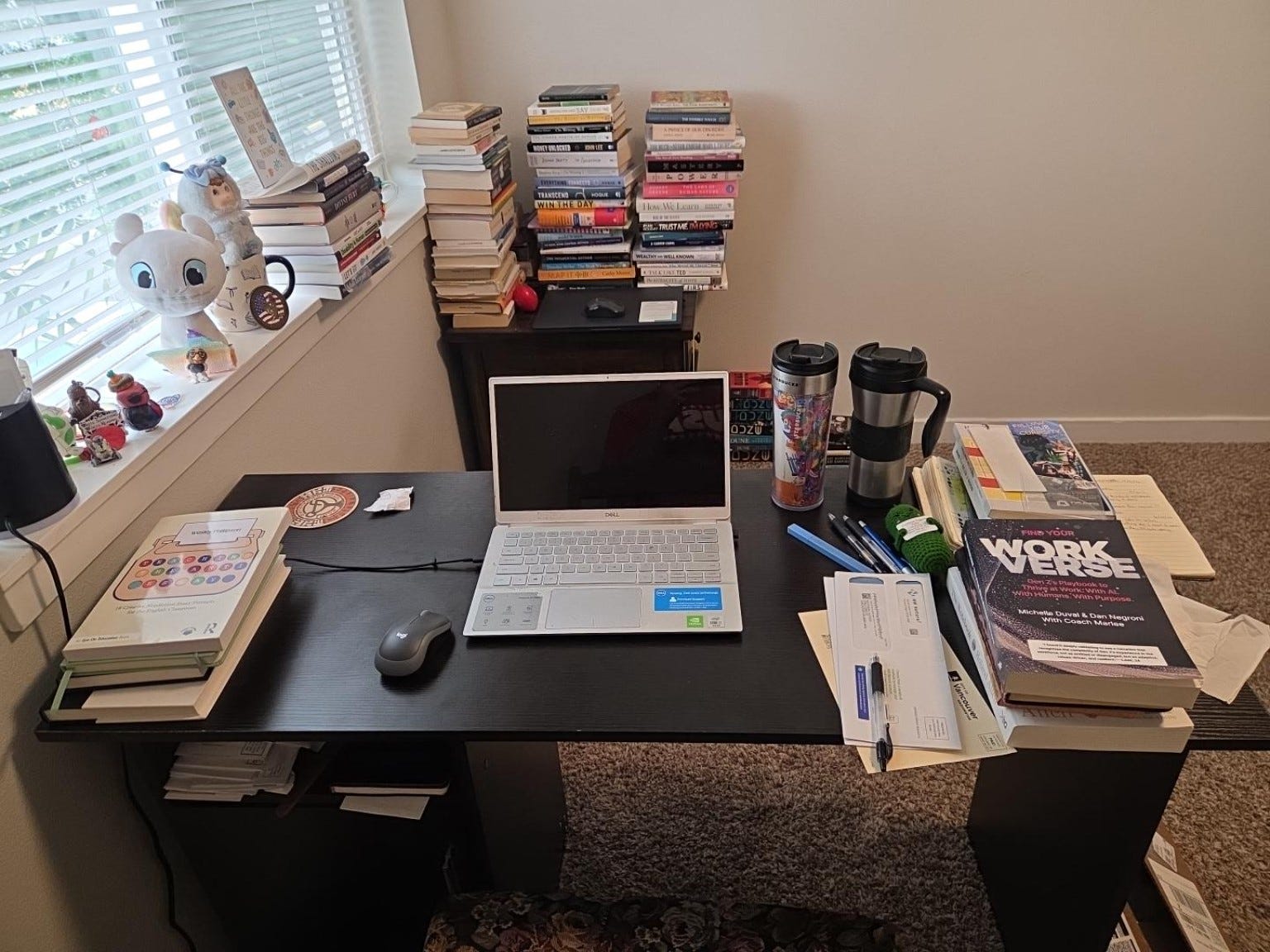
When I look around my workspace, my books are not neatly displayed in the background as decoration. They are stacked beside my laptop, spread across my desk, crowded near the window, and piled on the nightstand across from where I work.
Some are sitting upright. Some are leaning against each other. Some stacks look reasonably intentional. Others look as though I couldn’t decide where the books were supposed to go.
I still do not have a proper bookshelf after moving back to the United States from abroad. I could probably solve that problem fairly easily. Bookshelves are not like buying a house!
But the truth is that I kind of like having my books scattered around me.
The mismatched stacks are symbolic of the way ideas actually develop.
Ideas do not always arrive in a perfectly organized sequence. They overlap, collide, interrupt one another, disappear for a while, and then return when we are working on something completely different. Some ideas need to be organized. While we need much more time to digest others.
A bookshelf sometimes communicates that the ideas have been archived.
A stack on the desk says that the conversation is still happening.
Over the years, I have come to think of my books as my buddies. The best books do not stop influencing us when we close them and put them back on our bookshelves. Their physical presence can reactivate memories, ideas, questions, and possibilities. Even when we are not studying our notes or turning through the pages, seeing the title or cover can spark something that has been sitting quietly in our minds.
Here are seven ways I have learned to let physical books keep working in my life, even after the formal reading is finished.
The atmosphere where we work matters.
I want my office to feel warm, productive, calming, and conducive to generating ideas. For me, books help create that atmosphere.
I do not only see objects when I look around the room. I see past conversations, questions I have explored, lessons I have taught, and projects I might still create.
There are books beside my computer that I read years ago. There are others I have recently finished. A few are current reads, and several are waiting for me to begin.
Because they are visible, they remain part of my mental environment.
That visibility matters more than I once realized. A book sitting beside me can remind me of an idea before I consciously decide to retrieve it. I may glance at a title while working on a newsletter, curriculum project, lesson, or business idea, and suddenly remember something the author explained.
I might not recall the exact sentence. I might not remember which chapter it came from. But the general idea returns, and I can decide whether it is worth opening the book again, looking through my notes, or connecting it to what I am currently doing.
This is different from storing every book in a bookshelf (you can still see them, but they seem more hidden) and assuming I will somehow remember that it exists when the perfect situation arises.
Memory rarely behaves with the competence we want it to.
Keeping certain books visible gives them a chance to interrupt me.
Sometimes that interruption becomes the beginning of a new connection.
Several books in my workspace feel less like finished reading experiences and more like long-term companions.
How to Read a Book by Mortimer Adler and Charles Van Doren is one of them. I first read it in 2019, but many of its ideas still influence how I approach reading today.
One of the central ideas that stayed with me was the distinction between different levels of reading. The level I found especially fascinating was syntopical reading, which involves reading across several books on a related subject and placing their ideas into conversation with one another.
I have always liked taking that idea even further.
I enjoy connecting ideas not only across books about the same subject, but also across books that initially appear to have little to do with one another. A book about education might connect with one about creativity. A book about writing might help clarify a business problem. A biography might reveal something useful about deliberate practice, leadership, or finding a personal voice.
When I look at How to Read a Book, I remember that active reading is not simply about completing pages. It is about asking questions, examining ideas, and building relationships among what we encounter.
I filmed a video on YouTube about all four levels of reading.
That book is now due for a proper reread. I have skimmed parts of it over the years, but I have never gone back through it completely. I also take notes differently now, so rereading it would not mean repeating the same experience. It would mean meeting the book again with seven more years of teaching, writing, and learning behind me.
How to Take Smart Notes has a similar effect. I believe I first read it around 2021. Seeing it beside me reminds me that notes should not merely record what somebody else said. They should help ideas develop, connect, and eventually support original work.
More recently, Teaching the Anti-Essay has become another important companion because it connects so closely with my thinking about student voice, authentic writing, and the limitations of formulaic assignments.
These books are not simply references. They are reminders of ongoing questions.
They keep asking me:
What does it mean to read actively?
How do ideas become connected knowledge?
How should students learn to write?
What makes learning visible without making it mechanical?
A good book can continue asking better questions long after you have forgotten many of its answers.
Sometimes a book brings back an idea.
Other times, it brings back a season of your life.
Last winter was my first winter back in the United States after living for years in a tropical country. I had grown accustomed to warm weather throughout the year, so returning to a place with four distinct seasons was an adjustment.
The sun was rising at around eight in the morning and setting not long after four in the afternoon. The days felt short, cold, cloudy, and frequently wet.
Honestly, it was depressing.
During that period, I would sometimes look at The Creative Act, which was sitting on my windowsill. One of the ideas I carried from that book was that the sun is always shining.
That idea is both literal and symbolic.
Even on a cold, rainy, gloomy winter day, the sun has not disappeared. It is still there behind the clouds. You may not be able to see or feel it, but that does not mean it has ceased to exist.
Here’s a summary I wrote back in 2023.
I began connecting that idea to creativity and life more generally.
There are days when inspiration feels absent. There are seasons when our work seems to slow down, uncertainty grows, or everything feels heavier than usual. But creativity may still be present beneath the surface.
People are still around us.
Ideas are still available.
There are still things worth noticing, making, writing, teaching, and sharing.
When I saw that book sitting by the window, I did not need to reread the entire thing to regain that idea. The physical book became a reminder.
It reminded me not only of something I had learned, but also of the way I wanted to respond to a difficult season.
That is part of what makes books feel like buddies to me. The best ones accompany us through different parts of our lives, and their meaning changes as our circumstances change.
The books that I am currently reading usually stay directly on my desk.
That is deliberate.
I come into my office every day, so keeping the books in front of me reminds me to return to them. Sometimes I also bring them downstairs to the dining room table. They move around the house with me depending on where I am reading or working.
At this point, I generally try to focus on only two books at a time.
I used to read far more books simultaneously. Starting eight books can feel exciting because you are constantly encountering something new. But it also becomes incredibly easy to skim across the surface without diving deeply into any of them.
Two books gives you enough variety without fragmenting your attention too much.
Usually, they offer something different. I might have one book that is directly related to education, writing, or my current work, and another that stretches me in a different direction.
I also tend to keep one upcoming book right on my desk next to my laptop.
That anticipated read gives me something to look forward to. It does not make me rush through my current book. In some ways, it does the opposite. It reminds me that reading is an ongoing part of my life and that there will always be another question waiting.
I had not really thought about this as a system before. And I still don’t. It could change because there’s no carefully designed spreadsheet or book-rotation algorithm overseeing the process. That would spoil the fun!
But there is a pattern:
two current books;
a few influential books I like seeing regularly;
and one or two books waiting nearby because they connect with where my interests are heading.
Sometimes our most useful systems are the ones we discover we are already following.
The unread books around my workspace do something different from the books I have already read.
The books I know act as reminders.
The unread books represent potential knowledge to action.
I don’t think “unfinished curiosity” quite captures it. An unread book is not necessarily an incomplete responsibility. And I don’t owe every book I own a cover-to-cover reading experience.
Instead, the book represents something that might be discovered, questioned, adapted, criticized, tested, or eventually turned into something tangible.
The unread book currently creating the most curiosity for me is Thinking on Paper by V.A. Howard and J.H. Barton.
It is sitting directly on my desk, and it keeps egging me on.
I am especially interested in it because of the work I am currently doing around note-taking, writing, and the CARE Teaching Method. From skimming through the book, I can see that it approaches writing largely through an academic lens.
That makes me curious, but it also makes me slightly skeptical.
Wes Phillipson and I recently discussed how the traditional essay continues to be treated as a fundamental learning tool, even though much of real writing does not follow the predictable structure students are often taught.
We had the first Learning to Learn Well Podcast together recently.
As students move through high school and into university, they are frequently trained to write according to formulas: introduction, three body paragraphs, conclusion, quote, explanation, restatement, and so on.
The formula can provide useful support at an early stage. But eventually, writers need to develop a natural voice, make structural decisions, follow the needs of an idea, and communicate in a way that feels alive rather than assembled from instructional parts.
I am curious about what Thinking on Paper will offer, but I am also interested in what I may want to challenge.
That is another way an unread book can be valuable.
You do not have to approach every book as a passive recipient waiting to be instructed. You can enter with questions. You can disagree. You can test the author’s assumptions against your own experience.
Curiosity includes the possibility that a book will deepen what you believe.
It also includes the possibility that it will give you something worth arguing with.
I read ebooks and listen to audiobooks, and both formats have obvious advantages.
They are portable. They are convenient. An audiobook allows me to learn while walking, driving, exercising, or doing something else with my hands.
But they do not affect my physical environment in the same way. And they are typically used when moving about which usually makes it harder to follow The Care Note-taking Method, but not impossible.
An ebook cannot sit on my desk as an individual, visible reminder. A Kindle can sit there, but I have to turn it on, open the library, and look through the titles before any particular book reappears.
The same is true of audiobooks. Unless I open the app or deliberately recall the title, the book remains invisible.
A physical book has a cover, size, texture, location, and presence.
I can see it with my own two eyeballs.
I can pick it up, flip through the pages, notice a section I marked, or move it to a more prominent place when it becomes relevant again.
Then there is also the smell.
Before moving back to the United States, I had around 450 books in my office. The room smelled like books, and I loved that. The smell became part of the atmosphere of reading, thinking, and creating.
None of this means physical books are intellectually superior. Reading a paperback does not automatically make someone wiser than listening to the same ideas through headphones.
But physical books create a different kind of environmental cue. They become part of the space in which we work.
For me, that physical presence helps sustain curiosity and keeps certain ideas available.
There is an important caution to all of this.
Being surrounded by books can create the illusion of learning without actual engagement.
We can buy the book, display the book, highlight the book, finish the book, and place it on a shelf without allowing anything from it to change what we do.
I know this partly because I have struggled with it myself.
For years, I gathered knowledge from books, graduate study, teaching, note-taking, and personal development. I learned a great deal, but I did not always have a reliable process for turning that knowledge into action.
That gap eventually became one of the reasons I developed the CARE method. It was my attempt to synthesize what I had learned about reading, writing, teaching, reflection, feedback, and execution.
But the larger idea is much simpler than any formal method.
Information is not yet understanding, and finishing a source is not the same as finishing the learning.
I created a video five years back about the dangers of self-help
The real result is what the experience changes in what we notice, question, explain, connect, decide, write, build, or practice.
A book should not become a place where we hide from life.
It should help us return to life with better questions, stronger ideas, and something worth trying.
In that sense, I sometimes think we should spend more time outside the book than inside it.
Read the idea.
Close the book.
Write about it.
Explain it to somebody.
Try it in your classroom.
Test it in your work.
Create something.
Notice what happens.
Return to the book when experience gives you a better question.
When you do have more questions, you can then discover deeper answers.
There is something almost contradictory about using books as reminders to stop reading, but that may be one of the most valuable roles they can play.
The books around me remind me that learning is not meant to remain trapped inside them.
You do not need 450 books or stacks covering every available surface to create this kind of environment.
Start with three:
One book you have already read and loved.
Place it somewhere visible. Let it remind you of an idea you do not want to lose.
One book you are currently reading.
Keep it close enough that returning to it requires almost no effort.
One unread book that represents a question you are ready to explore.
Do not treat it as an obligation. Let it create anticipation.
Then pay attention to what happens when you see them.
Which idea returns?
Which question appears?
Which book makes you want to reopen it?
Which one reminds you of something you need to practice rather than merely remember?
Lastly, remember this:
Books are not my buddies because they agree with me, comfort me, or make my office look intelligent.
They are my buddies because they remain present.
They remind me of conversations I have already had, questions I am still carrying, and possibilities I have not yet explored.
Some books wait to be read.
Others wait to be remembered.
The best ones keep inviting us to do something with what they have given us.
Which book in your home or workspace is still quietly asking something of you, and what might happen if you answered it?
Thanks for reading Learning to Learn Well! This post is public so feel free to share it.
Comments
Nothing yet. Say the first thing.
Sign in to join the conversation.