
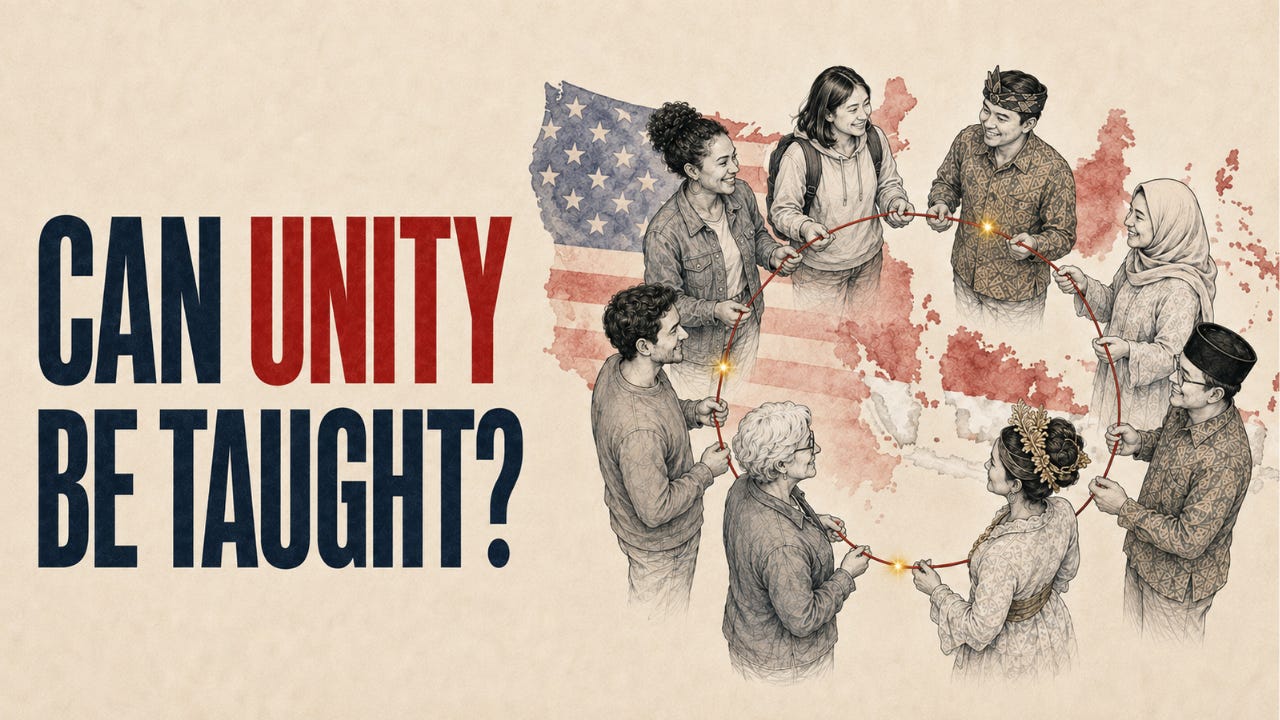
For fourteen years, I lived and taught in Indonesia. Now that I am back in the United States, I keep noticing differences that were harder to see when I was living inside only one of those cultures.
Some differences are small. Others are difficult to ignore.
One of the biggest is the way people understand national identity - and the role education plays in building it.
In Indonesia, students grow up with a shared civic language. They learn the same five foundational principles. They encounter them in school subjects, ceremonies, textbooks, projects, public symbols, and ordinary conversations. The principles are called Pancasila, a word formed from Sanskrit roots meaning “five principles” or “five pillars.”
In the United States, we have the Pledge of Allegiance, civics classes, state standards, founding documents, national holidays, and plenty of patriotic symbols. But these pieces do not always add up to a shared civic philosophy. They often feel like disconnected fragments. We repeat certain words, yet we do not necessarily agree on what those words require from us - or how we should treat the person living next door.
That difference has left me with a question:
What would it look like for the United States to develop its own version of Pancasila - not by copying Indonesia, but by agreeing on a small set of shared principles that every student would learn, examine, question, and practice?
I know this is sensitive territory. Americans are rightly suspicious of state-mandated ideology. A national civic framework could become propaganda, especially if one political group were allowed to define it for everyone else. Indonesia’s own history shows that danger clearly.
I am also not arguing that Indonesia has solved division, inequality, religious tension, or education. It has not. A common philosophy on paper does not automatically produce justice in practice. Indonesia’s schools still vary enormously in quality and resources, and its record of protecting pluralism is far from perfect.
But I do think Indonesia has done something the United States has struggled to do (or to keep alive): it has given a remarkably diverse population a durable vocabulary for belonging to one nation.
That is worth studying.
This article is not a finished policy proposal. It is an attempt to put an idea into the world so it can be tested. That is how I try to work through ideas: clarify what I am actually noticing, articulate the argument, refine it against the complications, and then decide whether there is anything worth executing.
Not every idea survives that full cycle. But ideas cannot be improved while they remain hidden.
So consider this an invitation to think with me.
Imagine a school ceremony in Indonesia.
Students stand together in rows. The red-and-white flag rises. The national anthem is sung. Pancasila is recited. These rituals are especially associated with the regular Monday flag ceremony, although practices vary among schools.
If you only witnessed the ceremony, you might assume Pancasila was simply Indonesia’s longer version of the Pledge of Allegiance. But the comparison misses something important.
The Pledge is primarily an oath of loyalty: allegiance to the flag and the republic it represents. Pancasila is closer to a philosophical framework. It attempts to answer a different question:
What principles should guide the life of the nation and the relationships among its people?
Here is the Pancasila in English, which is commonly rendered as:
Belief in the One and Only God. (NOTE: In the context of America, this wording would have to be altered to ‘fit’ the culture and respect that everyone has their own beliefs. I’ll dive into that in a bit)
Just and civilized humanity.
The unity of Indonesia.
Democracy guided by wisdom through deliberation and representation.
Social justice for all the people of Indonesia.
Together, the principles offer a recognizable moral sequence: spiritual grounding, humane treatment, national unity, deliberative democracy, and social justice.
Pancasila education is built into the national curriculum. Under the Merdeka Curriculum (Learning Independence), Pendidikan Pancasila is a named subject, and government guidance has treated Pancasila education as required national content. The curriculum has also connected Pancasila to character development through project-based learning and a broader learner or graduate profile.
The details change as governments revise curricula. The implementation varies. Some teachers create meaningful projects; others may teach the subject through memorization. But the continuity matters. An Indonesian student does not encounter national values once during a single unit and then leave them behind. The same core ideas return across years.
We rarely learn an important idea because someone tells it to us one time or recites it without any teachings behind the meaning and how to incorporate it into our lives. We learn it because we retrieve it, see it in different contexts, argue with it, connect it to experience, and gradually decide what it means.
A value that appears only on a poster remains a slogan. A value revisited through stories, discussions, community problems, history, and reflection has a chance to become part of a person’s mental framework.
This does not guarantee good behavior. Students in every country learn ideals that adults fail to practice. But repetition across contexts gives a society a shared reference point. When an Indonesian appeals to persatuan Indonesia, the unity of Indonesia, or gotong royong, the practice of mutual cooperation, the words connect to something other Indonesians recognize.
The United States has powerful words too: liberty, equality, justice, rights, democracy, opportunity, and E pluribus unum - out of many, one. But our educational system does not always weave them into a coherent civic identity. We inherit a toolkit. Indonesia provides something closer to a spine.
A country that had to learn how to become one
The achievement is easier to appreciate when we consider Indonesia’s diversity.
Indonesia is not a small, culturally uniform country. It stretches across a vast archipelago which, if laid across the whole United States of America, would go from end to end. It is definitely not a small country. The country’s official statistics have documented more than a thousand ethnic classifications, while Indonesia’s language agency has counted more than 700 regional languages. Religious life includes Islam, Protestant Christianity, Catholicism, Hinduism, Buddhism, Confucianism, and local belief traditions. Regional identities remain strong. A person can be proudly Javanese, Balinese, Sundanese, Minangkabau, Batak, Papuan, or Bugis while also being proudly Indonesian.
This kind of unity was painstakingly built.
Language played a major role. Bahasa Indonesia gave people from different regions a shared national language without requiring every local language to disappear. National symbols and ceremonies mattered. The shared struggle against colonialism mattered. So did the motto Bhinneka Tunggal Ika, usually translated as “Unity in Diversity.”
That phrase is more than cheerful multicultural branding. It expresses a difficult political problem: how can a population remain different without falling apart?
Pancasila was one answer.
Indonesia did not try to build unity around one ethnic group, one island, or one regional culture. It built a civic identity around principles broad enough to hold multiple communities together.
During my years there, I experienced that identity outside school as much as inside it.
I knew my neighbors. People gathered. Communities organized around local relationships, religious events, neighborhood concerns, celebrations, and mutual help. I saw mosques near churches and communities learning how to live with difference as a normal part of daily life. Religious topics could come up in conversation without every discussion becoming an argument about whose identity was under attack.
This is, of course, one person’s experience. It would be dishonest to turn my own neighborhoods into proof that religious tension does not exist in Indonesia. It does. Minority groups have faced discrimination. Some places are much more tolerant than others. A principle of unity can be honored in one community and violated in another.
Still, I felt something there that I have struggled to name since returning to the United States: a thicker layer of everyday belonging.
In America, I may know that the person across the street is my neighbor. But beyond geography, what do we share? Do we understand ourselves as responsible for one another, or do we simply happen to own or rent homes near the same road?
Location matters. Many American communities are close, generous, and deeply connected. I have met some of my neighbors, and they seem like good people.
But I don’t KNOW them.
I am not claiming that Americans are incapable of community. I am asking why community can feel like an optional personal preference rather than part of our civic identity.
Indonesia gave me a different baseline. The community was not something outside the individual. It was one of the structures through which the individual lived.
The closest American comparison to Pancasila is probably the Pledge of Allegiance. Both are learned by children. Both are connected to flags, ceremonies, and national belonging. Both can stir pride in some people and discomfort in others.
But they do different work.
The Pledge asks for allegiance to a nation described as indivisible, with liberty and justice for all. Those final words contain enormous moral substance. Yet the Pledge does not unpack them. It does not help a student explore what liberty requires when one person’s freedom conflicts with another person’s safety. It does not explain how justice should operate when the law has treated groups unequally. It does not tell us what obligations citizens have beyond loyalty.
The Pledge is a ritual. It is not a curriculum.
That distinction becomes clearer when we imagine two students reciting “liberty and justice for all.” One may understand those words through the civil rights movement, constitutional protections, and the responsibility to defend the rights of people with whom they disagree. Another may experience the phrase as thirty seconds of sound before the morning announcements.
The words are the same. The learning is not.
A philosophy becomes educationally useful when learners have to work with it. They need examples and non-examples. They need difficult cases. They need to see what happens when two values collide. They need to examine how earlier generations interpreted the same principle differently. They need to recognize the distance between a country’s stated ideals and its actual behavior.
Pancasila provides categories. “Just and civilized humanity” creates a question: What would humane treatment look like here? “Unity of Indonesia” creates another: Does this action strengthen unity or demand sameness? “Democracy guided by wisdom through deliberation” raises questions about how decisions should be made and whose voices are missing. “Social justice” forces attention toward distribution, opportunity, and the common good.
Again, the presence of a category does not guarantee deep thinking. It can be reduced to memorization. But without categories, civic learning becomes scattered. Students may learn the three branches of government, the dates of wars, the language of the Constitution, and the process of an election without ever assembling those facts into a philosophy of citizenship.
Institutional knowledge matters. But a functioning democracy needs more than people who can identify the judicial branch on a test. It needs people who can disagree without dehumanizing each other, examine evidence, participate in public life, recognize manipulation, and balance individual rights with shared responsibilities.
Those are learned practices, not automatic outcomes of living in a democracy.
The fragmentation I am describing is not an accidental administrative mistake. It grows from the structure of American education.
Education is primarily a state and local responsibility in the United States. The federal government can protect civil rights, collect data, direct certain funds, and establish conditions around federal programs. But it does not create one national curriculum. States develop standards and graduation requirements. Districts select materials, organize courses, and respond to their communities. According to the National Center for Education Statistics, the country had 13,318 regular public school districts in the 2021-22 school year.
Decentralization has real advantages, such as local communities responding to local needs. States can experiment. Teachers and districts can design programs connected to their students rather than waiting for a distant ministry to approve every adjustment. A rural district, a large urban system, a tribal community, and a coastal technical school do not need identical electives or examples. Local control can protect pluralism and encourage innovation.
It can also produce an instructional lottery.
Two students can graduate from high school in different states with very different experiences of American history, government, media literacy, debate, service learning, and civic responsibility. Nearly every state has some form of civics content, and it would be inaccurate to say that civics has vanished. But requirements, course structures, assessments, classroom time, and instructional approaches vary widely. In some places, civic learning emphasizes inquiry and participation. In others, it may be compressed into a test of names, dates, and governmental procedures. Some students complete action projects. Others finish a worksheet.
The difference is not simply liberal versus conservative. That frame is too easy. The bigger difference is between civic education as information and civic education as formation.
Information asks: What does the Constitution say? How does a bill become law? What powers belong to the states?
Formation asks: What kind of person can sustain a constitutional democracy? How do we deliberate with people whose beliefs differ from ours? When should a citizen challenge the majority? How do we distinguish evidence from propaganda? What do we owe our communities?
We need both.
The problem is that America has no durable national agreement about the second category. We often cannot even discuss civic formation without someone suspecting political indoctrination. As a result, schools may retreat toward facts that look neutral, even when those facts are disconnected from the habits students need in public life.
Local control works best when communities possess enough shared trust to make decisions together. In a low-trust society, local control can turn every school board election, textbook choice, and library decision into a proxy battle over national identity. This is where the American system now feels especially fragile.
We do not simply disagree about how to teach history. We disagree about what history is for. Is it supposed to build pride, expose injustice, develop analytical judgment, or all three?
We do not simply disagree about which books students should read. We disagree about whether encountering a different identity is education or threat.
We do not simply debate instructional methods. We interpret the existence of the other side’s ideas as evidence that institutions have been captured.
The result is a strange combination: education is decentralized, but every local conflict is amplified into a national culture war.
This atmosphere reaches beyond schools. Pew Research Center reported in 2025 that fewer than half of Americans said they trusted all or most people in their neighborhood, a decline from a decade earlier. Trust is difficult to measure, and no single survey captures a whole country. Still, the finding matches something many people feel: we are increasingly uncertain not only about institutions but about one another.
I do not want to exaggerate this into a direct comparison with George Orwell’s 1984. America is not Oceania. But Orwell understood what mutual suspicion does to ordinary relationships. When people begin to imagine that every neighbor, colleague, parent, student, or teacher may be an enemy reporting them to a hostile system, social life becomes unhealthy long before it becomes totalitarian.
Suspicion can be justified. Governments have abused power. Schools have excluded people and distorted history. Communities have silenced uncomfortable voices. A healthy democracy requires scrutiny.
But skepticism is not the same as permanent distrust. Skepticism asks for evidence. Permanent distrust assumes corruption before evidence appears. Skepticism can improve institutions. Permanent distrust makes shared institutions nearly impossible to maintain.
If every common standard is treated as control, every public institution as captured, and every disagreement as betrayal, then what remains to hold a nation together?
The market cannot do that work. Social media will not do it. A flag alone cannot do it. A political party certainly cannot do it.
Education may be one of the few places where a society can deliberately practice belonging before students inherit the full force of adult division.
At this point, it would be tempting to create a clean comparison:
Indonesia: centralized, unified, equal.
United States: decentralized, fragmented, unequal.
That comparison is memorable, BUT it is also too simple.
Indonesia has a national education system, national curricular expectations, and a much stronger national civic framework. Its Constitution directs the state to establish a single national education system and to allocate at least 20 percent of state and regional budgets to education. National ministries and agencies define curricular structures, learning outcomes, and required content.
But Indonesia has also undergone major decentralization. Local and regional governments play significant roles in funding execution, teacher management, and the delivery of basic education. Schools interpret national expectations through different resources, local cultures, leadership, and teacher capacity.
In other words, Indonesia’s unity is not created by controlling every classroom from Jakarta. It comes from establishing a recognizable national spine and then allowing implementation to vary around it.
For the American thought experiment, the United States would not need one federal textbook, one approved interpretation of history, or one scripted lesson taught identically in every school. In fact, that kind of uniformity would violate the pluralism the framework should protect.
What America could learn from Indonesia is not to centralize everything, but to decide what must be shared.
A national education system can be uniform in the wrong places and fragmented in the wrong places. It might require every teacher to complete the same paperwork while leaving the meaning of citizenship vague. It might standardize testing while allowing access to experienced teachers, safe facilities, and rich curriculum to depend on a ZIP code.
A better system would be firm about a small number of common commitments and flexible about the many ways communities can bring those commitments to life.
That is what I mean by a civic spine.
Curriculum is only one part of educational unity. Funding tells another story.
Indonesia’s Constitution contains a striking commitment: at least 20 percent of the state budget and regional budgets is to be prioritized for education. That constitutional rule does not guarantee that every rupiah is spent effectively. It does not erase corruption, geographic barriers, weak infrastructure, or differences in teacher quality. But it makes education a visible national obligation.
The American structure is different. Public schools draw revenue from federal, state, and local sources, and the proportions vary considerably by state. Local property taxes supplied 36 percent of total public-school revenue nationally in 2020-21, according to NCES, and 83 percent of local revenue came from property taxes.
That is an important correction to an easy misconception. American schools do not receive half of all their money from property taxes everywhere. But local property wealth still plays a major role, and the reliance varies dramatically by state. State funding formulas often attempt to equalize resources, with mixed results.
The larger principle remains: when access to educational opportunity depends heavily on where a family can afford to live, students experience the nation differently before they are old enough to vote.
A shared civic framework without the resources to teach it would become another unfunded promise. A school cannot run thoughtful community projects, source-rich historical inquiries, deliberative discussions, and sustained media-literacy instruction if teachers are overloaded and basic needs remain unmet.
This is where debates about curriculum and funding should meet. If we believe civic learning is a national necessity, then every community needs the capacity to provide it.
Funding equality alone would not create national identity. Indonesia’s constitutional allocation has not removed enormous gaps between well-resourced schools in parts of Java and schools serving remote communities. A national target is not the same thing as an equal learner experience.
But the target says education is not merely a local consumer good purchased through housing markets. It is part of the country’s shared future.
America spends a great deal on education in total, yet the system often communicates the opposite message: your school is primarily the concern of your family, your district, and your state. People can stop seeing another community’s children as part of the same public.
A civic identity cannot survive if “our children” only means the children within our property-tax boundary.
This is the point where admiration needs refinement.
Pancasila offers Indonesia a common language, but common language can hide contradictions. A country can:
Teach “just and civilized humanity” while people experience discrimination
Teach social justice while educational resources remain deeply unequal
Celebrate unity in diversity while minority communities face restrictions or prejudice.
Indonesia’s religious coexistence is real, but it is not complete. Human-rights and religious-freedom organizations continue to document obstacles faced by minority communities, including difficulties involving houses of worship and laws or local regulations that can be used against religious minorities. Regional, ethnic, and religious tensions have not disappeared simply because Pancasila says they should.
There is also a historical warning.
During Suharto’s New Order, Pancasila education was used as a tool of political conformity. The government promoted an authorized interpretation and required ideological training. A philosophy intended to unite citizens could be turned into a loyalty mechanism that protected those in power.
That history matters because Americans who hear “national civic creed” may immediately imagine ideological control. They are not irrational to worry about it. Indonesia itself demonstrates both the value of a shared framework and the danger of allowing a government to monopolize its meaning.
The lesson is not that national principles are inherently oppressive. Every nation already teaches values, even when it claims neutrality. The selection of historical events, classroom rules, graduation requirements, and acceptable forms of speech always communicates a vision of the citizen.
The lesson is that shared principles must remain open to inquiry.
Students should be allowed to ask whether the nation is living up to them. They should compare official ideals with lived experience. They should examine how language has been used by people seeking justice and by people protecting power. They should learn that loyalty to a principle may sometimes require criticism of the state.
That is the difference between civic education and indoctrination.
Indoctrination gives students the answer and punishes the question.
Civic education gives students durable questions, credible evidence, and practice in forming responsible answers.
One reason the Pancasila model interests me is that its central claim is not “be the same.” Indonesia’s national motto is unity in diversity, not unity through sameness.
Uniformity asks people to erase meaningful differences so that conflict becomes less visible. Unity asks people to maintain enough shared commitment that differences can exist without destroying the whole.
In a classroom, uniformity sounds like this: There is one acceptable interpretation, and good students repeat it.
Unity sounds different: We will examine competing interpretations, but we share rules for evidence, dignity, listening, and participation.
In public life, uniformity expects everyone to practice the same religion, tell the same version of history, hold the same political opinions, or express patriotism in the same way.
Unity establishes a common civic space in which different religions, histories, opinions, and forms of expression can coexist.
The United States already possesses language for this. E pluribus unum means “out of many, one.” The First Amendment protects religious exercise, speech, assembly, petition, and a government that does not establish a religion. The Fourteenth Amendment promises equal protection. The Declaration of Independence invokes equality and unalienable rights. The Constitution creates a system in which power is divided, contested, and transferred.
The raw materials are not missing.
What is missing is the educational synthesis.
We often teach these materials as separate historical objects. Students memorize which document contains which phrase. They may never be asked to assemble the ideas into a usable framework for living with other people.
This is one of the most common traps in education: mistaking exposure for learning.
We expose students to the Constitution, so we assume they understand constitutional democracy.
We expose them to the civil rights movement, so we assume they understand civic courage.
We expose them to diverse authors, so we assume they know how to live in a pluralistic society.
But knowledge becomes usable only when learners process, connect, test, and apply it!
If America wants unity without uniformity, students need repeated practice doing exactly that.
So what might an American version of Pancasila look like?
I hesitate to name the principles because the naming itself can sound grandiose. However, the process would need people from different political traditions, regions, religions, racial and ethnic communities, professions, and generations. The principles would need to be grounded in existing American constitutional ideals rather than invented as a new party platform.
Still, a thought experiment needs something concrete enough to test.
Here is one possible starting point.
1. Human dignity and equal citizenship
Every person possesses dignity, and every citizen stands equal before the law.
This principle would connect the Declaration’s language of equality with the Constitution’s later development, especially equal protection. It would also force students to study the gap between principle and history: slavery, Indigenous dispossession, segregation, exclusion from voting, disability discrimination, unequal treatment of immigrants, and other failures.
The point would not be to teach that America has always achieved equality. It would be to teach that the principle gives citizens a basis for demanding better.
2. Liberty of conscience, expression, and lawful choice
People must have meaningful freedom to think, speak, worship, question, create, and direct their lives, while respecting the equal rights of others.
This principle would protect religious and nonreligious students. It would also prevent the framework from becoming purely collectivist. Community matters, but the individual cannot simply disappear into the state or majority.
Students would need to examine hard cases. When does expression become harassment? When can a school limit speech? What happens when religious exercise conflicts with another person’s rights? Liberty becomes real when learners work through tensions rather than repeat the word.
3. Pluralism and national belonging
Americans may hold different identities, histories, beliefs, and ways of life while belonging to one civic community.
This would be the American version of unity in diversity. It would reject both forced sameness and permanent separation. A student should not have to choose between a cultural identity and an American identity, nor should national identity be defined as belonging to one race, religion, or region.
Belonging also creates responsibility. If another group is pushed outside the civic community, the damage is not only theirs. The meaning of American citizenship becomes smaller for everyone.
4. Constitutional democracy through evidence and deliberation
Public decisions should be made through lawful democratic processes, informed judgment, credible evidence, peaceful participation, and genuine deliberation.
This principle would go beyond telling students that voting matters. Voting is essential, but democracy also requires listening, organizing, serving, questioning sources, accepting lawful outcomes, protecting minority rights, and continuing the argument without treating opponents as enemies.
The word deliberation matters. It suggests that democracy is not simply the victory of whichever side can shout louder. It is a practice of giving reasons, hearing objections, revising positions, and making decisions under shared rules.
5. Mutual responsibility and the common good
Rights make free citizenship possible; responsibilities make shared life possible.
This principle would ask what we owe one another beyond avoiding harm. It could include service, care for public institutions, stewardship of natural resources, contribution to one’s community, and concern for whether other people have a genuine opportunity to participate.
It would not require agreement on the size of government or one economic program. Conservatives, liberals, libertarians, progressives, and people outside those categories will disagree about how the common good should be pursued. The shared principle is that citizenship is not only a private claim on rights. It also involves participation in a world we hold together.
These five principles would not settle American political disagreements. They should not.
Their purpose would be to create common ground underneath those disagreements.
Two people could agree that human dignity matters and still disagree about criminal justice policy. They could agree on liberty and still disagree about its boundaries. They could value the common good and propose very different budgets.
Shared principles do not remove politics. They make democratic politics possible.
The worst version of an American Pancasila would place five sentences on a classroom wall, require students to recite them, and punish anyone who questioned the government’s interpretation.
That would not create unity. It would create performance.
The better version would treat the principles as recurring problems for inquiry.
Young children could learn dignity, fairness, listening, and community through stories and classroom decisions. Middle-school students could examine historical cases in which rights and responsibilities came into conflict. High-school students could deliberate constitutional questions, analyze policy evidence, study propaganda, and complete community-based projects.
The principles would stay recognizable while the intellectual demand deepened.
This is the educational value of a spiral curriculum. A learner returns to the same important idea with greater knowledge, more complex cases, and a larger capacity for judgment. “Fairness” at age seven is not the same concept as equal protection at age seventeen, but the earlier idea creates somewhere for the later one to attach.
Students should study moments when the United States lived up to its ideals and moments when it failed them.
That means the curriculum should include courage, invention, democratic reform, mutual aid, and the expansion of rights. It should also include conquest, slavery, exclusion, political violence, and institutional failure.
The goal is not to balance every positive fact with a negative fact as if history were an accounting exercise. The goal is to ask a more demanding question: How have Americans used, violated, reinterpreted, and expanded their stated principles?
This allows students to develop attachment without mythology and criticism without cynicism.
Patriotism that cannot tolerate truth is fragile. Criticism that cannot recognize anything worth preserving is empty. Civic maturity requires both commitment and honesty.
Students need structured experience discussing issues where reasonable people disagree.
That means more than a competitive debate in which each side tries to win. Deliberation asks students to identify values, examine evidence, represent opposing views fairly, notice trade-offs, and decide what they would do.
Teachers need support for this. Leading a discussion on a contested public issue is difficult, especially when families fear political bias. Clear national principles could actually protect teachers by defining the purpose: not to recruit students into a party, but to teach constitutional reasoning and civic habits.
Students should not study community as an abstraction.
They might investigate pedestrian safety near the school, access to a local library, water quality, emergency preparedness, support for new families, or the preservation of a neighborhood story. They could interview residents, analyze public data, compare possible solutions, attend a meeting, create a proposal, and reflect on what they learned.
This is where civic education becomes formation. Students experience disagreement, limited resources, institutional constraints, and the need to communicate with real people. They discover that public life is slower and less dramatic than social media makes it look, but also more open to contribution.
A shared framework cannot survive if citizens inhabit completely different realities.
Students need to verify claims, trace information to original sources, distinguish reporting from commentary, recognize emotional manipulation, and understand how algorithms shape attention. They also need intellectual humility: the ability to say, “I may be wrong; I need more evidence.”
Media literacy should not become another method for labeling disliked opinions as misinformation. It should focus on transparent habits that can be applied across ideologies.
Who made the claim? What is the evidence? What is missing? Is the source close to the event? Has the image or quotation been taken out of context? What would change my mind?
Those questions are civic habits because democratic decisions depend on a shared capacity to evaluate reality.
Students should never be graded on whether they feel patriotic enough or agree with an official position.
They can be assessed on whether they use evidence accurately, explain a constitutional principle, listen and respond to another view, revise an argument, contribute to a project, and reflect on consequences.
The distinction is crucial. A democratic school assesses the quality of thinking and participation. An authoritarian school assesses conformity.
As I worked through this idea, I kept returning to the CARE process I use for turning notes and learning into action: Clarify, Articulate, Refine, Execute. It offers a practical structure for civic education because it does not tell learners what conclusion to reach. It teaches them how to move from confusion toward responsible action.
Clarify
Students begin by defining the problem, identifying the people involved, and separating what they know from what they assume.
If the issue is whether a community should restrict a form of public expression, clarification might include the relevant law, the purpose of the restriction, the groups affected, and the values in tension. Liberty may matter. Safety may matter. Equality may matter. The common good may matter.
Naming those tensions prevents students from rushing into slogans.
Articulate
Students explain their current position in their own words. They use evidence, examples, and a clear chain of reasoning.
Articulation matters because vague agreement hides weak understanding. A student may say “freedom is important” until asked which freedom, for whom, under what conditions, and at what cost.
Writing, speaking, drawing a concept map, or teaching the idea to someone else makes the thinking visible.
Refine
Students test their position against counterevidence, history, competing principles, and the strongest version of an opposing view.
This stage is often missing from public discourse. People clarify just enough to choose a side, articulate the side’s talking points, and then execute by posting. They skip refinement.
Refinement is where democratic judgment develops. It asks: What am I missing? Whose experience complicates my view? Which part of the opposing argument is valid? What unintended consequence could follow from my preferred solution?
Changing one’s mind is not failure. It is evidence that thinking occurred.
Execute
Students decide what responsible action fits the evidence and their level of authority.
Execution might mean writing a proposal, conducting a community interview, presenting to a school council, designing an informational resource, joining a service project, or choosing not to act until better evidence is available.
The action does not need to be dramatic. Civic life is built through small acts of attention and contribution as much as through elections and protests.
CARE would also make the national principles more than content to memorize. Students would use the principles as lenses throughout the cycle. Which commitment is involved? Where do commitments conflict? Which proposed action respects human dignity, pluralism, liberty, democratic process, and mutual responsibility?
That is what it means to turn a national philosophy into a learning practice.
Any serious proposal for a shared civic framework would need strong safeguards.
First, the framework could not belong to a presidential administration, political party, religious institution, or advocacy organization. If it changed every four years, it would become another partisan document. Its legitimacy would have to come from a broad, public, transparent process and from grounding in the Constitution and existing civic traditions.
Second, the framework would need to distinguish principles from policy conclusions. “Human dignity” can be shared. A particular health-care bill cannot. “Constitutional democracy” can be shared. A position on the electoral college will remain contested. Teachers should help students reason from principles without pretending that the principles yield only one answer.
Third, religious liberty would need explicit protection. Indonesia’s first principle begins with belief in God, reflecting Indonesia’s history and constitutional identity. An American framework should not copy that language. The American adaptation would need to protect religious practice and nonbelief under liberty of conscience, consistent with public schools’ constitutional obligations.
Fourth, students and teachers would need the right to criticize the framework itself. They should study who wrote it, which voices influenced it, what concepts were omitted, and how its language might be interpreted differently. A creed that cannot survive examination does not belong in a democratic classroom.
Fifth, local communities would need meaningful flexibility in examples, projects, texts, and teaching methods. A tribal nation, an immigrant neighborhood, a farming community, and a large coastal city should be able to connect national principles to their own histories and problems. The spine is shared; the learning experiences are not identical.
Sixth, the country would need to invest in teachers rather than simply announcing a mandate. Teachers require high-quality materials from multiple perspectives, professional learning in discussion and inquiry, time to plan, and institutional support when controversy appears.
Finally, evaluation should examine whether students can think and participate, not whether they can repeat approved language. A portfolio of deliberation, source analysis, community work, and reflection would reveal more than a loyalty test ever could.
These safeguards would make the framework slower to create and harder to control.
That is a feature, not a flaw.
Learning from another country does not mean importing its system whole.
The United States should not copy Indonesia’s religious foundation. It should not copy a history of authorized ideological interpretation. It should not assume that national curriculum language will be implemented equally across regions. It should not confuse ceremonial participation with genuine belief.
It should also avoid the bureaucratic trap of believing that more detailed standards automatically produce better learning.
I have worked in education long enough to know how this happens. A good idea becomes a framework. The framework becomes a document. The document becomes a compliance checklist. Teachers spend their time proving that they have covered the correct language, while students experience one more disconnected activity.
A civic spine should be short enough to remember and deep enough to revisit. It should reduce fragmentation, not create a new layer of paperwork. It should help teachers connect history, literature, media literacy, and community learning rather than compete with those subjects for time.
The United States should also preserve the best feature of decentralization:
the ability to experiment.
States and districts could pilot different approaches to the same national commitments. One might build civic projects into English and social studies. Another might use advisory periods. Another might partner with local libraries, tribal governments, universities, veterans’ groups, faith communities, unions, or nonprofit organizations. Researchers could compare outcomes. Teachers could share practices that worked.
Unity should create coordination, not stagnation.
The exchange should not travel in only one direction.
Indonesia’s national civic spine is powerful, but American education offers its own lessons. Local autonomy can create space for teachers to adapt learning to students. Open disagreement can expose where national narratives have become too neat. Strong protections for speech and inquiry can help students challenge official interpretations. Diverse curricula can surface histories that a centralized narrative may overlook.
The Merdeka Curriculum itself reflects some recognition of this need. Its language emphasizes greater flexibility, essential learning, differentiated instruction, and room for schools to adapt projects to local contexts. The idea of merdeka belajar - freedom to learn - complicates the notion that Indonesian education is simply top-down.
The strongest model may therefore sit between the two countries.
Indonesia offers a shared direction but needs to keep expanding inquiry, local responsiveness, and protection from ideological misuse.
The United States offers local freedom but needs a stronger shared direction, more equitable capacity, and a clearer language of civic responsibility.
The goal is not centralization or decentralization as an ideology. The goal is to place decisions at the level where they can best support learning while maintaining the commitments that make the system a public one.
Some things should be local.
Some things should be shared.
Wisdom lies in knowing the difference.
There is an obvious objection to everything I have proposed: schools cannot repair a culture by themselves.
That is true.
Students will not learn respectful deliberation if every adult example shows politics as humiliation.
They will not learn media literacy if profitable platforms reward outrage and adults share claims without reading them.
They will not learn mutual responsibility if public policy consistently treats every need as a private failure.
They will not trust institutions merely because a teacher assigns a lesson on trust.
Education is not magic. A national framework would not make polarization disappear.
But schools are not powerless either.
Education works slowly. It establishes language, habits, expectations, and memories that may become useful years later. A student who practices representing an opponent’s view fairly may not transform public discourse tomorrow. But that practice becomes part of what the student knows how to do. A class that solves one local problem will not repair national institutions. But students learn that participation can produce something other than anger.
Schools are also among the few institutions where people from different families and backgrounds still spend sustained time together. That makes them imperfect but irreplaceable practice grounds for pluralism.
The question is not whether education can single-handedly create unity.
The question is whether a divided nation can afford to leave unity to chance.
Even if the idea of an American Pancasila has merit, a national policy is not the first step.
The first step is conversation.
A school could ask families, students, teachers, and community members to name the principles they believe people need in order to live together across differences. Participants could compare their language with the Constitution, local tribal traditions, civil-rights history, religious and humanist ethics, and the experiences of newer Americans.
A district could identify three or five recurring civic questions and embed them across grade levels.
A teacher could choose one shared principle - dignity, liberty, pluralism, deliberation, or mutual responsibility - and use it as a lens across several texts rather than teach it in one isolated lesson.
A community organization could host structured conversations in which people do not begin with policy positions. They begin with the value they are trying to protect.
A state could create a civic-learning framework that includes inquiry, community action, media literacy, and reflection while preserving local curricular choice.
These smaller experiments would reveal whether the idea actually helps. They would also show where the language fails, which groups feel excluded, and which implementation demands are unrealistic.
That process matters to me. I am not interested in announcing a perfect system from a desk. I am interested in moving an idea from notes into the world, listening to what happens, and refining it.
Clarify the need.
Articulate a possible framework.
Refine it through disagreement and evidence.
Execute a small, testable version.
Then begin again.
Underneath this comparison of two countries is a larger question about what education is for.
Is education mainly the transfer of academic knowledge to individuals so they can compete for future opportunities?
Or is it also the process through which a society teaches people how to share a world?
The first purpose matters. Students need knowledge, skills, employment pathways, and the capacity to build independent lives. But if education stops there, it reinforces the idea that learning is a private investment and society is a competition among separate individuals.
The second purpose asks something else of us. It treats learners as future neighbors, colleagues, caregivers, voters, jurors, volunteers, leaders, and community members. It recognizes that no amount of individual achievement can compensate for the collapse of trust, public reasoning, and shared responsibility.
Indonesia’s educational system makes this civic purpose unusually visible. Its national philosophy may sometimes become ceremonial or rigid, but it doesn't pretend that education is value-free. It openly connects learning to the formation of a national community.
American education forms civic values too, but often indirectly and inconsistently. Students learn from which histories receive time, whose voices count as credible, how authority responds to disagreement, whether classroom rules are fair, and whether community problems belong to them. Even silence teaches something.
The choice is not between value education and neutral education.
The choice is between examined values and unexamined values.
A shared civic framework would make those values visible enough to question and practice.
When I look back on fourteen years in Indonesia, I do not remember a perfect model waiting to be exported.
I remember complexity.
I remember communities where people of different religions lived near one another and made everyday coexistence seem normal. I remember warmth, hospitality, and a sense that relationships mattered. I also know that other Indonesians have experienced exclusion and that a national ideal can sound different from the margins.
I remember a school system with a clear national identity. I also remember bureaucracy, uneven resources, and the distance between what a curriculum says and what a classroom can deliver.
I remember Pancasila as something people knew - not necessarily something they interpreted in exactly the same way, but something available as common language.
That is the part I keep returning to.
America has never lacked ideals. Our problem may be that we possess so many fragments of civic language without a sustained educational process for assembling them. We have a pledge, a motto, founding documents, court decisions, social movements, local histories, and generations of people arguing over what freedom and equality require.
What we do not have is a simple, recurring framework that helps a child connect those materials to the question:
How should I live with people who are different from me?
An American Pancasila would not need to use that name. It may not need to become a federal policy. Perhaps the phrase itself is only a thinking tool - a way to notice what our current system leaves disconnected.
But I believe the underlying need is real.
We need more than allegiance. We need belonging.
We need more than rights claimed in isolation. We need responsibilities practiced in relationship.
We need more than exposure to history. We need the ability to use history when judging the present.
We need more than tolerance understood as leaving one another alone. We need the skills to share institutions, solve problems, and remain neighbors after disagreement.
And we need education to do more than prepare each individual for a private future. It should help prepare all of us for a common one.
I do not know whether five principles would make a measurable difference, how long cultural change would take, or whether Americans could agree on the language. Those uncertainties are not reasons to abandon the question. They are reasons to test it carefully.
Indonesia did not become a unified nation because someone wrote five sentences. It built unity through language, institutions, education, ritual, community practice, historical memory, and generations of repetition. Pancasila is part of that system, not a shortcut around it.
The United States would need its own process, shaped by its own history and constitutional commitments.
But every process begins by naming what is missing.
Right now, too many Americans can describe the people they oppose more easily than the principles they share.
Education cannot solve that alone. It can help us practice another possibility.
So I will end where I began - not with a policy demand, but with a question:
If you looked at the people living on your street, what would you say you share with them beyond geography - and what should every child learn so that shared life remains possible?
Thanks for reading Learning to Learn Well! This post is public so feel free to share it.
The Constitution of the Republic of Indonesia of 1945 - Article 31
Indonesia’s official guidance on Pancasila education in the Merdeka Curriculum
Indonesia’s official overview of the Pancasila learner profile
BPS-Statistics Indonesia: Nationality, Ethnicity, Religion, and Daily Language from the 2010 Census
World Bank: Local Governance and Education Performance in Indonesia
World Bank: How Indonesia’s Subnational Governments Spend on Education
U.S. Department of Education: The Federal Role in Education
National Center for Education Statistics: Number of public school districts
National Center for Education Statistics: Public School Revenue Sources
Tufts CIRCLE: Equitable K-12 Civic Learning
Pew Research Center: Americans’ Trust in One Another
Global Centre for Pluralism: Indonesia Monitor Report
Research on Pancasila education and indoctrination during Indonesia’s New Order
Comments
Nothing yet. Say the first thing.
Sign in to join the conversation.