
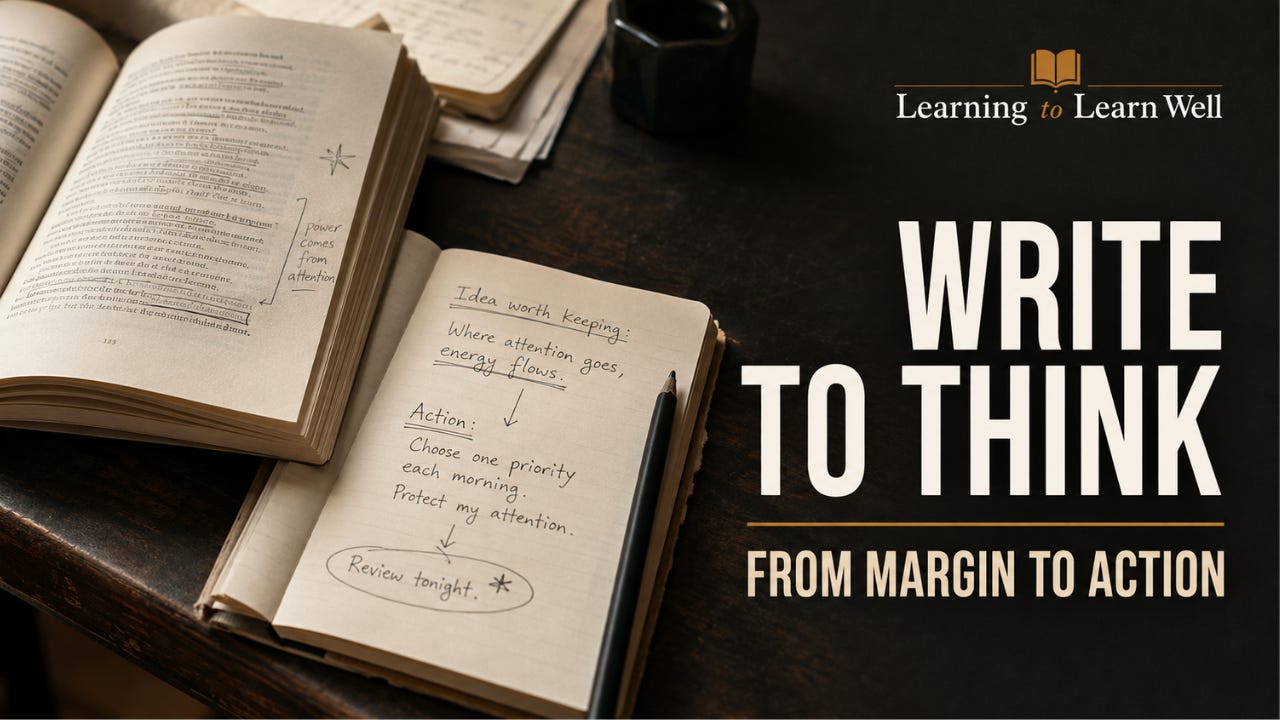
Writing is how reading becomes thinking.
In February 2020, I published a YouTube video called What Is Marginalia & Why You Should Use It. At the time, I had recently discovered the word marginalia through an internet search and realized the Bookstagram community on Instagram wasn’t really talking about it.
I remember thinking that it sounded like the perfect topic for a video.
I had already been writing in the margins of my books for years. I underlined sentences, wrote questions, added reactions, and occasionally responded to something the author had said, like having a conversation with them. But I had not really heard the practice described as marginalia before.
So I made a video about it.
When I recently rewatched that video, I was surprised by how much of my old thinking still resembles what I do today. My perspective on marginalia has changed, but it has not been abandoned.
It has expanded.
The practice of writing in the margins eventually became larger: underlining what catches my attention, writing my first thoughts in a notebook, developing those thoughts in my own words, refining them digitally, and eventually using them to write, teach, decide, experiment, or create something.
But rewatching the video also helped me notice an important weakness in my old approach.
Many of my notes were trapped inside the books.
I had marked interesting ideas, but I rarely returned to them. The books contained evidence that I had once noticed something important, but they did not necessarily help me remember what I had noticed—or what I intended to do with it.
Marginalia gets one very important thing right: reading should be active.
Even when reading fiction, we are not simply receiving words. We are making judgments, noticing patterns, imagining possibilities, questioning characters, connecting events, and interpreting meaning.
We might ask:
Why did the character make that decision?
What is this scene revealing?
What does this idea remind me of?
Do I agree with the author?
Where might this idea apply in my own life?
What am I supposed to notice here?
Writing in the margins makes some of that thinking visible.
A line in a book becomes more than a line in a book. It becomes a place where your mind met the author’s mind.
That meeting might produce a question, an objection, a connection, or a personal insight. The writing does not need to be polished. It might be a single word, a confused reaction, or an arrow pointing from one idea to another.
Underlining can help us slow down. A question in the margin can help us pay attention. A short reaction can remind us that we were not simply moving our eyes across the page. We were thinking.
But marking a book is not the same as fully processing an idea.
Sometimes you underline a sentence because it feels important. Then, a few weeks later, you see the same sentence again and recognize it immediately. It feels familiar, so you assume you understand it.
If you close the book, can you explain the idea? Can you reconstruct it in your own words? Can you give an example? Can you connect it to something else? Can you identify where it might be useful or where it might fail?
Research on retrieval practice makes a similar point. In one influential study, Jeffrey Karpicke and Janell Blunt found that practicing retrieval produced greater gains in meaningful learning than studying through concept mapping alone. The important part was not simply encountering information again. It was trying to reconstruct it from memory. Karpicke and Blunt, “Retrieval Practice Produces More Learning than Elaborative Studying with Concept Mapping”
This is one reason I now try to write about an idea after I have closed the book.
The attempt to remember forces me to discover what I actually understood.
I still underline.
I still mark sentences that catch my attention.
But now, I prefer to write my first thoughts in a physical notebook.
The notebook gives me room to slow down and think without worrying about organizing everything perfectly. I can write a rough reaction, a question, a connection, or an unfinished thought.
I might write:
This reminds me of the difference between collecting information and developing judgment.
Or:
I agree with the author, but this probably works only when the learner already has enough background knowledge.
Or:
Could this become a classroom activity?
The note is not meant to be a summary of the page. It is meant to be my response to the page.
This distinction matters.
I am not trying to reproduce the author’s language unless I want to preserve an exact quotation. I am trying to reconstruct the idea in language that belongs to me.
That process can feel slower, but it is also where the learning begins to deepen.
Research on self-explanation supports this practice. In their study of how students learn from worked examples, Michelene Chi and her colleagues found that stronger learners generated explanations that expanded and refined their understanding of the examples. They did not merely observe the solution. They explained why it worked and when it might apply. Chi et al., “Self-Explanations: How Students Study and Use Examples in Learning to Solve Problems”
Writing in your own words is a form of self-explanation.
It requires you to select what matters, retrieve what you remember, clarify what you mean, and notice where your understanding is incomplete.
There is also some evidence that writing by hand can support deeper processing, although the research should not be turned into a simplistic rule that handwriting is always superior to typing. In a well-known study, students who took notes longhand performed better on conceptual questions than students who took notes on laptops. The researchers connected this partly to the tendency of laptop users to transcribe information rather than process and reframe it. Mueller and Oppenheimer, “The Pen Is Mightier Than the Keyboard”
I am not attempting to capture everything.
I am trying to think with what I have read.
The physical notebook is where the idea begins, but it is not where the process ends.
After I have written my first thoughts, I transfer selected ideas into my digital second brain. This might be a Google Doc, a PDF, or a ChatGPT Project containing my own developed notes and source material.
The important word is selected.
I do not transfer every sentence. I do not try to preserve every highlight. I choose the ideas that seem worth developing.
This is another lesson I have learned over time: not every interesting idea deserves to become a project.
If I try to act on everything I read, I will quickly become overwhelmed. Reading can become another form of productivity theater—collecting ideas, saving articles, highlighting books, and creating lists of things I should eventually do.
The goal is not to turn every note into an action.
The goal is to identify which ideas deserve further attention.
In my digital notes, I can expand an idea, connect it to previous thinking, compare it with another source, identify gaps, and ask better questions.
This is where a highlighted sentence becomes a developed note.
It is also where the idea might become an Action Note: a developed thought that points toward something I could write, teach, test, decide, practice, or create.
For several years, I tried to absorb too many frameworks.
I read about different approaches to learning, productivity, note-taking, creativity, decision-making, and personal development. Many of them were useful. Some changed the way I thought for a while.
But I often moved on before one framework became part of my natural way of working.
Eventually, I realized that constantly searching for a better framework can become a form of avoidance. You keep learning about systems instead of committing to a system and allowing it to shape your behavior.
I still believe it is useful to experiment with different approaches. You need to explore before you know what works for you.
But at some point, it helps to narrow down.
Find one framework that gives you a reliable way to approach your work. Use it repeatedly. Let it become a familiar mental pathway.
You can continue reading about other methods without abandoning your primary one.
For me, that framework became CARE:
Clarify
Articulate
Refine
Execute
The CARE Method did not suddenly appear in 2026.
It grew out of years of trying to make reading more active, writing more personal, and learning more useful. When I rewatched my old marginalia video, I realized that my 2020 self was already practicing the beginnings of CARE.
The framework simply gave those instincts a clearer structure.
Clarifying is more than asking, “What is this book about?”
That question may be useful, but it is too general to guide much action.
A better question is:
What am I trying to understand, solve, question, notice, or create—and why does it matter to me now?
The same book can produce different learning depending on the reader’s purpose.
A teacher might read a book about motivation because students are disengaged. A student might read it because they are struggling to begin their work. A writer might read it because they are trying to understand how people change.
The words on the page are the same, but the questions are different.
Clarification connects the material to your actual life.
Before reading, or even before returning to your notes, try writing:
What situation in my life connects to this idea?
What problem am I trying to understand?
What might I want to change?
What would make this reading useful?
You do not need to know the final answer. You simply need enough direction to notice what matters.
This is where writing becomes central.
After underlining an important passage, close the book and try to explain the idea from memory.
Do not look back immediately.
Write what you remember. Explain what you think the author is saying. Then compare your explanation with the original passage.
You may discover that you remembered only part of the idea. You may realize that you misunderstood it. You may notice that your version is actually clearer than the original sentence—or that you still need more work.
All of those outcomes are useful.
Articulation is not simply paraphrasing. It is an attempt to understand the idea well enough to place it inside your larger mental landscape.
Ask:
What does this idea mean in ordinary language?
What example would make it easier to understand?
What does this idea connect to?
What would I say if I had to explain it to a student or colleague?
Where does this idea fit into the bigger picture?
This is the difference between looking at one tree and understanding how the tree fits into the forest.
An idea does not become stronger merely because you have rewritten it.
You also need to examine it.
Refinement might involve adding an example, finding a contradiction, comparing the idea with another source, or identifying an assumption.
You might ask:
When does this idea work?
When might it fail?
What is the author assuming?
Do I have evidence for this?
What would someone who disagrees say?
How does this connect to something I already know?
Could I test this in a small way?
This is also where digital tools and AI can become useful in my own workflow.
I do not want AI to generate my first response to a book. I want my initial thinking to exist before I ask for assistance.
But once I have developed my own notes, I can use AI as a thinking partner. I can ask it to identify gaps, propose counterarguments, compare two ideas, or help me organize a developing project.
The purpose is not to outsource judgment.
The purpose is to create useful friction.
Sometimes the most valuable response is not a polished answer. It is a question that shows me where my reasoning is incomplete.
Eventually, an idea needs a destination.
That does not always mean a dramatic life transformation.
Execution might mean:
writing a paragraph;
changing the way you teach a lesson;
having a conversation;
testing a small habit;
making a decision;
creating a product;
asking a better question;
changing your mind;
or deciding not to pursue the idea further.
Execution does not mean acting on every idea. Sometimes the action is recognizing that an idea is interesting but it’s better to pursue a different direction.
The deeper question is:
What will I write, teach, decide, test, practice, or change because of this?
And after you take action, the process does not necessarily end.
You might need time to reflect.
What happened? What did I expect? What surprised me? What would I change next time?
That reflection may send you back to refinement. CARE is not a perfectly straight line. It is a repeatable cycle.
You clarify what matters, articulate your current understanding, refine it through questions and experience, execute in the world, and then learn from what happened.
Thanks for reading Learning to Learn Well! This post is public so feel free to share it.
Here is a simple version of the process you can try with your next book.
Comments
Nothing yet. Say the first thing.
Sign in to join the conversation.