
Hello Shakers,
I hope you’re enjoying the summer (or whatever the weather is like in your part of the world), making the most of the seasonal fruits, and planning to take some time off to spend with your loved ones! 🍉
Before you go, here’s what you’ll find in today’s Learning Brief:
Why lessons learned don't always become learning
Upcoming community events and meetups happening across the world
A juicy mix of practical resources you’ll want to bookmark 😍
The latest updates from our community


This week, I came across a paper that helped me make sense of something I’ve repeatedly seen in organisations.
Let’s understand through an example
A leadership team attends three AI conferences and hears several success stories about how organisations are using AI to transform learning, productivity, and performance.
They return energised.
Suddenly, AI seems to be the answer to every capability challenge.
“We need AI-enabled learning.”
“Let’s redesign our leadership programmes around AI.”
“We should automate coaching.”
At first glance, it looks like the team is learning.
They’re gathering information.
They’re discussing new ideas.
They’re making decisions.
But are they actually learning?
According to a recent paper by Jose Balarezo, Nicolai Foss, and Bo Bernhard Nielsen, perhaps not.
The authors argue that learning doesn’t simply break down because organisations lack knowledge, processes, or learning systems. Sometimes learning breaks down because of the way people process information.
In the example above, the leadership team may be overestimating AI’s potential because of two well-known cognitive biases:
Availability bias - giving more weight to information that is recent, vivid, or easy to recall.
Confirmation bias - paying attention to evidence that supports existing beliefs while overlooking contradictory evidence.
The team isn’t intentionally ignoring reality.
They’re seeing reality through a cognitive filter.
And according to this research, those filters exist throughout the organisational learning process.
The researchers revisited one of the most influential models in organisational learning: Crossan, Lane, and White’s 4I Framework.
The framework describes how learning moves through organisations:
Intuiting → Interpreting → Integrating → Institutionalizing
The authors combined this framework with decades of research on cognitive psychology and bounded rationality to explore a simple but important question:
What cognitive barriers prevent learning from flowing through organisations?
Their answer is powerful:
Learning can break down at every stage of the learning process because of predictable biases in how individuals, groups, and organisations process information.
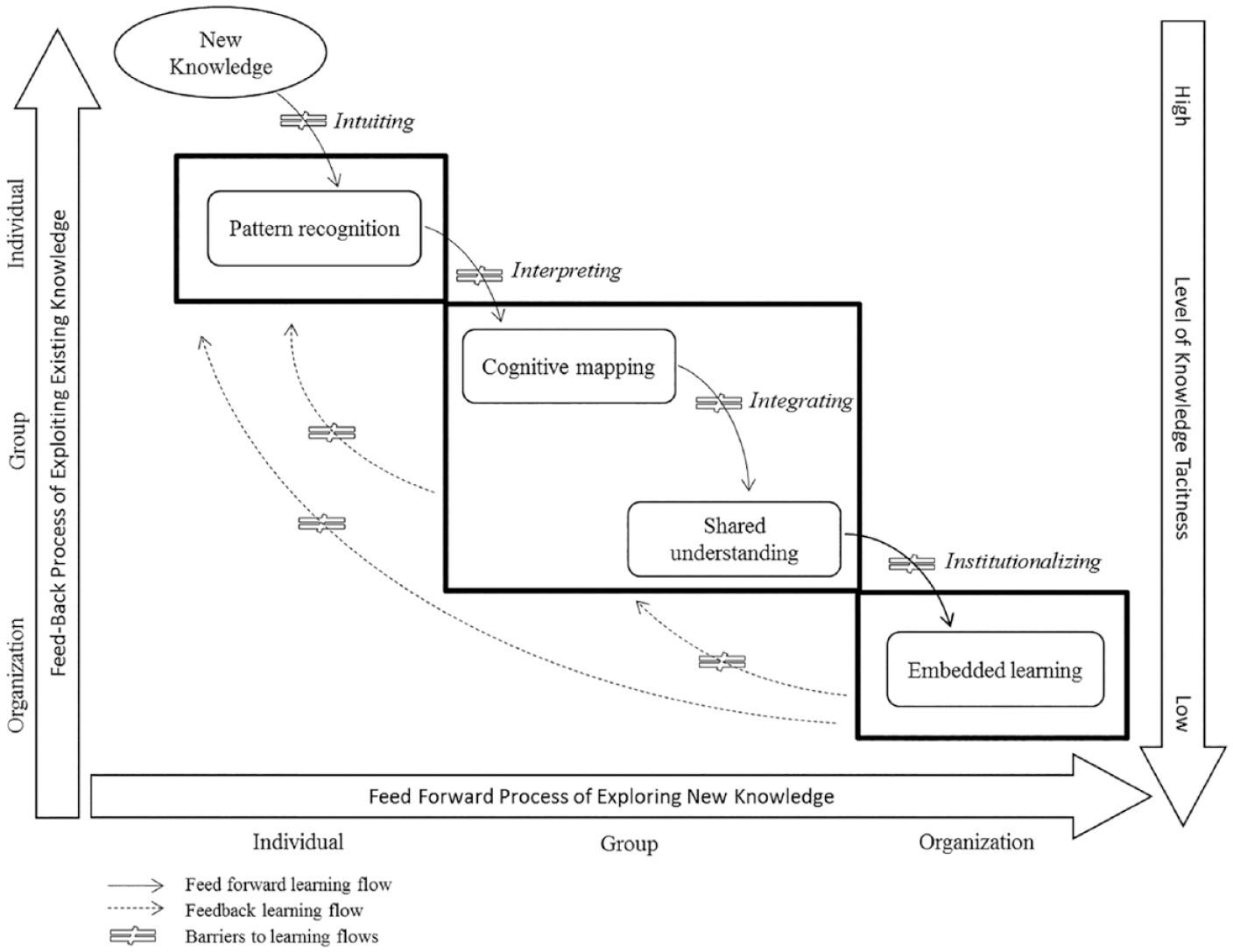
Let’s continue with our AI example.
This is where learning begins.
Individuals notice patterns, opportunities, trends, or signals in their environment.
The challenge is that people don’t notice everything equally.
Instead, they tend to notice information that is recent, memorable, familiar and consistent with existing beliefs
The leadership team remembers the AI success stories from the conferences because they were vivid, compelling, and easy to recall.
At the same time, stories of failed AI implementations receive less attention.
As a result, what gets noticed is not necessarily what’s most representative of reality.
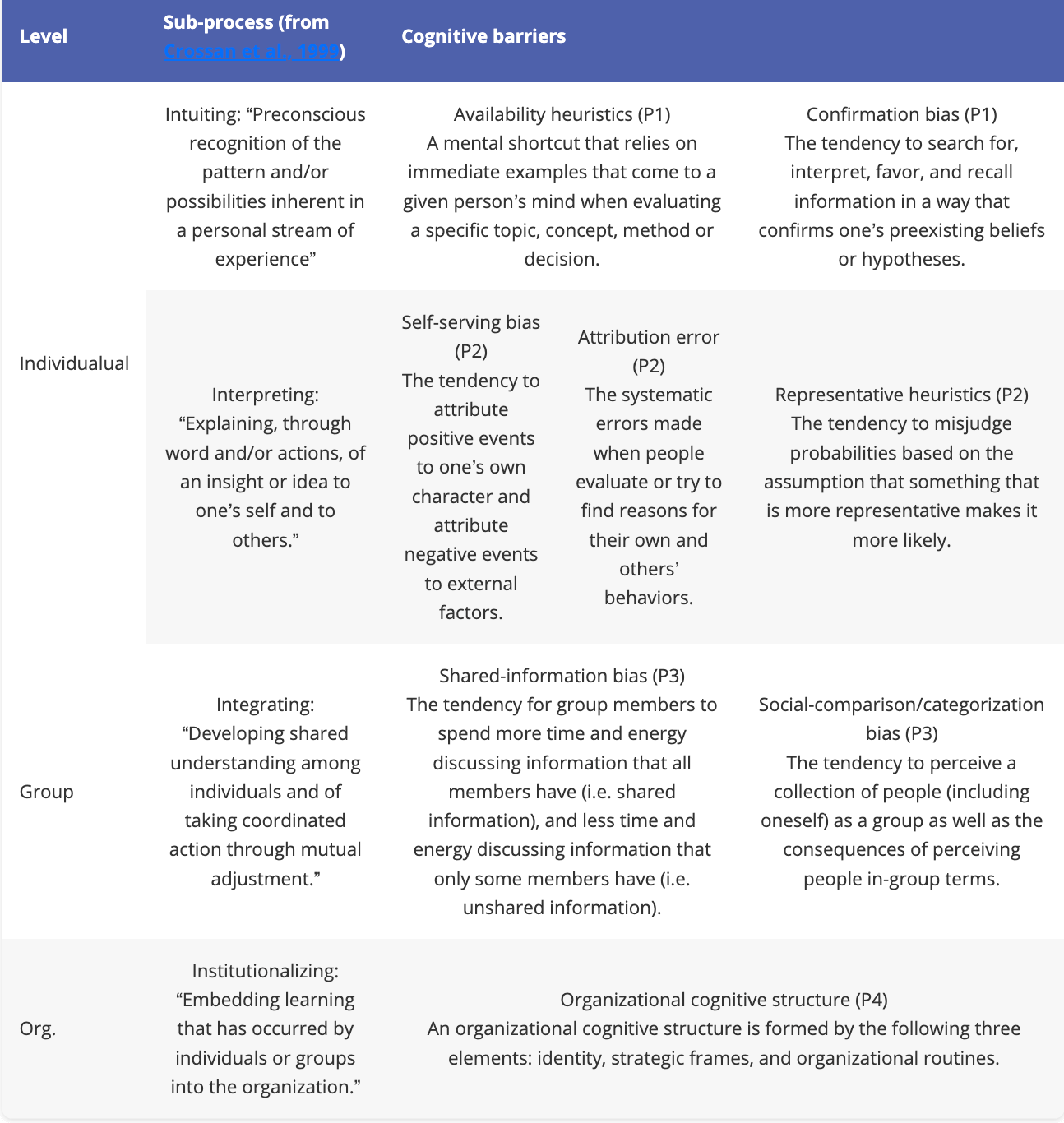
Barriers to intuiting:
Availability bias
Confirmation bias
Once people notice something, they need to make sense of it.
Now the team begins asking: “Why are these organisations succeeding with AI?” and this is where another set of biases emerges.
Perhaps they conclude that successful organisations are simply more innovative.
Perhaps they assume success happened because of AI itself rather than leadership support, organisational readiness, or available resources.
Perhaps they focus on examples that resemble their own situation while overlooking important differences.
The information hasn’t changed. But the interpretation has.
Barriers to interpreting:
Fundamental attribution error
Representativeness heuristic
Self-serving bias
Learning becomes organisational when people begin discussing, debating, and developing shared meaning.
This sounds straightforward.
In practice, it is often where learning starts to narrow.
Research shows that teams tend to spend more time discussing information everyone already knows than surfacing unique or contradictory perspectives.
Imagine someone in the room says: “We’ve also spoken to organisations where AI adoption failed.”
The comment receives little attention.
Meanwhile, the success stories dominate the conversation.
The team leaves aligned. But alignment is not always the same as learning.
Barriers to integrating:
Shared-information bias
Social-comparison bias
Social categorization
The final stage occurs when learning becomes embedded in systems, structures, routines, and ways of working.
The AI strategy gets approved. Budgets are allocated. Processes are redesigned. New initiatives are launched.
Yet another challenge emerges.
Organisations often accept learning that reinforces existing beliefs and reject learning that threatens them.
An organisation that sees itself as highly innovative may eagerly embrace AI.
An organization that prides itself on human-centred leadership may resist it.
In both cases, organisational identity influences what gets institutionalised.
Barriers to institutionalising:
Organisational cognitive-structure biases

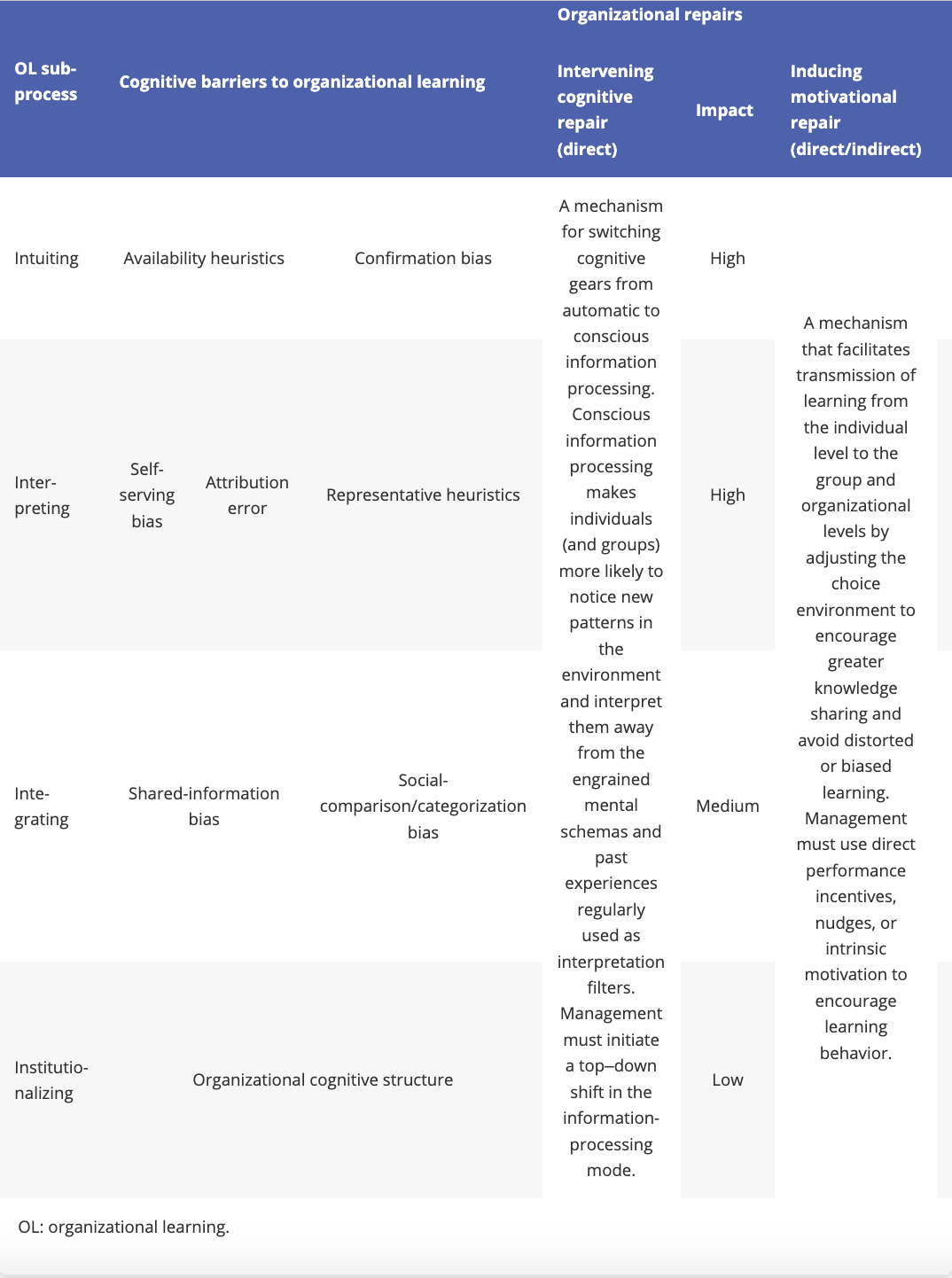
The authors proposed three organisational repair mechanisms that help reduce these barriers and improve learning flows.
Together, these extend the original framework from 4I to 4I + 3I:
1. Intervening - Creating deliberate shifts from automatic thinking to conscious thinking.
2. Inducing - Designing environments, incentives, and choice architectures that encourage better learning behaviours.
3. Inquiring - Creating cultures of dialogue, reflection, and collaborative inquiry.
In other words, if biases interfere with learning, leaders cannot simply hope that learning will happen.
They need to actively create conditions that help people notice differently, interpret differently, and think differently.
As I read this paper, I found myself thinking less about learning programmes and more about learning environments.
Many of us in L&D spend a lot of time designing experiences that help people acquire new knowledge and skills.
This research suggests we should spend equal time designing conditions that help people challenge assumptions, process information more consciously, and engage with perspectives they might otherwise overlook.
If we use the authors’ three repair mechanisms as a guide, several practical implications emerge.
One of the most interesting ideas in the paper is that learning often stalls because people remain in what the authors describe as an automatic mode of thinking.
They rely on familiar assumptions, past experiences, and existing mental models.
Learning requires moments that interrupt those patterns. The authors refer to this as creating a shift from automatic processing to conscious processing.
For L&D, this means designing experiences that challenge how people currently think, not just what they know.
Some practical examples:
Use scenario planning to explore multiple futures rather than a single expected future.
Incorporate premortems before major projects and initiatives.
Design simulations where participants experience unexpected outcomes.
Use critical incidents and anomalies instead of only showcasing best practices.
Create cross-functional rotations, shadowing opportunities, or immersion experiences that expose leaders to unfamiliar contexts.
One question I am taking away from this paper is:
What assumption are we making that would completely change our decision if it turned out to be wrong?
Another insight from the paper is that learning behaviours are heavily influenced by the environments in which people make decisions.
The authors draw on the concept of choice architecture and nudges.
Rather than trying to convince people to learn better, organisations can design systems that make better learning more likely.
For L&D, this could mean:
Building “What surprised us?” into every project review.
Requiring teams to identify evidence that challenges their conclusions.
Creating decision templates that ask for alternative interpretations.
Rotating who speaks first during retrospectives and lessons-learned sessions.
Creating cross-functional project teams that intentionally bring together diverse expertise.
Developing knowledge systems that make expertise easier to locate across the organisation.
One of my favourite examples from the paper comes from healthcare, where evidence-based protocols were introduced to reduce variation caused by individual intuition and experience.
The lesson for us isn’t necessarily to create more procedures.
It’s to think carefully about how our learning systems guide attention. Because people often learn from what is easiest to notice rather than what is most important to notice.
Many conversations about learning culture stop at psychological safety.
This paper pushes us further.
The authors argue that organisations need cultures of inquiry and collaborative reflection. Not just environments where people feel safe to speak.
Environments where people are expected to question assumptions.
That’s a much higher bar.
For L&D, this could look like:
Teaching leaders how to facilitate inquiry rather than provide answers.
Embedding dialogue practices into leadership development programmes.
Creating peer-learning circles that explore competing interpretations of the same challenge.
Training managers to ask better questions instead of offering immediate solutions.
Encouraging teams to openly discuss uncertainties, doubts, and alternative viewpoints.
A simple practice might be ending major reviews with questions such as:
What assumptions did we make?
Which assumptions proved wrong?
What evidence did we overlook?
What alternative explanation might exist?
Those conversations help organisations move beyond reporting lessons to actually making sense of them.
My biggest takeaway from the paper was that the final barrier to learning is often not individual - it’s organisational.
Organisations frequently struggle to learn because new learning threatens who they believe they are.
A company that prides itself on certainty may struggle with experimentation.
A company that sees itself as the expert may struggle with curiosity.
A company that values efficiency above all else may struggle with exploration.
For L&D, this means capability-building efforts should examine not only skills and knowledge but also the organisational beliefs that support or constrain those capabilities.
Questions such as: What aspects of our identity make this capability difficult to adopt?
OR what would we need to stop believing for this learning to take hold?
may unlock more progress than another training programme.
Because sometimes the biggest barrier to learning is not capability - it’s identity.
What I appreciate about this paper is that it shifts the conversation from learning as a knowledge problem to learning as a sensemaking problem.
We all know that organisations rarely suffer from a shortage of information.
More often, they struggle with what they notice, how they interpret it, whose perspectives they hear, and whether they are willing to challenge deeply held assumptions.
For me, the practical question coming out of this research is:
The next time a lesson learned fails to become a lesson applied, at which stage of learning did the breakdown occur?
Because improving organisational learning may be less about creating more learning opportunities and more about removing the cognitive barriers that prevent learning from flowing in the first place.

The agenda is looking very solid! 👌 Here are the sessions worth checking out!
🌟 L&D Backstage: The Reality of Innovation
Join us for an honest look behind the scenes of a corporate innovation challenge where L&D helped create the conditions for experimentation in a procurement function not used to taking risks. The result? 150 participants, 25 ideas, 5 projects, and plenty of lessons about what happens when innovation meets real-world constraints.
🌟 Social Mixer
Join our monthly social mixer to meet fellow Shakers, make new connections, and have some fun along the way. Expect games, breakouts, conversations, and plenty of opportunities to connect with people from across the community.
🌟 Parents Grow Too: Powering Parenting Decisions with Values
Working parents face countless decisions every day, from navigating career choices to supporting children’s emotions and managing family dynamics. In this reflective workshop, we’ll explore how clarifying our values can make those decisions feel less overwhelming and more intentional.
🌟 ThoughtLab: Stop Fighting to Be Heard — How to Position L&D as Business-Critical
In this ThoughtLab, Candice Mitchell shares a practical framework for helping L&D move from order-taker to strategic business partner. You’ll learn how to connect learning initiatives to business outcomes, ask better questions, and build credibility before a solution is ever designed.
🌟 Immersive Series: Mind the Gap — Developing Self-Awareness in L&D
In this interactive session with Toby Newman, we’ll explore self-awareness as a practical professional skill. Together, we’ll examine the gap between intention and impact, reflect on how others experience us, and explore tools for becoming more aware in our communication, facilitation, and leadership.
🌟 ID Power Hour: When Learning Doesn’t Change Behaviour
This month’s ID Power Hour with Damla, we’ll explore a challenge many learning teams face: when participation and completion metrics suggest success, but workplace behaviours tell a different story.
...and many more 👀
We’ve also got local hub meetups happening in Barcelona, Zurich, Munich, Berlin, New York, and Dublin. If you’re looking to connect with fellow Shakers in person, keep an eye on the calendar and join your nearest community. 🙌


[ 👀 Download ] The Transformation Triangle: The Latest AI in L&D Report
This report explores a question many L&D leaders are grappling with: if content is becoming cheap and easy to create, where does L&D create value? Through the Transformation Triangle framework, it offers three possible futures for the function - Skills Authority, Enablement Partner, and Adaptation Engine, making it a useful lens for rethinking strategy in the age of AI.
[ 🧰 Use ] Spark by Nina Pavlovska
Spark is a collection of 35 bite-sized creative exercises designed to help you break out of routine thinking and generate fresh ideas.
[ 🎧 Listen ] The Sailboat Metaphor: A Powerful Tool to Work with Strengths
This episode introduces a simple but powerful strengths-based coaching tool built around the sailboat metaphor. It explores how focusing on strengths, not just fixing weaknesses, can unlock energy, performance, and growth, while offering practical ideas for coaches, facilitators, and people developers.
[ 👀 Read ] When Everything Is a Priority, Nothing Is
If you’ve ever watched carefully planned priorities get derailed by shifting organisational demands, this piece will feel familiar. It explores why constant reprioritisation happens and offers useful insights for leaders trying to create clarity and focus in environments where the goalposts keep moving.
[ 🧰 Use ] The Presence Triangle
This assessment helps you explore the three elements that shape how others perceive you: warmth, authority, and command. Grounded in research on trust and executive presence, it offers a practical way to reflect on how you show up in meetings, presentations, and leadership situations.
[ 📺 Watch ] L&D’s Defining Moment: Four Perspectives on the Future of Learning in the Age of AI
This panel discussion in collaboration with L&D Shakers brings together four respected voices in L&D to explore one of the profession’s biggest questions: what happens to learning when AI changes how capability is built? It’s a thoughtful conversation that moves beyond content creation and examines where L&D can create value in the future.
[ 🧭 Explore ] The Behaviour Change Techniques Taxonomy
Most change initiatives rely on a familiar set of interventions—training, communications, champions, toolkits—without first understanding what’s actually driving behaviour. This evidence-based taxonomy provides 93 behaviour change techniques that can help you move beyond guesswork and design interventions that better match the barriers people face.
[ 🧭 Explore ] Liberating Structures
Liberating Structures is one of the richest collections of facilitation methods available today, offering practical ways to make meetings, workshops, and learning experiences more inclusive, engaging, and participatory. Whether you’re facilitating a team discussion or redesigning a large event, you’ll find plenty of ideas to experiment with and adapt in this newly revamped website.

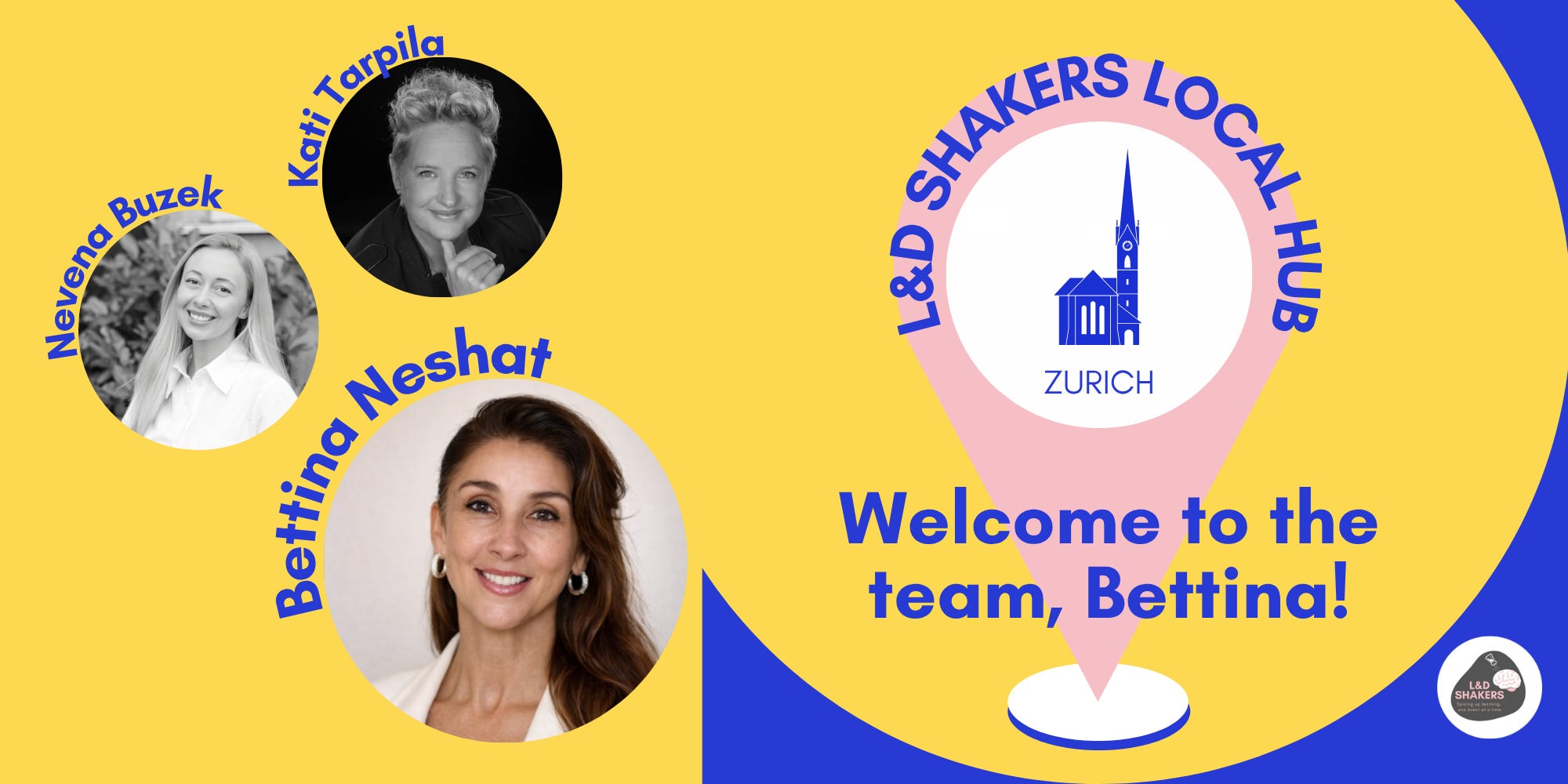
Bettina Neshat is joining Nevena and Kati as a co-lead of our Zurich Local Hub, bringing more than 20 years of experience in training and development to the team.
Big congratulations and welcome to the Core Team, Betty - we’re so excited to see you start this journey. Have lots of fun building the Zurich community together! 💛
And a heartfelt thank you to Valerie Pierre for all the energy, creativity, and care you’ve brought to the hub over the years. ✨
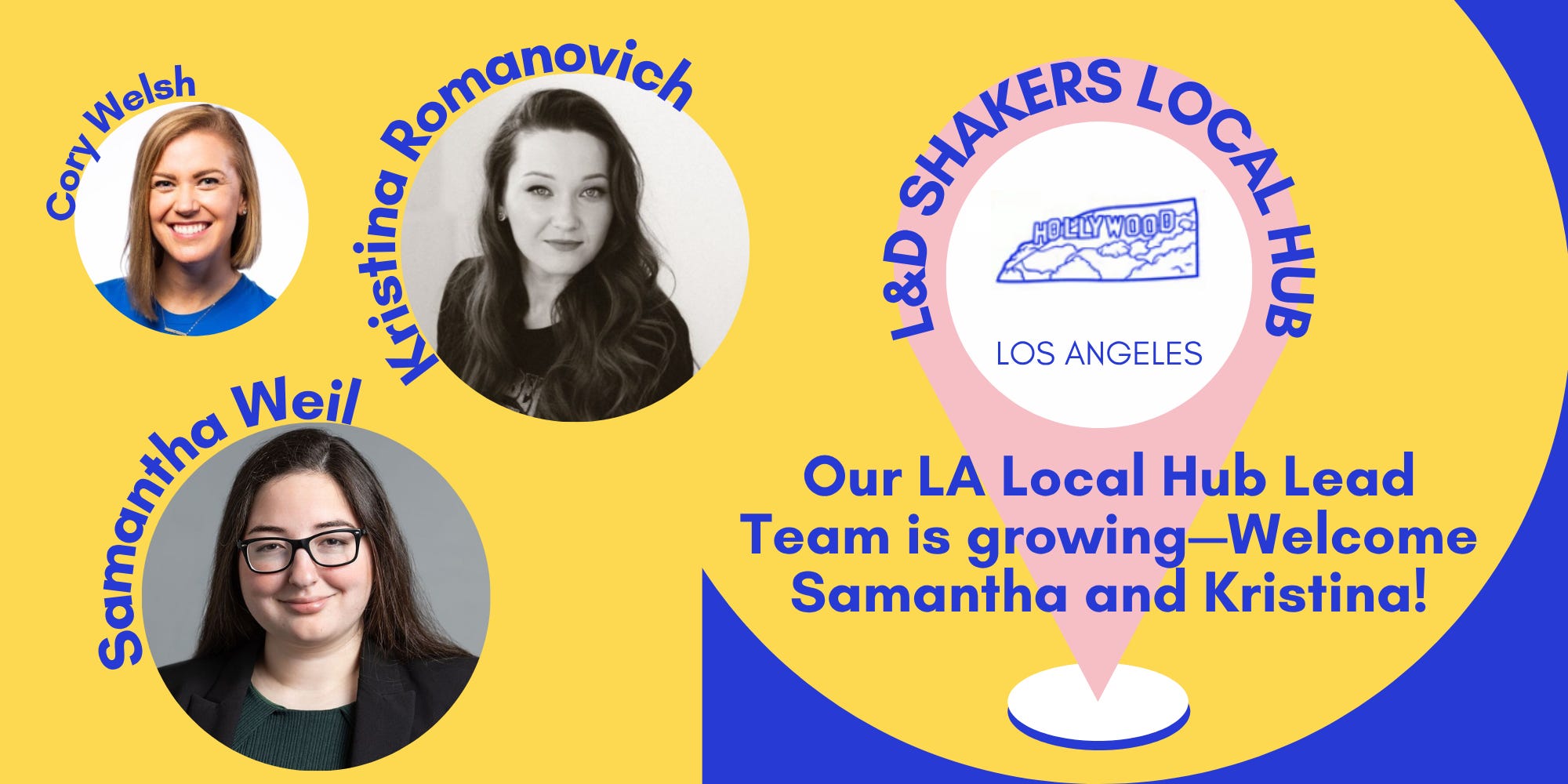
After leading the LA Local Hub solo for a while, Cory is now joined by Kristina Romanovich and Samantha Weil, bringing even more experience in leadership development, capability building, and learning strategy to the community.
Huge congratulations and welcome to the Core Team, Kristina and Samantha - we’re excited to see what you’ll create together. Have lots of fun building the LA community! 🌟
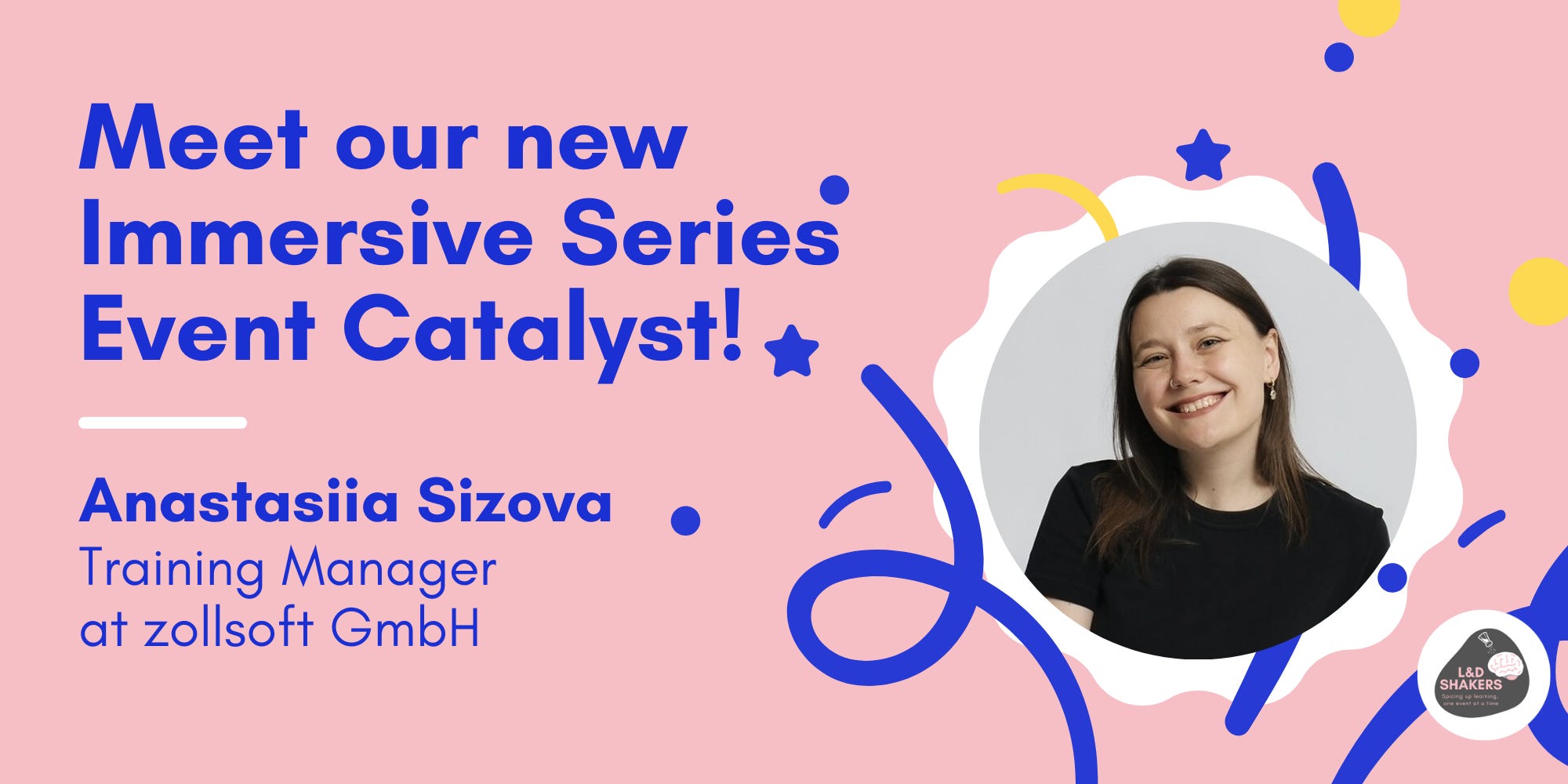
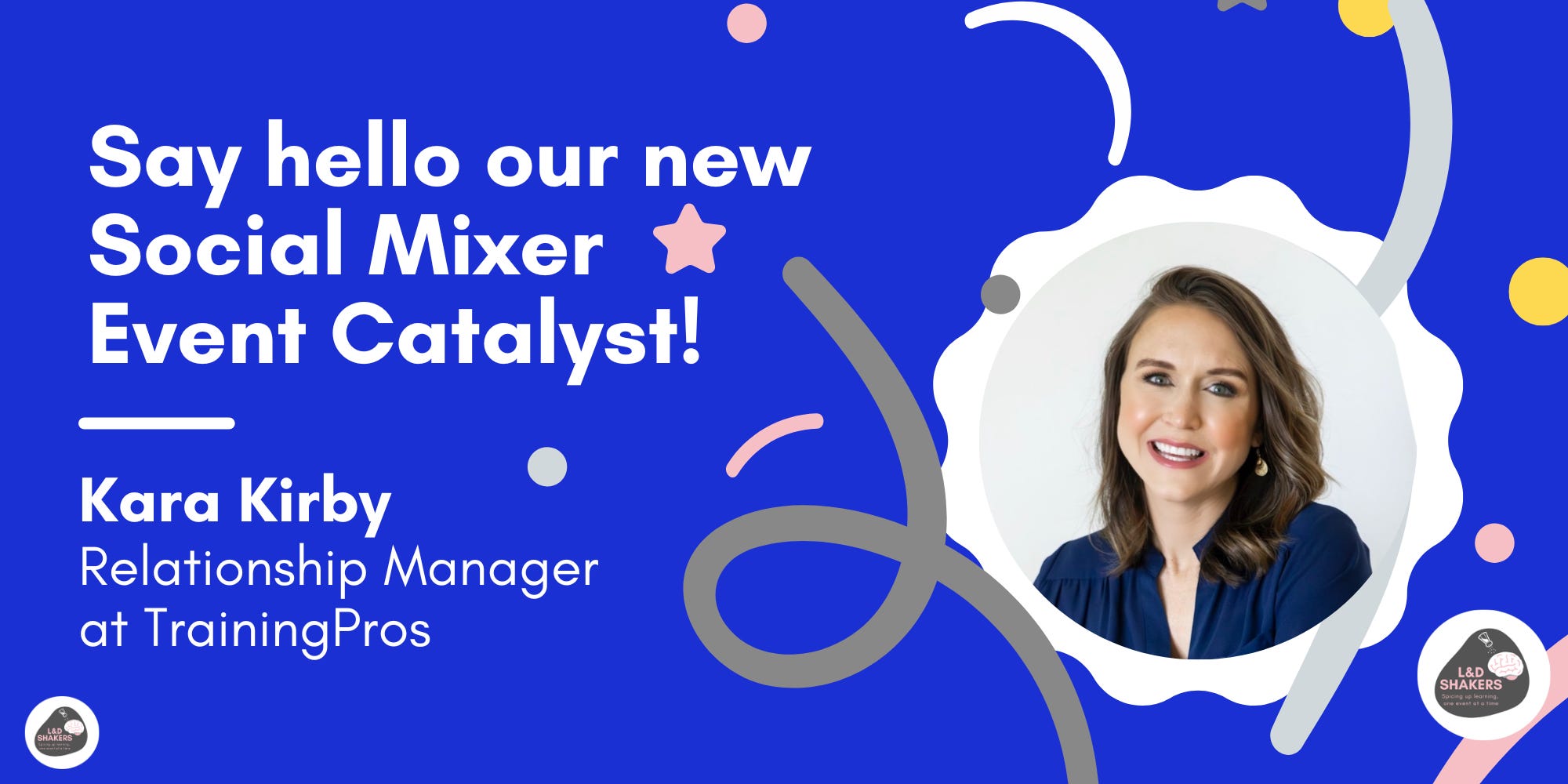
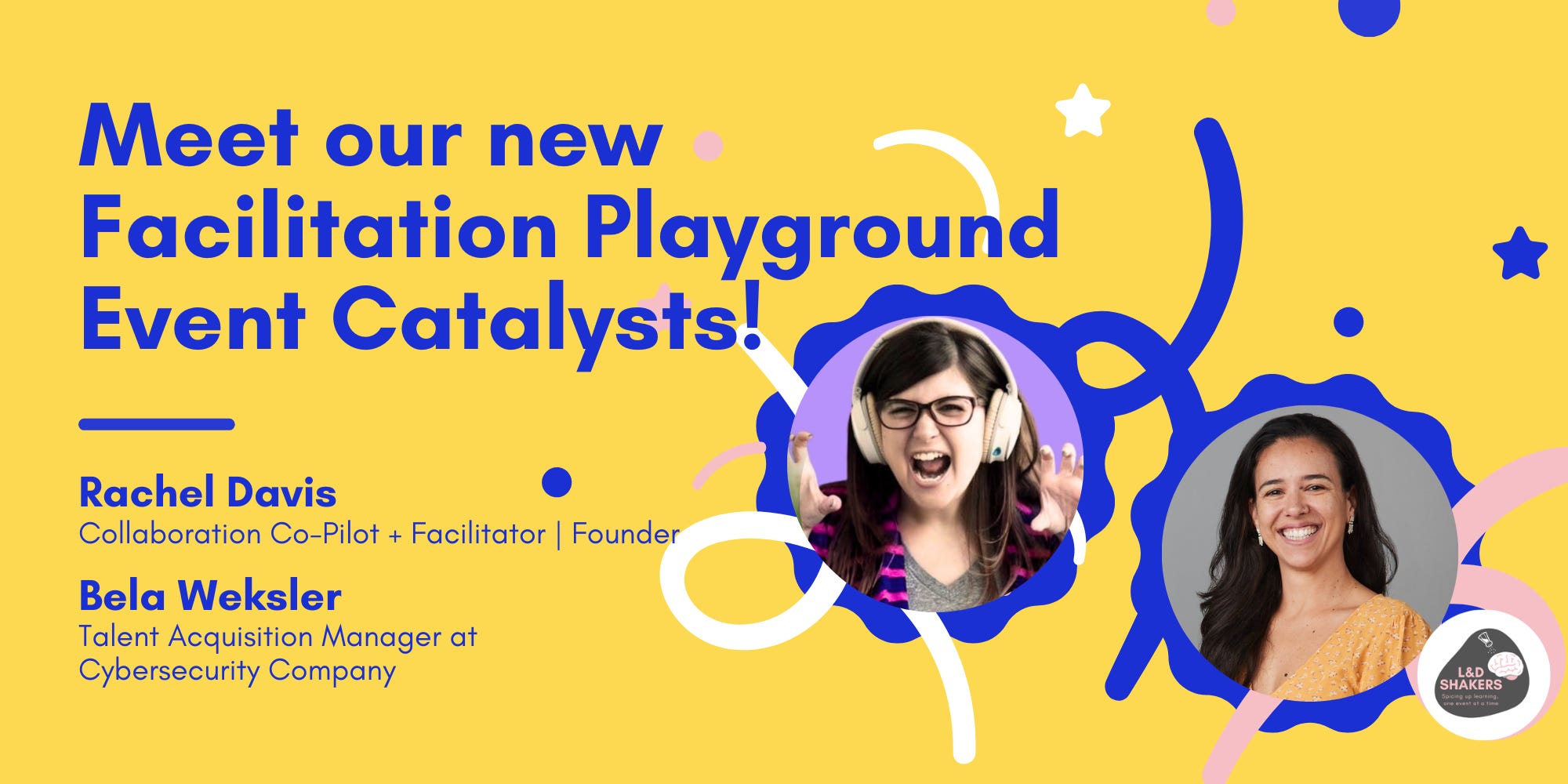
Shakers, we’ve got some wonderful new faces joining the Core Team! ✨
Anastasiia Sizova will lead our Immersive Series, Kara Kirby will host our Social Mixers, and Rachel Davis and Bela Weksler will keep the Facilitation Playground thriving and full of experimentation.
A huge welcome to the Core Team, Anastasiia, Kara, Rach, and Bela - we’re so excited to see the learning experiences you’ll create. Have a fun, creative, and rewarding journey! 💛
And to Andreea Gãtin, Marina Petersson, Camilla Smerieri, and Guillem Daniel - thank you for the passion, creativity, and care you’ve brought to these spaces.✨
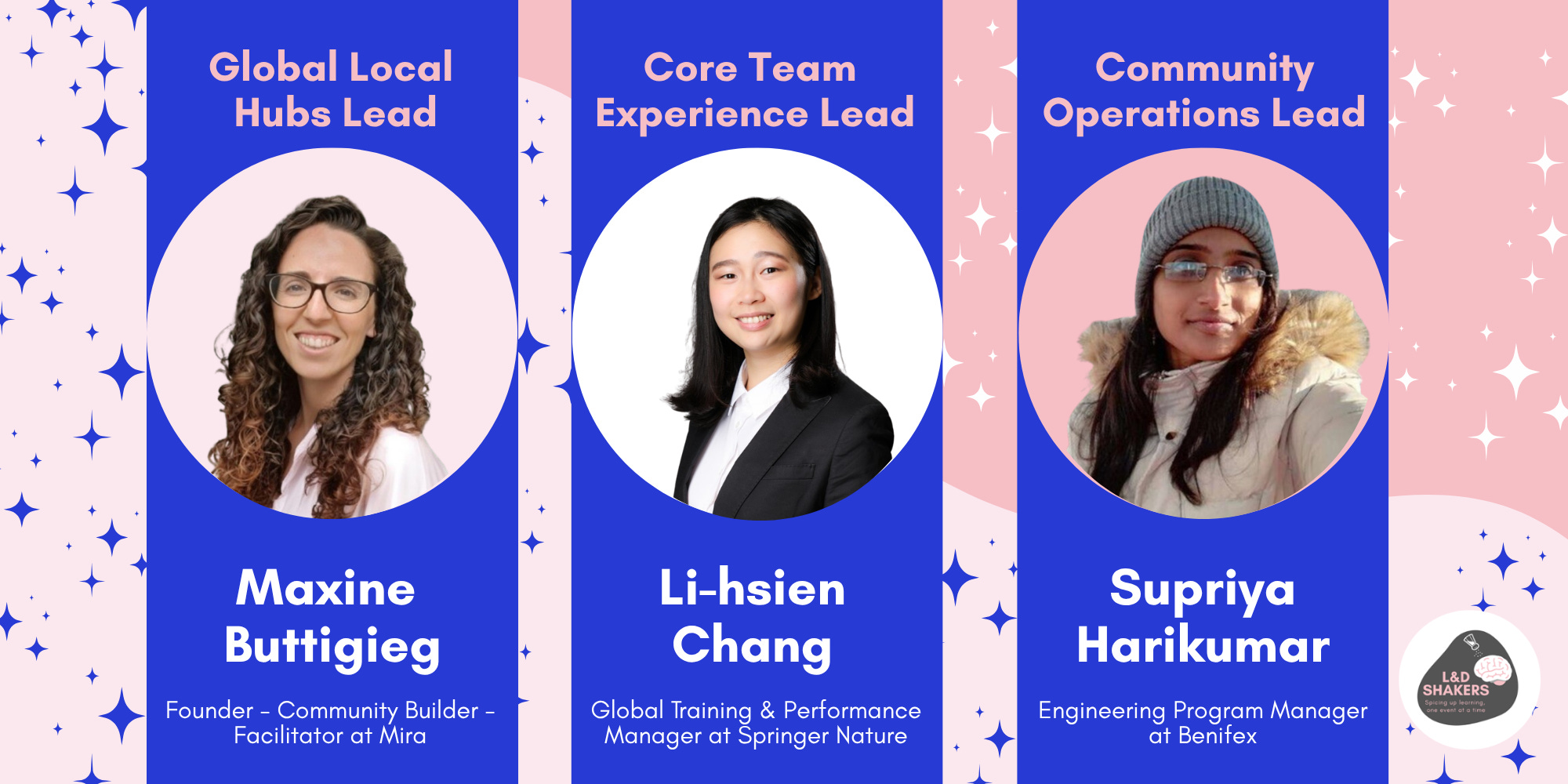
Shakers, we’re entering an exciting new chapter!
To help support and strengthen the engine behind L&D Shakers, Maxine Buttigieg, LiHsien Chang, and Supriya Harikumar are stepping into newly created community-wide leadership roles, helping our ecosystem grow, connect, and run more smoothly.
Huge congratulations to all three of you - we’re so excited to see you shape this next chapter of the community. Have lots of fun building what’s next together!💛

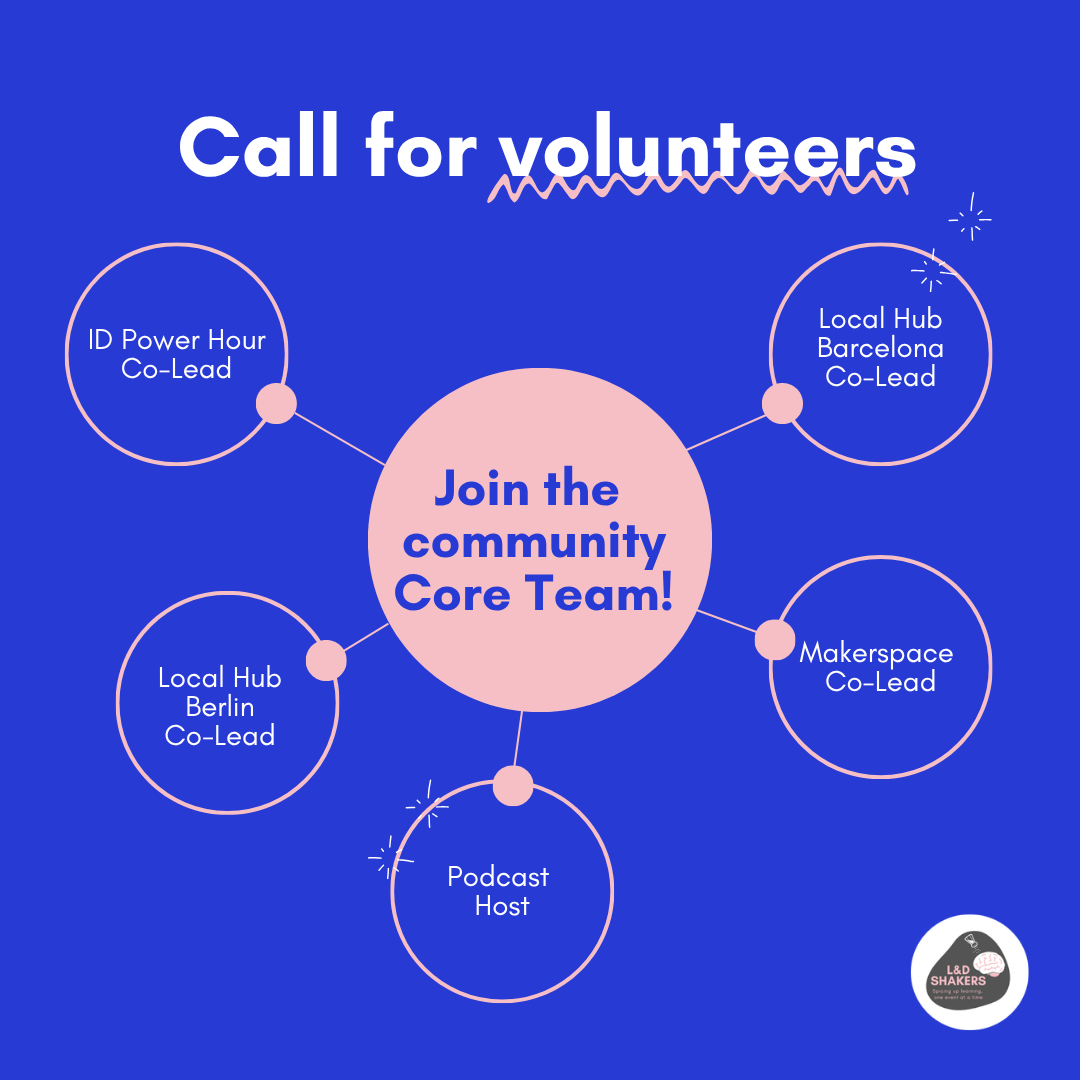
Shakers, we’re looking for new volunteers to join the Core Team!
If you’ve been thinking about taking a more active role in the community, this is your chance. We’re currently looking for co-leads and hosts across several community initiatives and local hubs.
Come help us build learning experiences, create connections, and shape the future of L&D Shakers- we’d love to have you on the journey.
Applications close June 19.
〜See you soon
Till then, keep spicing up your learning! 🧠🧂
Sejaal
If this edition made you think, smile, or steal an idea, pass it on to someone else too.
No posts
Comments
Nothing yet. Say the first thing.
Sign in to join the conversation.