
Hi, dear L&D Shaker, I hope your week is going smoothly.
Here’s what you can find in today’s Learning Brief:
A fantastic essay by Andy Sontag in which he argues that great experiences don’t hinge on better content, but on better-prepared participants who arrive motivated, engaged, and ready to act.
Upcoming community events and meetups all over the world!
A series of juicy and practical resources 😍
Latest news from our community.
Enjoy!
Anamaria


Spend less time preparing the experience, and more time preparing the participants.
As an Experience Designer and trainer, I have always placed enormous weight on the design of the experience. I have devoted my career to helping others get better at designing meaningful experiences that grow people and relationships. But lately, a more uncomfortable question has been nagging at me: what if the biggest leverage point isn’t the experience you design - but how you prepare the people walking into it?
In 1689, the philosopher John Locke proposed an idea that would quietly shape centuries of classroom design:
“Let us then suppose the mind to be, as we say, white paper void of all character, without any ideas. How comes it to be furnished?”
— John Locke, An Essay Concerning Human Understanding
The blank slate.
It sounds humble, even open.
But embedded in that metaphor is a dangerous assumption: the learner arrives empty, the professor’s only job is to fill them.
That logic gave birth to what we now call the Sage on the Stage, the lecturer who walks in, downloads their expertise, and walks out.
Prepare the content. Deliver the content. Done.
Influencing the learner’s inner state, their mindset, their motivation, their willingness to actually do something with what they heard - was never part of the design.
It didn’t need to be. Blank paper doesn’t need warming up.
But an experience is not something a designer creates and places in someone’s head. Experience is ALWAYS constructed by the learner. The science is unambiguous on this point: we don’t receive reality, we are co-creators in building it (Lisa Feldman Barrett, How Emotions Are Made). Which means that taking steps to increase participants’ motivation, agency, and will to apply what they learn isn’t a nice-to-have. It’s the whole point.
Dr. Ina Weinbauer-Heidel has a great model for what drives the application of learning.
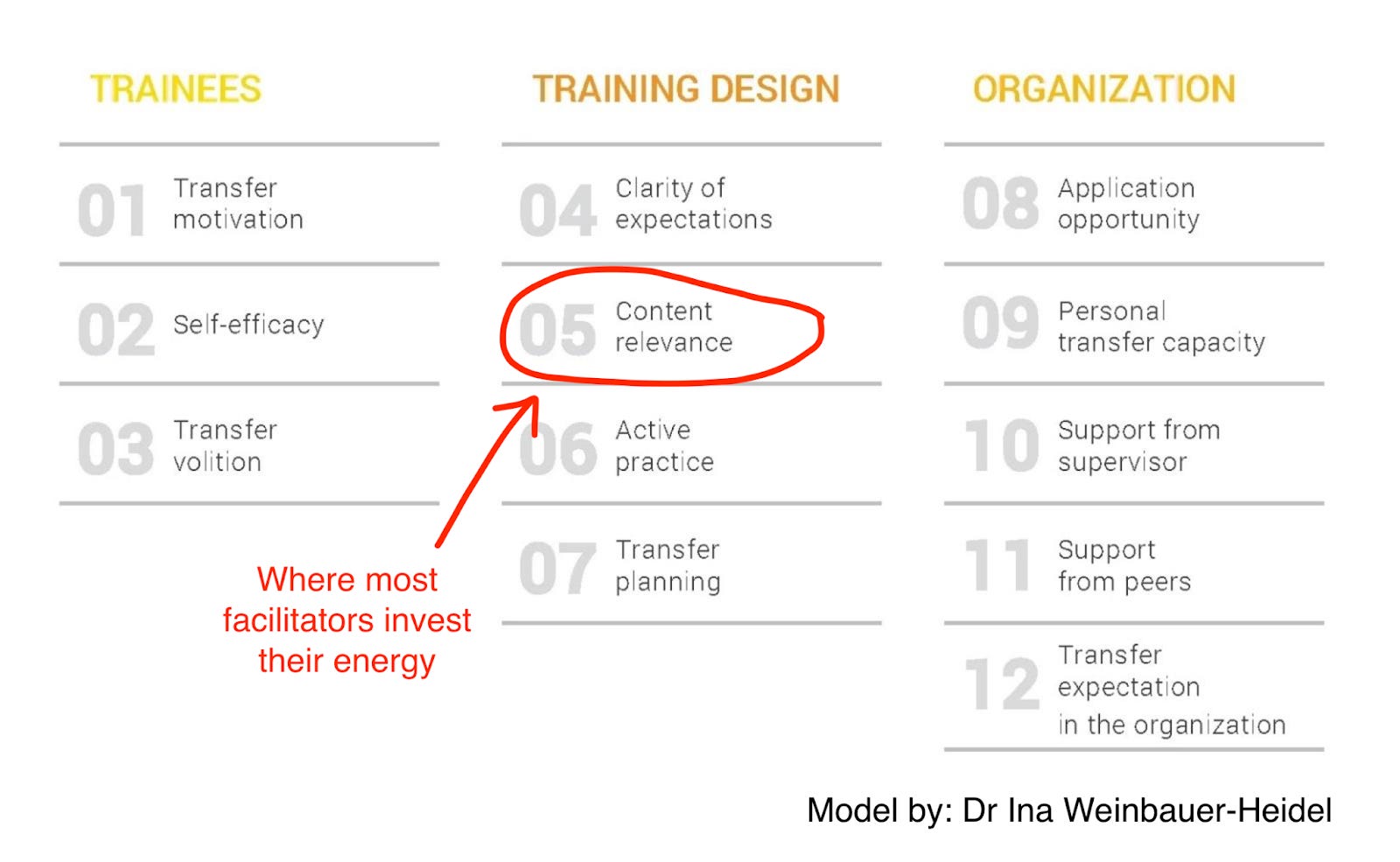
Out of curiosity, I asked my community where they spend the most time when preparing a session. Here is what people responded:
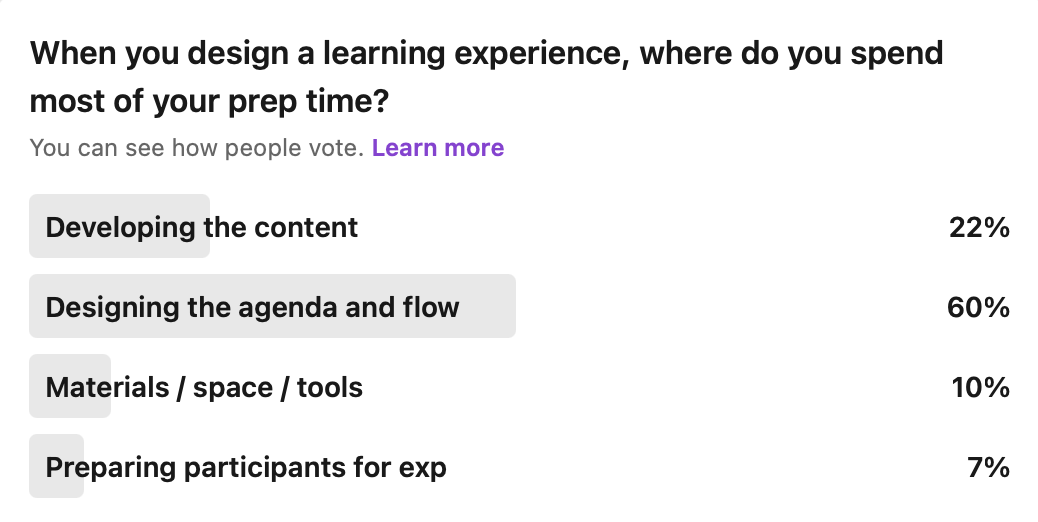
82% of us are spending our prep time on the experience itself - the content, the flow, the materials.
7% on preparing the participants.
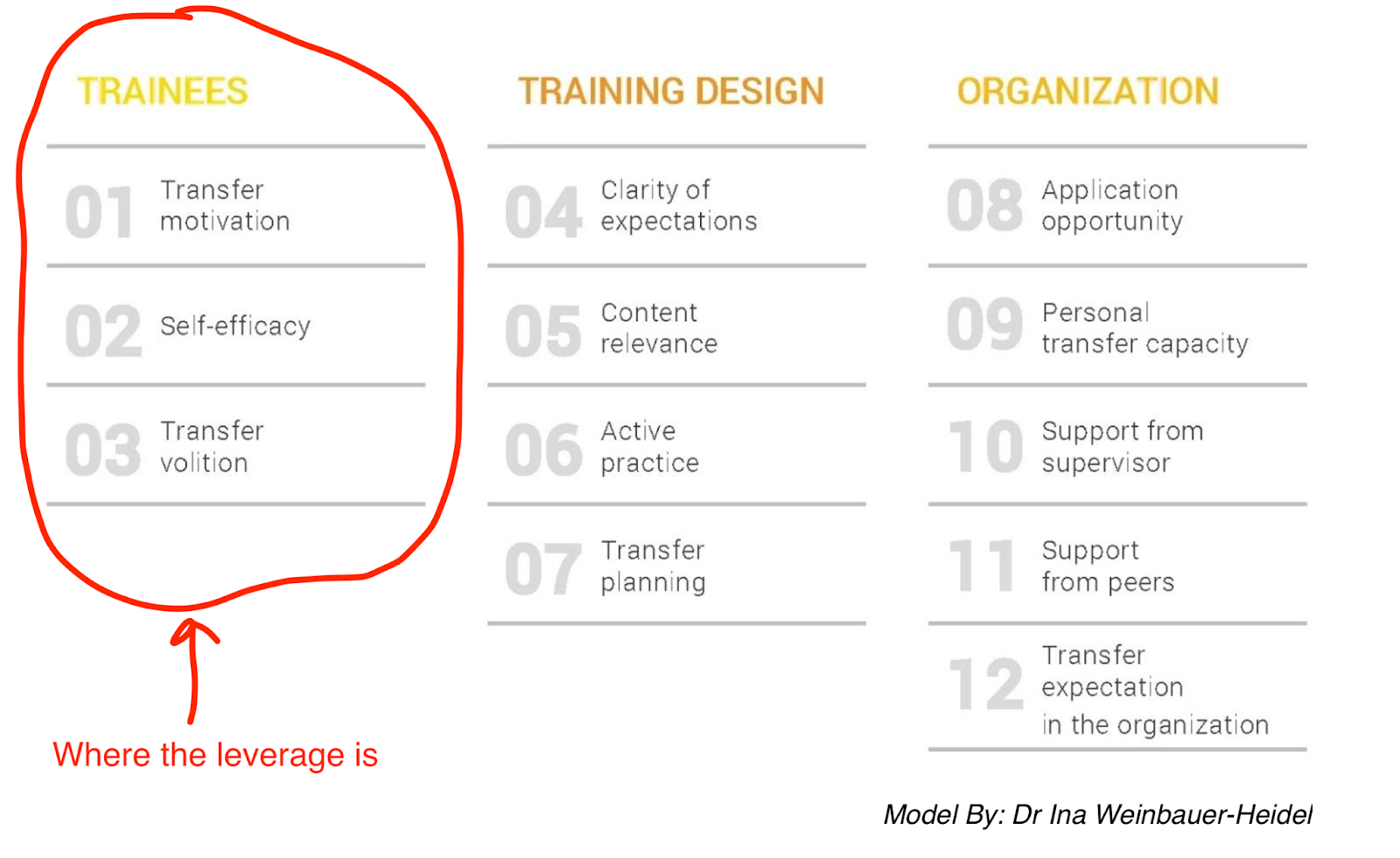
Dr. Ina Weinbauer-Heidel’s research on what actually drives learning transfer tells a different story. Of the 12 factors that predict whether people apply what they learn, the top three all live inside the learner — their motivation, their self-efficacy, and their volition to act.
We’re pouring our energy into factor #5.
The learner shows up however they show up. And we just hope for the best.
On my above LinkedIn post, Mykel Dixon, the legend, puts it like this: “(preparing participants)... When done well, the experience itself is 10x more impactful.”
The Participant’s Share
The art historian Ernst Gombrich coined the term “the beholder’s share” to describe something every great artist knows intuitively: the viewer isn’t a passive recipient. They complete the work. They bring their own imagination, memory, and emotion - and the final meaning lives in that collision between what the artist made and what the viewer brings.
Marcel Duchamp put a number on it. The artist, he said, completes 50% of the work. The viewer completes the rest.
The same is true in a learning room. The facilitator designs the experience. But the participant - their mindset, their motivation, their willingness to be changed - determines what it actually becomes. You can craft the perfect session and still lose the room, not because the design failed, but because the other 50% never showed up.
Call it the participant’s share.
The question no one is asking is: can you design for it?
There’s no single formula. How you prepare your participants depends entirely on who they are, what you’re asking them to learn, and what time and access you have. But the goal is always the same: increase their intrinsic motivation - not just to learn, but to do something with what they learn.
Here are two places to start.
There’s a quiet condescension in how we often treat adult learners. In the big corporations I have worked with, people are so busy that getting them to prepare for an offsite can feel like pulling teeth. Clients often want shorter sessions and less pre- and post-work.
But developmental learning doesn’t come from doing what is easiest. It comes from two things: creating spaces safe enough for developmental discomfort, and designing an experience disturbing enough to make an object of something participants were previously subject to. If that doesn’t quite land but sounds interesting, I really recommend reading more from the person who shared that framing with me: Alis Anagnostakis - Vertical Development Institute
I have called this intentional friction: when people are invited to navigate difficulty together (physical, emotional, or creative) they don’t just learn more, they grow closer. The keyword is intentional. It’s never about pushing discomfort onto people - it’s about inviting them to step into it.
Preparing participants is itself a point of friction. A well-crafted workbook that participants send back before the session, a snack or photo everyone is asked to bring - each one signals, before the room even exists: this is not a passive event. Come ready to contribute.
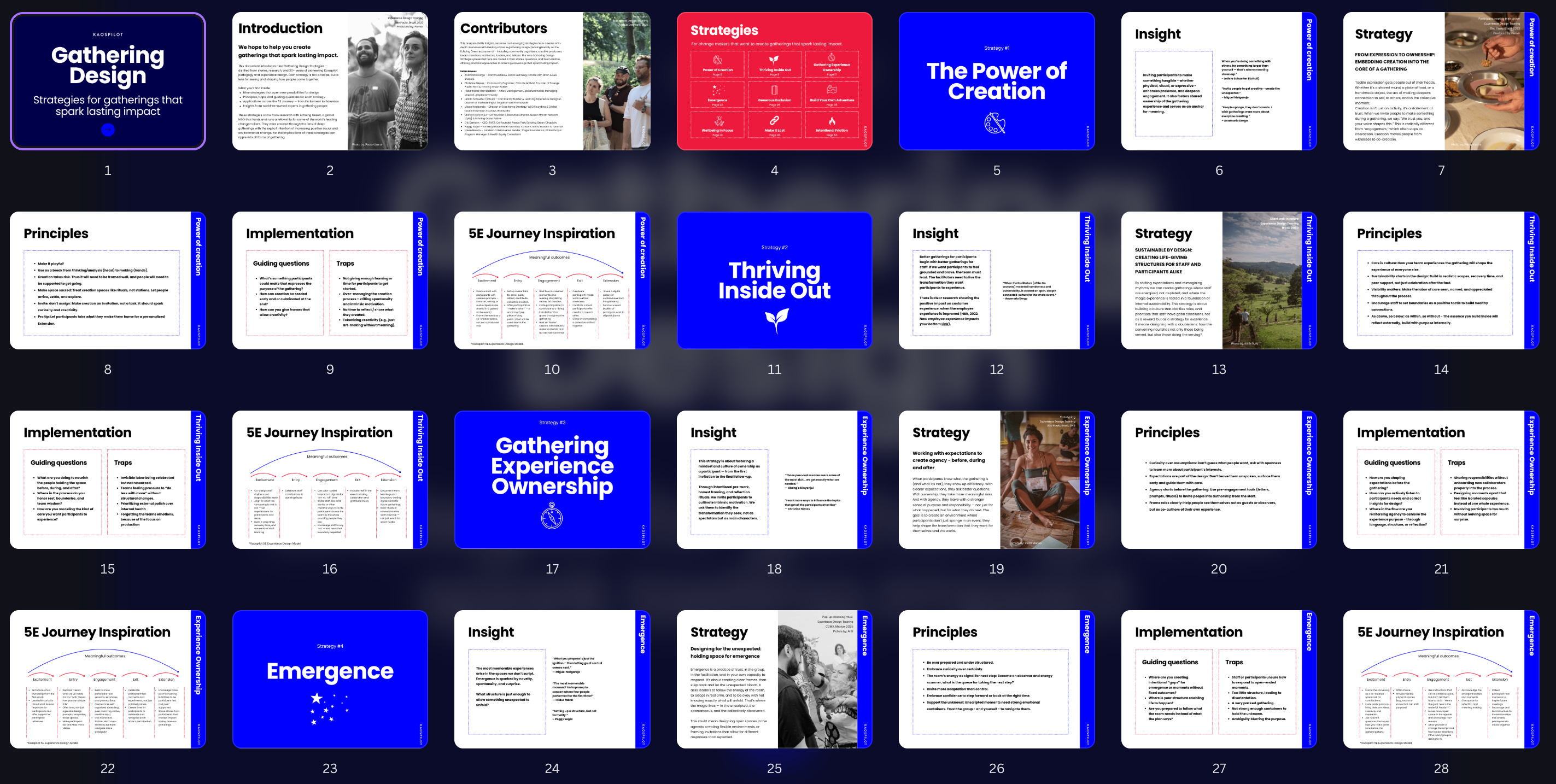
Intentional Friction is one of 9 Gathering Design Strategies developed by Kaospilot Experience Design.
None of the preparation in the world will stick if participants don’t genuinely care about the topic. Nick Shackleton-Jones calls this affective context — adults don’t learn from content, they learn from caring. Malcolm Knowles put the same idea differently: adults need the why before the what. Your job before the session is to make sure they arrive already caring — and already thinking about what they’re going to do with what they learn.
Dr. Ina Weinbauer-Heidel’s research makes it concrete: the strongest predictors of whether someone applies what they learn are trainee characteristics — motivation, self-efficacy, transfer volition. These aren’t fixed. They can be shaped. But only if you start before the training does.
Here’s what that looks like in practice:
Give them a real problem to bring. Ask every participant to arrive with a live design question — a real, unresolved challenge from their own work that they need to act on in the next few months. Not a hypothetical. Something that keeps them up at night. When learning is anchored to something they actually own, the application question largely answers itself.
Get specific about application. Not “I’ll use this at work” — but “I have a team meeting on Thursday where I could try this.” Specificity is the bridge between intention and action.
Prime their support system. Trying something new at work is vulnerable. Before the session, ask participants to have a conversation with their manager about what they’re hoping to apply — and to identify one colleague who can hold them accountable afterward. That social scaffolding, built before anyone enters the room, is what makes application survive contact with real life.
Before your next session, resist the pull to add one more activity or polish one more slide. Instead, ask yourself: Have I done anything to prepare the people walking into this room?
That 7% deserves a lot more of your attention.
Andy Sontag is a learning experience designer, facilitator, and entrepreneur focused on turning powerful experiences into sustained behavioral change.
Over the next couple months, Andy will be doing a deep dive into what comes after the experience is over? What are the best practices in terms of support learning integration, behavior change and scaffolding developmental support after learning experiences? If you are interested, you can follow his thoughts here.


The events lineup is lit 🔥 Here are a few sessions you don’t want to miss!
🌟 L&D Shakers Book Club: The Culture Code
We’re kicking off this year of big ideas with “The Culture Code” by Daniel Coyle, a practical, story-driven look at what the world’s best teams do differently when it comes to culture. We’ll give a summary of the key themes, then swap examples and inspiration of cultural habits we’ve seen succeed (or fail). We’ll also explore a few small changes we could try to bring this into our work.
🌟 The L&D Measurement Clinic
Join our 7th Clinic! The session works like this:
1. You bring a real-life example of a learning initiative you plan to evaluate
2. Learn which business metrics and evaluation methods to use to prove impact
3. Determine isolated impact and alternative methods
4. Learn to “talk business” with senior leaders to show the value of learning
We have offline meetups planned in London, Berlin, Prague, Barcelona, Amsterdam, and Ottawa.


[ 🧰 Use ] Creatures of Habit Toolkit
This toolkit is a practical manual for the human brain that helps you move beyond training delivery to actual behavior change. It breaks down complex psychology into seven relatable “creatures of habit” archetypes, like resistance and routine, to help you diagnose exactly why employees aren’t adopting new skills. You can access more tools here, including a diagnostic tool, a card deck, and much more.
[ 👀 Read ] Learning, Reinvented: Accelerating human–AI collaboration
Daria Rudnik shared this report from Accenture covering 14,000 workers and 1,100 executives across 20 industries, spanning 12 countries. It reveals a clear shift from traditional training to continuous learning and “co-learning”: dynamic, continuous collaboration between people and AI. This model boosts creativity, accelerates skill development, and enhances resilience by embedding learning directly into daily workflows.
[ 🎧 Listen ] When Leaders Lead the Leadership Programme
Matt Peade, Director of Learning & OD, shares how the 12-month People Leaders Program works and why it was created. The program mixes real work projects, mentoring, peer learning, and practical leadership skills, with senior leaders across the business actively involved in developing others. Instead of relying heavily on training content, the focus is on learning through real experiences, reflection, and collaboration, helping build a strong pipeline of leaders while strengthening the organisation’s culture.
[ 👀 Watch ] From Good to Transformative: Unlocking Measurable Impact in Leadership Development
This recording of one of our past learning sessions is a must-watch if you're tired of "vanity metrics" like attendance and want to prove that your leadership programs actually drive business results. It walks you through Bo Dury’s simple 11-step framework to align your training with company strategy, featuring a great case study on how a bank turned soft-skill development into measurable promotion and retention rates.


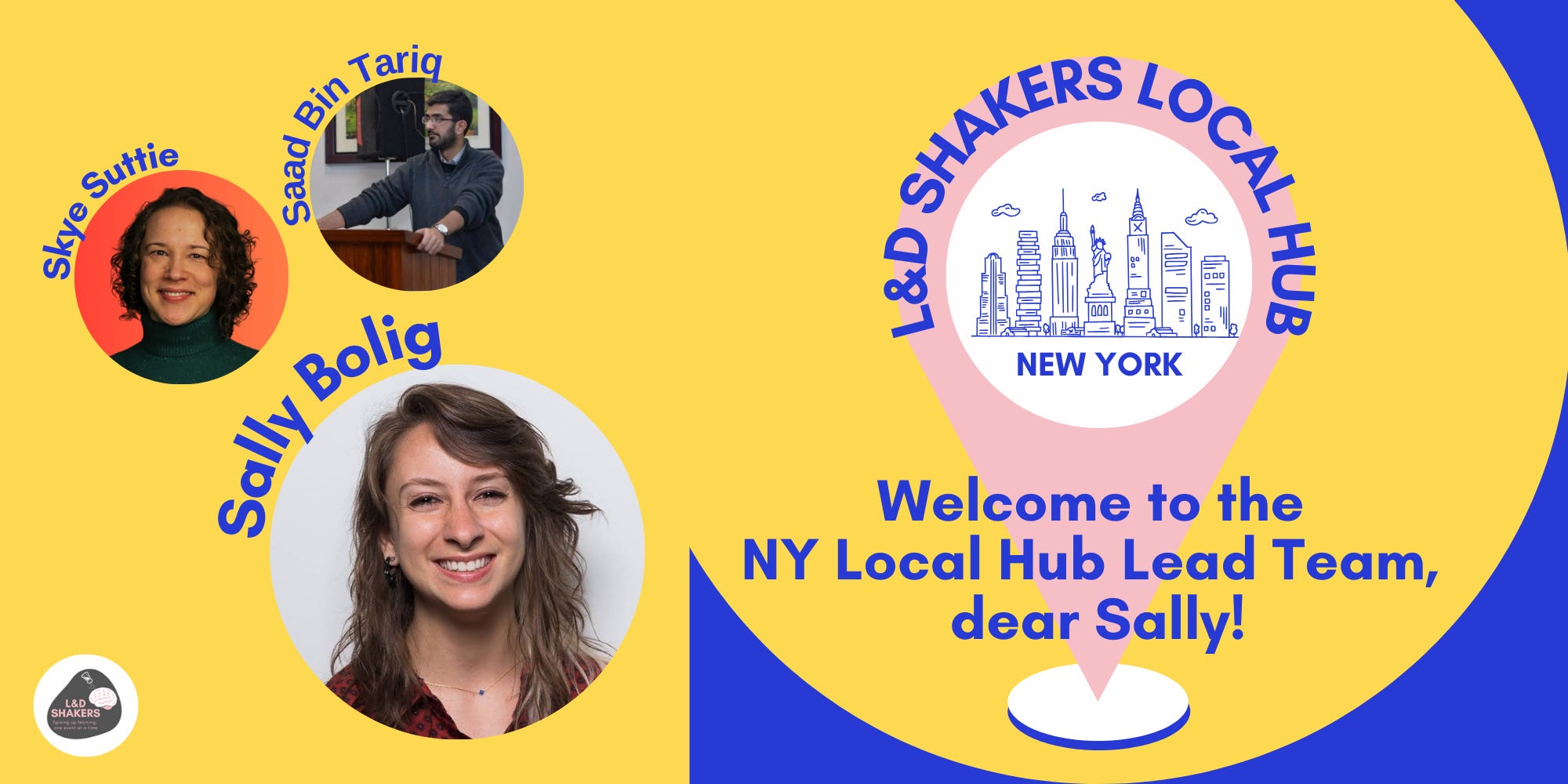
Our New York team is welcoming Sally Bolig to the Local Hub Lead Team, as she’s joining forces with the amazing Saad Tariq and Skye Suttie. She was most recently the Director of Talent Learning, Enablement, and Acquisition at HopSkipDrive, and brings years of experience in the L&D industry.
After pouring heart and soul into this community, Rebecca Millsop is taking a step back to focus on a new, exciting career opportunity! Thank you for everything, you will be missed! Sally, welcome to the Core Team!
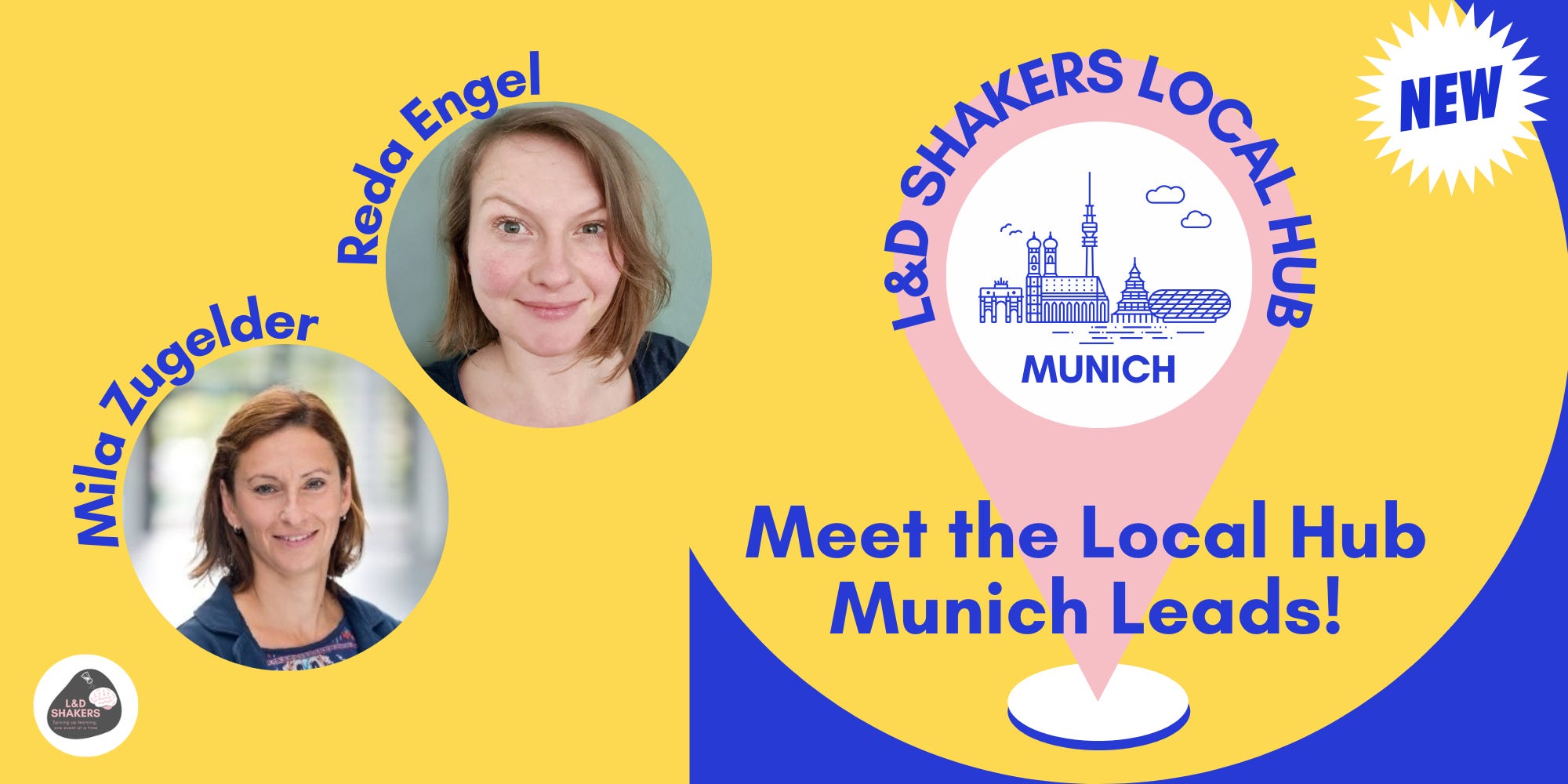
We’re reopening our Local Hub thanks to these two fantastic ladies!
Reda Engel is a Learning Experience Designer at Seitwerk GmbH, focusing on impactful e-learning design.
Mila Zugelder is a People Development Manager at yoummday, and has a backpack full of various L&D tools.
If you live in Munich, find them here #2-local-hub-munich in Slac to stay up to date with upcoming meetups.
Mila & Reda, have lots of fun in the new role! We can’t wait to see the Munich community come together with your support. Welcome to the Core Team!

〜Before I say goodbye, I wanted to make sure you know that with L&D Shakers, you can work with a coach or with a mentor, for free. Go tell a friend!
Anamaria
No posts
Comments
Nothing yet. Say the first thing.
Sign in to join the conversation.