
Hiiii, great to see you here!
Here’s what you can find in today’s Learning Brief:
An essay by Houra Amin on the behaviours leaders can do to actually change behaviour 😅
A bunch of AMAZING events and meetups all over the world!
A series of resources to spark fresh thinking, from toolkits to canvases and interesting research on AI.
News from the community, and the launch of our Coaching for L&D 9th (!) edition!
Enjoy!
Anamaria


When someone holds authority, their behaviour doesn’t just land, it echoes.
Words, tone, timing, and even silence are interpreted differently once power is involved. This insight is grounded in the research of social psychologist Adam Galinsky, who works on power and leadership.
This has important implications for anyone responsible for learning, enablement, or performance, whether in L&D, or broader business leadership. Behaviour change doesn’t happen primarily through training or messaging. It happens through the conditions people operate every day: the clarity they receive, the signals leaders send under pressure, and the degree of confidence or caution those signals create.
In my work with teams and senior leaders, I see this pattern constantly. People are busy. They’re delivering. They’re doing what they believe is expected of them.
But underneath, there’s often quiet uncertainty:
● Am I adding value?
● Is this the right priority?
● Am I on the right track?
This happens when expectations, direction, and feedback remain implicit rather than explicit. When signals are unclear, people may not disengage immediately. But they play it safe.
They second-guess themselves, avoid risk and may stop raising issues early. That’s not a motivation or skills problem. It’s a condition problem. People are responding rationally to the environment they’re operating in, one where the cost of getting it wrong feels higher than the reward for taking initiative.
And no amount of training will increase initiative if the surrounding signals quietly discourage it.
Galinsky’s research across thousands of accounts found three patterns that differentiate inspiring leaders from frustrating ones. These are simple patterns that show up in everyday behaviours:
Visionary:
Inspiring leaders make direction concrete and help people see the bigger picture. They don’t assume alignment, they reinforce it consistently and repeatedly. People know what matters this week, not just what mattered at the town hall three months ago.
Exemplar:
They stay steady when things get messy. That doesn’t mean being upbeat at all costs and having toxic positivity, it’s more about how they respond to pressure. Teams take their cues from tone, pace, and what leaders choose to amplify or ignore.
Mentor:
They create ownership rather than control. They offer boundaries and choice, not micromanagement. They empower and elevate and also empathise with their teams.
None of these behaviours are extraordinary and they don’t require charisma, seniority, or formal authority.
They show up in:
● how requests are framed
● how feedback is given (or delayed)
● how decisions are explained
● how uncertainty is acknowledged
In L&D, this often shows up as whether leaders actively reinforce priorities after a programme, or quietly move on, signalling that the learning was not important. For example, how leaders respond to risk will shape whether teams are encouraged to surface concerns early or learn to manage exposure silently.
These behaviours are easy to underestimate precisely because they feel small. But over time, they shape whether people feel confident enough to act, or careful enough to hold back.
That’s why leadership impact is less about defining the right behaviours on paper, and more about how consistently those behaviours are modelled in the moments that matter most.
If leaders unintentionally send confusing, risk-laden, or contradictory signals every day, training becomes compensatory rather than enabling.
You can design excellent learning experiences to build skills or raise awareness, but behaviour is ultimately shaped by the environment in which people apply those skills.
When the system rewards caution or speed, even implicitly, people adapt accordingly. They don’t ignore the training, they override it in favour of what feels safest in context. This is why we so often see strong learning programmes struggle to translate into sustained behaviour change.
For example, behaviour change won’t happen when teams are trained on brand risk, governance, or customer-centric decision-making, but leadership reactions only reward speed, output instead.
For L&D leaders, this reframes the work.
The question is no longer: “Did the training land?”
But: “What behaviours does the system make easiest to perform?”
Until those two align, learning will continue to look good on paper, and underdeliver in practice.
Here are a few practical ways L&D teams can apply this thinking.
When scoping programmes, don’t focus only on the people expected to apply new skills or behaviours. Design for the environment they’ll be applying them in, especially the signals coming from leaders.
Before focusing on content, pressure-test three things:
Leadership signals:
What messages do leaders currently send, intentionally or not, about what’s valued, risky, or worth time and attention?Signal gaps:
Where might silence, ambiguity, or inconsistency from leaders quietly undermine the behaviours the programme is trying to build?Reinforcement mechanisms:
What simple prompts, artefacts, or talking points could help leaders reinforce the desired behaviours in day-to-day work, rather than unintentionally blocking them?
This might mean equipping leaders with:
● framing language they can reuse
● decision principles to reference under pressure
● or a small number of explicit behaviours to model during and after the programme ends
The aim is to ensure the system around the learner makes the new behaviour easier to sustain.
Rather than isolating leadership behaviour in standalone programmes, use every learning or enablement moment as an opportunity to surface the micro-behaviours that shape trust day to day.
Invite leaders to reflect on things like:
● how they frame requests
● how much context they provide (or withhold)
● how they close loops
● how they respond when things feel pressured or uncertain
These moments determine whether people feel clear or cautious, confident or exposed, and whether they’re willing to take initiative or stick rigidly to what feels safe.
One practical tool Galinsky suggests is a simple, repeatable reflection cycle he calls REIP. Not as a workshop exercise, but as a regular leadership habit you can do once a month:
Reflect
When did or did not I inspire? What were the circumstances and context that led me to behave that way?Emulate
Whose behaviour lifted me up, and what can I copy?Intention
Take the reflection and emulation and turn them into a simple intention.Practice
Repeat it often enough that it becomes automatic.
Sustainable behaviour change often comes less from adding content, and more from creating structures for reflection and practice.
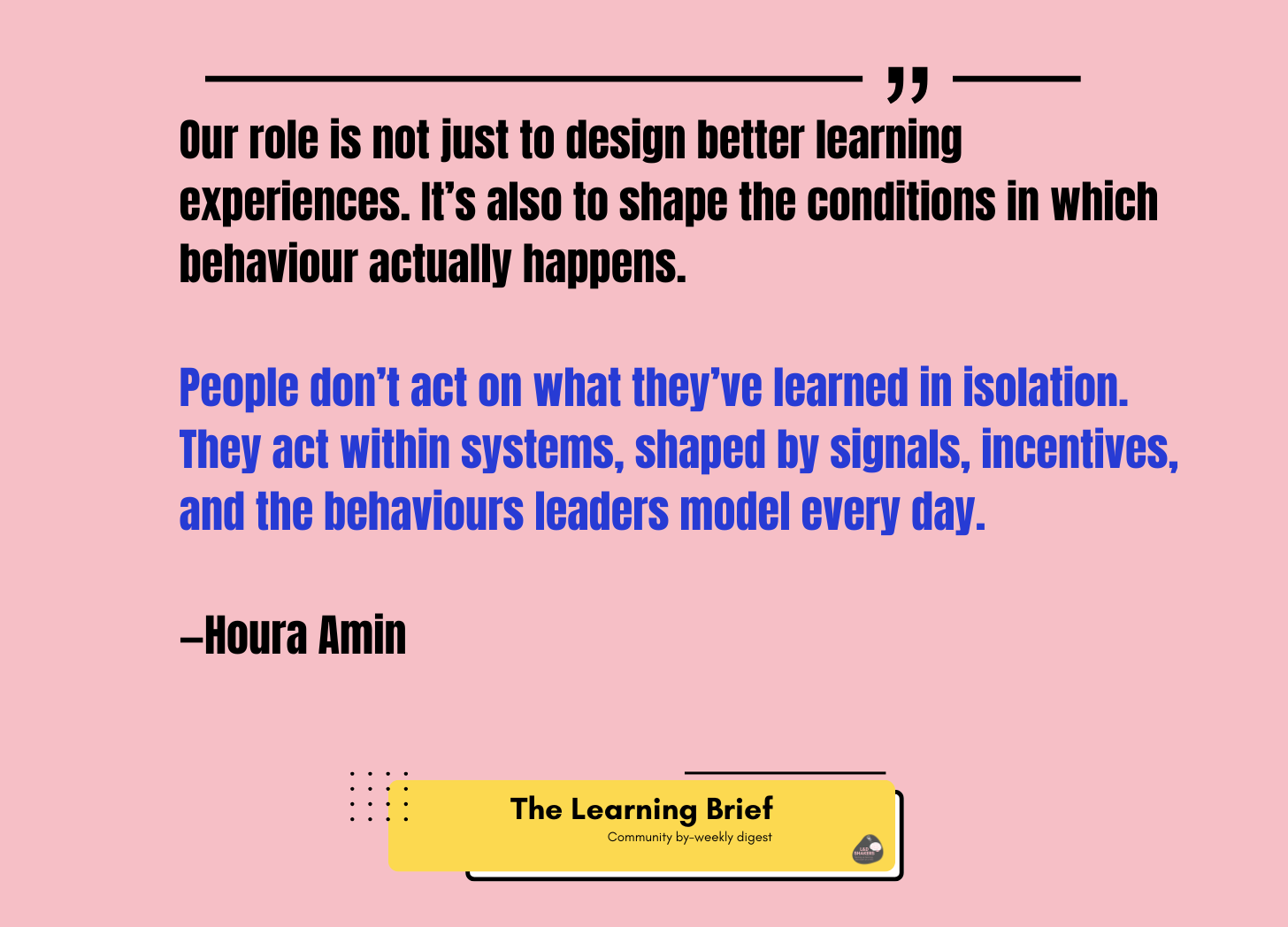
Our role is not just to design better learning experiences. It’s also to shape the conditions in which behaviour actually happens. People don’t act on what they’ve learned in isolation. They act within systems, shaped by signals, incentives, and the behaviours leaders model every day.
So a useful question to leave you with is this:
Where in your organisation might silence, ambiguity, or unspoken expectations be shaping behaviour more powerfully than any formal learning intervention?
That can be where the real work of impact begins.
Here’s a short YouTube video exploring the same insight through story and example.
Houra Amin helps organisations design learning strategies that lead to measurable behaviour change; not just completions, content, or good intentions.
At Blue Jay Learning, she combines behavioural science and systems thinking to solve real performance problems, including reducing compliance and reputational risk, improving onboarding and time-to-competence, and enabling capability building that actually shows up in day-to-day work.


Our calendar is full of FANTASTIC learning sessions online and offline, in cities like Birmingham, Prague, Berlin, Baku, Zurich, Barcelona, Sydney, Amsterdam, and Washington DC. 🌏
Here are a few highlights we believe you’ll love!
🌟 ID Power Hour: Ghosted — Creating high-impact learning when the expert disappears
A thought experiment for learning designers who ever had to move forward with a project where the expert was MIA. This won’t be a sit-back-and-listen session; we’ll think together, talk together, and pressure-test ideas in real time.
🌟 The L&D Measurement Clinic #7
A safe, fun space to help you build your evaluation and measurement strategy. You bring a real-life example of a learning initiative you plan to evaluate. Each person gets 10 minutes! Get peer feedback followed by expert guidance from Saad Qureshi.
🌟 Storytelling for Trainers & Facilitators: Crafting captivating stories for your workshops
In this interactive masterclass, you’ll actively explore core elements that make stories memorable and leave with practical insights you can immediately apply in your workshops, training, or talks.


[ ⬇️ Download ] The Nudge Canvas Facilitators Guide
This guide shows you how to use the Canvas yourself or facilitate a group session around the Canvas. The tool promotes a flow through the nudge design process.
[ 🧰 Use ] Working better together toolkit
The Hargraves approach to collaboration focuses on the everyday conditions that enable people to do their best work together: confidence, trust, a clear purpose, and strong relationships. Find assessment, workshop templates, and guides inside.
[ 👀 Read ] How your learners actually learn with AI
Dr Philippa Hardman digs into data from tens of millions of real AI learning sessions to show that learners aren’t just using AI to get the “answer.” Instead, they regularly use it to scaffold understanding, work through problems, and personalise explanations. The takeaway: stop designing learning around AI and start designing learning with it. Embedding AI into tasks, focusing assessment on thinking, and supporting learners where AI is least effective.
[ 🎧 Listen ] Eight Levers for the Future: Lori Niles-Hoffman on Reimagining EdTech Transformation
This was such a great read! Lori shared candid insights on how AI is reshaping L&D, not by changing the rules, but by exposing where we’ve been weak all along. She also shares why the “backend just got sexy,” and how the next competitive edge won’t come from beautiful interfaces, but from the quality of data and insights driving them.
[ 🧭 Explore ] WhatIFpedia (a future world-building tool)
WhatIFpedia from the Institute for the Future uses generative AI to let you explore plausible futures for 2035 in a Wikipedia-like format. You type in a topic you care about, and the platform generates interconnected, foresight-informed scenarios that help you expand your thinking about long-term possibilities and implications.


Again, marvelous coaches from our community offer pay-it-forward coaching sessions🥰 These create a supportive space to connect, reflect, and explore professional challenges together.
How does it work?
➡️ Head over to the Notion page
👀 Check out the Coache’s profile and choose the one that aligns with you
🗓️ Book the session directly with your coach through their booking link
📋 Fill out the intake form
👥 Have your session
💛 Pay it forward by donating to Save the Children
♻️ Repeat as many times as you like until the 30th of April 2026!
A massive THANK YOU to all our Coaches and the project team for making this possible! 🌟

We are soooo excited to announce that the Sydney Local Hub is welcoming a new lead: Georgina Anstice! It’s inspiring to see her step in to carry on the excellent work done by Eikris, Polina, and Maryanne over the past years. Let’s give her a big cheer!😍
If you are in Sydney, you can give her a hug IRL at the next meetup!
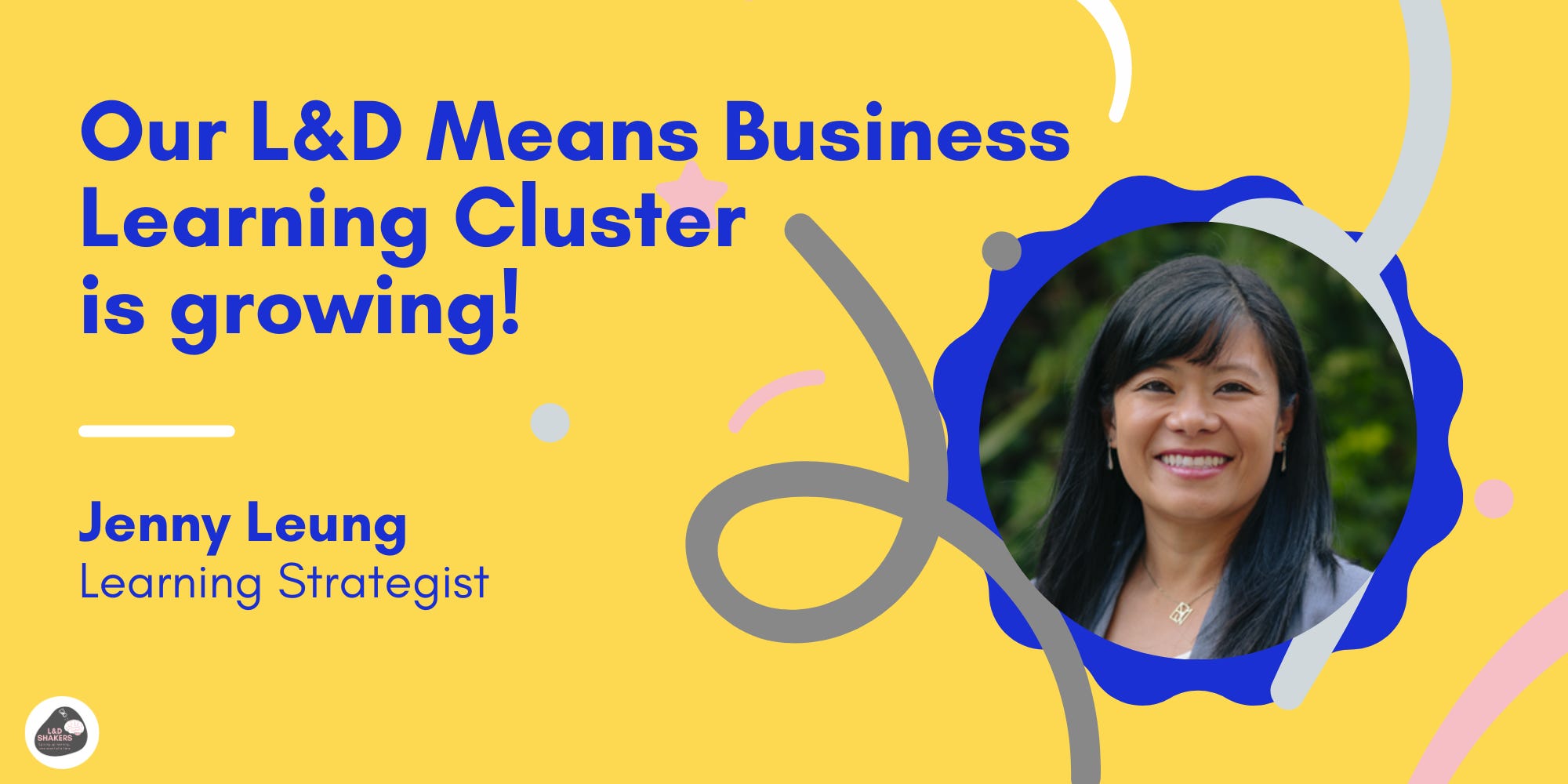
Whohooo! 🤸♀️ The amazing Jenny Leung is joining the fantastic duo Saad Qureshi and Supriya Harikumar to co-lead the L&D Means Business Learning Cluster. 😍
What is L&D Means Business? Our space to explore how we can be more strategic, anchored in business success, and speak our stakeholders’ language.
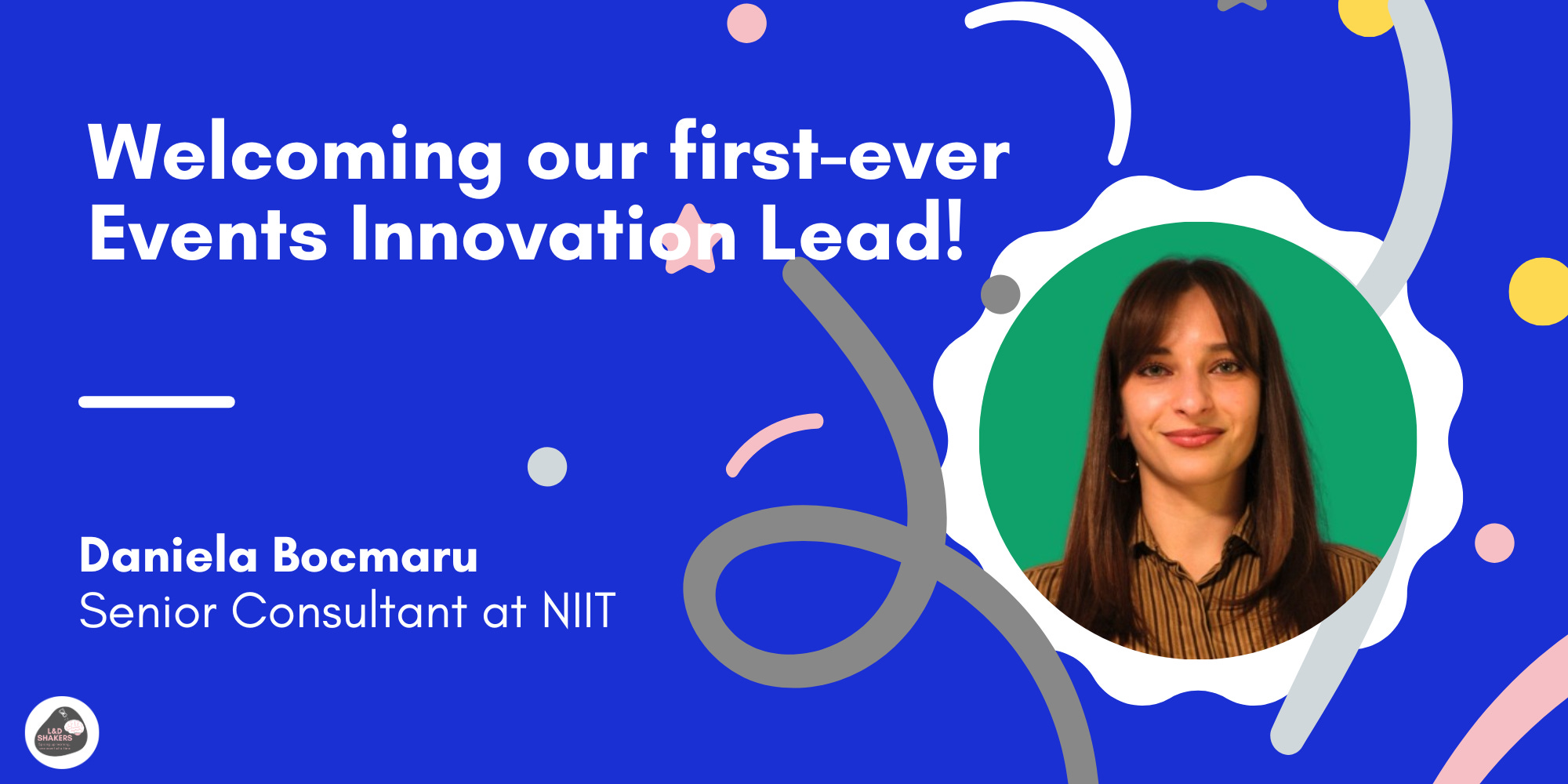
Every now and then, we invent new roles around the community to spice things up! This is one of them, and we are delighted to welcome Daniela Bocmaru to the Core Team as our first-ever Events Innovation Lead! 🔥
What is this role about?
Well, it’s all a big experiment, really, but the idea is for Daniela to work with the Corr Team and rally the community around fresh, new, creative, and experimental event formats. If you have a crazy idea, reach out to her. 😅

〜That’s all for now, dear ones. Have a great rest of the week!
Anamaria
No posts
Comments
Nothing yet. Say the first thing.
Sign in to join the conversation.