
That the Constitutional Convention was held under less than propitious circumstances is an understatement. Not only were delegates forced to sit cheek by jowl day after day in an unventilated hall with windows closed and barred to prevent eavesdropping, but they did so during a broiling summer in Philadelphia, where the temperature outside sometimes soared into the nineties. While delegates from the South were dressed in light linen or cotton clothing, many of the northerners wore only wool, which, when saturated with perspiration, added an additional sensory challenge to the proceedings.
In addition, many of the attendees did not like one another and the often heated debates did little to mitigate the anger and mistrust some felt toward their fellows. Reading the notes or correspondence of some of the delegates reveals sufficient antipathy to make it a wonder no blows were struck. And they were there under false pretenses. Only a handful of the delegates—Madison, Hamilton, John Dickinson, most prominently—knew that the convention had been called to scrap the moribund Articles of Confederation rather than simply rewrite them.
That fifty-five delegates from twelve states participated and most stuck it out from May until September 1787 is testament to the magnitude of the crisis that brought them there and the recognition that the country would fail without serious reforms.
The issue was what shape those reforms would take. Most delegates were primarily interested in protecting a variety of parochial interests, be they economic, political or social. Southerners wanted to ensure that slavery would not be abolished, although slave-hungry South Carolina and oversupplied Virginia differed on extending the slave trade. Northern commercial interests were insistent that commerce continue to flow freely and that their maritime interests remained unregulated. States with titles to western lands were at loggerheads with those without and states with smaller populations were determined not to be dominated by their more populous neighbors.
But within the sometimes acrimonious horsetrading, there were some extremely important principles on which there was near unanimity of opinion. Although their reasons might have differed, virtually every delegate present wanted to create a government that would preclude centralized power.
That theme was written into the Constitution in many ways, the most obvious being the creation of a Senate, in which every state, regardless of population, would be represented equally. Today, that means that Wyoming, with under one million inhabitants, has the same power in the Senate as California, more than forty times larger.
Other than the legislature, the greatest focus was on the executive. A major stumbling block was lack of a workable prototype for a head of state. A monarchy was out of the question, of course, but how to replace it was a conundrum. Would the executive be one man or three? How long should he serve? Should he be eligible for re-election? How should he be elected? What powers should he exercise? What should be the limitations on those powers? Should he be called “Your Excellency?” All of these were brought to the floor, discussed, voted on, then scrapped, only to have the process begin again. More than sixty separate votes were ultimately required to complete Article II of the Constitution.
But the common thread running through all the debates on the executive was how to avoid making the office too powerful, too dictatorial, too prone to prompting a descent into despotism. In the end, most delegates thought they had created an office that was largely “ministerial,” one in which the president would carry out the will of the legislature rather than wield power in his own right.
A national judiciary faced a different set of obstacles. Although the need for some form of national court was apparent, most Americans opposed a national court system. Each state already had a functioning legal apparatus whose power and responsibility would necessarily be diminished as those of a national judiciary were enhanced. The delegates, therefore, were reluctant to grant any national court too broad a mandate. Ceding local or state control over the judiciary to a national court that might not contain a single member from one’s own state promised to be massively unpopular, akin to asking Americans to sit in judgment before foreigners.
The delegates solved the problem by not solving it at all. They deferred to Congress. Article III contains only six short, often vague paragraphs, which do not include how many justices will sit on the Supreme Court or even whether there will a national court system beyond it. Also lacking are minimal qualifications to serve as a federal judge, including whether “good behaviour” means “for life,” or another alternative, such as “as long as the justices are not corrupt or mix in politics.” But here as well, the main goal was to prevent this branch of government from amassing sufficient power to dictate to the other two.
It is quite an irony, then, that the current Supreme Court, dominated by justices who call themselves “originalists,” has trampled on perhaps the most originalist concept of all—diffusion of power. The Court has long since seized unauthorized power of its own—ever since John Marshall hijacked Constitutional interpretation in Marbury v. Madison—but it has now taken to empowering the executive to a greater and more frightening degree than ever before in American history. Any proposal even approximating the Court’s tilt toward the presidency would have been unlikely to find a single state in support at the Convention.
And what a president the Roberts Court has chosen to do it for.
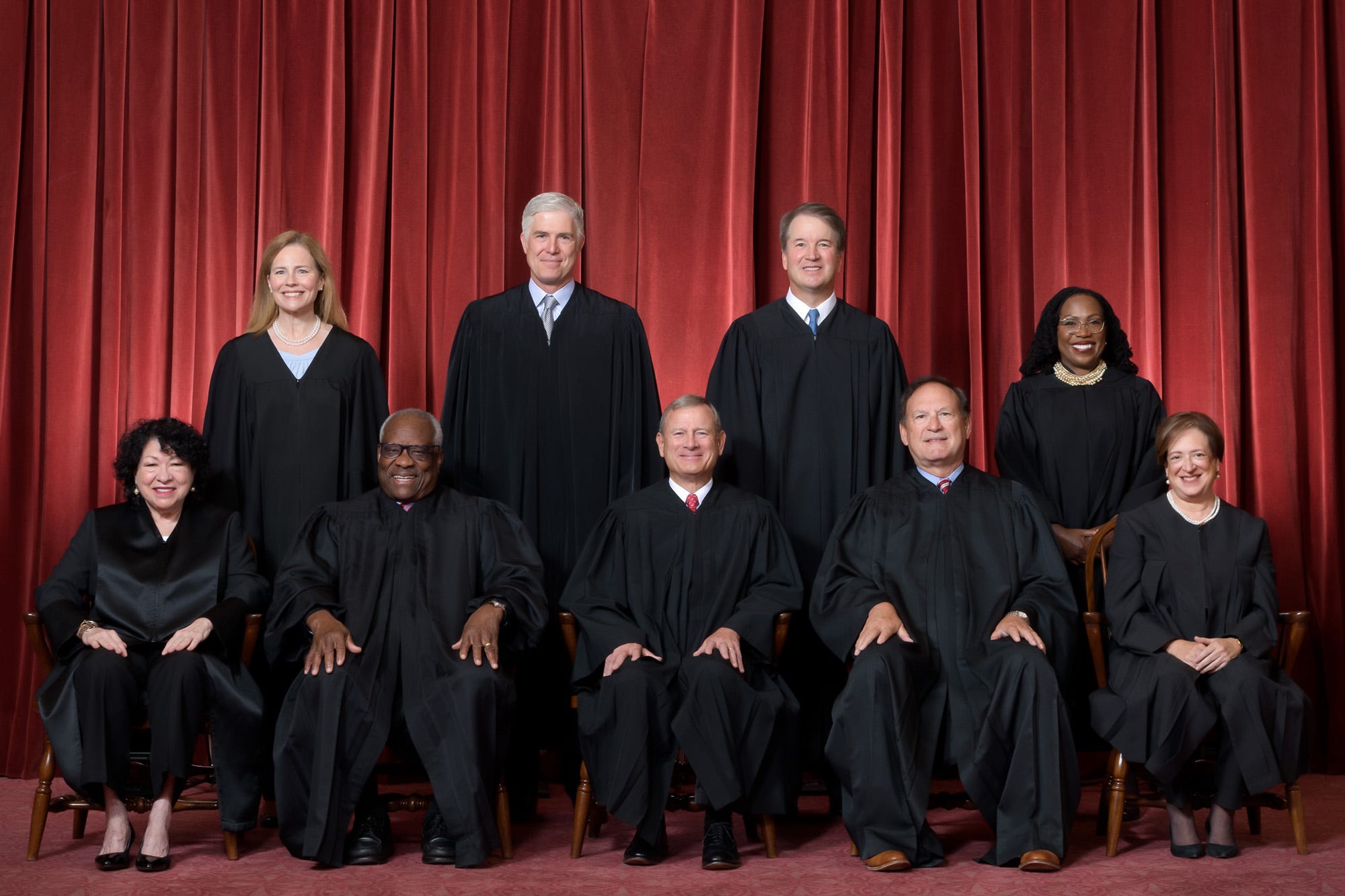
But maybe that is just the point. Maybe Donald Trump, perverse, craven, and dishonest though he may be, represents to the conservative justices the image of the nation they aspire to and they are all too willing to contort the Constitution to adhere to that image, despite knowing that the Constitution was…originally…drafted for just the opposite purpose. And further, maybe by enabling legislation that they believe will suppress the votes of their opponents, they sense that the distortions they favor will somehow be permanent.
Given the constant disingenuousness of the likes of Samuel Alito, this notion cannot be casually dismissed.
But what if conservatives lose power, lose control of both Congress and the presidency? What then? What happens if a Democratic president fires every conservative in every regulatory agency, prosecutes every right-wing terrorist, issues a raft of power-grabbing executive orders, indicts every member of the Trump family and his corrupt cronies for every dirty deal they’ve done at the taxpayers’ expense, tears down the ballroom, and wields power like a bludgeon, just as the Court has now encouraged?
If that happens, Roberts and his cohorts may find it more difficult than they now assume to overturn their own precedents and take the same power away from their enemies that they have now given to their friends.
No posts
Comments
Nothing yet. Say the first thing.
Sign in to join the conversation.