
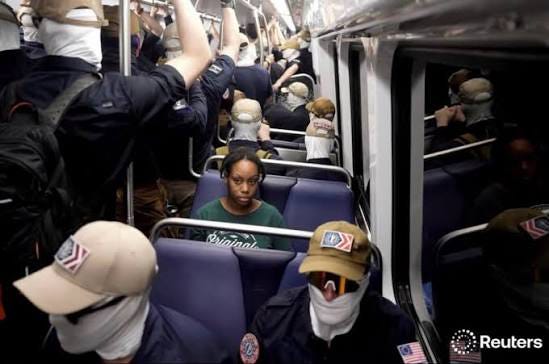
For at least a century, “white Christian nationalism” had been forced to lurk in the dark corners of American politics, but now, with the enthusiastic encouragement of Donald Trump, it has been thrust fully into the light. Many of Trump’s followers on the far-right have become more than willing to openly voice support for a doctrine that had long been dismissed as bigoted fringe ideology, outside the realm of legitimate political discourse.
The United States, these archconservatives insist, was not founded to be a racially and religiously diverse nation, but rather one in which racial purity and what they define as Christian values would form the core of both government and civil society. Some go so far as to insist that the United States was never meant to be a democracy at all, ruled by a majority of its adult citizens, but rather a republic in which representative government was chosen by a limited segment of the citizenry whose principal task was to perpetuate those values.
Such sentiments leave liberals and many centrists aghast, insisting, as Joe Biden often wistfully asserted, “This is not who we are.”
But it is who we were.
For many at the Constitutional Convention, held shortly after Shays’s Rebellion, a populist insurrection in western Massachusetts, the aim was to limit democracy, not expand it. Connecticut’s Roger Sherman, a key player in Philadelphia, insisted ordinary citizens could not be trusted to encourage sound government and that the nation already suffered from “an excess of democracy.” Another prominent delegate, Virginia’s Edmund Randolph, exhorted the convention to save the United States from democracy, believing, correctly, that such a sentiment would strike a sympathetic chord. Electoral districts were kept large in order to inhibit campaigning by all except those wealthy enough to travel within their expanded limits.
Rule was to be by the few, not the many. Virtually every member of the nation’s elite believed that the right to vote should only be available to those who owned real property. James Madison, Alexander Hamilton, and John Adams are all on record as opposing granting the vote to ordinary citizens, who, they claimed, were incapable of making vital decisions freely and wisely. As a result, only six percent of the nation was eligible to vote in the first presidential election, and only 42,000 did, this in a nation of more than 3 million free people and an additional 700,000 slaves, who were not considered fully human and deemed by most to be property.
The nation was to remain white. Although there was no definition of “citizen” in the Constitution, in the Naturalization Act of 1790, only white males of good character could apply for citizenship. These restricitions were first aimed principally at Blacks, but the doctrine was later expanded to include Chinese, Japanese, and East Asians. Even certain whites were not good enough. In the first decades of the twentieth century, immigration by southern and eastern Europeans was severely curtailed.
While many of the Founders, including Washington, Madison, Jefferson, and Hamilton, could hardly be described as devout, there was certainly a tacit understanding that the United States would be a Christian nation, although by Christian they meant Protestant. There was widespread distaste for Catholics, and in a number of states they were restricted from partaking in many civic activities, including, for example, teaching school.
So indeed, the United States was hardly founded on the principles most Americans claim to value and respect.
But that is only half the story.
Whether or not the United States was created on the prejudices of the day, be they racial, religious, or class oriented, the glory of this nation, what has made it the envy of the world, is its struggle over the ensuing two and a half centuries to expand the very rights that the Founders sought to limit. One by one, previously banned groups were allowed into the political process, first in choosing the nation’s leaders and then by becoming them. Property holding requirements to vote were eliminated in the first decades of the nineteenth century. Black Americans were guaranteed citizenship and the right to vote by the Fourteenth and Fifteenth Amendments and were allowed to become naturalized citizens in 1870. Women were granted the vote by the 19th Amendment in 1920.
Equal rights struggled ahead as well and Chinese, Japanese, East Asians, Southern Europeans, and Native Americans were all eventually guaranteed what was termed in the Fourteenth Amendment the “privileges and immunities of citizenship.” Catholics and Jews, once despised religious minorities, were permitted to aspire to any position in government they so desired and have become among the most prominent of the nation’s leaders. That the current Supreme Court, where white Christian nationalists have found a shocking degree of support, is dominated by the very brand of conservative Catholic that was once the focal point of religious prejudice is the ultimate irony.
This is not to say, of course, that America was ever successful in achieving full equality for previously marginalized groups, or that the progress the nation made was ever sufficient to eliminate bigotry, job and housing discrimination, and fair treatment under the law. Enormous problems always remained and certain marginalized groups were forced to fight constantly in both the legislatures and the courts to be treated with only a modicum of fairness. Even at the highwater mark of equal rights, they were often prevented from succeeding.
But torturous and tortuous as progress may have been, the nation was moving in the right direction.
Until now.
What Trump’s white Christian nationalists and other far-right MAGA allies are trying so hard to achieve is a legal and philosophical u-turn, to revert to the very outmoded values the Founders foisted on the nation at the end of the eighteenth century. Voting is to be limited, citizenship restricted, religious dogma substituted for tolerance, the legal system structured to keep minority groups from threatening white pre-eminence, and warmed over theocracy substituted for democratic rule. And all this under the banner of Making America Great Again.
What has actually made America Great was the willingness by those in power to share it, however grudgingly, and create a semblance of equal opportunity even though some in the traditional ruling groups would lose privileges they often had not earned. People from virtually every country in the world wanted to come to the nation that Americans had struggled for decades and decades to create, imperfect though it may have remained. They did not come because its leaders disparaged the poor, incarcerated racial or political minorities, or mocked the handicapped and those whose sexual orientation did not fit into faux religious boxes. If that was what they wanted, they had any number of other choices—Iran or Russia come to mind.
If America wants to be genuinely Great, it will need to recommit to moving forward, not backward. Only in rejecting Donald Trump, the far-right, and hateful values that are little more than undisguised bigotry will Americans be able to look back on this demoralizing turn in our politics and say legimately “This is not who we are.”
Also in honor of the 250th, here is a podcast on the Constitution that Nancy recommends highly. History Nerds United
No posts
Comments
Nothing yet. Say the first thing.
Sign in to join the conversation.