
The Graham Platner circus seems finally to have ended, but in addition to the immediate fallout, the episode has raised questions of both strategy and leadership in the Democratic Party. This is a particularly critical moment for uncertainty to arise, since, defying the impossibly long odds that existed after the 2024 elections, Democrats had pulled themselves up to be close to an even money bet to win back Congress.
Platner, of course, had been dogged by controversy since he entered the race, being attacked for everything from Nazi tattoos to neanderthal behavior with women. Until very recently, he had been remarkably deft in not only deflecting accusations but, reminiscent of Donald Trump, turning the actions that precipitated those attacks to his advantage.
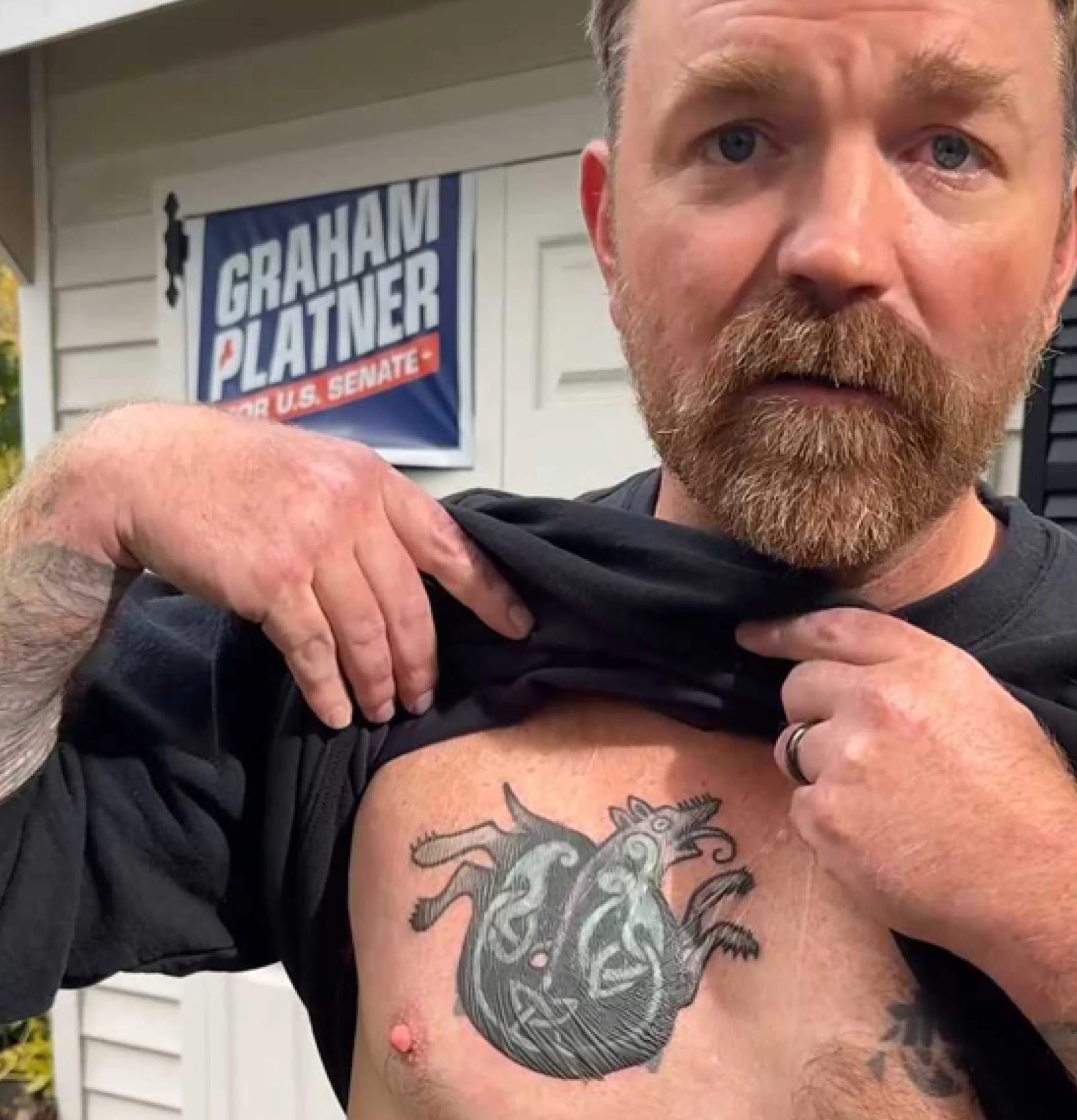
His campaign videos, many consisting of conversations with Republicans, were low-key and empathetic, with Platner utterly persuasive in both communicating that ordinary people were the victims of a corrupt and overbearing power structure and that he himself was a prime example of their determination to silence voices of true dissent. He gained enthusiastic endorsements from progressives across the nation, and, swallowing their misgivings, many mainstream Democrats eventually jumped on board as well. As a result, in the primary, Platner literally crushed the mainstream choice, Governor Janet Mills, outpolling her by a whopping 52 points.
Unlike Trump, however, for whom there is no reprehensible behavior that the devout Christians in the Republican Party will not shrug away, Democrats belatedly decided that an accusation of actual rape was a redline. Within a week, Platner was out, although he withdrew with a video in which his denials of wrongdoing and avowals of his own victimization were sufficiently heartfelt to explain how he had come so far so fast.
The impact of Platner’s withdrawal on the November Senate race is uncertain. He was marginally ahead in every general election poll, but whether that lead would have translated into victory over Susan Collins depended on how well Republicans could exploit both Platner’s far-left politics and his questionable behavior. With a less controversial opponent, Collins’s ties to a misanthropic, kleptocratic president and her appalling defense of her vote for Brett Kavanaugh can be brought into much sharper focus.
The larger issue is the process by which Democrats go about choosing who they want to stand for election against the party of Donald Trump. Platner, as has now been widely reported, was initially recruited by a trio of young progressive activists riding a wave of anti-establishment anger. One, Morris Katz, 27, was Zohran Mamdani’s media guru, and the others were Yale Law School graduate Daniel Moraff and his fiancée Leanne Fan, who met while working in the 2020 Bernie Sanders campaign.
To say that these three did not take the time to determine whether Platner could survive what promised to be a quite rugged campaign is an understatement. Katz told Politico, “Within, like, five minutes [of meeting Platner] I was thinking, ‘Holy shit, this guy can help save the Democratic Party.’” Perhaps he should have taken a little longer.
Say what you will about Chuck Schumer but, with one exception, everyone he recruited to run for the Senate in potential swing states—Sherrod Brown, Mary Peltola, Josh Turek, and James Talerico—is proving to be a solid, scandal-free candidate. Both Cook and Larry Sabato have moved the ratings to the left since they entered the races. The exception is Mills, who was polling ahead of Collins before she was sent packing by Platner.
Thus, at the very least, the young progressives, with a Mamdani gale blowing in their sails, had come to think so much of themselves that they decided a thorough vetting of their anointed savior unnecessary, an unconscionable failure of basic professionalism, especially in an era where the tiniest flaw can draw a few million hits on social media. Party regulars share some of the blame for not following up until allegations began to cascade, although by then it likely would have been too late anyway.
The other area of concern is geographic. As I wrote a few posts ago, “The Democrats biggest problem, one that bedevils them time and again—is recognizing that different constituencies demand different sorts of candidates. Where New York City might be the perfect venue for a young, charismatic, bearded, Muslim, Democratic Socialist, even the approximation of such a candidate would be swamped in Ohio, Alaska, or Texas. For the party to win, progressives must embrace centrists, centrists must embrace progressives, and each must understand that, as Barney Frank observed shortly before he died—what a loss—neither side can have everything it wants and both must subordinate their fondest wishes to attain what is doable.”
It is questionable whether the party is doing that. Progressives seemed to have decided that every electoral district in the nation is ripe for their message. This may be fatally shortsighted. In 1972, a senior operative in George McGovern’s campaign to be the Democratic presidential nominee said, “If we can nominate him, we can elect him.” But primaries are not general elections. McGovern got the nomination and won one state. During Watergate that led to bumper stickers that read, “Don’t blame me. I’m from Massachusetts.”
This is not to say that a progressive was the wrong choice for Maine. Platner’s success would indicate that he might have simply been the wrong progressive. But in other races, centrists can win where progressives likely would not. Josh Turek has a much better chance than Zach Wahls in Iowa and Talerico is more likely to win in Texas than was Jasmine Crockett.
Where progressives are correct is in their appreciation of the deep dissatisfaction felt by Americans across the political spectrum with the ruling classes and their enabling of the privileged and hyper-privileged. In 2025, two centrists, Mikie Sherrill and Abigail Spanberger, won gubernatorial races with a message that was essentially populist. Bernie and AOC have spoken to enthusiastic crowds in a number of red states.
But progressives frighten many working-class voters who, ironically, would find much of their program quite to their liking. Republicans will surely make cries of “Socialism!” or even, as Trump has field tested, “Communism!” a cornerstone of their electoral strategy.
Even with blatantly partisan redistricting and the Platner implosion, a Democratic House and Senate remain well within reach. But that can only happen if Democrats recognize that they cannot behave like amateurs and that both progressives and centrists admit that each needs the other to ward off an opponent with few scruples and even less of a commitment to the truth.
No posts
Comments
Nothing yet. Say the first thing.
Sign in to join the conversation.