
Before I write more about the topic I’m focused on in this little series - Mesopotamian demons - I want to review a certain point from the previous article about the Temple of Solomon. Recall the following:
In the Middle Bronze Age (2000-1550 BC), there was the second wave of settlement, again, the north was dense and agricultural and the south was sparse – with tiny settlements – and a lot of evidence of wandering pastoralists. But, by now, the central site of cult and economy was Jerusalem – a heavily fortified city that gives evidence of being part of the Hyksos Empire. This matches Manetho’s account of the Hyksos leaving Egypt and building a city and temple in Jerusalem. The only problem is: it’s the wrong date to have been built after the Hyksos left Egypt, so most archaeologists just assume that there was a Hyksos presence in Canaan that was contemporary to the Hyksos in Egypt. […] Apparently, Shechem possessed significant fortifications and a massive temple.
The Execration Texts mention a large number of coastal and lowland cities of Canaan, but only two highland centers: Shechem and Jerusalem. Keeping in mind the probable link between the Hyksos in Egypt and the Canaanites in Palestine, we can conjecture why the Egyptians were feeling so hostile toward Shechem and Jerusalem. The important thing is that the Execration Texts, which purportedly date back to at least 1630 BC, mention Jerusalem, Shechem, and Hazor, but none of them ever mention an entity called Israel.
[…] the city-state system of Canaan suffered a series of catastrophically destructive upheavals at the end of the Late Bronze Age (1550 BC). The archaeologists are uncertain as to the cause of this cataclysm, suggesting it to be the invasion of the Sea Peoples or other such propositions.
[…] the coastal city-states recovered from the cataclysms, had been rebuilt and were thriving, when suddenly they were destroyed a second time in a rather short period, this time – supposedly – by military onslaught and fire. Whatever it was, the destruction was so complete that the Canaanite cities of the plain and the coast never recovered. The source of this destruction is thought to have been the military campaign of Shishak (Sheshonq), founder of the twenty-second Dynasty. (945–924 BC approximately) This invasion is mentioned in the Bible where it says that “In the fifth year of Rehoboam, Shishak king of Egypt came up against Jerusalem; he took away the treasures of the house of the Lord and the treasures of the king’s house; he took away everything. He also took away the shields of gold that Solomon had made.”
Shishak/Sheshonq commissioned a triumphal inscription to commemorate the event on the temple walls at Karnak. This inscription lists about one hundred fifty towns and villages he wiped out in his march to the sea, so to speak. The targets of the Egyptians seem to have been the great Canaanite cities of Rehov, Beth-shean, Taanach, and Megiddo. A fragment of a victory stele bearing the name of Shishak was found at Megiddo. Thick layers of ash and the evidence of the collapse of buildings bear mute testimony to the presumed rage of Pharaoh, which led to the sudden death of the Canaanite territory in the late tenth century BC. There is very little evidence of this assault in the hill country, the main campaign being directed at the cities of the Jezreel valley. If there was a Temple that was plundered by Shishak, it wasn’t in Jerusalem.
The point I want to make is that it appears that there may have been a temple in Jerusalem during Hyksos times, and everything is so muddled that we don’t really know what happened to it. What we do know is that there is no direct archaeological proof of “Solomon’s Temple” or, for that matter, any other ancient temple built on the presumed site. Excavations cannot be done on the Temple Mount itself for political/religious reasons, and no unquestioned architectural remains have been found that can be definitively labeled “Solomon’s Temple” or “Temple of the Hyksos.”
Of course, there is a “consensus” that a First Temple existed by the late 7th-6th century BC.
Most historians and archaeologists think there was a temple (“house of Yahweh”) on the mount by the time of the Babylonian destruction (587/586 BCE), though the date of its construction and identity of its builder (Solomon, another king, a later dynasty) are debated. After reading endless debates on the topic, my own opinion is that there was likely a temple there, but it was probably a repurposed Hyksos temple and it was nowhere near as grand as Solomon’s temple was purported to be.
There are three separate stories of the “cleansing and rededicating” of the temple in the OT. The first story relates how king Joash/Jehoash physically repaired the temple during his reign generally dated to 835-796 BC. (2 Kings 12 // 2 Chronicles 24)
The second one relates how King Hezekiah had the Levites scrub everything up and perform the sacrifices in his first regnal year. (2 Chronicles 29, minimally paralleled in 2 Kings 18:1–6)
The third story is that of Josiah’s reform in the 18th year of his reign (conventionally placed at 622 BC)(2 Kings 22–23 / 2 Chronicles 34–35) During temple repairs, the high priest Hilkiah discovers “the book of the law” (sefer ha-torah), which is read to King Josiah who then tears his garments and sends officials to consult the prophetess Huldah, who confirms impending judgment on Judah for covenant violation but promises Josiah himself will not see the disaster. So, Josiah convenes the people and renews the covenant, pledging to follow the book’s commands. He then purges the temple and the land of foreign cult apparati: vessels made for Baal, Asherah, and “the host of heaven” are burned; the Asherah pole is removed; male cult prostitutes’ quarters are torn down; horses and chariots dedicated to the sun are removed; high places from Geba to Beersheba are defiled and destroyed, including altars going back to Solomon (for Ashtoreth, Milcom, Chemosh) and the Bethel altar attributed to Jeroboam; mediums and household gods are eliminated. Never mind that Josiah consulted a medium though, for form’s sake she was referred to as a “prophetess”. And then we read that the reform culminated in a nationally celebrated Passover, “such as had not been kept since the days of the judges” (2 Kings 23:22).
So, we have three stories told about three different kings and their reforms of the temple. I suspect these stories were part of oral history, and were recalled and written down much later and probably all referred to the same event: the re-purposing of the Hyksos Temple to the worship of Yahweh. It is also likely that the bit about finding the book of the law was a later addition after said book had been written, and was intended to impress upon readers the importance of the rules set out in Deuteronomy.
Some scholars (Thomas Römer, Rainer Albertz, and others) argue that 2 Kings 22–23 as a whole should be dated to the exilic period rather than reflecting a contemporary Josianic-era document, They also have doubts as to whether the sweeping, centralized "reform" as narrated ever happened as described, versus being a retrospective idealization — noting the lack of unambiguous archaeological corroboration. My position is sort of in the middle. I think that there was a Hyksos temple there (since there was certainly never a “Temple of Solomon”), and it needed to be repaired and refurbished for Yahweh worship, so these stories are echoes of those events.
I hope all of you reading this understand how charged this topic is in terms of power dynamics. A LOT of people need the history of the Jews told by the Jews in their OT to be true for a lot, LOT of reasons and they will fight to the death to demand that it be accepted. As I have said many times, being a ‘Bible scholar’ of any ilk with confessional belief in that text should exclude one from being a Bible scholar! If you believe in what you are studying, you’ve already lost any claim to scientific objectivity, so please don’t pretend to it.
Just how much scholarship is permeated with this problem of confessional belief or political necessity, is shown by the standard AI reaction to what I have written in the previous two installments of this little series. Once again, my husband asked Perplexity to take a look at what I wrote in the previous article and summarize and critique it. Perplexity wasn’t happy with me. (I shudder to think what Grok would say.) Perplexity pontificated as follows:
[…] the archaeological issue is more contested than the post’s forceful formulation suggests. The Omride dynasty was indisputably important: Omri established Samaria, and the ninth-century northern kingdom was a major regional polity. Some archaeologists, especially those associated with a “low chronology,” have argued that monumental structures once attributed to Solomon should instead be dated to the Omride period.
However, this does not establish that David and Solomon were wholly fictional, nor that all accounts of a Jerusalem-centred monarchy are later invention. The Tel Dan inscription is widely read as referring separately to a king of Israel and a king of the “House of David,” generally understood as the Judahite Davidic dynasty. It is not normally read as identifying Ahab’s Omride line as the House of David. Its significance is precisely that it provides external ninth-century evidence for a dynasty known by that name, while leaving the scale and character of David’s and Solomon’s tenth-century kingdom open to debate.
The reference to the Tel Dan inscription as being “widely read” as referring to two separate things: a king of Israel and a king of Judah, is true enough. I read a lot about this inscription and produced in the previous article what is considered to be the most accurate translation of what could be read on the stele. That’s what it said. And yes, it can be interpreted that way. Read it again:
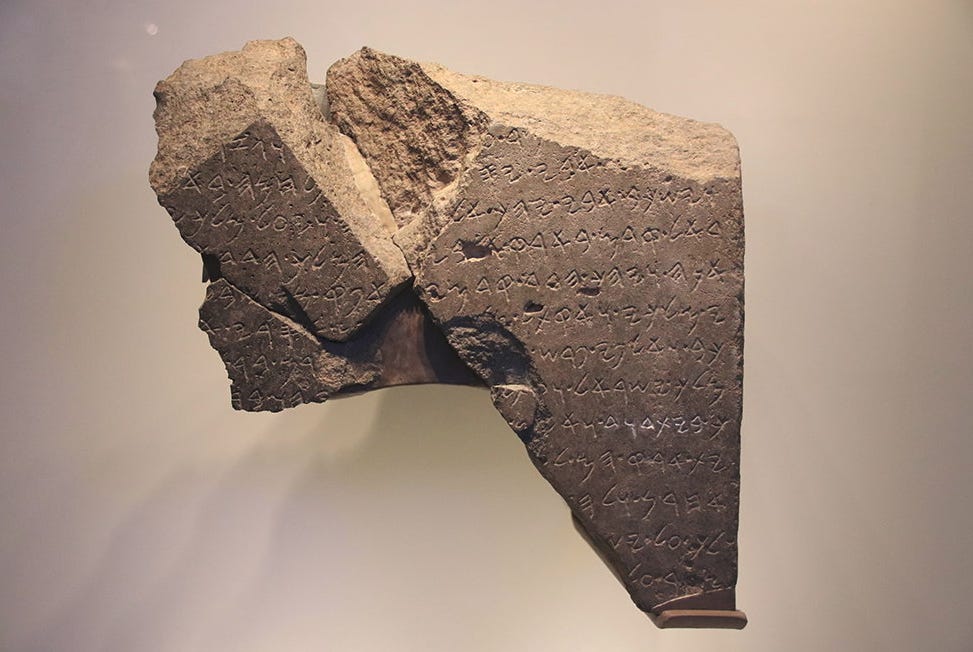
[I killed Jeho]ram son of [Ahab] king of Israel and [I]killed [Ahaz]iahu son of [Jehoram kin]g of the House of David. And I set [their towns into ruins and turned [their land into[desolation].
I’ve read the arguments against my reading and I just don’t buy it because of the archaeology. Through the 10th and into the early 9th century BCE, Judah's material footprint looks like a sparsely settled highland region: small, unfortified rural villages scattered through the Judean hill country, with little evidence of the administrative infrastructure. Israel Finkelstein and Neil Asher Silberman characterize this as a "chiefdom" rather than a kingdom. It’s not until the second half of the 9th century and especially the 8th century BCE, when fortified towns proliferate across the Shephelah and hill country.
Finkelstein's demographic work puts Judah's entire population at only a few thousand people — on the order of 5,000 adult males total in the whole territory — with Jerusalem itself amounting to a small hill-country village of perhaps a few hundred residents at most. The truth is: in the 9th century, when the Tel Dan Stele was carved, Judah was almost certainly a modest, thinly populated territory — nowhere near the scale it would reach a century later. So the claim that two kings of two different kingdoms, would be mentioned on the Tel Dan stele just doesn’t hold water. My reading is better.
Obviously, I could haul in every scrap of evidence and all the different “readings” and justifications. You would see the true believers and servants of the power structure lined up in one camp, the the true scholars who just follow the evidence where it leads in the other camp.
Tel Dan is the best attestation that there did actually exist a “House of David”. It is the best of three (yes, only three) pieces of evidence outside the Bible, but its most load-bearing feature — proof of two separate royal houses in one continuous text — rests on a fragment join now under genuine paleographic challenge, plus a phrase that departs from the text's own word-separation convention.
The first problem is that every other multi-element phrase in the inscription is separated by a dot, but bytdwd is written as one unbroken string. Philip Davies pointed out this is exactly the pattern used for toponyms like bytlhm (Bethlehem, “house of bread”) — a single place-name, not a construct phrase naming a dynasty. Frederick Cryer and others in this camp argue that since it patterns like the other undivided single words in the same text, it “cannot be translated as ‘House of David’” and “must rather refer to something else than a state or dynasty”. (“House of David' Built on Sand: The Sins of the Biblical Maximizers," BAR 20, no. 4 (July/August 1994): 54–55)
This drew a direct, named rebuttal from David Noel Freedman and Jeffrey Geoghegan, "'House of David' Is There!",(BAR 21, no. 2 (1995)), arguing the word-divider's absence is exactly what you'd expect for a fixed, well-established proper name/title (compare "son of Omri," "house of Agusi" in Assyrian texts, which behave the same way), and that byt could not stand alone as an independent word in that syntactic position anyway. George Athas later refined Davies's toponym idea rather than abandoning it, proposing specifically that bytdwd names Jerusalem itself, not an unknown village. That’s an argument from analogy, not a demonstration; it doesn’t close the question, it just supplies a plausible counter-reading.
In a later piece responding to Yosef Garfinkel’s claim that minimalism was intellectually dead, Davies wrote directly:
“As for whether bytdwd means ‘house of David,’ well, it might do, but actually that is not certain. I have myself written articles exploring the possibility that it is the correct reading (Davies 2008) as well as articles that explain why I am not sure that it does (Davies 1994, 1995). I personally would prefer ‘house of David’ because... it supports my contention that ‘Judah’ as a political entity was unknown in the ninth century and instead there was only a chiefdom bearing the name ‘house of dwd.’” (Philip Davies, “A Minimalist Disputes His Demise,” Bible and Interpretation/Biblical Archaeology Society)
To be clear: Davies did not use "house of David" (if that's what it is) to argue Judah/Israel were the same polity. He used it to argue Judah in the 9th century was a small chiefdom named after a founder called dwd, not a mistranslation collapsing Judah into Israel. His skepticism runs toward minimizing Judah's statehood, not toward erasing the Israel/Judah distinction — which is a different claim than the one I've been making.
The second problem is the entire "two kings, two houses" reading — Jehoram-son-of-Ahab-king-of-Israel and Ahaziahu-son-of-Jehoram-king-of-House-of-David — depends on splicing fragment A (found 1993) together with fragments B1/B2 (found 1994), which do not physically touch. Biran and Naveh joined them epigraphically, by argument, not by a physical fit. A 2024 paleographic study, using Reflectance Transformation Imaging, found systematic letter-form differences between fragment A and fragments B1/B2 — for example the bottom stroke of bet is a single curve on A but two straight strokes on B1/B2 — consistent with two different scribal hands, and concluded the traditional placement "must be abandoned" because "fragment B does not continue the lines started by fragment A" (Armstrong Institute, 2024; the underlying study is Langlois 2024, IEJ 74/2). If that's right, the famous parallel structure — two kings, two dynasties, killed in the same breath — is partly an artifact of how the excavators chose to arrange broken stones, not something read continuously off one surface. One specialist (K.L. Noll) had already flagged this decades earlier, refusing to read across the fragment boundary at all. So: bytdwd as a string of letters is genuinely and securely on the stone, unreconstructed. But the reading that makes it mean "a second, distinct royal house alongside Israel's" leans on a fragment join that is now actively disputed on paleographic grounds, and on a word-formation pattern that lacks the era's normal spelling convention.
Regarding the other two alleged pieces of evidence that the “House of David” was a real political entity: The Mesha stone fragment is an open argument amongst top-level scholars. The Shoshenq topographical list at Karnak is a minority proposal most specialists don't accept. So much for them.
Nevertheless, the six letters bytdwd, is physically and securely present on one stone, the Tel Dan Stele, whose grammatical function (proper dynastic name vs. toponym vs. common noun) is a real, unresolved dispute among serious non-minimalist scholars — separate from the question of whether David existed at all, and separate from whether that stone's other fragment was even originally continuous with the piece naming Ahaziahu.
I’ve read it all and weighed it and looked at it from many angles. I still think the Tel Dan stele, if the fragments can be shown to be part of a larger piece, was referring to the Omri dynasty as the "House of David"; just another way of describing him and his family, and the whole divided kingdom with its list of kings mirroring the kings of Israel, the northern kingdom, was all a tissue of lies and fabrications. Otherwise, it’s just the name of a place and means nothing at all.
Anyway, Perplexity finishes me off with:
[…] the post’s strongest historical insight lies in its attention to cultural appropriation, polemic, and retrospective memory: ancient traditions frequently preserve inherited knowledge while changing its moral meaning and assigning it to new authorities. Its larger reconstruction of a “phantom” Solomonic empire should be treated as a provocative interpretation within continuing scholarly disagreements over texts, archaeology, chronology, and the formation of biblical history.
So, now you are aware of what a heretic I really am. And hopefully, you are aware of how nasty the Control System gets when it is being exposed.
His landmark book, In Search of "Ancient Israel" (Sheffield: JSOT Press, 1992), predates the Tel Dan discovery by about a year and set out the framework the minimalists still use: he distinguished "biblical Israel" (the literary construct in the text), "historical Israel" (whatever actually existed, recoverable only from independent evidence), and "ancient Israel" (a modern scholarly hybrid of the two he considered methodologically confused). This is the intellectual scaffolding underneath his later reaction to Tel Dan — for Davies, the burden of proof always sits with anyone claiming a biblical figure is historical, not with the skeptic.
I corresponded with Philip Davies during the writing of my book “From Paul to Mark” and was very thankful for his encouragement. I was very upset when he died during that period. He was an outstanding scholar and exceptional person.
~~~
Organized by position rather than alphabetically, so the balance of camps is visible at a glance. Notes indicate why each item matters to the argument and flag known weaknesses or disputes.
Biran, Avraham, and Joseph Naveh. 1993. “An Aramaic Stele Fragment from Tel Dan.” Israel Exploration Journal 43: 81–98. — The original publication of Fragment A.
Biran, Avraham, and Joseph Naveh. 1995. “The Tel Dan Inscription: A New Fragment.” Israel Exploration Journal 45: 1–18. — Publishes Fragments B1/B2 and the joined reading that produces “House of David”; this join is what a 2024 Langlois paleographic study (below) later complicates.
Davies, Philip R. 1992. In Search of “Ancient Israel.” Journal for the Study of the Old Testament Supplement Series 148. Sheffield: JSOT Press. — Predates Tel Dan by a year; lays out the theoretical case that the biblical “United Monarchy” is a literary construct, the framework Davies later applied to the inscription.
Lemche, Niels Peter, and Thomas L. Thompson. 1994. “Did Biran Kill David? The Bible in the Light of Archaeology.” Journal for the Study of the Old Testament 19, no. 64: 3–22 (Scribd copy). — The first sustained minimalist rebuttal, published in the same JSOT issue as Ben Zvi’s defense (below) — the two were run back to back as a debate.
Cryer, Frederick H. 1994. “On the Recently Discovered ‘House of David’ Inscription.” Scandinavian Journal of the Old Testament 8, no. 1: 3–19. — Raises authenticity questions short of alleging forgery; Cryer himself wrote “I doubt that the inscription is a forgery... but the matter will definitely bear further looking into.”
Garbini, Giovanni. 1994. “L’iscrizione aramaica di Tel Dan.” Atti della Accademia Nazionale dei Lincei, Classe di Scienze Morali, Storiche e Filologiche, Rendiconti, series IX, vol. 5, fasc. 3: 461–471. — Disputes the dating and, elsewhere, argues the biblical David figure derives from a narrower title, “dawid” (”viceroy”), attested on the Mesha Stele.
Davies, Philip R. 1994. “’House of David’ Built on Sand: The Sins of the Biblical Maximizers.” Biblical Archaeology Review 20, no. 4 (July/August): 54–55. — Argues bytdwd is a toponym analogous to bytlhm (Bethlehem), not a dynastic label.
Cryer, Frederick H. 1995. “A ‘Betdawd’ Miscellany: dwd, dwd’, or dwdh?” Scandinavian Journal of the Old Testament 9, no. 1: 52–58.
Thompson, Thomas L. 1995. “’House of David’: An Eponymic Referent to Yahweh as Godfather.” Scandinavian Journal of the Old Testament 9, no. 1: 59–74. — Reads dwd as a divine epithet (”the beloved”) rather than a personal name.
Cryer, Frederick H. 1995. “King Hadad.” Scandinavian Journal of the Old Testament 9, no. 2: 223–235.
Thompson, Thomas L. 1995. “Dissonance and Disconnections: Notes on the bytdwd and hmlk.hdd Fragments from Tel Dan.” Scandinavian Journal of the Old Testament 9, no. 2: 236–240.
Cryer, Frederick H. 1996. “Of Epistemology, Northwest-Semitic Epigraphy and Irony: The bytdwd/House of David Inscription Revisited.” Journal for the Study of the Old Testament 21, no. 69: 3–16. — Cryer’s most developed technical case that bytdwd must be read as a single unanalyzed word, not “house of X,” precisely because it lacks the internal word-divider used elsewhere in the text — the strongest philological plank of the skeptical position, and the one point later scholarship (Rendsburg, below) engages most directly.
Lemche, Niels Peter. 2003. “’House of David’: The Tel Dan Inscription(s).” In Jerusalem in Ancient History and Tradition, edited by Thomas L. Thompson with Salma Khadra Jayyusi, 46–67. Journal for the Study of the Old Testament Supplement Series 381 / Copenhagen International Seminar 13. London/New York: T&T Clark International. ISBN 0-8264-6664-8. — Contains Lemche’s walk-back on forgery: arguments for fabrication “need to be much more forceful... if they are to prove beyond doubt that the inscription is the work of a forger.”
Unresolved citation: Davies, Philip R. 2008 — self-cited by Davies in his 2012 piece (below) as an article “exploring the possibility that [House of David] is the correct reading.” I have not been able to locate the exact title or venue despite searching.
Salibi, Kamal S. 1988. Secrets of the Bible People. London: Saqi Books (US edition: Northampton, MA: Olive Branch Press/Interlink Publishing Group). ISBN 0-86356-180-2. — Source of the b-ytdwd (place-name) parsing Ben Zvi cites in a footnote. Salibi’s broader project relocated most biblical geography to Arabia — a far more radical claim than anything in Lemche or Thompson, and shouldn’t be read as representative of minimalism generally.
Ben Zvi, Ehud. 1994. “On the Reading bytdwd in the Aramaic Stele from Tel Dan.” Journal for the Study of the Old Testament 19, no. 64: 25–32. — Companion piece to Lemche/Thompson in the same issue; concludes in favor of the “House of David” reading, so despite superficial appearances this is a consensus-supporting item, not a skeptical one.
Rainey, Anson F. 1994. “The ‘House of David’ and the House of the Deconstructionists.” Biblical Archaeology Review 20, no. 6: 47 (BAS Library). — Polemical in tone; dismisses Davies and Thompson by name rather than engaging their strongest philological point (the missing word-divider).
Freedman, David Noel, and Jeffrey C. Geoghegan. 1995. “’House of David’ Is There!” Biblical Archaeology Review 21, no. 2 (March/April): 78–79.
Rendsburg, Gary A. 1995. “On the Writing bytdwd in the Aramaic Inscription from Tel Dan.” Israel Exploration Journal 45: 22–25. — Published in the same journal issue as Biran and Naveh’s second Tel Dan article; the most direct technical answer to Cryer’s word-divider argument, citing biblical parallels for divider-less compound proper names.
Lemaire, André. 1998. “The Tel Dan Stela as a Piece of Royal Historiography.” Journal for the Study of the Old Testament 23, no. 81: 3–14. — Situates the stele’s formulae within Aramaic, Akkadian, Phoenician, and Moabite royal-inscription conventions.
Garfinkel, Yosef. 2011. “The Birth & Death of Biblical Minimalism.” Biblical Archaeology Review 37, no. 3 (May/June): 46–53.
Davies, Philip R. 2012. “A Minimalist Disputes His Demise.” Biblical Archaeology Society Daily, June 19 (BAS Daily). — Davies’s most nuanced statement: he says he would actually prefer the “House of David” reading, since it supports his separate claim that ninth-century Judah was a minor chiefdom, not that Israel and Judah were one polity.
Garfinkel, Yosef. 2012. “A Minimalist Disputes His Demise: A Response to Philip Davies.” Biblical Archaeology Society Daily (BAS Daily).
Athas, George. 2006. The Tel Dan Inscription: A Reappraisal and a New Interpretation. Journal for the Study of the Old Testament Supplement Series 360. London: T&T Clark (Google Books preview). — Athas explicitly rejects the “minimalist” label and argues for a historical David; his dispute is only over whether bytdwd denotes dynastic Judah or the city of Jerusalem (”City of David”). Important to keep distinct from the Copenhagen School entries above.
Lemaire, André. 1994. “’House of David’ Restored in Moabite Inscription.” Biblical Archaeology Review 20, no. 3: 30–37. — The original proposal.
Finkelstein, Israel, Nadav Na’aman, and Thomas Römer. 2019. “Restoring Line 31 in the Mesha Stele: The ‘House of David’ or Biblical Balak?” Tel Aviv: Journal of the Institute of Archaeology of Tel Aviv University 46, no. 1: 3–11 (preprint via HAL). — Proposes “Balak” instead; none of the three authors is a Copenhagen School minimalist, so this dispute is orthogonal to the minimalist/consensus axis.
Langlois, Michael. 2019. “The Kings, the City, and the House of David on the Mesha Stele.” Semitica 61: 23–47 (author’s PDF). — Defends the original reading against Finkelstein/Na’aman/Römer.
Lemaire, André, and Jean-Philippe Delorme. 2022. “Mesha’s Stele and the House of David.” Biblical Archaeology Review 48, no. 4: 40–45. — Latest defense; this line remains a live, unresolved dispute among non-minimalist specialists, unlike the Tel Dan reading itself.
Kitchen, Kenneth A. 1997. “A Possible Mention of David in the Late Tenth Century BCE, and Deity Dod as Dead as the Dodo?” Journal for the Study of the Old Testament 76: 29–44. — Proposes a Shoshenq I Karnak toponym as a reference to David; a minority reading, phonetically non-standard, not widely adopted even among consensus scholars.
Broshi, Magen, and Israel Finkelstein. 1992. “The Population of Palestine in Iron Age II.” Bulletin of the American Schools of Oriental Research 287: 47–60.
Faust, Avraham. 2010. “The Large Stone Structure in the City of David: A Reexamination.” Zeitschrift des Deutschen Palästina-Vereins 126, no. 2: 116–130. — Argues for the structure’s Iron Age date and Davidic-era significance.
Finkelstein, Israel. 2011. “The ‘Large Stone Structure’ in Jerusalem: Reality versus Yearning.” Zeitschrift des Deutschen Palästina-Vereins 127, no. 1: 1–10. — Direct counter to Faust; argues the structure’s Iron Age dating and unity are unsupported. These two items are a live, ongoing dispute among mainstream archaeologists about Jerusalem’s monumentality, independent of the minimalist/consensus debate over the inscriptions.
Langlois, Michael. 2024. “The Tel Dan Inscription after Thirty Years: A Fresh Look.” Israel Exploration Journal 74, no. 2 (PDF). — A paleographic study finding systematic scribal-hand differences between Fragment A and Fragments B1/B2, challenging whether Biran and Naveh’s join is valid. This is the most consequential item in the whole list, since it questions the physical basis of the “two kings, two houses” reading independent of any theoretical commitment to minimalism or maximalism.
Comments
Nothing yet. Say the first thing.
Sign in to join the conversation.