
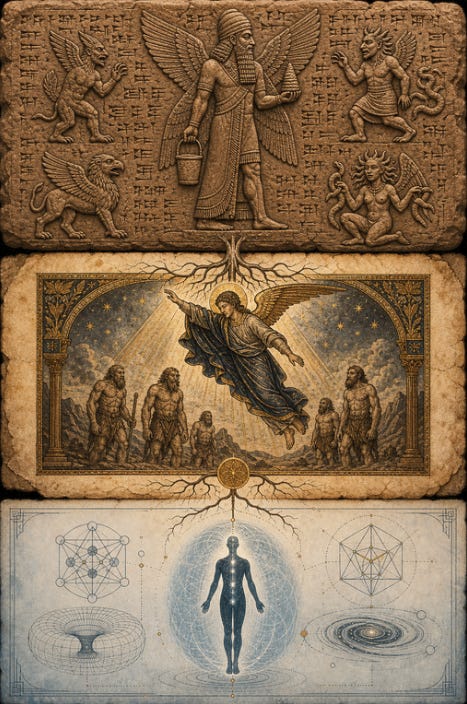
The previous three articles were preparatory to what I want to write about today. Let me give a brief recap to jog everyone’s memory and get us on the same page.
In the first piece, Giants, Omens, and Signs, I mentioned at the beginning that Henryk Drawnel’s paper on the Mesopotamian background of the Enochic giants and evil spirits pinged several things in my mind as I read it. Drawnel argued that the violent giants of 1 Enoch were deliberately modeled on Mesopotamian demons, especially the utukku type found in the bilingual exorcistic series Utukkū Lemnūtu. So the first thing I thought about was Van de Mieroop’s book “Philosophy Before the Greeks” where he describes the Omen Texts. But in order to really get a handle on the Omen Texts, one needs to understand the development of writing itself. So, I went back to Uruk’s invention of writing (via Mario Liverani) as an administrative technology, and then laid out Marc Van de Mieroop’s argument that Babylonian scribal culture developed an “epistemology of signs” which was, basically, the idea that reality is a text to be read through omens, lists, and correspondences rather than observed directly. That, in itself, made me think at the time I was reading it, that the scribes were talking about more than just our 3D reality. And, back then, I also realized that this Babylonian scribal practice appeared to me to be at the root of many esoteric/occult things of our own day. So, I connected the Babylonian astral-magical worldview with Hellenistic Chaldean astrology, Second Temple Judaism, and into the Enoch literature as the transmission point feeding later Jewish, Christian, and Western esoteric traditions.
In the second article, Enoch’s Theft and Solomon’s Phantom Empire, I went on to discuss Drawnel’s conclusion that the Book of the Watchers polemically inverted Mesopotamian scholarly achievement into demonic corruption. For me, that was a very interesting conclusion that had never occurred to me. Yes, I knew that Enoch was based on Babylonian texts, but I had not seen the polemic stance. But Drawnel points out that, in Enoch, the āšipu (exorcist-scholars) who fought demons in Mesopotamian tradition are recast as the fallen Watchers who caused the demonic world. I was startled by this because I had just assumed, along with many others, that the Watchers of Enoch were representative of some sort of hyperdimensional beings interacting with humans. But Drawnel makes a very good case for his reading. Enoch’s Watchers was a “negative assessment of Babylonian culture” and scholarly wisdom designed to elevate the God of Israel as the sole power capable of purifying the earth. Right there the pieces slotted into place. That then led to my consideration of how the Babylonian wise men were replaced in Jewish lore with the “Solomon-as-magus” tradition: Testament of Solomon, the Seal of Solomon, later grimoires like the Key of Solomon, etc. I realized that this was Jewish appropriation of foreign occult prestige under a borrowed name. That pinged the issue of the great kingdom of David and Solomon which I already knew from past research simply never existed. So, I decided to present that evidence to the reader by bringing in the historical facts; facts that suggest that David and Solomon’s empire and Temple are largely unsubstantiated, and that the real prosperous, monumental kingdom of this era was the northern Omride dynasty (Omri and Ahab), whose achievements biblical writers vilified and effectively transferred onto a fictionalized, southern (Judah) Davidic-Solomonic narrative.
In the third piece, The Phantom Temple and the Tel Dan Stele, I thought it was necessary to be more explicit and actually bring forward some of the detailed arguments. This was after I read what Perplexity AI had to say about the article and realizing how glaringly wrong it was. In that last piece, I made explicit my thoughts that any structure that may have been on the Temple Mount in very early times was likely a repurposed Hyksos-era temple rather than a grand Solomonic building. I reviewed three biblical “temple cleansing” narratives (Joash, Hezekiah, Josiah) as probably being oral echoes of that one underlying event. I then felt that it was necessary to engage in a more detailed defense of a possible alternate reading of the Tel Dan Stele by walking through the philological dispute over whether bytdwd means “House of David” as a dynastic label or is merely a toponym, and highlighting a 2024 paleographic study (Langlois) that challenged the physical join between Fragment A and Fragments B1/B2 underlying the “two kings, two houses” reading. At the end of that article, I included an annotated bibliography of the minimalist/maximalist debate, so that the reader could be fully aware that there was a very good case that the “Solomonic empire” is a retrospective ideological construct supported by “true believer pseudo-scholars” partly on contested epigraphic evidence. What this might mean for true believers in lies, from Jews to Christians to Occultists who all base their beliefs and acts on the existence of David and Solomon and the great temple that never was, I can only speculate.
In the end, the bottom line of the three articles is this: Mesopotamian scholarly and demonological knowledge was absorbed, then polemically inverted, by Enochic and biblical authors who simultaneously demonized Babylonian science and fabricated a grander national past than the archaeological and epigraphic record supports.
And now that the historiographical groundwork (how and why this material was appropriated and distorted) has been laid, I want to come back to the scheduled discussion I have been aiming at: the specific question of Mesopotamian demons themselves: the utukku and their kin.
The utukku (Akkadian) / udug (Sumerian) is the most common demon type in the bilingual Sumero-Akkadian incantation series Utukkū Lemnūtu (”Evil Utukku-Demons”), a corpus of texts with roots in Sumerian anti-demonic literature of the mid-third millennium BC (roughly 2500 BCE) that stayed in active use — in Assyria, Babylonia, and even at Ugarit, Boğazköy, and Sultantepe — until the end of cuneiform culture around 75 AD. That gives a total active lifespan of roughly 2,500 to 2,600 years for this demonological tradition, making it one of the longest continuously attested textual/ritual traditions in human history comparable in duration to the entire span from the founding of Rome to the present day. The Utukku demon is a broad, ambiguous class, not intrinsically evil by origin, but the incantations address its malevolent form: demons that are described as tall, hostile in appearance, wrapped in a dark shadow with no light within its body, claws dripping bile/poison, a venomous tread (whatever that is), and a roar that is deafening despite not being divine. The utukku demon attacks on the open plain, “grips a man by the shoulder,” binds the body, causes fevers, headaches, disease, madness, and paralysis, prowls at night like a bat, fox, or bird, and infiltrates sleep to cause nightmares or possession. Really creepy! In fact, it brings to mind the opening prologue of William Friedkin’s 1973 film, The Exorcist.
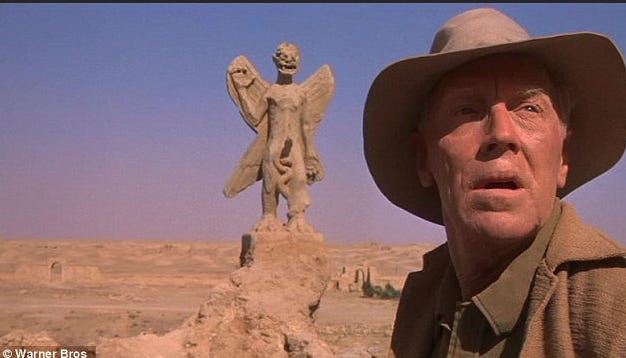
In the movie, Father Lankester Merrin - an elderly Catholic priest who is also involved in archaeology - is at a dig explicitly identified as northern Iraq, filmed at the ruins of Hatra, southwest of Mosul. The priest uncovers a demonic amulet, and then encounters a much larger statue of the same figure amid the ruins in the desert. The entity is Pazuzu, who we will meet below in more detail.
The scene in the movie is not a face-to-face apparition; instead, it is represented as a silent, ominous confrontation between Merrin and the statue, with unsettling signs all around including fighting dogs. The implication is that he recognizes an old spiritual enemy and is experiencing some kind of foreboding. The encounter is meant to foreshadow the force possessing the child, Regan, later in the film. At this point, I find it quite interesting that the origin of the evil demon in that film was Iraq, considering all that has happened there since. I also thought it was curious that one inference I made at the time was that “messing around ancient places and digging them up can unleash all kinds of horrors on the world.”
Anyway, to continue: the Utukku demon is only part of a wider taxonomy. The standard incantation lists the following: "the wicked Utukku who slays man alive on the plain, the wicked Alû who covers man like a garment, the wicked Etimmu, the wicked Gallû, who bind the body". This is, effectively, a cohort of demons that, on closer inspection, each occupies a highly specific niche within the broader system of nocturnal, sleep-related, and reproductive affliction.
Alû is described as mouthless, lipless, and earless, a genuinely unnatural, half-formed being that prowls at night and “covers a man like a garment,” an idiom for smothering or overwhelming its victim so completely that possession results in unconsciousness or coma. Sumerian and Akkadian literary parallels use the same “cover like a cloak/garment” imagery elsewhere to describe storms, confusion, and dumbness overwhelming a person, suggesting Alû’s attack was conceived as an oppressive, engulfing pressure closely resembling what would later be called sleep paralysis or an incubus visitation. Some sources add that Alû hides in dark corners, ruins, and caverns, is sexless or androgynous, torments victims “for its own cruel amusement,” and may be sent by the lilītu or ardat-lilî to a man to whom she has attached herself, linking Alû functionally into the wider líl-demon network described below.
Alû’s signature attack — an unseen, faceless entity that “covers a man like a garment,” causing unconsciousness or immobilization — maps almost exactly onto the modern abduction narrative’s most consistent feature: waking paralysis, an oppressive presence in the room, and a sense of being physically overwhelmed before “losing time”. This is also the same phenomenological cluster (sleep paralysis, incubus/succubus visitation, night-terror possession) that later folklore across cultures consistently describes, and which some UFO researchers explicitly treat as the historical continuity underlying modern bedroom-abduction accounts. I’m not sure how a sexless or androgynous being can be an incubus or succubus, but it does sort of describe gray aliens. And torturing with all kinds of intrusive “tests” fits right in there too.
Etimmu is simply the ghost (Akkadian eṭemmu) of a deceased human that failed to receive proper burial rites or died an unresolved death, becoming aggressive and demon-like out of the same grievance-driven logic that makes it functionally indistinguishable from a true demon once listed alongside Utukku and Gallû in incantation formulas.
Gallû’s defining trait, per the incantation formula, is that it “binds the body” — a mode of attack distinct from Alû’s suffocating cover, suggesting paralysis or physical restraint rather than smothering unconsciousness. Gallû appears repeatedly alongside Alû and Etimmu as part of the standard demonic trio/cohort invoked in exorcistic ritual, and later demonological tradition (echoed in the term “gallu” surviving into later Near Eastern demon-lists) treats it as one of the primary “binding” agents of bodily affliction.
Lamaštu, daughter of the sky god Anu, is depicted as a hybrid monster with a lioness’s head, donkey’s teeth and ears, bird’s talons, and long fingernails, typically shown nursing a pig and a dog while holding snakes. Her specific predation targets infants and pregnant/nursing women: she kidnaps and gnaws the bones of nursing infants, sucks blood, slays unborn and newborn children, causes miscarriage, disturbs sleep with nightmares, and even infests rivers and poisons foliage, making her one of the most dreaded and functionally broad demons in the entire system.
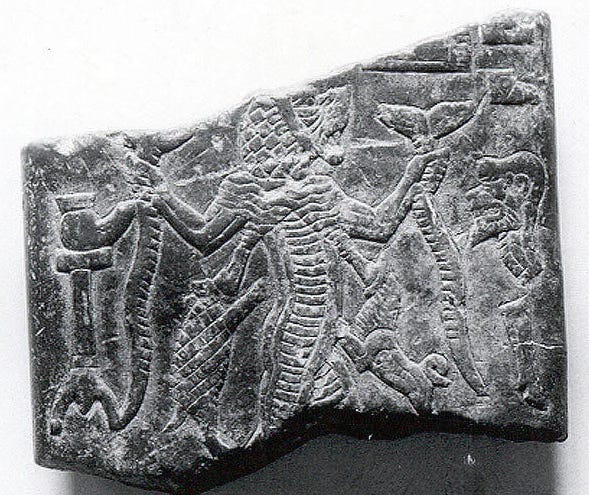
Lamaštu’s specific focus on infants, pregnant women, and unborn/newborn children - kidnapping, gnawing bones, causing miscarriage - echoes one of the most recurrent and controversial themes in abduction lore: alleged reproductive experimentation, fetal/embryo removal, and “missing pregnancy” narratives reported by abductees. The ardat-lilî’s fixation on bachelors, women in childbed, and infants likewise centers reproduction and sexuality as the primary zone of demonic interest, exactly where much abduction literature places its most sensational claims.
Labasu (also Labartu) is grouped by Sumerian tradition into a trio of female demons alongside Lamaštu and Akhkhazu, sharing overlapping fever- and plague-bringing functions. Labasu is less textually distinct than Lamaštu but consistently appears as part of this closely related female-demon cluster associated with sickness and childbirth danger, sometimes described as her shadowy double or lesser counterpart.
Lilû is the masculine wind-and-night demon of the “líl” family, etymologically rooted in the Sumerian word for “moving air” or “phantom of the wind,” conceived as a restless spirit of the desert and open wilderness who comes to sleeping women as a phantom lover, causing nightmares, disturbed rest, and reproductive harm. His female counterpart Lilītu performs the mirrored function against men, and the Sumerian king list even names Lilû as the father of Gilgamesh, showing this demon type had mythological reach beyond ordinary exorcistic texts.
The entire Lilû/Lilītu/ardat-lilî family operates specifically at night, targeting sleeping victims with phantom sexual visitation and disturbed rest — a template that lines up closely with the “alien lover” and nocturnal bedroom-visitation motifs common in abduction testimony, right down to the demons being wind-borne, faceless, or shadowy rather than fully corporeal.
The ardat-lilî is the most specifically socially-conditioned entity in the group: the ghost of a young woman who died before marriage or motherhood, is demonized precisely because her normal life-cycle was interrupted, and who wanders “to seek what death denied her,” sometimes attaching to sleeping men and threatening bachelors, women in childbed, and infants. Old Babylonian texts already attest her by the early second millennium BC, and she remained active in exorcism series like Maqlû and Šurpu for well over a thousand years, forming - together with Lilû and Lilītu - a tight family unit distinguished by Assyriologists as related but textually distinct figures rather than interchangeable names for one being.
Taken together, this taxonomy shows Mesopotamian demonology assigned each entity a genuinely specialized mode of attack rather than treating “demon” as an undifferentiated menace: Alû smothers and induces unconsciousness, Gallû binds and paralyzes, Etimmu haunts through unresolved death-grievance, Lamaštu and Labasu target the reproductive and infant sphere, and the Lilû/Lilītu/ardat-lilî triad governs nocturnal sexual disturbance and the demonization of failed marriage or parenthood. This granular specialization is precisely the kind of detailed, technical demonological knowledge Drawnel argues the Enochic author drew on and then collapsed into the single undifferentiated category of “evil spirits” emerging from the giants - a simplification that not only marks a significant point of divergence between the two systems, but also deprives the Enochic system of the scientific (by ancient standards) approach.
The attacks of the demons are morally arbitrary: the Utukkū Lemnūtu series never moralizes the victim’s suffering; the afflicted person is simply a “distraught man and helpless victim” the gods notice and choose to aid.
Ghosts (eṭemmu, Sumerian gidim) and demons were not sharply separated categories — the cuneiform sign UDUG covered both “ghost” and “demon” undifferentiated as early as the mid-third millennium BC, and the terms could be outright synonyms later. Every person automatically becomes an eṭemmu at death, living an orderly afterlife in the netherworld (Irkalla) if properly cared for through descendants’ offerings. Only specific failures — improper or absent burial, violent or premature death, dying without descendants, or an unrecovered corpse — turn it into a restless “evil ghost” (edimmu/eṭemmu lemnu) that enters the living through the ear and causes illness, confusion, and nightmares while seeking the attention it was denied.
Once transformed, it is explicitly bundled with the “evil utukku-demons” in standard incantation formulas across Utukkū Lemnūtu, Maqlû, and Šurpu. One taxonomy list runs “the wicked Utukku... the wicked Alû... the wicked Etimmu, the wicked Gallû” as one predatory cohort, and utukku itself was sometimes used for a plain ghost; one omen text: “the ghost of the wronged man will seize the land”. Certain named demons occupy an explicit middle ground, arising from disrupted life-cycles: the ardat lilî (unmarried woman’s ghost, with a rarer male counterpart) and the Kūbu (stillborn/very young dead children). Demonization of the dead indicate either a state of social or biological failure. In practical terms, ghosts and demons required the same cure: the āšipu’s incantations and ritual apparatus were deployed against both indiscriminately, and figures like Pazuzu straddled both worlds, causing plague and drought like a demon while also defending against Lamaštu and evil ghosts. This tells us that the ghost-demon boundary was functional, not ontological.
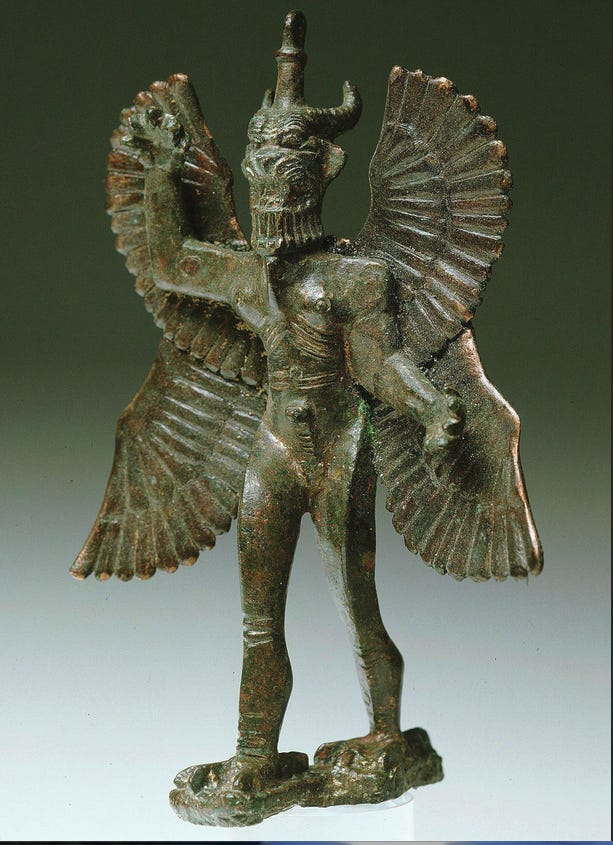
Weather — destructive winds, storms, dust, drought, darkness — was understood as the direct action of demonic beings, not an impersonal force. Pazuzu, “king of the Lilû demons,” was identified with the hot, dust-laden southwestern wind bringing drought, famine, and locust swarms; his own inscription claims he “scaled the powerful mountains” and made “the contrary winds” flee westward. Because he commanded these winds himself, he was paradoxically also invoked as defense against them; his grotesque image was worn as an amulet to repel the very winds he embodied.
An older tradition, “The Seven Evil Spirits,” names each of seven demons directly as a weather event. The first is “the South wind,” another “a storm... which takes vengeance” and also blames them for eclipses via “sending cloudy weather.” (Which might give an alternate meaning to the “astronomical impossibilities” noted by Van de Mieroop.) The Asakku demon fused this with disease: identified with the hot wind believed to carry fever and epidemic, described in the Gilgamesh Epic as “the embodiment of the hot side,” its attacks described through the metaphors of flood and tornado. The fusion extends to cosmogony itself: in the Enuma Elish, Marduk creates “the evil wind, the hostile wind, the tempest, the storm... the whirlwind” as weapons against Tiamat, a primordial goddess, the personification of the salt sea and a mother of the gods, with “the evil wind” forcing open her mouth for the kill. So it appears that weather-demons as divine tools were there from the founding of the cosmos. Anzu caused whirlwinds by flapping his wings, while the lion-headed Ugallu was a beneficent demon deployed against storms and illness.
Demonic attack operated at three nested scales. Individually: fevers, headaches, paralysis, madness, miscarriage (Lamaštu), and the haunting of young men (ardat lilî). Mesopotamian medicine drew no firm line between natural and supernatural illness. Communal effects: demons were believed to “encroach upon the protected and ordered world of the Mesopotamian city,” destabilizing communities through famine and broken family ties, which is why the āšipu’s expertise was mobilized to protect “residential homes, temples and palaces” as a matter of civic survival. Cosmical effects: demons represented chaos encroaching on divine order, sometimes dispatched by the gods to punish ritual failure. Yet other traditions (like “the Seven”) show demons paradoxically integrated into cultic administration, reflecting an ambivalent Mesopotamian view of demons as both destabilizing and part of the necessary balance of the world. The institutionalization of the āšipu profession across three millennia is itself evidence of how pervasively this threat was understood: an unresolved, perpetually re-fought ritual war rather than a war with any final resolution.
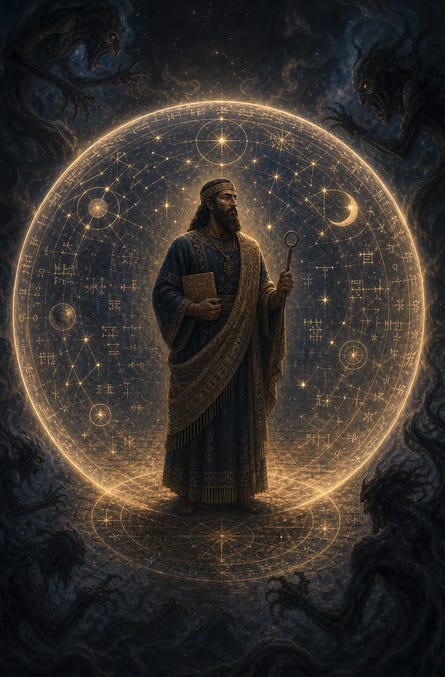
Standing against ghosts, weather-demons, and disease-demons alike was the āšipu, the professional exorcist-scholar whose incantations, drums, herbs, amulets, and ritual acts constituted humanity’s institutionalized defense — a role kept strictly separate from and opposed to the demons themselves. His professional portfolio — medico-magical arts, celestial and terrestrial divination, incantation, astrology — is the detail Drawnel identifies as the template later inverted in 1 Enoch.
Drawnel’s 2014 Dead Sea Discoveries article (”The Mesopotamian Background of the Enochic Giants and Evil Spirits”) argues 1 Enoch’s giants and evil spirits are literary constructs deliberately modeled on the utukku demons above, not on historical warrior-kings as earlier scholars proposed.
1 Enoch 7:2–5 depicts the giants as offspring of the fallen Watchers and human women. They were three thousand cubits tall and progressed through an escalating sequence: consuming all human labor, then killing and devouring men and drinking their blood, then turning on the animals, and finally devouring each other. After their destruction, 1 Enoch 15:8–11 says “evil spirits” emerge from their bodies bearing the identical label the giants themselves held. Drawnel reads this as an “existential as well as functional identity,” meaning the spirits are simply the giants’ destructive nature continuing, not a new category of being. As spirits they attack, cause desolation, and cause illness, and - distinctively - eat no food and are thus perpetually thirsty and hungry, rising specifically against “the sons of men and the women” from whom they originated.
This is the crux of Drawnel’s argument. Mesopotamian tradition keeps the āšipu (demon-fighter) and the utukku (demon) as separate, opposed categories. Enoch collapses this and reverses the moral valence: the fallen Watchers, whose profile (secret arts, exorcism-adjacent knowledge, astrology, medicine) tracks the āšipu’s portfolio precisely, become the cause of the demonic scourge, since their illicit union with women produces the giants. The very group Mesopotamians credited with defeating demons is recast as their progenitor thus converting a protective, prestigious priestly office into the villain of a Jewish morality tale. This is a “conscious,” adversarial reuse of specific Mesopotamian classifications, not vague cultural osmosis. A second point: Enoch’s giants aren’t meant to evoke the apkallū sages or historical kings, they are demons, plain and simple, drawn from the utukku template, letting Drawnel sidestep the “giants = kings” debate entirely.
The apkallu (Akkadian) or abgal (Sumerian), meaning "wise one" or "sage," are seven mythical demigods credited in Mesopotamian tradition with bringing civilization to humankind before the Great Flood. They were sent by the god Ea (Sumerian Enki) from the apsû (the cosmic freshwater abyss beneath the earth) and their mandate was explicitly civilizational: each sage was paired with one of the seven antediluvian kings of the Sumerian King List and tasked with teaching the newly settled human population writing, kingship, law, ritual, agriculture, metallurgy, and the mantic disciplines of omen-reading.
The Uruk List of Kings and Sages, a Seleucid-era tablet from the temple library at Bīt Rēš, preserves their names in order: Uanna (later identified with the culture-hero Adapa), "who finished the plans of heaven and earth"; Uannedugga, "endowed with comprehensive intelligence"; Enmedugga, "allotted a good fate"; Enmegalamma, "born in a house"; Enmebulugga, "who grew up on pasture land"; An-Enlilda, "the conjurer/purification priest of Eridu"; and Utuabzu, "who ascended to heaven" (as did Enoch). Berossus, the Babylonian priest writing in Greek in the Hellenistic period, rendered the first and most important of these, Uanna, as Oannes, describing him as possessing "the body of a fish, but also the feet, arms, head, and voice of a man," who taught humanity reading, writing, mathematics, city-building, temple-founding, law, land division, and agriculture, and even explained the gods' creation of the world.
In iconography, the apkallu are consistently depicted emerging from the sea or freshwater abyss, and typically shown with the lower torso of a fish or wearing a full fish-skin cloak draped over the body and head, denoting their status as intermediaries between Ea's watery, wisdom-bearing domain and the human world. Scholars group first-millennium apkallu iconography into three distinct types: the fully human, winged ummânu-sage; the bird-headed ("Nisroc"-type) apkallu, sometimes called ūmu-apkallu; and the fish-cloaked purādu-type, most closely associated with the antediluvian Oannes tradition. Physical depictions of these figures on palace reliefs and in glyptic art appear to be a distinctly first-millennium BC artistic development, even though the mythic tradition itself is far older.
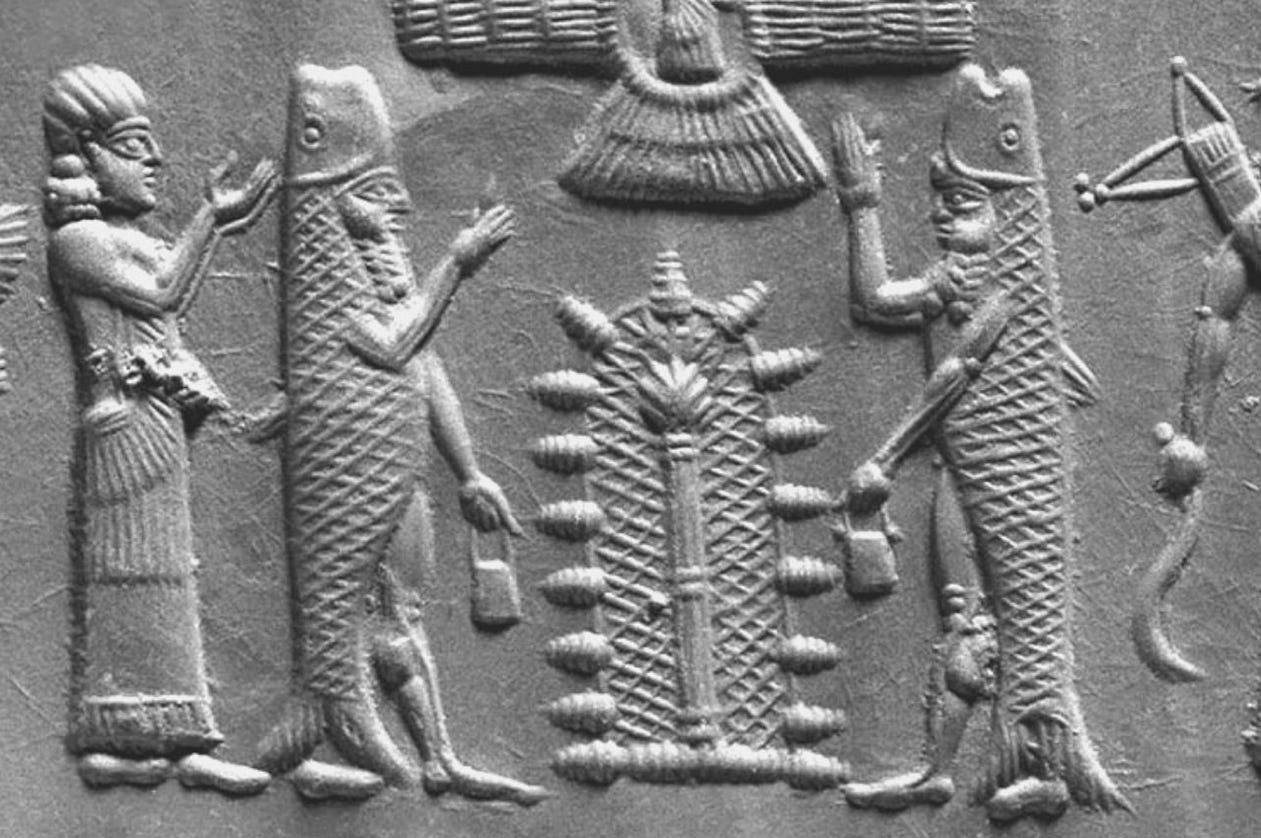
The apkallu were also credited with delivering the me (the divine decrees or cultural ordinances structuring civilized life) and were tied specifically to the founding of the seven great primeval cities: Eridu, Ur, Nippur, Kullab, Kesh, Lagash, and Shuruppak. They served simultaneously as priests of Ea and as counselors or viziers to the antediluvian kings, embedding wisdom transmission directly into the structure of early kingship itself.
According to the tradition, the apkallu vanished at the time of the Flood, descending back to Ea's abode in the subterranean waters. Berossus states flatly that "from that time nothing further has been discovered". A second, distinctly human generation of sages (ummânū) is described as carrying the inherited antediluvian sciences forward into the historical kings of Mesopotamia, with four named post-diluvian human sages — Nunpiriggaldim, Piriggalnungal, Piriggalabzu, and Lu-Nanna — sometimes appended to the original seven.
Beyond their mythic role as culture-bringers, apkallu figurines became a central tool of protective ritual magic in the first millennium BCE. Small clay images of fish-cloaked, bird-headed, or human-winged apkallu were buried beneath house floors, doorways, and temple foundations — often in ritually significant sets of seven — specifically to "protect individuals and buildings from disease and evil forces" and to ward off malevolent spirits.
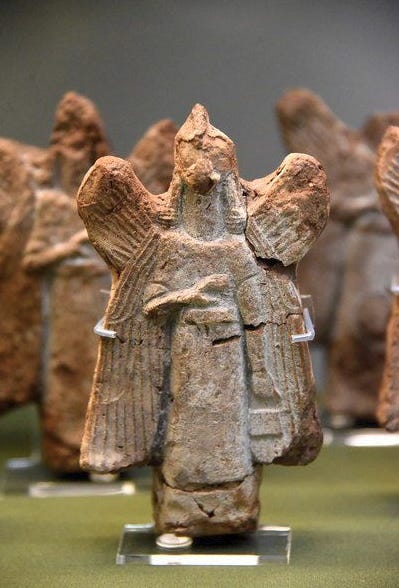
Ritual texts describe these figures functioning as "purifiers and exorcists whose presence continuously protects the inhabitants against evil influences," carrying implements associated with cleansing and purification (a cleaning instrument, a ritual bucket). This apotropaic use directly explains the connection Drawnel draws in his Enochic Watchers thesis: the āšipu-exorcists of the historical period explicitly modeled their own professional prestige and protective ritual craft on this antediluvian apkallu lineage. One medical colophon claims its remedies derive "from the oral tradition of the apkallus from before the Flood," making the apkallu the mythic charter and legitimating ancestry for the entire later exorcistic profession that Enoch's Watchers narrative polemically inverts.
Drawnel’s more precise claim is, however, that the Watchers are modeled on the historical Babylonian āšipu-priests of the Persian and Hellenistic periods, not the mythic apkallū sages directly. The forbidden sciences the Watchers teach in 1 Enoch 8:3 - medico-magical arts, divination, incantation, astrology - match the āšipu’s actual attested portfolio point-for-point, and cannot be reconciled with the older apkallu tradition.
Let me give a minute or two to the cone and bucket like objects mentioned that can be seen in the hands of the apkallu in the image above since I’ve read a lot of speculative nonsense about them. Those objects are the single most iconic and most disputed attribute pair in ancient art, held almost exclusively by apkallu-genies, animal-headed demons, or the king's attendants. The bucket is called banduddû in Akkadian, and the cone-shaped object is called mullilu, which means, literally, "purifier". Despite over a century of scholarly discussion, no single explanation commands universal consensus, though the field has converged around two dominant, competing readings.
The majority scholarly view holds that these are ritual purification implements: the mullilu (cone) is dipped into the banduddû (bucket), which held holy or sacred water, and then shaken or pointed to sprinkle purifying liquid onto the king, courtiers, temple spaces, or the stylized "sacred tree (as seen in the image above). This reading is philologically grounded — the Akkadian word for the cone-object is literally "purifier," and ritual texts describe the apkallu's core function as protective/apotropaic exorcism, continuously safeguarding people and buildings from evil influences, which fits neatly with a water-based cleansing rite that is still used to this day in religious contexts, including exorcisms.
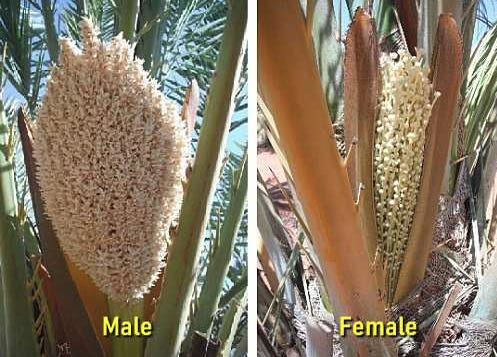
The competing theory holds that the cone represents the male inflorescence (flower spike) of the date palm, and the bucket contains pollen rather than water. That would have the genies performing manual pollination of the sacred palm tree, a practice ancient Mesopotamian farmers actually needed to perform to keep date palms fruiting. According to this interpretation, the scene is fundamentally about fertility and agricultural abundance rather than purification, with the "cone" actually being a stylized date-spathe rather than a coniferous pine cone. I don’t think that is what is being shown since I’ve looked at date palm parts and I think the artists of the time could do a lot better job of depicting a stylized date spathe.
Frans Wiggermann, in his landmark study Mesopotamian Protective Spirits (1992), identified and translated two Neo-Assyrian ritual texts that explicitly describe the apkallu figurines, their attributes, and their function. These are the closest thing found that gives a direct "explanation" from the ancient sources themselves. Text I is the more complete, describing figure by figure what each apkallu type holds and does; Text II is a shorter extract that supplies additional detail Text I omits
The texts confirm the purification reading directly and in the apkallu's own terms. One incantation incipit addressed to bucket-and-cone-bearing apkallu figures reads: "attunu salmānu apkallu massarī" — "you are the statues of the sages, the guardians". Another incantation calls them "VII NUN.ME.MEŠ ašareddūtu" — "seven leading sages," directly identifying them with the mythic apkallu tradition rather than generic protective spirits. The ritual instructions describe the bucket (banduddû) as containing holy water that "effectuates release," and the cone (mullilu, literally "cleaner"/"purifier") as the sprinkling instrument dependent on the bucket's contents. "When the figure carries a bucket in its left hand, the cone appears in the right," and the cone is used to "activate" the holy water as a sprinkler. A related liturgical fragment gives the fuller ritual logic explicitly: the exorcist is instructed to imitate the god Marduk, who, on Ea's advice, "takes water from the mouth of the twin rivers, casts his spell over it, purifies it with his holy incantation, and sprinkles that water over the man, the son of his god". The effect of this sprinkling is explicitly said to produce the "release" (pṭr) of "the threatened man," language drawn directly from the exorcistic series Šurpu, meaning the ritual's documented purpose is to lift a curse, sin, or demonic affliction from a person under threat. The apkallu's cone-and-bucket ritual thus reinforces their core identity as guardians who maintain cosmic and civic order against decay, corruption, and evil influence, the same protective function Drawnel identifies as the template the historical āšipu (and, polemically, the Enochic Watchers) inherited from this mythic sage-lineage.
Enoch places this myth before the Flood because the āšipus themselves claimed prestige by tracing their lineage back to the antediluvian apkallū - fish-man sages who, per Babylonian tradition (echoed in Berossus), taught humanity civilization. A Seleucid-era Uruk tablet pairs each of the first seven kings with an apkallu; exorcist-priests were sometimes depicted in fish-man garb; a medical colophon claims its remedies derive from “the oral tradition of the apkallus from before the Flood.” By setting the corruption in that same mythic time, the Enochic author directly attacks the āšipu’s claimed genealogy of prestige.
The Watchers’ “sexual sin” is not purely literal but metaphorical, echoing biblical usage where “fornication” and “defilement” signify idolatry and apostasy. The illicit union symbolizes the illegitimacy of transmitting Babylonian learning through an impure channel — which is why the knowledge itself becomes tainted rather than neutral.
Nevertheless, with the sexual activity of demons described above, set side-by-side with the sexual activity of alleged aliens in the modern day, it’s not hard to draw out a conclusion that some sort of hybridization program could easily be implied.
Drawnel contrasts this with Enmenduranki, the antediluvian king of Sippar who receives divinatory knowledge directly from Šamaš and Adad and transmits it father-to-son. Enoch imagined and described as a deliberate rival: instead of a corrupt scribal guild founded on knowledge from Babylonian gods, Enoch receives teaching from faithful angels and passes it to Methuselah, creating an alternative “purified” transmission line that is intended to displace the Babylonian model. We see here that the deepest structural divergence is in relocating legitimate knowledge-transmission into illegitimate angelic rebellion while making Enoch the new scribal hero superseding the āšipu. (Note: Šamaš and Adad are major Mesopotamian gods: Šamaš is the sun, truth, and justice god; Adad is the storm, thunder, and rain god. Neither is a demon.)
Pulling the threads together: beyond the causal inversion already described, Enoch personalizes the target. The spirits specifically attack “the women” who bore the giants (a kinship vendetta absent from indiscriminate utukku attacks), drops the human counter-force entirely (no āšipu-equivalent; only divine judgment via angels, with Enoch himself as revelation-recipient rather than ritual specialist), and adds an existential dimension via the giants’ perpetual hunger and thirst — a punishment of endless want that Mesopotamian incantations, focused on physical symptoms, never dwell on.
Now, let’s have a look at some unusual correspondences to work done in our own times.
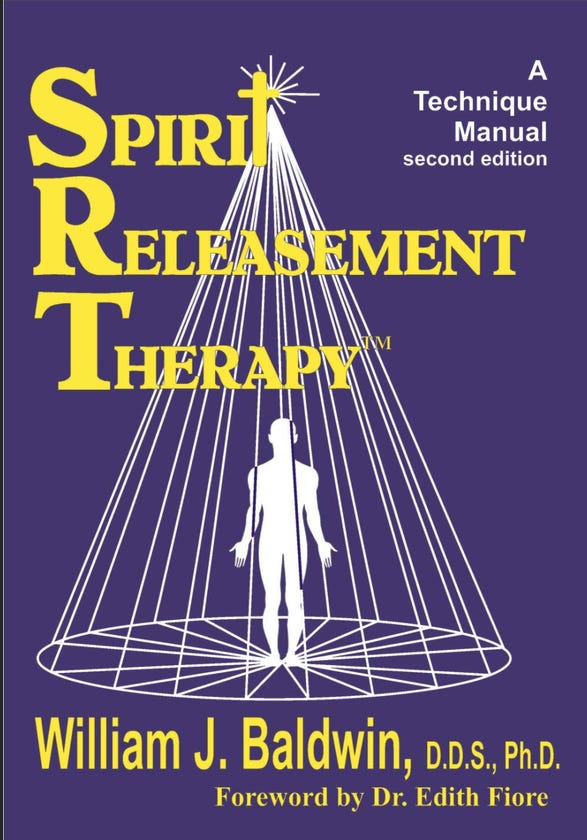
William J. Baldwin, a dentist-turned-hypnotherapist, developed Spirit Releasement Therapy (SRT) after roughly 6,000 sessions, estimating 70–100% of the population is influenced by discarnate entities at some point, and stressing there is never just one attachment per client. Earthbound spirits (EBs), the most prevalent type, are deceased humans who failed to move into “the Light,” retaining name, gender, age-at-death, and emotions they impose as “residue” on the individual they have attached or invaded. Also in Baldwin’s scheme based on those thousands of sessions, spirits of terminated pregnancies and “mind fragments” of living persons also act detrimentally on the people they attach to. (That should certainly give us pause when you consider the hundreds of thousands, or millions of abortions women have obtained in the past 50 or more years). These entities attach through unfinished business or attraction to a host’s strong emotions of physical injuries or weaknesses. Dark force entities (DFEs) are “the classic demon” — non-human, hostile, and marked by “emphatic refusal to leave.” Baldwin has a category of Extraterrestrials (ETs), “usually nonphysical” despite the label, who he has a specific protocol for detachment; Baldwin’s later work focuses on DFE-ET overlap which doesn’t surprise me since I had a couple of phone conversations with him back in the mid-to-late 90s about this very issue.
Another issue that should make us stop and think in this time of not just sexual freedom, but total sexual abandoment, Baldwin directly addresses sexual contact as a mode of possession in Spirit Releasement Therapy: A Technique Manual. He states: "The openness and surrender during sexual intercourse can allow the exchange of attached entities between two people," treating sex as a channel through which entities can pass from one partner to another, not just a source of vulnerability in the abused partner alone. He treats consensual intercourse and sexual trauma as two distinct but related mechanisms and both can make a personal vulnerable:
Consensual sex as an energetic exchange channel — the mutual “openness and surrender” of intercourse lowers the normal boundary between two people’s energy fields, allowing an entity attached to one partner to transfer to the other.
Sexual abuse as a forced opening — Baldwin states that “sexual abuse such as rape, incest, molestation of any sort creates vulnerability to spirit invasion,” and that “violence during sexual abuse increases the likelihood of intrusion by an opportunistic spirit,” making trauma a more acute, forced version of the same vulnerability seen in consensual exchange.
He repeats this point in his later book Healing Lost Souls: Releasing Unwanted Spirits from Your Energy Body, again pairing “the openness and surrender of individuals during sexual intercourse” (as an exchange channel) with “violence during sexual abuse” as what “opens the way for intrusion by a dark force entity” specifically; so in his mature framework, ordinary sex is a potential channel for any attached entity to cross over, while sexual violence specifically opens the door to DFEs (the “classic demon” category).
The sex angle is an added vulnerability/transmission mechanism alongside grief, stress, and substance use connecting Baldwin's clinical vulnerabilities back to older traditions (e.g., the Mesopotamian ardat lilî/incubus-succubus-type figures, or Enoch's own framing of the Watchers' union with women as the vector for demonic corruption). We see that "illicit sexual contact as literal opening for demonic transmission" motif has a real structural parallel.
Across types: migraines, dizziness, tinnitus, chronic fatigue, addictions, personality changes, and rare “inspirational possession.” The universal complaint is energy drain and feeling “invaded, soiled, violated.” New attachments show sudden onset (following surgery, accident, or emotional upset); long-standing ones can produce full amnesic “complete takeover.”
Baldwin devised a protocol to detach possessing entities: (1) Discover all attached entities; (2) diagnose which type is present; (3) dialogue through the client’s voice to find the unresolved need; (4) release into the Light; (5) seal the space with guided imagery; (6) follow-up therapy for the underlying vulnerability. I described this process briefly in my discussion with Jay Campbell on June 21st, 2026.
Here is the X link:

Jay Campbell@JayCampbell333
Part 14: The Alien-Demon Deception: How Humanity Gets Herded https://t.co/M0BCtlXTYv
6:03 PM · Jun 21, 2026 · 2.6K Views
1 Reply · 2 Reposts · 13 Likes
Here is the Webinar Link: https://streamyard.com/tbnkus7rkfww
Baldwin’s earthbound spirits map precisely onto the eṭemmu — both are the confused dead, fixated and unable to transition, attaching through unfinished business or emotional pull. His dark force entities map onto the utukku and kin (Alû, Gallû, Asakku): never-human, hostile, resistant. The clearest divergence is scope: Baldwin’s third category (ETs) has no Mesopotamian equivalent, because Mesopotamia’s third domain was weather-demons (Pazuzu, the Seven, Asakku), entities operating at the scale of climate and epidemic rather than individual attachment. Symptomatically the overlap is striking (headache, fatigue, mood change, unexplained onset in both systems), and both frame causation as functional/vulnerability-based rather than strictly moral. Both, finally, resolve the problem through a trained human specialist engaging an external intelligent agent - the āšipu’s ritual versus Baldwin’s six-step hypnotic dialogue - suggesting Baldwin’s model reconstructs, likely unknowingly, the same demonological logic 1 Enoch absorbed and inverted from the āšipu tradition.
The Cassiopaean Experiment dialogues reframe Baldwin’s “extraterrestrials” as denizens of a hyperdimensional reality within which our 3D (+time) world is embedded: 4th-density “Service to Self” (STS) beings whose ongoing war with positively-oriented “Service to Others” (STO) counterparts periodically bleeds through into our reality as violent weather and geologic events — though the material is careful to note much weather and geology is simply natural. Asked why this “war in the sky” isn’t perceptible, the answer given was that it is “disguised at this point as weather. Fighting part still in other dimension.” Hurricanes were called “a reflection of battles at higher levels,” later extended to earthquakes, floods, fires, and volcanic eruptions (with the caveat that an eruption “could represent the degaussing of a 4D STS being... or just a volcanic eruption”), and technological interventions like HAARP are framed as tools these entities use to intensify such events.
This is a near-exact structural echo of the Mesopotamian material: where the Seven Evil Spirits were directly identified with storms and eclipses, and the Enuma Elish‘s “evil wind” was a weapon in Marduk’s primordial battle, the Cassiopaean framework substitutes an STS/STO war as the hidden mechanism behind weather and geologic upheaval; both systems rejecting purely naturalistic explanation while still allowing for a substantial “natural” residue. Most significantly, this recasts Baldwin’s third clinical category entirely: rather than physical aliens who occasionally attach to human hosts, “ETs” become denizens of an adjacent, superior plane of reality, structurally closer to the Mesopotamian gods and demons inhabiting the heavens and netherworld than to any modern alien-visitor concept. The result is a three-way convergence: the Mesopotamian utukku/weather-demon complex, Baldwin’s clinical DFE/ET categories, and the Cassiopaean 4D-STS framework may be independent attempts, across religion, clinical hypnotherapy, and channeled cosmology, to describe the same posited category of non-human, higher-dimensional intelligence — perceived by embedded 3D observers as either personal affliction or large-scale natural disaster.
Another point that should be made: Baldwin’s own “dark force entity” and “extraterrestrial” categories were separated mainly by his clients’ own framing language, not necessarily by any different underlying phenomenon, and the Cassiopaean sessions reframe “ET” activity as hyperdimensional intrusion rather than physical alien visitation — the same repositioning that would argue Lamaštu, Alû, and the ardat-lilî are pre-modern descriptions of the identical intrusive phenomenon later relabeled “alien abduction” once the cultural vocabulary shifted from religious/demonic to science-fictional. That reframing - same underlying phenomenon, shifting cultural vocabulary across four millennia (demon → ghost → incubus → alien) - looks like a genuinely strong relationship.
Scholarship on this repeatedly stresses that demons in Mesopotamia operated “erratically, affecting both the innocent and the guilty without distinction,” functioning as scapegoats for otherwise inexplicable suffering rather than as agents in a moral drama. Demons are explicitly described as “asocial and amoral,” distinguished from gods precisely because they don’t participate in the reciprocal, moral relationship of cultic offering and obligation that binds humans to deities; they are simply liminal, natural-order phenomena, associated with wilderness, ruins, and chaotic, pre-civilized space. One recent analysis even notes ancient scribes catalogued demons “not by their strength or moral standing... but rather by their geographic environments,” an almost taxonomic, quasi-empirical approach that functions more like ecological classification than theology. From the various comparisons made above, it seems that this is “just the way things are in our reality. Illness itself, Akkadian murṣu, was conceived as a disturbance of equilibrium, not necessarily a moral consequence, and the āšipu’s job was diagnostic and technical - identify which entity, apply the matched countermeasure - much like a physician isolating a pathogen.
That said, the sources do show some nuance worth flagging for accuracy: Mesopotamian theodicy texts could sometimes link illness to a person’s own moral failing (having angered a personal god), so the system wasn’t purely amoral in every strand. But this moral causation, when present, was individualized and transactional - a private breach between a person and their own deity - never expanded into the totalizing, exclusivist, cosmic framework Enoch introduces, where the demons’ very existence stems from a singular primordial angelic sin and only one God possesses the power to purify the earth of them at all. That is the real ontological break: Mesopotamian practitioners diagnosed and treated a recurring feature of reality using a repeatable technical craft available to any trained āšipu, whereas Enoch converts the same phenomena into evidence for a unique salvation-historical claim, monopolizing the “fix” in a way that has no Mesopotamian counterpart and that indeed carries straight through into the later Christian claim that only Jesus can resolve it.
Baldwin’s clinical stance reproduces the Mesopotamian posture almost exactly: he treats attachment as a near-universal, recurring feature of human existence (his estimate that 70–100 percent of people experience it) requiring differential diagnosis and a repeatable technique, not moral judgment of victim or entity. Even his “dark force entities,” the closest analogue to genuinely malevolent demons, are approached procedurally - identify, dialogue, redirect - rather than framed as evidence of a singular fall or requiring an exclusive redeemer. This marks a coherent and sharp divide between two methodologies: a diagnostic/technical tradition (Mesopotamian āšipu, Baldwin) treating spirit-affliction as a recurring structural feature of reality, versus a soteriological/exclusivist tradition (Enoch and its Christian heirs) that re-narrates the same phenomena as a moral catastrophe solvable only through one authorized power.
The Cassiopaean sessions state this principle repeatedly and unambiguously: “knowledge protects, ignorance endangers,” with the explicit claim that “the more knowledge you have, the more awareness you have as to how to protect yourself,” and that “if you strive perpetually to gain and gather knowledge, you provide yourself with protection from every possible negative occurrence that could ever happen”. Crucially, the mechanism given is not passive luck but active perceptual sharpening - knowledge functions as a “shield” precisely because it increases awareness, and the sessions elsewhere warn that disinformation is dangerous specifically because it “diverts your attention away from reality thus leaving you open to capture,” implying the inverse: accurate knowledge keeps attention properly oriented and therefore closes off the vulnerability that hostile intrusion exploits. This maps exactly onto the idea that it’s less a magical force field than heightened situational and cognitive awareness that denies the intruding force the inattention or ignorance it needs to operate.
Enūma Anu Enlil, the great Babylonian celestial-omen series of some 6,500–7,000 entries, systematically catalogued not just observed astronomical events but genuinely impossible ones — eclipses where “the shadow moves in a direction opposite to that which occurs in reality,” or Jupiter “entering” configurations that cannot physically happen. Scholars studying these omen compendia note this pattern is deliberate: the lists include impossible protases because the underlying assumption was that the gods were “not... separable from all possible natural phenomena,” meaning literally any conceivable event - physically possible or not - needed a place in the interpretive system, since the sign-giving power behind reality was not bound by ordinary physical law. Crucially, Babylonian scholars insisted a sign was “not an absolute cause of a coming event, but a warning” that could be averted “by appropriate actions” (namburbi rituals) - meaning the entire omen-cataloguing project functioned exactly like the Cassiopaean model: comprehensive knowledge of every possible (and “impossible”) sign-pattern was itself the mechanism that allowed the danger to be neutralized before it fully manifested. This suggestst that if the source of celestial signs was understood as divine/transdimensional rather than strictly physical, then cataloguing “impossible” astronomical events wasn’t superstition but a coherent response to a cosmology in which the sign-senders weren’t constrained by 3D physical law, precisely the premise the Cassiopaean material makes explicit rather than implicit.
Both systems, separated by roughly three thousand years, arrive at the same underlying epistemic strategy: comprehensive, even exhaustive, cataloguing of anomalous phenomena (including logically “impossible” ones) as a defensive discipline against an intelligence or set of intelligences not bound by ordinary physical constraint. The Mesopotamian scribal-diviners built exhaustive if-then omen lists and reported constantly to the king precisely to maintain maximal situational awareness of celestial/atmospheric irregularity, while the Cassiopaean material frames the accumulation of general knowledge about reality itself as producing the same protective, awareness-generating effect. The āšipu’s protective ritual craft and the omen-scholar’s exhaustive celestial cataloguing may be two branches of the identical impulse - using rigorous, comprehensive knowledge-gathering as the primary defense against a hyperdimensional or trans-physical intrusion - with Baldwin’s clinical diagnostics and the Cassiopaean “knowledge protects” principle representing its modern continuation.
These latter points also highlight the danger of ignorant belief in a savior who can do the work for you. It's like the story of the crocodile skin: you can make wishes, and with every wish it becomes smaller. And, you are told that when it becomes too small, then you die. And, of course, you try, and say 'let me do one more wish...' and that is it. Once you make the choice to ask and not do the work, then it becomes easier and easier and you want more and more... and your own will and force becomes smaller and smaller... The Cassiopaean source has even said: "we are not communicating with you in order to "prove" our existence. If one has faith and is willing to learn, to explore new realms and to discover what will one "day" be commonplace awareness profile, then no "proof" is necessary. If, on the other hand, one is of the opposite psychic orientation, then no amount of proof is adequate." and "Knowledge is power. If we give it to you like Halloween candy, it is diffused."
The fisherman’s-wish/crocodile-skin metaphor and the two quotes together illuminate a coherent critique of savior-dependency that is directly relevant to my argument here.
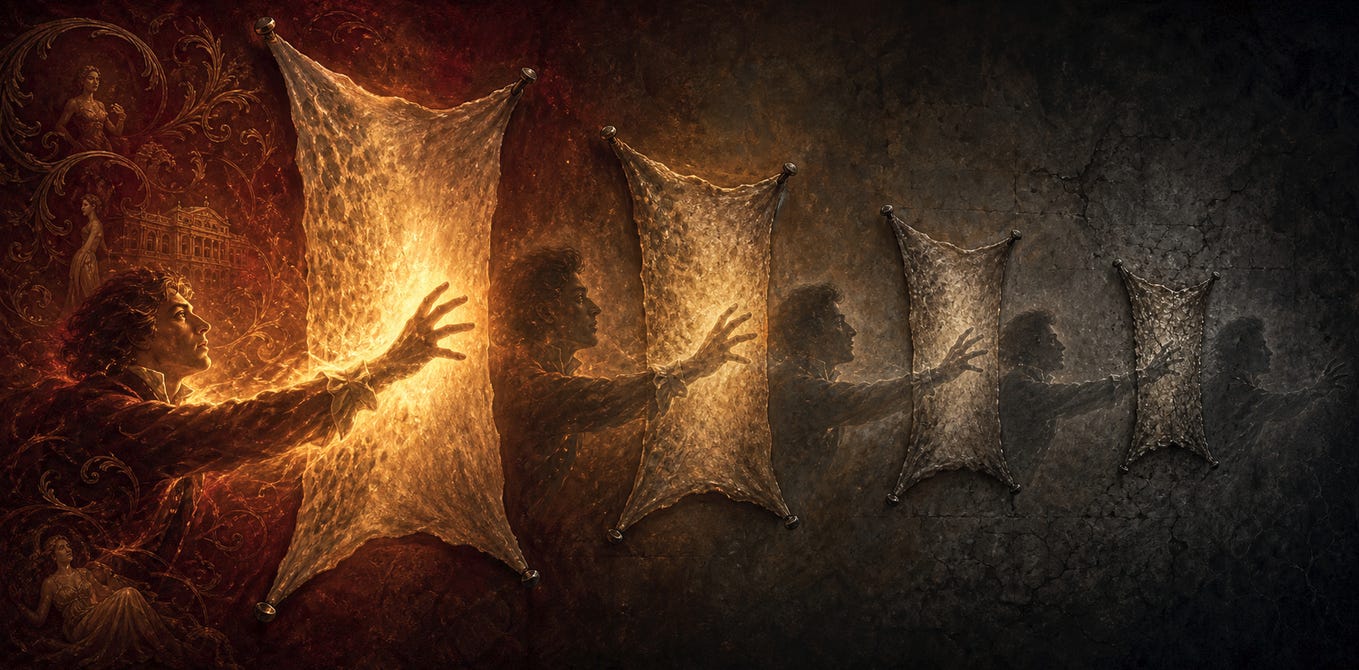
The sessions state explicitly that direct answers are deliberately withheld because they would be disempowering rather than helpful: “we are not here to lead by the hand... some answers are for you to decipher,” and warn that “if we answer for you now, you will be helpless when it becomes necessary for you to perform this function on a regular basis”. This is the crux of the crocodile-skin analogy — every time a “wish” (a shortcut answer, an outsourced solution) is granted rather than earned through one’s own effort, the recipient’s own “power center” atrophies rather than grows, precisely as the source frames it: “if we give it to you like Halloween candy, it is diffused,” and unearned knowledge (or salvation) doesn’t build the muscle that actually protects a person. The sessions elsewhere state flatly that “the only defense needed is knowledge” and that this knowledge “defends you against every possible form of harm,” but the entire framework only functions if the knowledge is actively sought and struggled for, not passively received - learning “increases your power tenfold” specifically because initiative was used, in direct contrast to “asking us for all the answers directly”.
The Cassiopaean source states it does not seek to “prove” its existence, because genuine engagement with reality-exploration renders proof unnecessary for a person of the right orientation, while “no amount of proof is adequate” for someone of the opposite orientation. This functions as a kind of self-selecting gate - the source’s refusal to simply hand over convincing, unearned certainty is structurally the same refusal seen in the “Halloween candy” quote: certainty and salvation obtained without effort or discernment doesn’t actually transform or protect the recipient, and may in fact be sought precisely by the “wrong” orientation (one seeking rescue rather than growth).
This sharpens the divergence already established between the diagnostic/technical tradition (Mesopotamian āšipu, Baldwin, Cassiopaean “knowledge protects”) and the soteriological/exclusivist tradition (Enoch, later Christian doctrine). The āšipu’s craft, the omen-scholar’s exhaustive cataloguing, and the Cassiopaean emphasis on self-earned knowledge all require the practitioner’s active participation and ongoing skill-building — nothing is transferred passively. Enoch’s innovation, by contrast, is to relocate agency entirely outside the human: only God (later, only Jesus) can purify the earth of the demonic problem, meaning the sufferer’s own will, effort, and discernment become largely irrelevant to the resolution. The crocodile-skin image captures precisely what’s lost in that shift — each act of asking rather than doing shrinks the human’s own “will and force,” making dependency self-reinforcing exactly as the wish-granting skin shrinks with each granted wish, until nothing capable of independent action remains. The ancient technical traditions and their modern analogues preserve human agency as the actual mechanism of protection, while Enoch’s polemical inversion — in exchange for a compelling moral narrative — quietly strips that agency away and replaces it with a demand for exclusive faith in an external redeemer.
Going back to the two exorcism models, one being a diagnostic/technical tradition (Mesopotamian āšipu, Baldwin) treating spirit-affliction as a recurring structural feature of reality, versus a soteriological/exclusivist tradition (Enoch and its Christian heirs) that re-narrates the same phenomena as a moral catastrophe solvable only through one authorized power, leads to a few thoughts. The Cassiopaean version advocates knowledge acquisition for everyone as a means of protection and the Mesopotamian/Baldwin versions advocate knowledge acquisition at least for the technician. But the Catholic/other Christian denominations version advocates ignorant belief - "It is God's mystery”. It seems to me that the latter is something like a blunt instrument that probably causes more harm than good. If people were taught from an early age about the dangers of the environment in relation to spirits of different sorts, and that they needed to acquire a great deal of knowledge in order to beef up their personal protection, (and all this is assuming the model is at least 10 percent accurate), then we might live in a very different society.
This isn’t a vague cultural drift - it’s formal canon law. Canon 1172 states that “no one can legitimately perform exorcisms over the possessed unless he has obtained special and express permission from the local Ordinary,” and the 1985 Vatican letter (Cardinal Ratzinger, later Pope Benedict XVI) went further, explicitly forbidding even ordinary laity from “questioning demons directly” or seeking “their identity” in deliverance prayer meetings, even when no formal possession is suspected. A 2020 Vatican-recognized exorcists’ guidebook reinforces this by warning that unauthorized lay attempts “may open the door to further demonic influence” - meaning acquiring and acting on this knowledge without institutional sanction is framed not merely as unhelpful, but as actively dangerous.
The Catechism makes the theological reasoning for this explicit: “It is a great mystery that providence should permit diabolical activity,” and the proper response is not investigation but faith - “we must... approach the question of the origin of evil by fixing the eyes of our faith on him who alone is its conqueror” (Christ). This is a direct doctrinal statement that technical/diagnostic knowledge is not the sanctioned path - trust in the authorized power (Christ, mediated exclusively through the ordained priest-exorcist) is. Notably, one Catholic source even states the Church “does not so much” address evil “through increase of knowledge as through stimulation or re-direction of the will” — an explicit rejection of the knowledge-acquisition model in favor of moral/volitional correction.
The Mesopotamian āšipu and Baldwin both distribute diagnostic competence to trained specialists who actively study the phenomenon (open, cumulative craft knowledge), while the Cassiopaean model goes further and democratizes this to "everyone should acquire knowledge" as personal protection. The Catholic model, by contrast, doesn't just centralize competence in a single authorized channel - it actively discourages the laity from even asking questions of the phenomenon, redirecting them toward submission and faith instead of inquiry. Structurally, this is the same "wishful thinking"/savior-dependency pattern described in a number of Cassiopaean discussion, now backed by literal ecclesiastical law: the individual is told not just that they don't need to investigate, but that doing so without authorization is spiritually hazardous, closing off the self-directed knowledge-acquisition pathway almost by design.
If even a fraction of the phenomena described across the Mesopotamian, Baldwin, and Cassiopaean models are real, then a policy that (a) centralizes diagnostic competence in a tiny, hierarchically-controlled priesthood, (b) discourages ordinary people from developing any environmental/situational awareness of the phenomenon, and (c) frames investigation itself as spiritually risky, would predictably leave the general population maximally undefended compared to either the ancient technical-diagnostic model or the modern "knowledge protects" model. Whether or not one accepts the underlying ontological claims, the comparison of institutional epistemic policy is fully defensible on its own terms — it's simply a fact that one tradition invests in distributed, cumulative diagnostic literacy, while the other invests in centralized authority plus faith, and these produce very different social outcomes regardless of which ontology is ultimately correct.
The reference is to Honoré de Balzac’s 1831 novel La Peau de chagrin (variously translated as The Wild Ass’s Skin or The Magic Skin), part of his La Comédie humaine cycle.
A destitute young man, Raphaël de Valentin, on the verge of suicide, is given a magical piece of shagreen (a type of animal skin, from a wild ass or onager) by a mysterious antique dealer. The skin grants its owner any wish they make, but with every wish granted, the skin visibly and irreversibly shrinks - and the owner’s own remaining lifespan shrinks along with it. When the skin disappears entirely, the owner dies.
Raphaël initially believes he can outsmart the bargain by simply refusing to make further wishes, but he finds himself constantly wishing anyway - sometimes involuntarily, sometimes because desire itself is unavoidable - and watches in mounting horror as the skin (and his life) contracts further each time. The novel becomes a meditation on desire versus willpower: every act of wanting and having one’s want gratified without effort depletes the vital force that could otherwise have been used to pursue those same ends through genuine will and labor. Raphaël’s tragedy is that possessing unlimited wish-granting power actually destroys him faster than ordinary struggle would have, since it removes the necessity - and thus the exercise - of his own agency.
A power that grants outcomes without requiring effort doesn’t merely fail to help - it actively consumes the very capacity (will, life-force, agency) that would otherwise have sustained and protected the person, which maps directly onto the problem of savior-dependency displacing self-directed knowledge-seeking.
There is a broader “wishing skin” motif in folklore (e.g. the tale literally titled “The Wishing Skin,” where a fairy-woven skin grants wishes and shrinks with each one). That kind of tale could easily be retold with the skin imagined as crocodile rather than donkey/shagreen, especially in oral or teaching contexts where “crocodile” is more vivid or culturally resonant.
The Cassiopaean transcripts describe wishful thinking as a specific cognitive failure mode: “The STS mode always adopts the Wishful Thinking of ‘that won’t happen to me! I’m an exception!’”. The sessions elaborate this at length through a striking density-based explanation: STS beings on a higher level (4th density) “see only what they want to see” rather than objective reality as it actually is, and this selective, self-flattering perception is called “the highest manifestation possible of that which you would refer to as wishful thinking”. Crucially, the source notes that “wishful thinking represented on the fourth level of density becomes reality for that level” — meaning at higher densities, subjective wanting starts to substitute for and distort objective awareness in a way that has real consequences, whereas for us (3rd density) it “isn’t quite reality” yet, but is evidently still a dangerous rehearsal of the same pattern. The broader reading of this frames wishful thinking alongside “desires, wants, motivation, taking energy and not giving any back” as a cluster of traits that collectively “feed the STS dynamic”.
Where Baldwin, the Mesopotamian āšipu, and the “knowledge protects” principle all require active, objective engagement with reality - diagnosing what’s actually happening rather than what one wishes were happening - wishful thinking is defined as the inverse operation: substituting a self-flattering fiction for objective assessment. The crocodile/magic-skin story and the savior-dependency critique both dramatize exactly this failure: Raphaël’s wish-granting skin lets him get what he wants without confronting reality’s actual demands, and it destroys him; likewise, “asking a savior to do the work” is a form of wishful thinking — assuming reality will bend to accommodate one’s desire for rescue rather than requiring the effortful, reality-testing labor (research, self-examination, skill-building) that both the Cassiopaean material and the diagnostic exorcist traditions insist is the only real form of protection. STS orientation, savior-dependency, and wishful thinking are all structurally the same move - preferring a comforting subjective narrative over the harder work of objective, knowledge-based engagement with a genuinely intrusive and complex reality.
In many ways, scientific materialism is the modern incarnation of one side of the old conflict between the flesh and the Spirit, to use Paul’s terms, only taken to new extremes. Often not explicitly formulated or even acknowledged, this belief system is based on the idea that the material world is all there is, and everything else – consciousness in particular – is derived from it, a mere side effect. What’s more, it is often assumed that the physical world is causally closed, which implies that our free will is just an illusion. But for this belief system to make any sense, if only superficially, its proponents need their own creation myth to explain the complexity of human life, experience and consciousness: enter Darwinism. A random material universe, so the story goes, is somehow capable to produce life by chance; the complexity of our experience, including our so-called illusion of having free will, so the story continues, is just a product of selecting ‘advantageous’ traits over long time spans. Never mind that if the physical universe is causally closed and we have no free will, then our consciousness is entirely useless and certainly not advantageous for survival.[1] But if we have free will, that is, if our minds can somehow break the causal chains of the strictly physical world, then there must be something seriously wrong with materialist doctrine.[2]
But the materialists are determined to hold the line against any single acknowledgment of any process that is not totally random, accidental, and material. Evolution is their gospel, Darwin their savior. Their story is that the Big Bang was the explosion of a primal atom, and all matter in the Universe was in this incredibly dense atom. Everything that has happened since is just the result of random jostling of particles that, over billions of years, may form affinities by accident, and different forms of matter arise. Eventually, some of this matter jostles against some other bit of matter, some sort of electrical (or other) interaction takes place, and that is ‘life.’
But make no mistake about it! The Big Bang theory is Creationism. Materialists believe that matter sprang suddenly into existence with nothing prior. That primal atom was there, and they make no attempt to explain it. That’s exactly the same as saying ‘God was just there’ and decided to create the universe. Archeologist Steven Mithen writes:
Creationists believe that the mind sprang suddenly into existence fully formed. In their view it is a product of divine creation. They are wrong: the mind has a long evolutionary history and can be explained without recourse to supernatural powers.[3]
As you can see, Mithen is arguing from as false a premise as the ‘God-did-it-in-six-days’ gang. He has already made a big leap of assumption that when anyone speaks about ‘mind’ they are speaking exclusively about a mind that is tied to a physical body. It apparently never occurs to him that pure consciousness is what is meant by ‘mind’ and not masses of neurons talking to each other with chemical and electrical signal systems. The very idea that consciousness might exist prior to matter is anathema to the materialists, yet that very idea in its most basic form is being discussed in recent years as the foundation of all existence in the form of pure information. At the same time, a close study of the matter reveals that many scientists involved in biochemical research have actually gutted classical Darwinism and some of them are coming forward and saying so plainly.[4]
Proponents of Darwinism or neo-Darwinism insist that there are clear distinctions between science and religion. Indeed, there are obvious differences in the style and content of a laboratory experiment and a claim to divinely revealed knowledge. Materialists say that science is concerned with knowledge of the proven and visible, while religion is concerned with mindless faith in the unprovable and invisible. And yet, when the facts are known, one must ask: is natural selection really a proven system based on demonstrated knowledge, or is it an unproven hypothesis in which there are so many contraindications that belief in it is also, in the final analysis, only a matter of faith? Natural selection is no more visible than a Deity and, frankly, less likely to do what is claimed than supernatural intervention!
Evolutionists are often found taunting those who think that something higher is involved in our existence – that their miracles of special creation can, by definition, be neither proved nor disproved. Yet the evolutionists arrive at similar propositions, especially when they exclude any possibility of something that guides and propels evolutionary processes. The main difference between the believers in miracles of special creation and believers in accidental variations is that the former has God Almighty pulling the strings and the latter has only impossible probabilities of jostling atoms and molecules as its ultimate reality. Not much difference, eh?
The late Weston La Barre, professor of anthropology at Duke University, was consumed with ideological fervor against the ‘enemy’ and wrote that all religions other than evolution are maladaptive retreats from reality. When considering the Platonic philosophy which holds that ideas, forms, patterns, types and archetypes have an existence and reality of their own and would, therefore, seem to have an obvious relevance to evolution and the origins of species, he regularly compared Plato to Adolf Hitler. He neglected to mention that Hitler was a confirmed – even extreme – Darwinist, believing that man evolved from monkeys, a proposition that Plato would have considered absurd.
The writings of many great researchers, including physicists and mathematicians, suggest that Plato was correct and that there are immaterial realities independent of physical brains, and more. The evidence for this is actually more considerable than the rags and tatters of evidence glued together to attempt to validate macroevolution. And, of course, this means that the advocates of materialistic Darwinism are the ones who are laboring under one of history’s greatest delusions.
Quantum physics indicates that not only does ‘matter’ seem to dissolve into patterned vibrations at the most fundamental levels, it has become apparent that there is a structuring role played by consciousness, by information.[5]
There is now much accumulated evidence that mind does exist separate from the physical brain and that phenomena such as telepathy, psychokinesis, and other so-called paranormal effects are not only demonstrable, they conform to models of the universe with non-local causes. In the fields of mathematics and physics, the world has changed under the material evolutionist’s feet and there is much more to our reality than the naive realism upon which neo-Darwinism is based. The fact that most contemporary evolutionists still cling to the old-fashioned, crude and mechanical theories in spite of the well-known developments in other scientific fields is more proof of the religious character of their beliefs.
And here we come to an interesting idea: the difficulty for both believers in purely mechanistic evolution and the creationists is that any cosmology that is sufficiently explanatory of the phenomena we observe in our universe has deeper dynamics and implications.The evolutionists and creationists both seem incapable of the truly abstract, subtle thinking required to parse these implications. It is as though both types are confined within a set of cognitive restrictions that drive their perceptions, experiences and priorities.
[1] Karl Popper argues this point in some depth; see Karl Popper and John C. Eccles, The Self and Its Brain: An Argument for Interactionism (Routledge, 1984).
[2] For a thorough philosophical refutation of materialism in general, see for example Thomas Nagel, Mind & Cosmos: Why the Materialist Neo-Darwinian Conception of Nature Is Almost Certainly False (Oxford University Press, 2012); David Ray Griffin, God Exists But Gawd Does Not: From Evil to New Atheism to Fine-Tuning (Process Century Press, 2016); Bernardo Kastrup, The Idea of the World: A Multi-Disciplinary Argument for the Mental Nature of Reality (Iff Books, 2019); Rupert Sheldrake, Science Set Free: 10 Paths to New Discovery (Deepak Chopra, 2013).
[3] Steven Mithen, The Prehistory of the Mind (Thames & Hudson, 1999).
[4] See, for example, Michael J. Behe, Darwin’s Black Box: The Biochemical Challenge to Evolution (2nd ed., Free Press, 2006), The Edge of Evolution: The Search for the Limits of Darwinism (Free Press, 2008) and Darwin Devolves: The New Science About DNA That Challenges Evolution (HarperOne, 2019); David Berlinski, The Deniable Darwin (Discovery Institute, 2010); Stephen C. Meyer, Signature in the Cell: DNA and the Evidence for Intelligent Design (HarperOne, 2009) and Darwin’s Doubt: The Explosive Origin of Animal Life and the Case for Intelligent Design (HarperOne, 2013); Matti Leisola and Jonathan Witt, Heretic: One Scientist’s Journey from Darwin to Design (Discovery Institute, 2018); and the references in footnote 10 above.
[5] Florin Gaiseanu, Informational Model of Consciousness: From Philosophic Concepts to an Information Science of Consciousness (Philosophy Study, April 2019, Vol. 9, No. 4, 181-196 )
Scientific materialism as “the modern incarnation of one side of the old conflict between flesh and Spirit” is structurally accurate to how philosophers like Nagel and others have criticized the current neo-Darwinian synthesis: a causally closed physical universe, consciousness as epiphenomenon, and free will reduced to illusion. Once you take that seriously, you’re forced to build a creation story that explains complexity and subjectivity without any guiding principle - hence Darwinism as a functional myth of origins, complete with axioms accepted on faith (e.g. brute emergence of life and mind from random jostling plus selection) just as “God was just there” is accepted on faith in classical creationism.
The contrast between “Big Bang as primal atom out of nothing” and “God creating ex nihilo” highlights the formal symmetry: both stop at an unexplained ultimate given. The materialist’s refusal to admit this as a metaphysical stance doesn’t change the fact that, structurally, it is a creationism — just with “primal atom and laws” in the slot where the older myth puts “God.”
Mithen assumes “mind” means only mind-as-brain, whereas I, and a growing number of information-theoretic and consciousness researchers, explicitly aim at “pure consciousness” or mind-as-fundamental - which is now being reintroduced in modern guise as information or consciousness as the primitive ontological category. When we consider this, we notice 2 things:
Enoch’s polemical re-write that collapses all “higher” guidance into one jealous God.
Cassiopaean and similar frameworks that recast “mind” and information as structurally prior to matter.
Quantum physics ends up dissolving “matter” into patterned vibrations with a structuring role for consciousness/information; it’s exactly this that causes us to revisit the demon/omen/knowledge-protects framework in non-naive terms.
The comparison between natural selection as invisible, unobservable “mechanism” and a hidden deity is sharp and philosophically to the point: both function as explanatory black boxes, and both are defended with a zeal indistinguishable from religious commitment when counter-evidence or conceptual problems are raised. That brings us to consider the following:
Mesopotamian omen cataloguing and āšipu practice: knowledge as a living, constantly updated, pragmatic discipline.
Cassiopaean “Knowledge protects” plus “knowledge is power; if we give it to you like Halloween candy, it is diffused”: knowledge must be earned, tested, integrated, or it doesn’t protect.
Like the Catholic Church, Neo-Darwinian materialism functions as an anti-knowledge stance on certain fronts (e.g. closing off entire domains of evidence as “impossible by definition”), thereby acting more like a dogmatic religion than like the open-ended inquiry it claims to be.
In that sense, insisting the universe is “nothing but” blind matter plus accidental variation is itself a wish - the wish that there is no higher-order structure, no hyperdimensional interference, no non-local mind, and thus nothing beyond what current materialist methods can in principle control.
Scientific materialism/neo-Darwinism is the latest Enochian move: a totalizing narrative that denies any non-material agency, denies any legitimate role to demon/ghost/hyperdimensional discourse, and yet sits structurally in the same slot as the old creation myths it claims to have displaced. Against that, both the Mesopotamian omen-scholars and the Cassiopaean declaration that “knowledge protects” appear not as regressions, but as different attempts to inhabit a cosmos where mind, information, and non-local causality are real features to be studied rather than denied.
Scientific materialism is the latest “flesh side” of Paul’s old “flesh vs. Spirit” dichotomy, now claiming the mantle of neutrality and inevitability. The irony is that materialist evolutionists insist their story is the opposite of religion, yet it functions as a faith commitment to a closed, purely physical cosmos in which any hint of non-local mind or hyperdimensional agency is ruled out a priori. Where the Mesopotamian, Enochic, and Cassiopaean frameworks all assume some form of trans-physical influence (demons, angels, hyperdimensional beings), scientific materialism responds by declaring the entire class of phenomena impossible - effectively another kind of wishful thinking: the wish that only what current methods can measure with 3 D instruments and control is real. This makes materialism, too, a savior myth of a sort: the “savior” is a totalizing narrative of blind matter that promises to explain everything without ever confronting the anomalies that gave rise to demonology, parapsychology, or hyperdimensional frameworks in the first place.
The Mesopotamian demon lists (Utukkū Lemnūtu, Alû, Gallû, Lamaštu, Lilû, ardat-lilî, etc.) are the earliest systematic attempt we know of to classify intrusive intelligences and their modes of attack, and to respond with a disciplined, knowledge-based craft. Enoch was a historical pivot that moralized and monopolized this material under a jealous monotheism. Modern parapsychology and Cassiopaean-type experiments - as well as the daily experiences of multiplie millions of people - are evidence that the underlying phenomena (possession, intrusion, anomalous weather/events) continue, and that the technical, knowledge-centered response has never entirely disappeared.
What is needed now is neither a nostalgic return to Mesopotamian ritual, nor a naïve embrace of any channelled cosmology, nor blind faith in a materialist creation myth. Rather, we need a renewed, honest version of what the āšipu and the Babylonian omen-scholars were already doing: systematic observation, disciplined cataloguing of anomalies, ruthless avoidance of wishful thinking, and a commitment to the principle that “knowledge protects” - not because knowledge flatters us, but because it forces us to see, and respond to, reality as it actually is.
Drawnel, Henryk. “The Mesopotamian Background of the Enochic Giants and Evil Spirits.” Dead Sea Discoveries 21, no. 1 (2014): 14–38.
The central 2014 article: argues 1 Enoch 7:2–5 and 15:8–11 model the giants and their post-mortem spirits on the utukku demons of Utukkū Lemnūtu, displacing the older “giants = historical warrior-kings” reading. This is the anchor text for articles one through three and for your planned fourth.
Drawnel, Henryk. “Knowledge Transmission in the Context of the Watchers’ Sexual Sin with the Women in 1 Enoch 6–11.” The Biblical Annals (Roczniki Biblijne) 2, no. 1 (2012): 123–151.
The companion technical study behind the deeper argument covered in this thread: identifies the Watchers specifically with the historical āšipu (not the apkallū), traces the pre-diluvian setting to the āšipu’s own claimed apkallu genealogy, reads the “sexual sin” as a metaphor for illegitimate knowledge-transmission, and contrasts Enoch’s transmission chain with the Mesopotamian myth of Enmenduranki.
Baldwin, William J. Spirit Releasement Therapy: A Technique Manual. 2nd ed. Terra Alta, WV: Human Potential Foundation Press / Headline Books, 1992. Full text PDFpearl-hifi
Baldwin’s founding technique manual: source of the three-part typology (earthbound spirits, dark force entities, extraterrestrials), the six-step releasement protocol, and — most relevant to the sexual-attachment question — his statement that “the openness and surrender during sexual intercourse can allow the exchange of attached entities between two people,” alongside sexual abuse as a distinct, more violent opening for intrusion.
Baldwin, William J. CE-VI: Close Encounters of the Possession Kind. Terra Alta, WV: Headline Books, 1999.
Baldwin’s later monograph focused specifically on the overlap between dark force entities and extraterrestrial attachments — the source for his claim that “ET” attachments are “usually nonphysical,” which is the detail the Cassiopaean material most directly reframes.
Baldwin, William J. Healing Lost Souls: Releasing Unwanted Spirits from Your Energy Body. Charlottesville, VA: Hampton Roads Publishing, 2003.
Restates and refines the typology and the sexual-exchange mechanism for a general audience, again pairing “the openness and surrender of individuals during sexual intercourse” with sexual abuse as “opens the way for intrusion by a dark force entity.”
Knight-Jadczyk, Laura, et al. “HAARP, Weather, Roswell Rods, 4th Density Battles & Bleedthrough...” Compiled session transcripts, Cassiopaea.org, September 15, 2010 (citing sessions of July 30, 1994 and October 7, 1995).
The primary transcript source for the “war in the sky... disguised at this point as weather” exchange and the confirmation that “hurricanes are a reflection of battles at higher levels,” plus the HAARP/”magnetic belt overlay” material used to frame technological intervention within the same hyperdimensional-war structure.
Cassiopaea Session Transcripts Archive. transcripts.cassiopaea.org and
Full searchable transcript archive.
Annus, Amar. “On the Origin of Watchers: A Comparative Study of the Antediluvian Wisdom in Mesopotamian and Jewish Traditions.” Journal for the Study of the Pseudepigrapha 19, no. 4 (2010): 277–320.
The competing position Drawnel argues against — that the Watchers derive from the apkallū sages directly and the giants represent kings — cited in this thread as the view Drawnel’s āšipu-identification supersedes.
Kvanvig, Helge S. Primeval History: Babylonian, Biblical, and Enochic. An Intertextual Reading. Supplements to the Journal for the Study of Judaism 149. Leiden: Brill, 2011. Publisher recordbooks.
The other major scholarly voice Drawnel positions against on the “giants = kings” question; also relevant via Kvanvig’s earlier Roots of Apocalyptic (1988) on the Mesopotamian background of the Enoch figure.
1 Enoch (Book of the Watchers), chapters 6–11, 15. Referenced throughout via Drawnel’s translations of 7:2–5 and 15:8–11 on the giants and evil spirits.
Utukkū Lemnūtu (”Evil Utukku-Demons”). Bilingual Sumero-Akkadian exorcistic incantation series, the primary Mesopotamian comparandum for the utukku demon type, taxonomy, and āšipu counter-ritual discussed throughout.
Enuma Elish. Babylonian creation epic, cited for Marduk’s creation of the “evil wind” as a weapon against Tiamat — the cosmogonic root of the demon-as-weather motif.
Testament of Solomon. Greek pseudepigraphical text, 1st century–medieval.
The primary source behind the “Solomon-as-magus” tradition discussed in article two, describing Solomon’s ring-based command over named demons and the later grimoire lineage (Key of Solomon, Lesser Key/Goetia) it spawned.
Baldwin, William J. “Differential Diagnosis in Spirit Releasement Therapy.” International Journal of Regression Therapy. Accessed 2026. https://regressionjournal.org/jrt_article/differential-diagnosis-spirit-releasement-therapy-william-j-baldwin-is-14/
Baldwin, William J. Close Encounters of the Possession Kind. https://cdn.preterhuman.net/texts/alien.ufo/Baldwin,%20William%20-%20CEVI.pdf
Baldwin, William J. “Report of a Study: Diagnosis and Treatment of the Spirit Possession Syndrome.” International Journal of Regression Therapy, Issue 10. https://regressionjournal.org/jrt_article/report-study-diagnosis-treatment-spirit-possession-syndrome-william-j-baldwin-is-10/
“Spirit Attachment and Human Health.” Scribd. Accessed 2026. https://www.scribd.com/document/226107995/Spirit-Attachment-and-Human-Health
“The Wave Chapter 8: Everywhere You Look, There Is the Face of God.” Cassiopaea.org, May 8, 2010. https://cassiopaea.org/2010/05/08/the-wave-chapter-8-everywhere-you-look-there-is-the-face-of-god/
“Knowledge Protects?” Cassiopaea.org Forum, August 5, 2006. https://cassiopaea.org/forum/threads/knowledge-protects.2721/page-3
“The Voice of Reason During Millennial Madness.” Cassiopaea.org, September 14, 2010. https://cassiopaea.org/2010/09/15/the-voice-of-reason-during-millennial-madness/
“HAARP, Weather, Roswell Rods, 4th Density Battles & Bleedthrough.” Cassiopaea.org, September 14, 2010. https://cassiopaea.org/2010/09/15/laura-answers-questions-from-readers-haarp-roswell-rods-4th-density-bleedthrough-and-7th-density
“The Grail Quest and The Destiny of Man: Part II: The Terror of History.” Cassiopaea.org, February 22, 2011. https://cassiopaea.org/2011/02/23/the-grail-quest-and-the-destiny-of-man-part-ii-the-terror-of-history/
“Questions to Cassiopaeans.” Cassiopaea.org Forum, March 2, 2024. https://cassiopaea.org/forum/threads/questions-to-cassiopaeans.54350/
“Session 19 June 1999.” Cassiopaea.org Forum. https://cassiopaea.org/forum/threads/session-19-june-1999.23949/
“Need Assistance with Interpreting the Channeling Transcripts.” Cassiopaea.org Forum, December 27, 2025. https://cassiopaea.org/forum/threads/need-assistance-with-interpreting-the-channeling-transcripts.53128/page-2
“Jordan Peterson Quotes That Echo The C’s, Gurdjieff, Forum etc.” Cassiopaea.org Forum, February 5, 2018. https://cassiopaea.org/forum/threads/jordan-peterson-quotes-that-echo-the-cs-gurdjieff-forum-etc.45465/
“Apkallū (Seven Sages).” Livius.org. Accessed 2026. https://www.livius.org/articles/concept/apkallu/
“Apkallu (Mesopotamian Pre-Flood Sages).” Satyori. Accessed 2026. https://satyori.com/ancient-mysteries/articles/apkallu/
“Apkallu.pdf.” Scribd. Accessed 2026. https://www.scribd.com/document/452575941/Apkallu-pdf
“Apkallu: The Seven Fish-Cloaked Sages of Mesopotamia.” Gods and Monsters Info, January 26, 2024. https://godsandmonsters.info/apkallu/
“Enki’s Seven Sages (Adapa/Oannes and the Apkallu).” Center for Open Access in Science, Open Journal for Studies in History 7, no. 1. http://centerprode.com/ojsh/ojsh0701/coas.ojsh.0701.03031b.pdf
Gane, Constance. “Apkallu: Composite Beings in Neo-Babylonian Art.” PhD diss. https://reydekish.com/wp-content/uploads/2014/08/apkallu-composite-beings-in-neo-babylonian-art.pdf
“Dedicating Magic: Neo-Assyrian Apotropaic Figurines and the Protection of Assur.” Academia.edu. Accessed 2026. https://www.academia.edu/23733257/Dedicating_magic_Neo_Assyrian_apotropaic_figurines_and_the_protection_of_Assur
“Apkallu: Mesopotamia’s Bird-Headed Sages Before the Flood.” Spoken Past, August 8, 2025. https://spokenpast.com/articles/mesopotamian-apkallu-bird-headed-sages/
“Apkallu-figure Fertilizing the Sacred Tree.” Brooklyn Museum, Object 70574. Accessed 2026. https://www.brooklynmuseum.org/objects/70574
“Apkallu-figure Fertilizing the Sacred Tree.” Brooklyn Museum, Object 70573. Accessed 2026. https://www.brooklynmuseum.org/objects/70573
“Apkallu-figure.” Brooklyn Museum, Object 70571. Accessed 2026. https://www.brooklynmuseum.org/objects/70571
Giovino, Mariana. The Assyrian Sacred Tree: A History of Interpretations. Orbis Biblicus et Orientalis, Book 230. Vandenhoeck & Ruprecht, 2007. https://www.scribd.com/document/488061555/Orbis-Biblicus-et-Orientalis-Book-230-Mariana-Giovino-The-Assyrian-Sacred-Tree_A-History-of-Interpretations-Vandenhoeck-Ruprecht-2007.pdf
“The Ritual Bucket (Banduddû) and Cone (Mullilu) in Neo-Assyrian Iconography: Purification Rituals and Symbolism.” Reddit r/AncientWorld, April 4, 2026. https://www.reddit.com/r/AncientWorld/comments/1scj9t6/the_ritual_bucket_bandudd%C3%BB_and_cone_mullilu_in/
“The Original Context of a Winged Genie.” Academia.edu, December 31, 2014. https://www.academia.edu/27746754/The_Original_Context_of_a_Winged_Genie
“Apkallu Details (Excerpt from Wiggermann).” Samizdat, July 5, 2015. https://therealsamizdat.com/2015/07/05/apkallu-details-excerpt-from-wiggermann/
“Never Opened: The Banduddu as Portable Abzu in Mesopotamian Apkallu Iconography.” Academia.edu, 2025. https://www.academia.edu/165176220/Never_Opened_The_Banduddu_as_Portable_Abzu_in_Mesopotamian_Apkallu_Iconography
“The Standard Inscription of Assurnasirpal II.” ORACC (Nimrud Project), December 17, 2019. https://oracc.museum.upenn.edu/nimrud/livesofobjects/standardinscription/
“Evil.” Catholic Encyclopedia. New Advent. Accessed 2026. https://www.newadvent.org/cathen/05649a.htm
“Exorcist.” Catholic Answers Encyclopedia, November 18, 2018. https://www.catholic.com/encyclopedia/exorcist
“Vatican-recognized Exorcists’ Group Offers Guidelines for ‘Quality Control’.” Crux Now, July 18, 2020. https://cruxnow.com/church-in-europe/2020/07/vatican-recognized-exorcists-group-offers-guidelines-for-quality-control
“Letter to Ordinaries Regarding Norms on Exorcism.” Congregation for the Doctrine of the Faith, Vatican.va, September 24, 1985. https://www.vatican.va/roman_curia/congregations/cfaith/documents/rc_con_cfaith_doc_19850924_exorcism_en.html
Catechism of the Catholic Church, paragraph 1780. Catholic Culture. Accessed 2026. https://www.catholicculture.org/culture/library/catechism/cat_view.cfm?recnum=1780
Catechism of the Catholic Church, paragraph 1764. Catholic Culture. Accessed 2026. https://www.catholicculture.org/culture/library/catechism/index.cfm?recnum=1764
“A Catechism Lesson: Discouraged by Evil and Sin? Take Heart!” Catholic Digest, August 24, 2023. https://www.catholicdigest.com/from-the-magazine/from-the-catechism/a-catechism-lesson-discouraged-by-evil-and-sin-take-heart/
Geller, Markham J. Evil Demons: Canonical Utukkū Lemnūtu Incantations. SAACT 5. Helsinki: Neo-Assyrian Text Corpus Project, 2007; expanded as Healing Magic and Evil Demons: Canonical Udug-hul Incantations. Berlin: De Gruyter, 2016 (open access). Open-access translation of the entire Utukkū Lemnūtu series — the primary text Drawnel draws on and the natural citation for any direct quotation of the incantations themselves.
Wiggermann, Frans A. M. Mesopotamian Protective Spirits: The Ritual Texts. Cuneiform Monographs 1. Groningen: STYX Publications, 1992. Publisher recordbooks.google
Foundational study of the ritual apparatus (protective figurines, amulets) the āšipu deployed against demonic intrusion — useful background for the “counter-force” material.
Scurlock, JoAnn. Magico-Medical Means of Treating Ghost-Induced Illnesses in Ancient Mesopotamia. Ancient Magic and Divination 3. Leiden: Brill/Styx, 2006. Reviewmuse.jhu
The standard reference on the ghost (eṭemmu)/demon overlap and its medical treatment, directly relevant to the “ghosts as a subset of the demonic” material covered in this article.
Comments
Nothing yet. Say the first thing.
Sign in to join the conversation.