
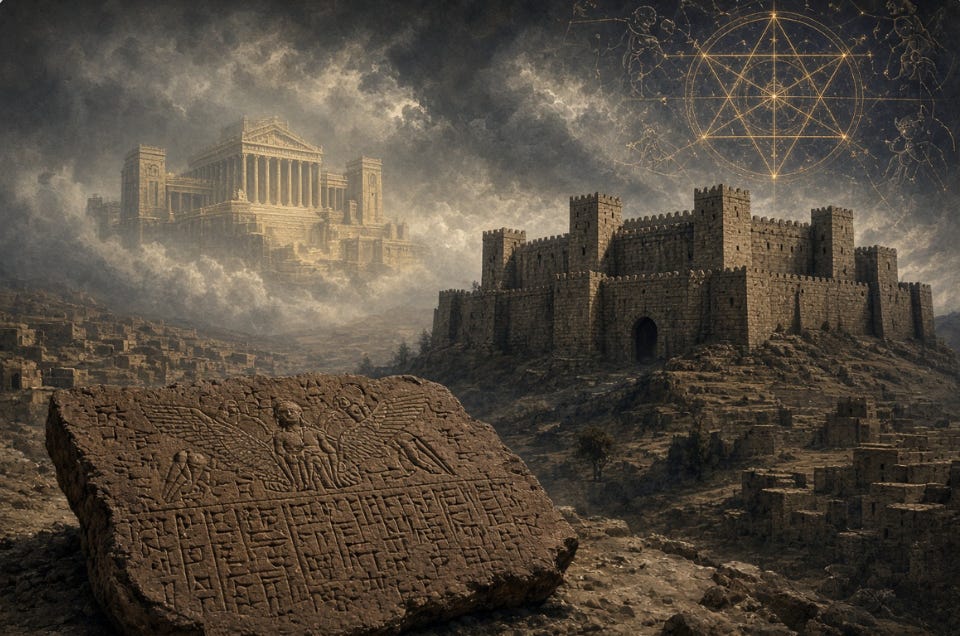
In the previous post, I traced how Babylonian epistemology — the idea that reality is a system of signs to be decoded rather than simply observed — was carried into modern occultism largely through the Books of Enoch, whose giants and demons were built directly on Mesopotamian models. That is to say, more precisely, Enoch was the key conduit/transmission point in a much longer and more convoluted chain (Babylon → Enoch → Jewish mysticism → Christian/Kabbalistic/Hermetic streams → Renaissance occultism → modern esotericism), not the sole origin of the transformation itself. There was more twisting and layering as we will see.
In this continuation, I will follow the trail from Mesopotamian scholarship through the Books of Enoch into the Solomon-as-magus tradition that later occultism still leans on. I will suggest strongly, based on comments by Drawnel, that the Book of the Watchers deliberately inverted Babylonian learning into demonic corruption, while biblical writers later transferred the real achievements of Omri and Ahab onto a largely fictional (and farcical) Davidic-Solomonic empire centered in a near-empty Judah. The result was a cleverly deceptive counter-history that both appropriated foreign knowledge and demonized its sources—leaving later Jewish, Christian, and esoteric traditions with a profound deficiency in understanding what the Mesopotamians really achieved and how it could benefit humanity.
To get us started, I want to go back to Drawnel’s paper with which we began the previous article. In his Conclusion section, he writes:
“The overlapping of the presentation of the giants and evil spirits in the Enochic Book of Watchers with the bilingual Utukkū Lemnūtu incantation series allows one to fruitfully interpret one tradition in the light of the other. When constructing his demonic world, the Jewish author based the functional description of the evil spirits on the destructive function of the demonic forces in the Mesopotamian tradition. […]
“It is difficult to explicate unequivocal reasons for the modeling of the giants on the Mesopotamian demonic beings, but in the context of 1 En. 6:11 one possible suggestion may be proposed. In recent scholarship attention was drawn to the Mesopotamian origin of the Enochic Watchers, whose “scientific” competence overlaps with that of the Mesopotamian āšipu. It seems that the strong antithetic relationship between the the Mesopotamian enchanter, the āšipu, and the demonic realm in the Mesopotamian religion might have been translated in the Enochic myth into a strong positive and generational relationship between the Watchers and the giants. (1 En. 7:1-2) The consequences of such a change are devastating for the priestly āšipu, depicted in the Enochic myth as the fallen Watchers; those who in Mesopotamian culture and literature used their knowledge and magical crafts to expel demons and heal the patient are presented as the main cause of the existence of the demonic world. The implication of such an approach is a negative assessment of Babylonian culture and religion in matters related to the elimination of demonic influence in the world. Only the punitive intervention of God and his angels (1 En. 1):1-14) saves the world and humanity. Such a perspective presents the God of Israel and his angels as the exclusive and efficacious powers able to eliminate the demon existence and purify the earth.
FN: The Mesopotamian āšipu are never associated with harmful demonic activity except to oppose it. However, the Enochic myth written by a Jewish writer, most probably in Mesopotamia, did not intend to extol the work of the Babylonian enchanter but to criticize it. …Criticism directed against the main representative of Babylonian scholarship in Late Babylonian period was a necessary step to accept some parts of Mesopotamian astronomical knowledge within the structure of the Jewish religion. The Watchers/āšipu are accused of generating the demonic giants in the same way as they are accused of witchcraft and hate-producing charms. This negative assessment continues in the Aramaic Book of Giants, where Gilgamesh and Humbaba, two famous heroes of the Mesopotamian Gilgamesh epos, are presented as demonic giants doomed to Extinction.”
In other words, it looks like the author of that section of the books of Enoch took what was (at the time) a fairly scientific, scholarly enterprise and turned it into a farrago of lies.
Now, it can be argued that the author of the Book of the Watchers was probably not trying to deceive readers about an established science of long duration. He was recasting rival or foreign prestigious knowledge as illicit, corrupting knowledge within a Jewish apocalyptic theology.
That is something that has always bothered me about the Book of the Watchers, how the knowledge that was given to humanity was described as corrupting. The main passage is 1 Enoch 8:1–3 in the Book of the Watchers. (R. H. Charles translation):
1 And Azazel taught men to make swords, and knives, and shields, and breastplates, and made known to them the metals of the earth and the art of working them, and bracelets, and ornaments, and the use of antimony, and the beautifying of the eyelids, and all kinds of costly stones, and all colouring tinctures.
2 And there arose much godlessness, and they committed fornication, and they were led astray, and became corrupt in all their ways.
3 Semjaza taught enchantments, and root-cuttings, Armaros the resolving of enchantments, Baraqijal taught astrology, Kokabel the constellations, Ezeqeel the knowledge of the clouds, Araqiel the signs of the earth, Shamsiel the signs of the sun, and Sariel the course of the moon.
The author of this portion of the Books of Enoch does not distinguish harmless scholarly knowledge from harmful uses of knowledge. It gathers weapon-making, cosmetics, magic, plant knowledge, astronomy, cloud knowledge, and lunar knowledge into a single category of forbidden revelation and moral ruin. Knowledge that arose from and belonged to to serious Mesopotamian learned disciplines—metallurgy, astronomy, observation of clouds and celestial cycles, herb knowledge—is described as knowledge illicitly delivered by rebellious heavenly teachers. Enoch treats astronomy, technical knowledge, and learned Mesopotamian traditions as the gifts of corrupt angels. This was - and is - a powerful polemical distortion.
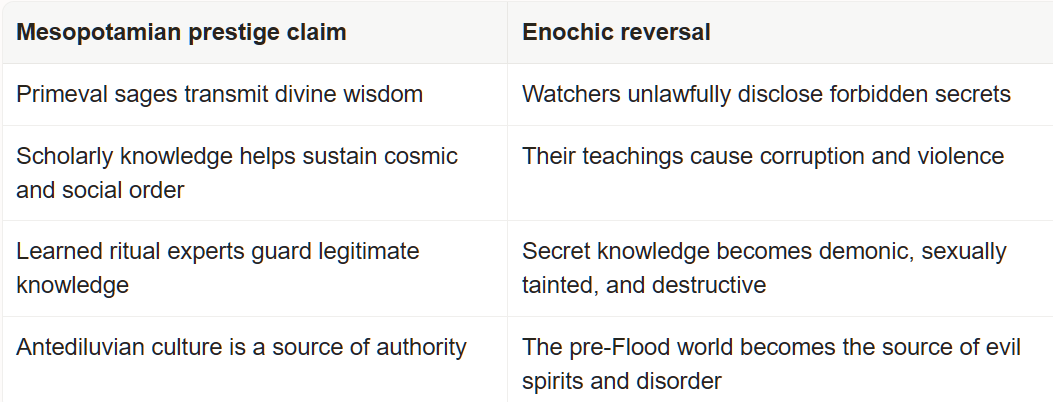
In short, the Book of the Watchers is essentially a theological argument about who owns legitimate knowledge. Enoch keeps revelation, cosmology, and wisdom—but transfers their rightful custody to Enoch and the God of Israel, while depicting a Mesopotamian body of expertise as the consequence of angelic rebellion. The confusing factor that leads people astray is that the Enochic authors still valued astronomy and cosmic knowledge intensely. The Astronomical Book itself uses Mesopotamian-derived astronomical structures, but presents them as the legitimate revelation given to Enoch, not something derived from thousands of years of Mesopotamian science.
The author of the Book of the Watchers appropriated elements of an advanced Mesopotamian scholarly culture while polemically reversing their value: what Babylonian tradition could present as ancient, divine, civilization-making wisdom is recast as illicit teaching by fallen beings that produces violence, exploitation, and corruption. That makes Enoch less a straightforward historical source for what happened before the Flood and more a politically charged counter-history—one that may help explain why later Jewish, Christian, and occult traditions inherited both Mesopotamian knowledge and a profound, almost schizophrenic suspicion of it.
But, as usual, there is way more to the story.
A great deal of “Magickal” lore nowadays is attributed to the wisdom of the great king Solomon. (Think: Masons.) And here is where we discover another tricky maneuver that amounts to ancient Jews planting a flag on someone else’s territory.
In the Hebrew Bible Solomon is famed for wisdom; in late Second Temple and early Jewish apocalyptic texts, that wisdom begins to include power over spirits and exorcism, as seen in fragmentary Qumran psalms and early references where Solomon’s name is invoked against demons.
By the first few centuries CE, the pseudepigraphic Testament of Solomon presents him explicitly as a magician who commands demons through a ring (the Seal of Solomon), catalogs them, and uses them to build the Temple—a proto‑grimoire blending demonology, angelology, and ritual power.
In Jewish mystic lore, the Seal of Solomon (ring/hexagram/pentagram) gives Solomon power over shedim (demons) and jinn, and the ability to speak with animals.
Islamic tradition, borrowing from Jewish lore also develops Solomon (Sulaymān) as a master of jinn and occult wisdom, and this image feeds back into medieval Jewish and Christian stories.
So well before Renaissance occultists, there is already a Solomon-as-magus myth in Jewish (and broader Near Eastern) circles. It’s “Jewish” in the sense that it grows from biblical lore and Jewish pseudepigrapha, but it’s also shared and elaborated in Christian and Islamic cultures.
When we get to medieval and Renaissance magic, this becomes especially relevant.
Grimoires like the Key of Solomon, Lesser Key of Solomon (Lemegeton), and many other “Solomonic” texts are not literally written by Solomon; they are composite Latin (and vernacular) works drawing on Jewish, Christian, and Arabic magic. Scholars agree the Solomonic authorship is pseudonymous, used to give the material scriptural authority and prestige. These grimoires embed:
· Jewish angelology and demonology (often via Kabbalah and Midrash).
· Arabic astrological and planetary magic (itself rooted in Babylonian and Hellenistic astral science).
· Christian liturgical elements (psalms, invocations of Christ and saints).
The Solomon label is a way to weave these strands into a single story: “this is the ancient wisdom of the great king and magus.”
The hexagram/star symbol that later becomes the Star of David starts as Solomon’s Seal, a magical emblem used in practical Kabbalah and amulets from at least late antiquity. (For more detailed information about the origins of the “Star of David”, see my book “The Horns of Moses”. It is available on amazon. In addition, I’ll try to write something about it on substack when I get around to it.)
Later occultists didn’t invent Jewish ownership of occult wisdom, but they leaned heavily on the Solomon myth—already developed in Jewish and related traditions—to give their practices scriptural legitimacy and a clear, venerable “Jewish” anchor, even while those practices rested on a much older Babylonian and Hellenistic astral‑magical infrastructure.
The problem of the lack of outside validation of the existence of Israel as a sovereign nation in the area of Palestine finds reverse correspondence in the Bible itself. As Donald Redford points out, the Bible displays absolutely no knowledge of Egypt or the Levant during the 2nd millennium BC. The Bible says nothing about the Egyptian empire spreading over the entire eastern Mediterranean (which it did); there is no mention of the great Egyptian armies on the march (which they were); and no mention of marching Hittites moving against the Egyptians (which they did); and especially no mention of Egyptianized kinglets ruling Canaanite cities (which was the case).
The great and disastrous invasion of the Sea Peoples during the second millennium is not even mentioned in the Bible. In fact, Genesis described the Philistines as already settled in the land of Canaan at the time of Abraham!
The names of the great Egyptian kings are completely absent from the Bible. In other places, historical figures that were not heroic have been transformed by the Bible into heroes as in the case of the Hyksos Sheshy (Num. 13:22). In another case, the sobriquet of Ramesses II is given to a Canaanite general in error. The Egyptian king who was supposed to assist Hosea in his rebellion of 2 Kings 17:4 has suffered the indignity of having his city given as his name. The Pharaoh Shabtaka turns up in the Table of Nations in Genesis 10:7 as a Nubian tribe!
The errors of confirmed history and archaeology pile higher and higher the more one learns about the actual times and places, so that the idea that comes to mind again and again is that the writers of the Biblical royal history must have lived in the 7th and 6th centuries BC, or later, and knew almost nothing about the events of only a few generations before them. Donald B. Redford, Professor of Near Eastern Studies at the University of Toronto, has published extensively on archaeology and Egyptology. Regarding the use of the Bible as a historical source, he writes:
For the standard scholarly approach to the history of Israel during the United Monarchy amounts to nothing more than a bad attack of academic wishful thinking. We have these glorious narratives in the books of Samuel and 1st Kings, so well written and ostensibly factual. What a pity if rigorous historical criticism forces us to discard them and not use them. Let us, then, press them into service what else have we? and let the burden of proof fall on others.[… ]
While one might be unwise to impute crypto-fundamentalist motives, the current fashion of treating the sources at face value as documents written up in large part in the court of Solomon, arises from an equally misplaced desire to rehabilitate the faith and undergird it with any arguments, however fallacious.[ ]
Such ignorance is puzzling if one has felt inclined to be impressed by the traditional claims of inerrancy made by conservative Christianity on behalf of the Bible. And indeed the Pentateuch and the historical books boldly present a precise chronology that would carry the Biblical narrative through the very period when the ignorance and discrepancy prove most embarrassing. [ ]
Such manhandling of the evidence smacks of prestidigitation and numerology; yet it has produced the shaky foundations on which a lamentable number of histories of Israel have been written. Most are characterized by a somewhat naive acceptance of sources at face value coupled with failure to assess the evidence as to its origin and reliability. The result was the reduction of all data to a common level, any or all being grist for a wide variety of mills.
Scholars expended substantial effort on questions that they had failed to prove were valid questions at all. Under what dynasty did Joseph rise to power? Who was the Pharaoh of the Oppression? Of the Exodus? Can we identify the princess who drew Moses out of the river? Where did the Israelites make their exit from Egypt: via the Wady Tumilat or by a more northerly point?
One can appreciate the pointlessness of these questions if one poses similar questions of the Arthurian stories, without first submitting the text to a critical evaluation. Who were the consuls of Rome when Arthur drew the sword from the stone? Where was Merlin born?
Can one seriously envisage a classical historian pondering whether it was Iarbas or Aeneas that was responsible for Dido s suicide, where exactly did Remus leap over the wall, what really happened to Romulus in the thunderstorm, and so forth?
In all these imagined cases none of the material initially prompting the questions has in any way undergone a prior evaluation as to how historical it is! And any scholar who exempts any part of his sources from critical evaluation runs the risk of invalidating some or all of his conclusions. (Redford, Donald B., Egypt, Canaan, and Israel in Ancient Times, (Princeton: Princeton University Press 1992), pp. 301, 258, 260-1, 263.)
From the earliest times, Israel was composed of a poorly distinguished and variable number of city-states (more like tribal towns) whose population was a melting pot from all areas of the Mediterranean. The specific location that is identified as Israel proper was a more or less backward, rural buffer zone between the civilized Syrians and the nomads of Arabia. The culture of this region was a mixture of the advanced cultures surrounding: Egyptian, Assyrian and Babylonian. These city states rose and fell, fighting each other incessantly. A retrospective view seems to suggest that acquiring plunder was seen as more productive than agriculture. In another sense, these petty wars were seen as the conflict between the gods of one tribe against the gods of another. As we will discover, this concept may not have been too far from the truth.
The books of Samuel tell us that the anointing of David, son of Jesse, as king over all the tribes of Israel was the culmination of the promises that had begun with the covenant between Abraham and God. Never mind that the first choice for king had been the heroic and dashing Saul from the tribe of Benjamin, it was David who became the folk hero of early Israelite history.
The endless stories in praise of King David were claimed by the Bible to be so widespread that it passes understanding how they were not known in the external world of Egypt, Greece, Assyria and Babylon – if they were true. But, as we will discover, perhaps they were – under a different name and title. The only question is: which versions are the most accurate? Did the Hebrews co-opt these stories to their own history, or was there something about their history that was borrowed by the later sources? And in either case, what is the actual historical setting of these stories? Were they an overlay of myth on an actual historical series of events? Or was a historical series of events manufactured out of myth?
In any event, just as Perseus slew the Gorgon and cut off her head, David slew the giant, Goliath. They both had wallets and stones were important elements of both stories. David was adopted into the royal court because he was a famous harpist and singer in the manner of Orpheus. Like Hercules and other Greek heroes, David was a rebel and freebooter, and like Paris stole Helen, he stole another man s wife – Bathsheba. He also conquered the great citadel of Jerusalem and a vast empire beyond.
The stories of David’s son and heir (from Bathsheba), Solomon, tell us that he was the wisest of all kings. He was also the greatest of all builders. The stories tell how he was so brilliant and how his judgments stand as a model for all time. What is more, his wealth was beyond anything else in the known world, and most particularly, he constructed the great Temple in Jerusalem.
For millennia, readers of the Bible have discussed the days of David and Solomon in Israel as though they actually occurred exactly as described. Even people who are not Christian accept that the Temple of Solomon existed, and the plan of this temple has been developed and discussed endlessly by esotericists for centuries. Endless books and legends and secret doctrines have been based on the stories of the Temple of Solomon. Pilgrims, Crusaders, visionaries and even many modern-day books about human origins and the origins of Christianity, have all spread fabulous stories about the magnificence of David’s city and Solomon’s Temple and the supposed treasures contained within. Our entire Western culture has a heavy, vested interest in these stories being true. What are we going to do with this vast body of literature, including such things as Masonic and Magical lore if it turns out that there never was a Temple of Solomon ?
But, the fact is, that seems to be the case. At least, there was no Temple of Solomon in the terms described in the Bible.
One of the first quests of archaeologists in Palestine was the search for the remains of Solomon’s Temple and the great empire of David. It would be tedious to go through all the descriptions of the many excavations, the results, the assumptions, the wild claims of “I’ve found something that proves it!” which were then followed by sober science demonstrating that it wasn’t so. The reader who is interested in deeper knowledge in this area can certainly read both sides of the argument, and then look at the scientific evidence and come to the same conclusion I have: The Kingdom of David and the Temple of Solomon in Jerusalem never existed as described by the Bible, if it existed at all.
Even though there were remains of some sort of kingdom found at Megiddo, Gezer and Hazor, it was later determined that this empire was actually something altogether different than might initially be supposed as we shall soon see. What is important, however, is the fact that the area that was specifically claimed as the homeland of David and Solomon – Judah – was conspicuously undeveloped during the time of the purported empire of Solomon. The facts are that the culture of this region was extremely simple. Based on the evidence of the spade, the land was rural – with no trace of written documents, inscriptions, or even any signs of the kind of widespread literacy that would be necessary for a functioning monarchy. What is more, the area was not even homogeneous. There is no evidence of any kind of unified culture, nor of any sort of central administration. The area from Jerusalem to the north was densely settled, and the area from Jerusalem to the south, the land in question, was very sparsely settled in the time that David and Solomon were supposed to have lived. In fact, Jerusalem itself was little more than a typical highland village. Archaeologically, nothing can be said about David and Solomon. Yet the legend endured. Why?
The important thing to remember at this point is the fact that the evidence supports only a gradual emergence of a distinct group in Canaan at the end of the thirteenth century BC, not a sudden arrival of a vast number of Israelite settlers. And, as noted, the ones who were present in the land were not very organized or civilized in the area that was claimed as the great kingdom of David and Solomon.
Biblical historians and biblical archaeologists have long attempted to take the biblical account of the rise and fall of the united monarchy at face value. They have assumed an original ethnic unity and distinctiveness of the Hebrew people reaching into the primeval past. They took for granted that the united monarchy of David and Solomon, and its tragic collapse, were facts belonging to Israel in terms of the land of Palestine at a particular period in time. Further, it was assumed that, since Judah and Israel, the two kingdoms, had originally been one, when they split, they both inherited fully formed institutions of church and state. At that point, they were believed to have engaged in competition with one another on a more or less equal footing.
However, intensive archaeological work in the hill country of Israel in the 1980s and later put those ideas to rest. Curiously, what the archaeologists found was that there had been three waves of settlement activity. The first was between 3500-2200 BC. The second was around 2000-1550 BC. The third was 1150-900 BC.
During these three periods of settlement activity – periods when new people arrived and left evidence of a distinct cultural norm, the northern and southern kingdoms always seemed to be separate in these terms. The northern settlement system was always dense and possessed evidence of complex hierarchy of large, medium, and small sites. These sites were heavily dependent on settled agriculture.
The southern kingdom, on the other hand, was sparsely settled in small sites, with only evidence of a population of migratory pastoral groups.
During the early period of settlement, these northern and southern regions were each dominated by a single center that was probably the focus of regional politics, economics, and most likely, cultic activity. In the north, it was the area that was later occupied by a city that the Bible calls Tirzah. This became the first capital of the northern kingdom. In the south, the main center was Ai, located northeast of Jerusalem.
In the Middle Bronze Age, there was the second wave of settlement, again, the north was dense and agricultural and the south was sparse – with tiny settlements – and a lot of evidence of wandering pastoralists. But, by now, the central site of cult and economy was Jerusalem – a heavily fortified city that gives evidence of being part of the Hyksos Empire. This matches Manetho’s account of the Hyksos leaving Egypt and building a city and temple in Jerusalem. The only problem is: it’s the wrong date to have been built after the Hyksos left Egypt, so most archaeologists just assume that there was a Hyksos presence in Canaan that was contemporary to the Hyksos in Egypt. Nearby was Hebron; also heavily fortified. In the north, the center of activity had moved to Shechem. Apparently, Shechem possessed significant fortifications and a massive temple.
Regarding this particular period of history, there is also external evidence from Egypt as to who was who and what was what. These consist of what are called the Execration Texts , the Egyptian version of voodoo. The Egyptians would write curses on clay figures of their enemies and then smash them and ceremonially bury them. The idea was, of course, to symbolically smash the object of the curse. What is important about the Execration Texts is that they give us a clue as to who the Egyptians felt to be most threatening. The Execration Texts mention a large number of coastal and lowland cities of Canaan, but only two highland centers: Shechem and Jerusalem. Keeping in mind the probable link between the Hyksos in Egypt and the Canaanites in Palestine, we can conjecture why the Egyptians were feeling so hostile toward Shechem and Jerusalem. The important thing is that the Execration Texts, which purportedly date back to at least 1630 BC, mention Jerusalem, Shechem, and Hazor, but none of them ever mention an entity called Israel.
Another Egyptian inscription, which records the adventures of a general named Khu-Sebek who led an expedition into the Canaanite highlands, purportedly in the 19th century BC, refers to the land of Shechem, and compares Shechem to Retenu which is one of the Egyptian names for all of Canaan. Interestingly, the Egyptians also referred to the Hyksos as “princes of Retenu.” This indicates that as early as 1800 BC there was a territorial entity in northern Canaan and that an important center of this territory was Shechem; further, that it did indeed have a close relationship, at some point, to the Hyksos in Avaris; and it wasn’t Israel.
The Tell el-Amarna letters confirm that there is, at some point late in this period, a southern territory of some significance to Egypt, with the city of Jerusalem as an important center. A number of these letters refer to the rulers of these two city-states – a king named Abdi-Heba who reigned in Jerusalem; and a king named Labayu who reigned in Shechem. Each of them controlled a territory of about a thousand square miles. This was the largest area held by a single local ruler since all the rest of Canaan was divided up into small city-states. It is also curious to note the similarity of these names to Abraham and Laban.
The problem is, as Redford notes, that one has the sinking feeling in approaching this period that a most significant page is missing in the record. And indeed there is.
The bottom line is: archaeological evidence suggests that despite the biblical claims of richness and glory, Jerusalem was little more than a village in the time assigned to David and Solomon. In the interim, during the missing page period, the former fortified city had long since disappeared. In other words, the northern kingdom that was supposed to have broken away from the rule of Jerusalem was well on its way to major state status while Judah had been returned to a condition not unlike a backwater sheep station.
At the same time that the northern highlands were outpacing the southern highlands during all the three periods of settlement, the coastal city-states were leaving both of them in the dust. They were busy, thriving, cosmopolitan, and wealthy. Archaeologists think that what made possible the initial independence of the highlands was the fact that the city-state system of Canaan suffered a series of catastrophically destructive upheavals at the end of the Late Bronze Age. The archaeologists are uncertain as to the cause of this cataclysm, suggesting it to be the invasion of the Sea Peoples or other such propositions. I’ll leave that aside for the moment.
What seems to have happened is that the coastal city-states recovered from the cataclysms, had been rebuilt and were thriving, when suddenly they were destroyed a second time in a rather short period, this time – supposedly – by military onslaught and fire. Whatever it was, the destruction was so complete that the Canaanite cities of the plain and the coast never recovered. The source of this destruction is thought to have been the military campaign of Shishak, founder of the twenty-second Dynasty. This invasion is mentioned in the Bible where it says that “In the fifth year of Rehoboam, Shishak king of Egypt came up against Jerusalem; he took away the treasures of the house of the Lord and the treasures of the king s house; he took away everything. He also took away the shields of gold that Solomon had made.”
Shishak/Sheshonq commissioned a triumphal inscription to commemorate the event on the temple walls at Karnak. This inscription lists about one hundred fifty towns and villages he wiped out in his march to the sea, so to speak. The targets of the Egyptians seem to have been the great Canaanite cities of Rehov, Beth-shean, Taanach, and Megiddo. A fragment of a victory stele bearing the name of Shishak was found at Megiddo. Thick layers of ash and the evidence of the collapse of buildings bear mute testimony to the presumed rage of Pharaoh, which led to the sudden death of the Canaanite territory in the late tenth century BC. There is very little evidence of this assault in the hill country, the main campaign being directed at the cities of the Jezreel valley. If there was a Temple that was plundered by Shishak, it wasn’t in Jerusalem.
Nevertheless, it is suggested that this raid of Shishak’s created an opportunity for the people of the highland to expand into the lowlands at the beginning of the ninth century. Meanwhile, the archaeological records show that, far to the south, Jerusalem continued along as a regime of dispersed villages and pastoral shepherds.
This is the evidence of the spade at the time of the supposed end of the united monarchy around 900 BC.
In the northern kingdom, regional administrative centers were built in the early ninth century. They were heavily fortified and complete with elaborate, luxurious palaces. These cities include Megiddo, Jezreel, and Samaria. Similar constructions appear in the southern territory only in the seventh century. Yet, even when the construction methods moved south, the buildings were smaller and the construction was of a poorer quality.
In short, it can be said that the northern kingdom of Israel, supposed to have been the bad-boy breakaway from the great united kingdom of David and Solomon in the south, was actually a fully developed state while Judah was still a country cousin.
Yahweh was present in both kingdoms, however – among many other cult gods. And it is certain that peoples of both kingdoms shared similar stories about their origins, though in different versions, and they most certainly spoke a similar language. By the 8th century BC, they also both wrote in the same script. The chief thing about them, however, is that the two kingdoms had a different experience of the world around them. Their demographics were different. Their economy was different. Their material culture was different. How they related to their neighbors was different. In short, they actually had quite different histories and cultures.
The question we should like to ask is: why does the Bible tell the story of the schism and secession of Israel from Judah when that is clearly not supported by the evidence of either archaeology or history as known to external sources? Why were the two kingdoms systematically portrayed as twin offspring of a single great empire that was headquartered in Jerusalem? There was a reason, as we will soon see and it was very similar to the reason that the Books of Enoch denigrated the accomplishments of Mesopotamian scholarship and science.
In actual fact, the first great king of Israel was Omri. The Bible gives a very sketchy and confused history of the first period of the Northern kingdom after its supposed defection from unity. The sordid tale of violence and treachery culminates in the suicide of a usurper, Zimri, in the flames of the royal palace at Tirzah. Omri, the commander of the army is invited by the people to become king, and he naturally obliges. It was a good choice. The story carries echoes of the selection of David – a military commander – for kingship over the heirs of Saul.
Omri built a new capital for himself at Samaria and laid the foundations of his dynasty. After twelve years, his son Ahab came to the throne. Ahab made a brilliant marriage to the daughter of the Phoenician king Ethbaal, King of Tyre, so we have again a curious reflection of the Bible story of Solomon and his friendship with Hiram, King of Tyre. Was this Ethbaal the real Hiram? In any event, Ahab built magnificent cities and established one of the most powerful armies in the region. He conquered extensive territory to the north and in the Transjordan, and Israel enjoyed wealth and extensive trade connections. The kingdom of Israel was finally something to notice! However, the character of this kingdom was markedly different from the tiny kingdom of Judah in the South.
Ahab was about the most hated individual in all the Biblical texts. What Ahab did that caused him to be so viciously vilified, according to the editor of the Bible, was that he committed the greatest of Biblical sins: he introduced foreign gods into the land of Israel and caused the priests and prophets of Yahweh to be put to death. What s more, he did it because of the influence of that wicked Phoenician princess he had married: Jezebel.
The Bible dwells long and pruriently upon the sins of this famous couple. Nevertheless, we ought to note that these very same sins were attributed to Solomon who was, however, transmogrified into a southern kingdom monarch, and was, therefore, forgiven even if Yahweh was determined to punish his family. One gets the disorienting feeling that the stories of Omri and Ahab and David and Solomon are, essentially, the same. Jezebel was most especially hated because she tossed the prophets and priests of Yahweh out on their ears. Solomon was also recorded to have ejected the priests of Shiloh, so again, we have a cross connection.
In the Bible, the heroes of the story of Omri and Ahab are the prophets Elijah and Elisha – no doubt priests of Shiloh (which will become quite significant rather soon) – since it was recorded as the home of the prophet Ahijah in 1 Kings, 14:2. A great demonstration of the power of Yahweh is said to have been engineered by Elijah in his confrontation with Ahab, and the result was that the people seized the prophets of the foreign god, Baal, and slaughtered them at the brook Kishon.
Jezebel, naturally, went on a rampage, and Elijah felt it was time to get out of Dodge. He headed for the hills in the wilderness and talked to God on Mount Horeb just like Moses was supposed to have done. Yahweh pronounced a dire prophecy against Ahab, but curiously gave him a few more chances to redeem himself as evidenced by his victories against Ben-Hadad, king of Aram-Damascus. Yahweh, apparently, was willing to relent if Ahab would kill Ben-Hadad. However, Ahab decided to make peace instead, and a treaty was arranged. On and on the account goes, vilifying Ahab and Jezebel. After his death, Elisha anointed another general in the army to be king, Jehu. This guy was more to Yahweh’s liking, apparently, and Yahweh saw to it that Jezebel suffered a terrible death, thrown from a window and devoured by dogs. Jehu then sent for all of Ahab’s sons, (there were reportedly 70 of them), by any number of wives or concubines, and had them all slaughtered and their heads piled up in a mound at the gate of the city to inspire awe and confidence in the new king, not to mention Yahweh.
The Bible says that Jehu brought down the Omrides, yet there is evidence that this is probably not true.
In 1993, an inscription was found that is believed to have been produced by Hazael, king of Aram-Damascus. From the inscription, it seems that Hazael captured the city of Dan around 835 BC and refers to the House of David. Hazael’s invasion was clearly the one that weakened the power of the northern kingdom. The text of the Dan inscription links the death of Jehoram, the son of Ahab and Jezebel, to an Aramaean victory. Hazael boasts:
[I killed Jeho]ram son of [Ahab] king of Israel and [I]killed [Ahaz]iahu son of [Jehoram kin]g of the House of David. And I set [their towns into ruins and turned [their land into[desolation].
This tells us that Ahab was father of Jehoram and Jehoram was father of Ahaziahu, and they were all three of “The House of David.” Thus it is that the likelihood that the violent destruction of the “Solomonic palaces” (Palaces of Ahab, actually) that was long ascribed to the Egyptian raid led by Pharaoh Shishak in the late 10th century BC, actually took place around 835, and was due to Hazael and not Jehu.
Thus ended the Omride dynasty.
Let me emphasize again that the Omride dynasty is referred to by Hazael as the House of David. Why? Was Omri, in fact, the Beloved of Yahweh? Or was the House of the Beloved originally the Beloved of another god?
Nevertheless, we begin to see how Elijah s terrible prophecy on the fate of Ahab was fulfilled: by twisting the facts after the fact. Of course, as we will see, an awful lot of Yahweh’s other prophecies were fulfilled after the fact and only during the writing of the Bible. The invasion of Ben-hadad, who Ahab was supposed to kill and didn’t, and thus angered Yahweh, actually took place much later in the history of the northern kingdom.
So we find, again and again, when the anachronisms and historical inaccuracies are removed from the story, there is really nothing left of the Biblical history of Israel proper except a tedious tale of threats by Yahweh and fulfillment of those threats all designed to establish Yahweh as the Universal God. Never mind that this process includes twisting and distorting the facts all out of recognition.
What the record of the spade shows about the Omrides is a significant kingdom and a time of general prosperity for all. It provides, in fact, a much more modest model of the Davidic and Solomonic kingdom of Israel in all respects except for the worship of Yahweh. That is why it was damned by the writers of the Bible and retold in a new version that promoted Yahweh as the god who had made Israel great, and whose abandonment had brought it to its knees.
The facts are that Israel never achieved anything under the rule of the priests of Yahweh except constant suffering and exile because of rulers who kept shooting themselves in the foot with their two-faced politics and religio-cultural isolationist policies.
The Omrides were a militarily powerful family of rulers reigning over a strong state of the Near East during that period of time. It was only then that the rest of the world began to sit up and take notice of Israel. A stele from this time says that Omri was king of Israel, and he oppressed Moab. Moab was a vassal state of Israel. The stele continues by telling us how Mesha, the king of Moab responsible for the stele, expanded his territory in rebellion against Israel. We learn from Mesha that the kingdom of Israel reached far to the east and south of its earlier domain in the central hill country.
The Bible stresses the Omride s military embarrassments repeatedly, but it seems that they were sufficiently competent that they could assemble a force that impressed the heck out of the great Assyrian king Shalmaneser III, and sent him home in a hurry. Naturally, Shalmaneser boasted of his victory in what is called the Monolith inscription. But it was found in Nimrud, not Israel, which testifies to who really prevailed! The Bible mentions an Aramaean army besieging Samaria; it is clear that it was the Assyrian army and that Israel held their own.
The many archaeological finds in Palestine that were at first loudly proclaimed to have been evidence of the reigns of David and Solomon, actually turned out to be the building projects of Omri and Ahab. Thus it is that if there was a David and Solomon of Israel, it was Omri and Ahab, the dynasty that established the first fully developed monarchy in Israel.
It is evident that the building projects of Omri employed sophisticated earth-moving operations to turn small hilltop settlements into significant fortresses. Where did the power and wealth come from? What occurred to enable the northern kingdom to grow into the Omride state? With the limited resources of the hill country being only sufficient to maintain relatively small towns and villages, what happened to nurture expansion?
Well, as noted, there was a wave of destruction of the cities of the lowlands at the end of the 10th century BC, prior to the destruction of the “Solomonic palaces,” of the Omrides and it is now thought that this opened the way for a strong man with brains and ambition to grab the reins and create an empire. Apparently Omri was such a man. He wasn’t responsible for the destruction of the Philistines, as the Bible claimed about David, but he was certainly the man of the hour who knew when his star was on the ascendant. He expanded from the original hill country into the heart of the former Canaanite territory at Megiddo, Hazor, and Gezer. He enveloped the territories of southern Syria and Transjordan. He established a vast and diverse territorial state that controlled rich agricultural land and held sway over a busy international trade route. What was even more significant: his territory was a multi-ethnic society. This was another reason the authors of the Bible demonized him.
When the northern kingdom of Israel united the Samarian highlands with the northern valleys, it amounted to the integration of several ecosystems including the heterogeneous population. It is very likely that the core territory in the highlands would have identified themselves as Israelites, but the peoples of the lowlands, the valleys, were the indigenous Canaanite population. Farther to the north were those whose ethnicity was Aramaean. Toward the coast, Omri ruled over peoples who were Phoenician in origin. The archaeology shows that the cultural roots of each group were consistent through this period, and thus were apparently not disturbed by Omri. The evidence shows stability in the settlement patterns such that it is evident that Omri did not try to force anything on anybody; not even religious beliefs. He truly united the tribes of Palestine, even if they weren’t, as the Bible suggests, the sons of Jacob united under the divine guidance of Yahweh; they were a diverse and unique mix. And it is very likely this gathering together of different ethnic groups was the real, historical event that was later falsified in the myth of the 12 tribes as actual families of sons descended from Abraham. It seems that this very diversity was the most important factor contributing to the growth and expansion of the Omride dynasty. According to estimates, Israel may have been the most densely populated state in the Levant. Its only rival was Aram-Damascus in southern Syria.
The rise to power of Omri coincided with the general revival of eastern Mediterranean trade. The harbor cities of Greece, Cyprus, and the Phoenician coast were busily involved in trade and commerce, and thanks to Omri, Israel participated. There was a strong Phoenician artistic influence on the Israelite culture, and a great many Cypro-Phoenician style vessels appear in the archaeological strata. This isn’t terribly unusual considering the fact that Ahab married a Phoenician princess.
Conceptually and functionally, the Omride citadels resemble the great Canaanite city-states of the Late Bronze Age. A similar cultural continuity is evident in places like Taanach, where a decorated cult-stand from the 9th century BC displays elaborate motifs of the Canaanite traditions of that time. All of this is interesting, however it creates a problem. From the archaeological perspective, there is nothing particularly Israelite about the northern kingdom at all. In fact, it is only from the Bible that we learn – or are told – that it was an Israelite kingdom, broken away from the Solomonic empire. The true character of the Omride dynasty is that of military might, architectural achievement, governmental sophistication, and cosmopolitan tolerance. But all we learn from the Bible was how much Omri and Ahab were hated.
The Biblical author obviously had to tell the stories about Omri, even if they had already been mythicized, but he twisted and distorted every word. He diminished their military might with ridicule and recitations of failures. He omitted the many victories and successes that must have occurred or the dynasty would not have achieved such expansion. The Biblical author also linked the opulence of the dynasty with idolatry and social injustice; he connected the Phoenician princess to evil practices and whoring after false gods. The Biblical author historicized what had already been mythicized, only he put his own negative spin on it. In short, he wanted to show that the entire history of the northern kingdom had been one of sin and degradation piled to heaven.
Yet, the evidence of the spade says otherwise.
The Biblical author then tells the tales of the House of David as though it were the exclusive possession of the Southern kingdom. And we are beginning to understand why: it was to justify Yahweh as the Only God: the god of Israel.
So, in addition to the Book of the Watchers being written as a theological argument about who owns legitimate knowledge, Enoch being the repository of revelation, cosmology, and wisdom via the God of Israel, we now see some of that wisdom being transferred over to a great King Solomon who never existed as described, who also, interestingly, acquires powers to control demons. ( If you want to read about how deep this distortion of history goes, read THIS.)
Now, the question must be asked in the interests of epistemology and ontology: if the history in the Old Testament is mostly borrowed, made-up, falsified, and otherwise based on what amount to, plainly, lies, what effect does this have on anything and everything based on that religion? And that includes occultism and esotericism.
Annus, Amar. “On the Origin of Watchers: A Comparative Study of the Antediluvian Wisdom in Mesopotamian and Jewish Traditions.” Journal for the Study of the Pseudepigrapha 19, no. 4 (2010): 277–320.
Biran, Avraham, and Joseph Naveh. “An Aramaic Stele Fragment from Tel Dan.” Israel Exploration Journal 43, no. 2/3 (1993): 81–98.
Biran, Avraham, and Joseph Naveh. “The Tel Dan Inscription: A New Fragment.” Israel Exploration Journal 45, no. 1 (1995): 1–18.
Drawnel, Henryk. “The Mesopotamian Background of the Enochic Giants and Evil Spirits.” Dead Sea Discoveries 21, no. 1 (2014): 14–38.
Drawnel, Henryk. “Knowledge Transmission in the Context of the Watchers’ Sexual Sin with the Women in 1 Enoch 6–11.” The Biblical Annals 2, no. 1 (2012): 123–151.
Drawnel, Henryk. “The Punishment of Asael (1 En. 10:4–8) in Light of Mesopotamian Anti-Witchcraft Literature.” The Biblical Annals 3, no. 2 (2015): 285–307.
Drawnel, Henryk. “Between Akkadian Ṭupšarrūtu and Aramaic ספר: Some Notes on the Social Context of the Early Enochic Literature.” Revue de Qumran 24, no. 3 (2010): 373–403.
Drawnel, Henryk. Qumran Cave 4: The Aramaic Books of Enoch, 4Q201, 4Q202, 4Q204, 4Q205, 4Q206, 4Q207, 4Q212. Oxford: Oxford University Press, 2019.
Finkelstein, Israel, and Neil Asher Silberman. The Bible Unearthed: Archaeology’s New Vision of Ancient Israel and the Origin of Its Sacred Texts. New York: Free Press, 2001.
Finkelstein, Israel, and Neil Asher Silberman. David and Solomon: In Search of the Bible’s Sacred Kings and the Roots of the Western Tradition. New York: Free Press, 2006.
Redford, Donald B. Egypt, Canaan, and Israel in Ancient Times. Princeton, NJ: Princeton University Press, 1992. (Quoted at pp. 258, 260–61, 263, 301.)
Van De Mieroop, Marc. Philosophy before the Greeks: The Pursuit of Truth in Ancient Babylonia. Princeton, NJ: Princeton University Press, 2016.
Charles, R. H., ed. and trans. The Book of Enoch, or 1 Enoch. Oxford: Clarendon Press, 1893 (rev. 1912). — Source of the 1 Enoch 8:1–3 translation quoted in the article.
Duling, Dennis C., trans. “Testament of Solomon.” In The Old Testament Pseudepigrapha, vol. 1, Apocalyptic Literature and Testaments, edited by James H. Charlesworth, 935–987. Garden City, NY: Doubleday, 1983.
Pritchard, James B., ed. Ancient Near Eastern Texts Relating to the Old Testament (ANET). 3rd ed. Princeton, NJ: Princeton University Press, 1969. — Contains the Mesha Stele (Moabite Stone) and the Kurkh Monolith of Shalmaneser III in standard scholarly translation.
Gmirkin, Russell E. Berossus and Genesis, Manetho and Exodus: Hellenistic Histories and the Date of the Pentateuch. Library of Hebrew Bible/Old Testament Studies 433; Copenhagen International Seminar 15. New York: T&T Clark, 2006.
Gmirkin, Russell E. Plato and the Creation of the Hebrew Bible. Copenhagen International Seminar. London: Routledge, 2016.
Gmirkin, Russell E. Plato’s Timaeus and the Biblical Creation Accounts: Cosmic Monotheism and Terrestrial Polytheism in the Primordial History. Copenhagen International Seminar. London: Routledge, 2022.
Wesselius, Jan-Wim. The Origin of the History of Israel: Herodotus’s Histories as Blueprint for the First Books of the Bible. Journal for the Study of the Old Testament Supplement Series 345. London/New York: Sheffield Academic Press (A&C Black), 2002.
Wajdenbaum, Philippe. Argonauts of the Desert: Structural Analysis of the Hebrew Bible. Copenhagen International Seminar. Sheffield: Equinox Publishing, 2011. (Revised doctoral dissertation, University of Amsterdam, supervised by Jan-Wim Wesselius.)
Louden, Bruce. Homer’s Odyssey and the Near East. Cambridge: Cambridge University Press, 2011.
West, Martin L. The East Face of Helicon: West Asiatic Elements in Greek Poetry and Myth. Oxford: Clarendon Press, 1997.
Van Seters, John. In Search of History: Historiography in the Ancient World and the Origins of Biblical History. New Haven: Yale University Press, 1983.
Van Seters, John. Abraham in History and Tradition. New Haven: Yale University Press, 1975.
Bryce, Trevor. Daily Life in the Hittite World. Oxford: Oxford University Press, 2002. (Referenced in the article as “Daily Life of the Hittites.”)
Finkelstein, Israel, and Neil Asher Silberman. The Bible Unearthed: Archaeology’s New Vision of Ancient Israel and the Origin of Its Sacred Texts. New York: Free Press, 2001.
Whitelam, Keith W. The Invention of Ancient Israel: The Silencing of Palestinian History. London/New York: Routledge, 1996.
Thompson, Thomas L. The Historicity of the Patriarchal Narratives: The Quest for the Historical Abraham. Berlin: De Gruyter, 1974.
Thompson, Thomas L. Early History of the Israelite People: From the Written and Archaeological Sources. Studies in the History of the Ancient Near East 4. Leiden: E. J. Brill, 1992.
Lemche, Niels Peter. Early Israel: Anthropological and Historical Studies on the Israelite Society before the Monarchy. Leiden: Brill, 1985.
Lemche, Niels Peter. The Canaanites and Their Land: The Tradition of the Canaanites. Journal for the Study of the Old Testament Supplement Series 110. Sheffield: Sheffield Academic Press, 1991.
Davies, Philip R. In Search of ‘Ancient Israel’. Journal for the Study of the Old Testament Supplement Series 148. Sheffield: Sheffield Academic Press, 1992.
Dever, William G. Who Were the Early Israelites and Where Did They Come From? Grand Rapids: Eerdmans, 2003.
Garbini, Giovanni. History and Ideology in Ancient Israel. Translated by John Bowden. London: SCM Press, 1988.
Coote, Robert B. Early Israel: A New Horizon. Minneapolis: Fortress Press, 1990.
Mazar, Amihai. Archaeology of the Land of the Bible, 10,000–586 B.C.E. New York: Doubleday, 1990.
Na’aman, Nadav. Ancient Israel’s History and Historiography: The First Temple Period. Winona Lake, IN: Eisenbrauns, 2006.
Liverani, Mario. Israel’s History and the History of Israel. London: Equinox, 2003 (Italian original 2003; English translation 2005).
Grabbe, Lester L. Ancient Israel: What Do We Know and How Do We Know It? London: T&T Clark, 2007.
Noll, K. L. Canaan and Israel in Antiquity: An Introduction. Sheffield: Sheffield Academic Press, 2001.
Pfoh, Emanuel. The Emergence of Israel in Ancient Palestine: Historical and Anthropological Perspectives. Copenhagen International Seminar. London: Equinox, 2009 (referenced in article as 2016).
Herzog, Ze’ev. “Deconstructing the Walls of Jericho.” Ha’aretz, October 29, 1999.
Halpern, Baruch. David’s Secret Demons: Messiah, Murderer, Traitor, King. Grand Rapids: Eerdmans, 2001.
Adler, Yonatan. The Origins of Judaism: An Archaeological-Historical Reappraisal. The Anchor Yale Bible Reference Library. New Haven: Yale University Press, 2022.
Simkovich, Malka Z. Review of The Origins of Judaism, by Yonatan Adler. Jewish Review of Books (2023). Cited in the article as arguing Adler underestimates Persian- and Hellenistic-period literary evidence for Torah familiarity.
Sand, Shlomo. The Invention of the Jewish People. Translated by Yael Lotan. London: Verso, 2009.
Sand, Shlomo. The Invention of the Land of Israel: From Holy Land to Homeland. Translated by Geremy Forman. London: Verso, 2012.
Edelman, Diana Vikander. The Origins of the Second Temple: Persian Imperial Policy and the Rebuilding of Jerusalem. London: Equinox, 2005.
Edelman, Diana Vikander, and Ehud Ben Zvi, eds. The Historian and the Bible: Essays in Honour of Lester L. Grabbe. London: T&T Clark, 2010.
Gerstenberger, Erhard S. Israel in the Persian Period: The Fifth and Fourth Centuries B.C.E. Translated by Siegfried S. Schatzmann. Biblical Encyclopedia 8. Atlanta: Society of Biblical Literature, 2011.
Avalos, Hector. The End of Biblical Studies. Amherst, NY: Prometheus Books, 2007.
Wellhausen, Julius. Prolegomena zur Geschichte Israels. Berlin: Georg Reimer, 1878. Translated as Prolegomena to the History of Israel. Edinburgh: Adam & Charles Black, 1885.
Blenkinsopp, Joseph. The Pentateuch: An Introduction to the First Five Books of the Bible. The Anchor Bible Reference Library. New York: Doubleday, 1992.
Nicholson, Ernest. The Pentateuch in the Twentieth Century: The Legacy of Julius Wellhausen. Oxford: Clarendon Press, 1998.
Brettler, Marc Zvi. The Creation of History in Ancient Israel. London: Routledge, 1995.
Carr, David M. The Formation of the Hebrew Bible: A New Reconstruction. Oxford: Oxford University Press, 2011.
Kratz, Reinhard G. Die Komposition der erzählenden Bücher des Alten Testaments. Göttingen: Vandenhoeck & Ruprecht, 2000. Translated as The Composition of the Narrative Books of the Old Testament. London: T&T Clark, 2005.
Kratz, Reinhard G. Historical and Biblical Israel: The History, Tradition, and Archives of Israel and Judah. Translated by Paul Michael Kurtz. Oxford: Oxford University Press, 2015.
Römer, Thomas. The So-Called Deuteronomistic History: A Sociological, Historical and Literary Introduction. London: T&T Clark, 2005.
Schmid, Konrad. Genesis and the Moses Story: Israel’s Dual Origins in the Hebrew Bible. Translated by James D. Nogalski. Winona Lake, IN: Eisenbrauns, 2010.
Gnuse, Robert. No Other Gods: Emergent Monotheism in Israel. Journal for the Study of the Old Testament Supplement Series 241. Sheffield: Sheffield Academic Press, 1997.
Kitchen, Kenneth A. On the Reliability of the Old Testament. Grand Rapids: Eerdmans, 2003.
Knight-Jadczyk, Laura. Comets and the Horns of Moses: The Secret History of the World, Book III. Grand Prairie, TX: Red Pill Press, 2010. — Referenced in the article for background on the Seal of Solomon / Star of David.
Knight-Jadczyk, Laura. “Giants, Omens, and the Architecture of Signs.” Letters From the Edge of Reality (Substack), August 11, 2026. lauraknightjadczyk.substack.com/p/giants-omens-and-the-architecture — The unlinked “previous post” the article opens by referring back to.
Knight-Jadczyk, Laura. “AI and Truth: Exposing the Curatorial...” Letters From the Edge of Reality (Substack). lauraknightjadczyk.substack.com/p/ai-and-truth-exposing-the-curatorial
Comments
Nothing yet. Say the first thing.
Sign in to join the conversation.