
Have you ever averaged up the ages of your grandparents and parents at the time of their deaths? You can add in uncles and aunts, too, if you have them. That’s the number, the one that doesn’t offer false promises of magical technology or statistical soothing. By that number, I passed middle age years ago, and I’ve lived through a half-lifetime’s share of catastrophes.
Last month, I experienced eucatastrophe.
Yes, I’m aware of how hyperbolic that sounds, but it is finally the best and most appropriate word I could find for the avalanche of feeling rolling around in my heart. Do words come easily for other writers? There is a threshold of feeling beyond which I simply cannot express, and I keep reaching for words that communicate the unspeakable realities I have encountered. I fail and fail and fail. It’s embarrassing.
My dear cousin, my moonchild friend who charged me a quarter every time I wanted to be in her club, called me up a few weeks ago on a Saturday morning, squealing into the phone with uncontained delight at the surprise she had in store for me. She was at a Comic-Con showing her art and had discovered that our shared childhood treasure— the work that inspired her to draw, and me to dream and write a little— was there, in the flesh.
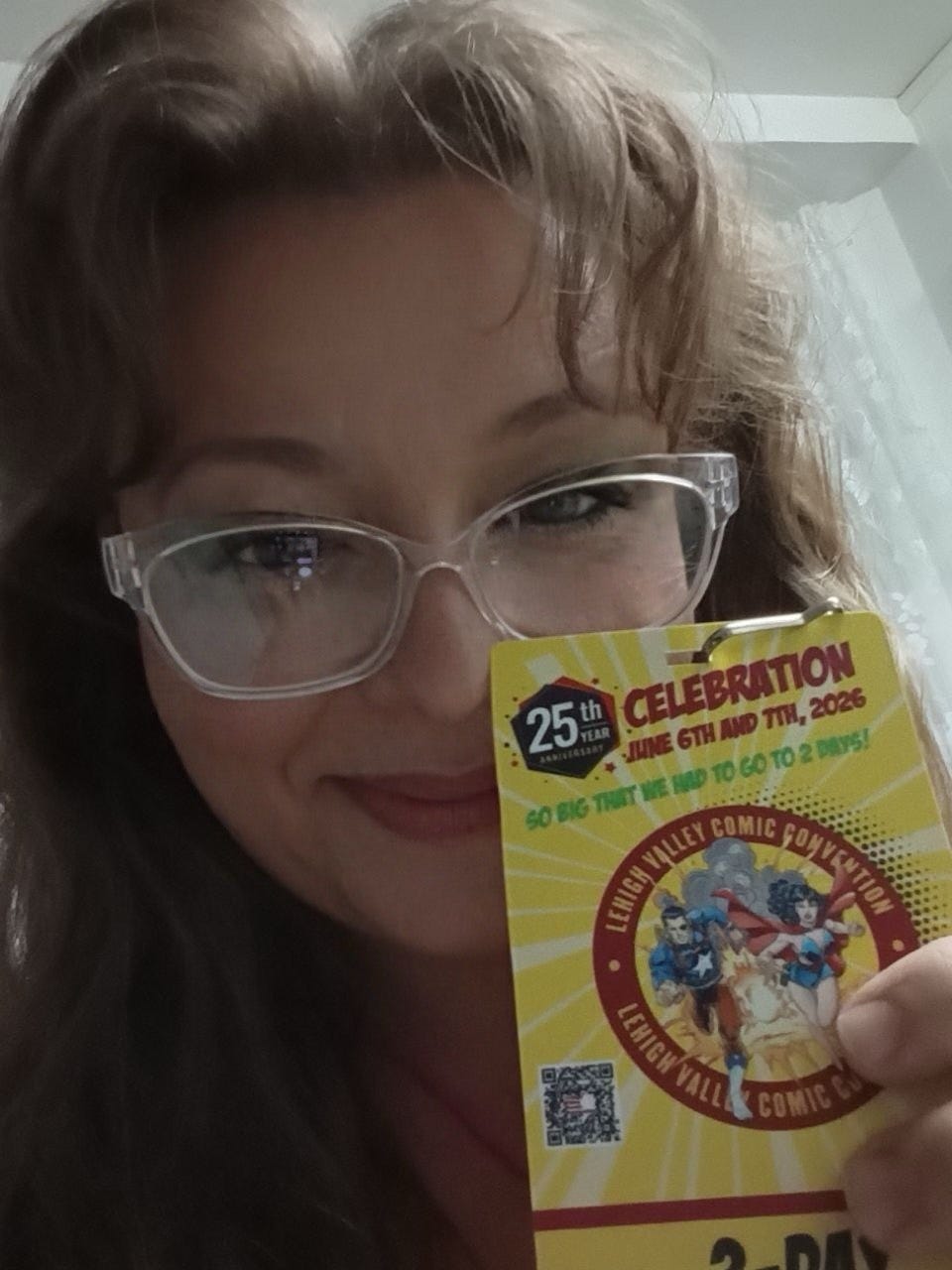
“Get over here!” she crowed. “We have to go meet Wendy and Richard Pini!”
Cue the record scratch and rewind a little bit. When I was about five or six I liked being read to, especially by my dad. The trouble was that my dad wasn’t much of a reader himself and found kids’ books boring. So he’d change the words or embellish the story or even just accidentally zone out in the middle of a page, which had a tendency to infuriate little me and sour the reading experience. He would have kind of rather watched Predator “together,” even if it meant I was hiding behind the couch.
One day my mom was out shopping at Waldenbooks (do you remember those?) and came upon something that surprised her. It was like a comic book, but bigger and different and colorful, and it had a cool title. She was granted the lucky thought that perhaps her husband would enjoy reading this ElfQuest aloud to their little daughter. No, ElfQuest is not a children’s book. We’ll get to that.
But for the next year I perched on the arm of the recliner every time my dad had a moment to spare. There wasn’t much time, honestly-- as a young country doctor, he was working 90+ hour weeks, plus rehabbing our turn-of-the-century house into something livable-- but bless him, he made space to start me out on a quest that would become a unifying note throughout the rest of my life. He read it to me first, and then I reread it over and over again over the course of decades. I entered the Quest as a child-contemporary of such characters as Dart and Newstar, and I dug out my mom’s halter tops and bandanas and my own clip-on hoops to dress as Nightfall for first grade “book character day”-- yes, I suspect it totally scandalized Mrs. Young, but to her credit, she rolled with it.
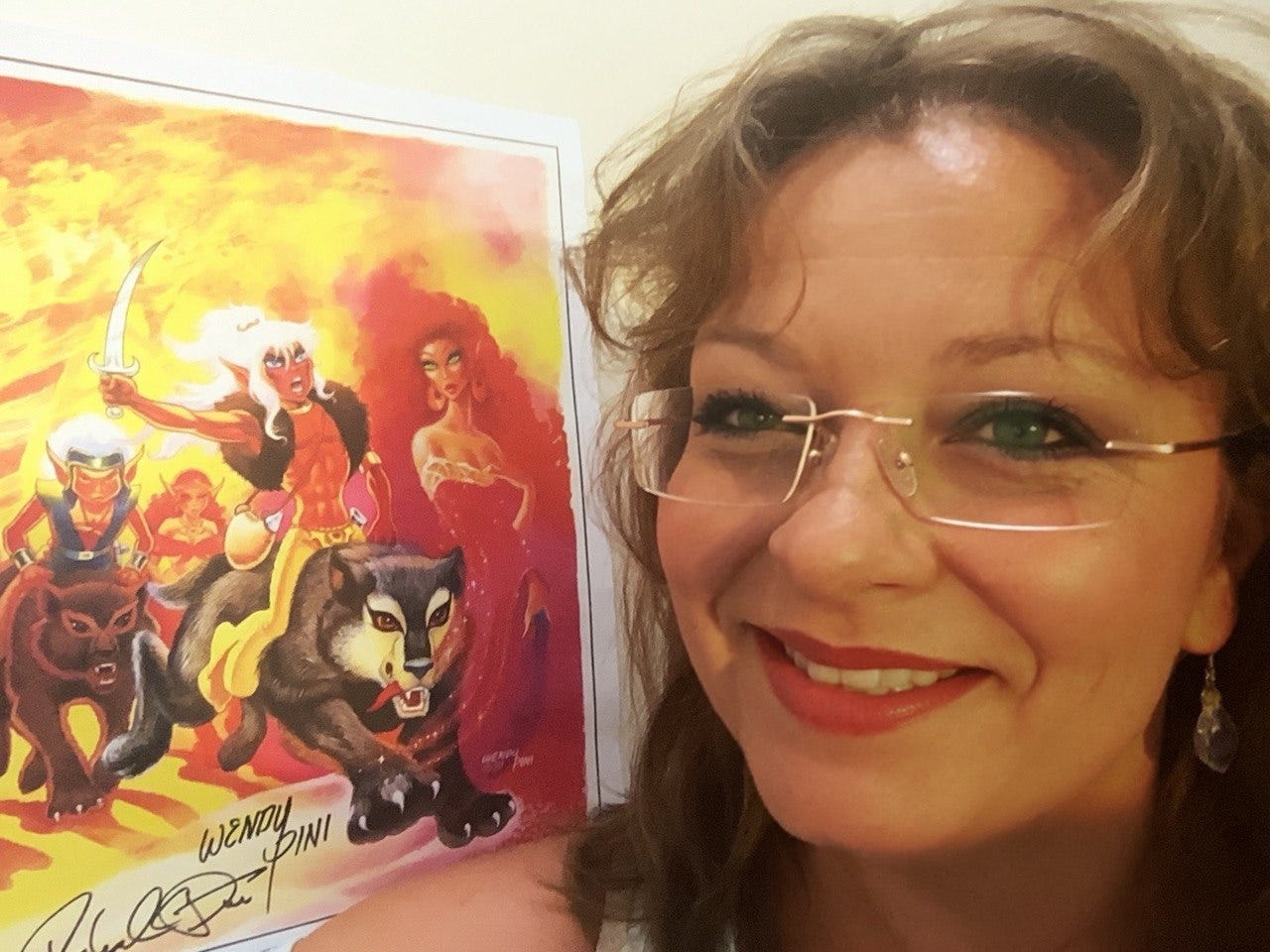
ElfQuest was not a children’s book, but it was exactly the story I needed as an emotionally and imaginatively intense child. It gave form to the swirling mix of perception and intuition that warred in my head, helped make sense of my mom and dad who were grieving the recent losses of their own mother and father respectively. As I grew, the story grew with me, and I came of age with Cutter and Skywise, struggling to find the Way and to learn how to dream better dreams, wrestling with my own shortcomings and returning once again...
Ugh. See, again I fail. The words aren’t enough. Because ElfQuest is more than a story; it is life and it is death; it is love and loss and war and peace; it is alienation and homecoming. You can hold it in your hands, but you cannot contain it within the confines of a single heart. All great books change you, but not all change you in the same way; many of our great classics are works of ideas made flesh that operate on our rational minds through the vehicle of story. Rarer are the works that create for us entire new worlds, peopled with characters who are as intimate to us as our own brothers and sisters. It’s terribly difficult to talk about family publicly!
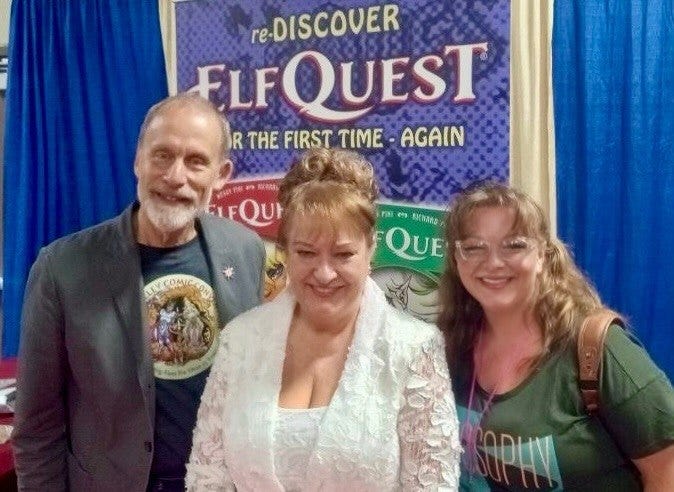
So to say that I was excited to meet Wendy and Richard would be a most profound understatement. How do you meet someone who has given you such a gift? How can a single encounter hold all of that? True human encounter always bursts with potential energy, desiring nothing more than the kinetic transformation of ourselves and each other into greater and higher fullness. Meeting Wendy and Richard was like going to your best friend’s cousin’s birthday party, revealing unguessed aspects of an already precious loved one.
This is the eucatastrophe: It is a great wonder to be met with friendliness and hospitality by the powerful imaginations that made worlds one has had so much joy in visiting and playing within. It’s a revelation of the apocalyptic unity of the human race. Let me try this another way.
I know a woman, whether in the body or out of the body I’m still not sure, but she had a vision, and she doesn’t really talk about it because people already think she’s weird enough. In it she saw that one single human mind, in all its smallness and insignificance, can imagine an entire cosmos, an entire history, in the single tick of the secondhand of the clock. Then it was like she was pulled back and zoomed out, and she saw that at this moment in time, there were billions of human imaginations creating untold billions of universes every second, universes that multiplied and filled to fullness and burst like bubbles without ever being spoken into word. And she saw that this had been the case for untold thousands of years, and she marveled, Truly they are like unto little gods, and they wield unthinking an awe-full power over one another. Truly it would be better for them to perish in the depths of the sea than that they should wield this terrible power to one another’s destruction. But what if they used this power out of love? What if they offered their universes as freely given gifts? What contagions of goodness could they send out into the void?
We don’t usually get to meet the people who help sculpt our interiority. Many of our beloved authors and artists and musicians are not contemporaneous with us; most of the others are separated from us by means of unbridgeable space. One of our great human flaws, and what I believe is the great weakness and temptation of hagiography, is to stratify one another, so that we think that by the sheer variety of their giftedness, certain human beings become a different kind of thing from the rest of humanity.
It’s so delightful, because in rereading the entirety of the series over the past month, I see this theme also addressed within its pages. The characters in ElfQuest are given many diverse gifts, some of which are truly mind-boggling in their scope. It would be simple to isolate certain characters as saintly, as ascended beyond the rest who still struggle, but the Pinis consistently resist this temptation and push into the tension of immortality that we usually cognitively contort ourselves to avoid. To put it in “in-universe” words, walking up to the ElfQuest table was like encountering a High One and discovering the generosity and personalism of Timmain instead, an encounter not with an abstract idea but with splendid real people. This is how you meet those who help shape you-- by encountering them as delightful and real human beings, and allowing that encounter to reposition you into a more real relationship with everyone else.
I said before that ElfQuest is about life and death. It’s also about the contradictions and revelations that come with being both mortal and immortal, and in this way, ElfQuest packages some very deep and pressing spiritual issues within its story-pocket-universe-- because as human beings, this is the essence of our own spiritual conundrum. All the evidence of our material senses tells us we are mortal dust, and yet we find our own hearts are incapable of believing this and living meaningfully. I’m not claiming that everyone has to be a particular strain of deist to accomplish a form of this; Viktor Frankl’s concept of meaning is big enough to transcend the limitations of the kind of self-contained, solipsistic mortality that I think inevitably leads to existential despair. ElfQuest doesn’t offer facile answers, either-- but it does aim the questions further up and farther out, stretching our imaginations so that they stop artificially constraining the cosmos we live and move and breathe in.
Most of the elfin characters do not wrestle with internal corruption. Those that do are stagnating characters whose belief in their inevitably superior place in hierarchy collapses into the hubris of pride and violence against others. Instead, most character growth is driven by a lack of fullness, which is a delicate trick to pull off believably, as our own human experience is marked by a different kind of shadow side than elves possess. Eternity-as-spiral implies that there is no end-point of growth, but rather deeper and fuller experience of reality; as Dr. Timothy Patitsas has said, this actually gives each of us a definition of “sin” that changes us retroactively-- because as we move closer to infinite goodness and truth, the more our previous iterations of self appear lacking and flawed. And conditioned as we are by the senseless repeated conflicts of human generations, it’s hard for us to imagine what continued growth looks like outside of our confined experience.
The elves in ElfQuest offer a compelling vision of what this kind of personal and spiritual growth looks like. How can we picture personal development within a community that really and truly serves and scaffolds us? Not individuality swallowed up by the group, nor individuality positioned as constant opposition. If we can imagine this possible cosmos, can we find a way to realize it? This is story working in its most powerful register, by envisioning possibility and passing it from one heart to another.
Elves are not a direct allegory for humans, and they never pretend to be-- that’s one of the rules of the ElfQuest universe. Elves are not humans-- they are far more beautiful in their quotidian movements than we are yet in our most fervid striving. But we can imagine such beauty, and in contemplating it, we can learn important truths about ourselves-- the first lesson of which is that we must gaze unflinchingly on our own envy and acknowledge it in order to wriggle out from under its controlling thumb. We must first learn to be humble in the presence of beauty, in the presence of eternity; we must allow ourselves to be very small before we can become a microcosm of the macrocosm, part of the infinitely fractalizing cosmic fabric. Our hearts so long for eternity that our reflex is to grasp for it greedily, to demand it, rather than to first desire to be worthy of it.
Consider these ways the beautiful elves show us our own instinctive ugliness: The grand majority of elves do not murder, physically or spiritually, and the grand majority of elves share a reverence of childhood that creates optimal conditions for the growth and development of elf children. Despite our willingness to agree in principle, we daily wound each other physically and slay each other spiritually, and constantly witness adults demand their own rights and disregard the fragile needs of children.
In moralistic cultures, we often focus attention on behavior modification far downstream of first causes. That’s one of Jesus’s provocative teachings: murder and adultery, the corruptions of our incensive and desiderative powers, start in the heart far earlier than they manifest in behavior. It’s also present in a lot of human child-rearing practices that generally seek behavior modification before they tend to internal growth and development. ElfQuest postulates that a people can leapfrog in development by refusing these corruptions: by trying to avoid actively hurting one another, by repairing whenever possible, by granting children the space to grow into the adult problems they will face. The “morality” of the elves begins far upstream from behavior, and starts with a fundamental disposition of care and regard for one another. That human beings still lack these in the face of centuries is both appalling and true; that such simple changes are possible is proven attainable by countless salt-of-the-earth nobodies who manage to choose better ways in the face of adversity. That’s worth thinking about.
Now, at this point, I’ve got to tell you that many of my schoolfriends were a bit scandalized by the sexuality in ElfQuest, and some couldn’t get past the sex to see that ElfQuest was not celebrating human hedonism, but instead was portraying a vision of sex-positivity that could be possible for a people who operated beyond the constraints of a corrupted eros. It’s not even a bit scandalous within the rules of the story-pocket-universe: elves encounter one another with care and regard, scrupulously protect childhood from degradation, and lack the logistical constraints of mortality. They have accomplished what I’ve elsewhere described as no longer using their sexuality to hurt others with desire (eros) or will (thymos).
So, to go back to where I began, meeting Wendy and Richard was also a form of self-discovery, as it reveals to me how much my imagination was prepared to wrestle with these grand schemas of thought by first encountering them in the World of Two Moons. Could I have written anything here without them? I don’t think so. I’m just grateful to have met them in this life, and I could have listened to them talk about their storytelling philosophy for hours. In the short time I spent with them, I could see Cutter and Skywise winking at me through their eyes.
As I’ve said before, ElfQuest isn’t a children’s story, but it’s not NOT a children’s story, either. The hero’s journey doesn’t belong only to adults, and when it’s told exceptionally well, it doesn’t need to be age-exclusive, even if there is sex and violence. The concept of children’s literature is itself a very modern concept, and it’s liable to a lot of unnecessary digressions about what makes literature “suitable” for a child. There’s always some moral panic about the moral characters of authors, or what constitutes appropriate framing for various age cohorts. All of that moral hair-splitting inevitably misses the point that when a reader encounters a story-pocket-universe, regardless of age or preparedness, that encounter is outside the sphere of control of anyone else-- author, parent, teacher, or friend. Reading will never stop being dangerous and subversive because there are universes that multiply and fill to fullness and burst like bubbles every second of every day across all of space and time. And when such treasures are shared, what contagions of goodness they send out into the void!
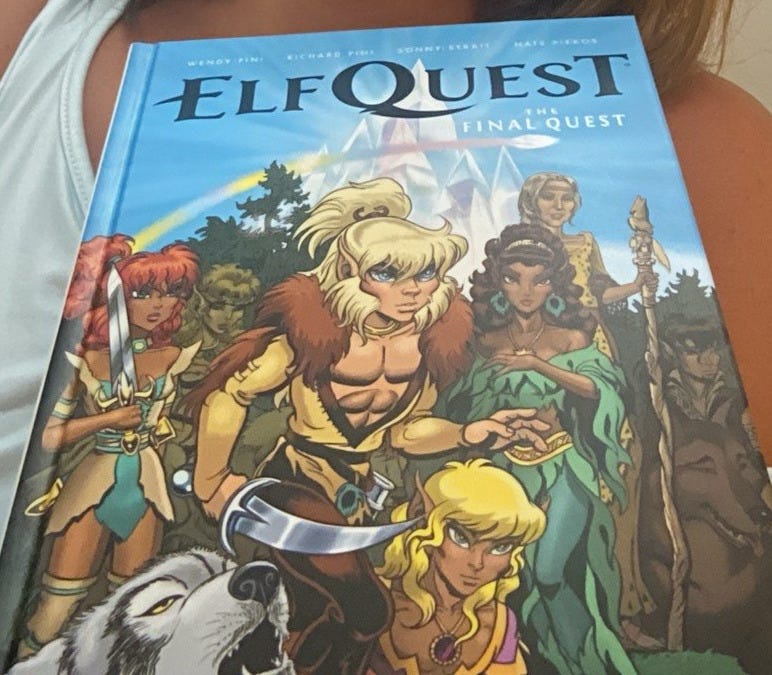
As I’ve struggled with writing this piece, I’ve gradually realized that I’m not going to be able to say it all in one place, and it would be beyond foolish to try. I’d like to give you at least one more, from the perspective of a writer and crafter, on what ElfQuest can teach us about art and storytelling. Wendy and Richard were kind enough to share their worldbuilding rules with me, and I’d love to tell you about them.
But I also have to admit, it’s hard to dive into more specific literary criticism with this corpus, because despite being around for almost five decades, it’s still considered a cult classic. I can count on one hand the number of people I’ve met in the wild who have read even a portion of it-- so any attempt I make to offer detailed analysis of character or story arc will necessarily offer spoilers. I really do believe that ElfQuest is a largely undiscovered classic of contemporary fantasy literature, and it absolutely has yet to find the totality of its audience. I want to show you more, but in the meantime, I’ll be waiting for everyone in the Holt.
In addition to another ElfQuest essay, I’ve got a review in the pipeline of Michael Martin’s new release, Surely Some Revelation Is At Hand: Poetry, Magic, Imagination. And, of course, I’ve got the upcoming launch of my new children’s book, The Hidden Hosannah! Please follow me and share widely, so that the good news reaches everyone it is meant to.
Thank you for the gift of your attention in this crowded internet-fairyland!
Comments
Nothing yet. Say the first thing.
Sign in to join the conversation.