
I’m not crazy about the genrification of books. I get that we need a little bit of it in order to organize our libraries and bookstores, but I’m never going to be an enthusiast.
What do you call, though, the genre of books that is intelligent, well-read people talking about things that interest them? When the topic is specific, it’s typically a scholarly study of some sort, but that just repeats our society’s captivation to specific knowledge over general knowledge. I love a good monograph as much as anything else, but that’s not what I’m talking about. I suppose literary criticism comes close, maybe some memoir reaches in this direction, but even those are a defined fields with too narrow of a lane for what I’m trying to grasp. I want a shelf dedicated to the kinds of books that explore the meditations of people who live rich inner lives, read widely, live with vitality and intentionality, and write about the many relationships they have and connections they make with both the world around them and the ideas that fascinate them.
Take Helen Luke, for example: A well-read Jungian analyst with a lot of life experience. While her training as an analyst is a primary lens through which she works, it would be reductive to think of her as just a Jungian literary critic. Many of her essays are broader meditations on our circumstances of life and common humanity-- she draws upon her experiences and her own inner life and in the process creates space for a reader to encounter themselves within her thoughts. I read most her books straight through about a decade ago, but I still enjoy dipping in and out of them (they make great purse books!) and if you’ve never read her, I always recommend her essays Eowyn and Orual. Maybe we can call such explorations wisdom essays? I’m tempted by the label, but I’m hesitant with it, too, because I’m concerned that it weights them too heavily into the cerebral. One of the great strengths of this genre, done well, is stance of epistemological humility. Helen Luke, I believe, paved the way for this, with the warmth of her personal voice coupled with the academic rigor of her Jungian training. Her writing showed that the authors of wisdom essays need above all to be faithful to their own phenomenological experience, to offer it humbly as fodder for others’ growth.
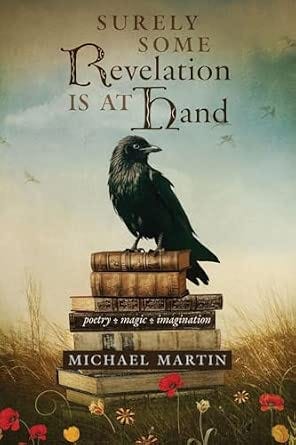
When Surely Some Revelation Is At Hand: Poetry-Magic-Imagination first came across my radar a few months ago, I was intrigued. A synopsis of the book hinted at something similar to Helen Luke, only instead of Jungian analysis as an interpretive lens, Michael Martin promised to offer his lived experience of Sophia. Do I want to read musings about literature and philosophy from someone with such a perspective? Why yes, I most certainly do. Ideas don’t ever seem to be genuinely encountered in the abstract-- when human beings wrestle with angels, we want the sprained hips to go with it. So yes, please give me more of this genre-- people who have digested the big ideas and live through them long enough to show if there is truly sustenance there. Essays about wisdom, framed by the peculiarities of individual lives. Wisdom essays, but perhaps more intriguingly, sophiological essays.
If you’ve heard the term Sophiology but haven’t read any original source material, chances are good that you have some substantial misunderstandings. I know that I absolutely did, until my friend sent me Bulgakov’s The Bride of the Lamb-- I was wary of the bogeyman of the flattened “fourth feminine hypostasis of God” accusation of heresy, and was peripherally aware of the disparaging way internet theologians dismissed the idea as being a category of new age nonsense. I mentioned finishing it last fall, and I ended up not writing much about it simply because I was afraid I’d get caught up in trying to explain something I was still thinking about.
The trouble with explaining Sophia is that it’s the wrong mode. When you’re introducing two of your friends to each other, you don’t go, “So, hey, Roger, this is Susan. Let me explain her a little bit. She’s super intelligent and I think she’s utterly captivating, but of course, I don’t worship her because she’s not God, even though talking with her puts me into a certain mood...” You’d sound like a nutjob, and both Susan and Roger would likely go get some bean dip. Without you.
Sophia-- both divine and creaturely, a theologically crucial distinction-- is met in the mode of relationship and encounter. To relate to Sophia is to acknowledge the consciousness, the personhood, the particularity potentialized and being realized in all of existence. The hypostasization, or becoming, of creation, if you will. When we reach for words to describe a mystical spirituality, an enchanted cosmos, a post-pagan Platonism, a Christian animism-- these are all things for which relating to Sophia provides vocabulary. In moving the wisdom essay into the sophiological territory, Martin grounds wisdom where she is meant to be found: in relationship.
Sophiology, then, is an attempt to describe the nature of that relating, the interactive field present between Person and Person, Person and person, and person and person. You don’t examine or explain Sophia. You get to know Her. And like all relationships that are Good and Beautiful and True, knowing Her helps you know the One who made Her. Which is why a book like Surely Some Revelation is At Hand, written by a person like Michael Martin who has made it his life’s work to know Sophia, is an invaluable introduction to a way of being in the world that feels both entirely natural to life and at the same time entirely orthogonal to the way most other people go about it.
If I’m losing you already, remember that both J.R.R. Tolkien and C.S. Lewis themselves-- admired orthodox Christians par excellence-- had profound respect for Owen Barfield, who was himself a sincere anthroposophist in direct communication with Rudolph Steiner. One of the fascinating connections that Martin reveals in Surely Some Revelation is At Hand is that anthroposophy shares a heritage and vocabulary with Sophiology; an observation which helps me frame my own long-term respect and fascination with both anthroposophy and its kissing cousin, Swedenborgianism. Can you even be a homeschooling parent without looking into Waldorf philosophy? I don’t know, but I do know you can’t live in eastern Pennsylvania and not cross paths with the New Church.
Back to the book. In Surely Some Revelation is At Hand, Martin offers us a glimpse of how embodied Sophiology works: through the lived experience and practice of a contemplative, creative life. Poetry, yes, and magic and imagination, too. If, like me, you have been trying to figure out how magic really works in our world, without retreat into overly intellectual definitions of metaphor and analogy, the book is a great place to start. We do not really understand our own imaginations, I think, and we most certainly take them for granted. As Martin says in his introduction, “The language of the poets and mystics partakes of the quality off magic-- and I mean that literally. But theirs is a good magic, intended not to enslave the hearer or reader but to liberate him.” The imagination is the medium through which we interact with magic, though that doesn’t mean it’s all just pretend.
The thing about living imaginally, magically, poetically, is that it resists simple definition. To live in such a mode is to sing, full-throated about both the death of the pagan god Pan and the death of Christ, and trust the song to find the fullness of its meaning in the heart of the hearer. One of Michael Martin’s gifts is that he is able to describe this mode in intellectual terms that bypass the rational resistance of the modern mind. He’s not describing the way to think like a neo-pagan, he’s modeling what enchanted life looks like from a particular perspective. Look at this delightful bit:
“The word “Pan” not only means “all,” it also means “he who feeds.” Thus the understanding of Christ as the Great Pan discloses the sacramental dimensions of the Crucifixion, connected as it is to the story of the Holy Grail as well as the Eucharist. Christ, then, is “the Great One Who Feeds.” In this conceptual movement, in its breathing fluidity, we enter into a poetic metaphysics.
Some will ask, “Are you saying Christ is Pan, or that Pan is Christ?” This is the wrong question… In a poetic metaphysics, plasticity overshadows concepts, which can now mean one thing, now another.”
It’s entrancing. In just a few sentences, Martin has introduced us to a Pan I never thought to meet, and shown us how to let the great faun dance us to Christ. It’s a wisdom essay that has pushed just a little farther, into encounter.
Don’t let me give the you the false impression that everything Martin says in this book is easy. This is a very particular book, and the personhood of its author shines through on every page. I liked that, though-- one of the hallmarks of wishy-washy spirituality is its overly anodyne agreeableness, and that’s notably absent in these pages. Instead, Martin gives us a series of poetic visions, take them or leave them-- of Dionsyian revel and Eucharist, of Dylan Thomas as a Christian Druid, of fairies as necessary to the rewilding of the Christian faith and astrology as necessary to the return of the New Middle Ages. Ir’s a series of images that is exciting and invigorating and challenging, and above all, beautiful.
It’s also very Western in etymology, which is doubly interesting, as I came across the quote from Carl Jung a few months ago that said something to the effect of how important it would be for all of us, as inheritors of the western tradition, to not try to circumvent the struggle with western civilization by trying to find the right answers outside of it. Like it or not, we’re all of us here products of western civilization, and coming to grips with that means not simply accepting or rejecting it, but integrating it. Speaking from my own experience in the Orthodox Church, I think that sometimes people come to it expecting to side-step the intellectual and religious tensions we’ve inherited, particularly in America, and Orthodoxy can look like a tempting, simple solution.
I think we are overly accustomed these days to have everything framed to us in false antinomies, and every good we think we find is subsequently positioned as against a bad of some sort. Less usual is demonstrating how good can also move in that orthogonal vector, and instead of opposing something different from itself, unfold into a fuller goodness than was previously understood. What I mean by this, in part, is that so many of the wide topics Martin addresses in this book have been dismissed as unworthy simply because they don’t fit into the strictly rational or classical ways of interacting with the world-- but we don’t actually need to choose one as good and the other as evil. Perhaps we can be both intellectual and magical, unironically. Perhaps the way we relate to one another prepares us to relate also to Sophia, wholeheartedly and without cynicism.
There was so much about this book that I liked that halfway through reading it I sent a copy to a friend (the same friend who sent me Bulgakov) so that she could read it with me. An unexpected gem for me was the chapter on romanticism, a movement that has been thoroughly scorned by many modern thinkers as something best left to one’s slightly shameful adolescent interests. Not so for Martin! We are treated, instead, to a discussion of Romanticism as a flawed expression (are any human expressions not flawed?) of a legitimate human hunger, a tradition with a place right beside the poets of the Celtic twilight. It was good for me to welcome the Romantics back into my heart, to learn a new way to relate to them with less judgment and more curiosity.
Yes, I think we can call this genre of books wisdom essays, and I imagine that as more writers become familiar with the vocabulary of Sophia, that bookshelf will begin to fill with more sophiological essays as well, and we will know them by the way they lead us into encounter with others, with God, and with creation around us. Surely Some Revelation is At Hand: Poetry-Magic-Imagination is an excellent place to start such a collection.
Alright, so tell me. Who here has read any of the Sophiologists? How about Barfield, Steiner or Swedenborg?
Comments
Nothing yet. Say the first thing.
Sign in to join the conversation.