
Welcome to Part Two of our conversation! If you missed it, here’s Part One, which ends on the cliffhanger where Nick tells us that he was raised as an Objectivist throughout his childhood. Wild, right?
Nick: I was raised a strict Objectivist until I was twelve. There’s no shortage of “isms” in the contemporary online content-creation universe, but the younger folks might not have heard of that one. Briefly, it’s Rand’s own term for her savagely individualistic ethos-aesthetic.
Laura: Oh, boy. I’ve met lots of people who had an Ayn Rand phase, but never one who had a childhood marinated in it! Can you tell me more? What was it like?
Nick: Sure.
If I’m not careful here, I will write a book. In short, this is how it was; my mother was the oldest daughter of a U.S. Marine from Illinois, a Purple Heart recipient during WWII for wounds taken fighting in the Pacific. That man, my grandfather, settled in the small-town Deep South after the war, started a very successful small business, and raised a classic American family under strict discipline like you’d expect from a Midwestern Marine combat vet. Each of his kids give you a different story about that man, and none of them are lies; combining those stories, I find a picture of a man who was intelligent, loyal to the death to his friends and family, and difficult in the way that only a strictly principled and emotionally remote person can be.
Mom (may her memory be eternal) was like him. A young woman in the sixties, she hated rural Southern life and always spoke about wanting to find people who were “interested in learning things.” She discovered Rand in college, and constructed out of Rand’s philosophy and Boomer bootstrap optimism a worldview where human achievement was near-infinite in potential and the highest ideal of any individual’s life. She met my father in her first job as an engineer after college, and when I came along determined to raise me to be a prodigy. (Her words, not mine.)
It wasn’t long after that that my parents’ marriage failed, and unpaid tax bills led to my family’s homelessness. Turns out the IRS is unimpressed with ideas about the immorality of income taxes. Years of misadventure passed here that are beyond the scope of this piece, but evidently at the lowest point of our troubles Mom experienced a conversion event that I suspect to be an honest-to-God miracle. She wound up becoming as strict an adherent to Reformed Calvinist Christianity as she ever was to Rand’s philosophy. The two worldviews are surprisingly compatible.
She died last year in her mid-70s, after a second life where she reinvented herself as a natural health and childraising expert. (I will note that I’m an only child.) She left behind a cadre of thousands of devoted followers who lived by her ideas on alternative medicine. She had several other failed marriages, but lived alone when cancer caught up with her. She had no assets, but fortunately (as in Rand’s case) Medicare paid for her end-of-life care.
One of the last things I recall her saying, as we sat on her porch, was that the theme of her life had been loneliness.
If you’re seeing a through-line here between my upbringing and the disdain I have for guruism and adherence to axiomatic philosophies in place of caring for specific humans, you’ve got the picture.
Laura: Wow. That’s an amazing family history. It sounds like if there ever were personalities big enough to fill out Ayn Rand’s principles, your mom at least had a fighting chance! (May her memory be eternal!) I really relate to her hunger for maximizing human potential, for seeing the greatness people are capable of.
I can definitely see philosophical through-lines running through this, especially with how people with strong, forceful personalities can come to identify themselves with their own beliefs and thought-processes. I know people like this -- it can become impossible to disagree with them without them treating that disagreement as an attack on the whole person, or at least the whole belief system. This kind of identification of the self with belief system seems to lead to a particular kind of philosophical bullying, almost, where a difference of opinion or perspective becomes impossible without conflict.
But wow. To be raised as an Objectivist... I’m picturing you being reared on Ayn Rand anecdotes instead of fairy tales and Bible stories...
Nick: Thanks. You’re not wrong about Mom. The world is less for her absence. You’re right about the fairy tales, too, which I loved. As I was settling Mom’s estate, I ran across some correspondence between her and her Reformed pastor, where she lamented letting me read myths and Tolkien and stuff, blaming it for my conversion to Orthodoxy as a grown man. She was, of course, completely correct.
You just can’t get away from the connection between aesthetics -- can I just say “beauty”? I like the word more -- and the beliefs of your heart, whether or not you’re conscious of them. Rand knew this, and she lived and died by it.
There’s an apocryphal story about Rand that I encountered somewhere in that sphere -- I’m not sure where I first ran across it, though it’s said to have appeared in her Journal in 1965. Notorious for applications of her moral philosophy to every aspect of life, Rand was a sharp critic of music, art, and architecture. Like I hinted at earlier, I really think her appeal arises from the way she champions a certain ideal of classical, vanishing beauty at a time when that aesthetic is not what we see being built around us.
Rand’s interests weren’t limited to architecture or science. According to the story, Rand presented a careful, logical argument using her Objectivist principles identifying one particular style of music as objectively, optimally good. She coined the term “tiddlywink” for it, a hilariously undignified name which I understood at the time to refer to some form of polka.1 Even as a kid, I could see pretty clearly that the proper moral to this story is not “Tiddlywink is the Objectively Correct Music And Also Totally A Real Word,” but rather, “Ayn Rand is fond of polka.” The journal article2 on her musical history makes it clear where she developed this taste -- music of that sort was part of her childhood in St. Petersburg, Russia, with her father frequently taking her to a local park to enjoy free big band music.
A genuinely pleasant scene to imagine, occurring as it did right before the chaos of the October Revolution.
Laura: The timing makes it particularly poignant, and probably had at least a little bit to do with its powerful emotional resonance for her.
So Rand was committing the error of universalization, right? She was taking a personal preference-- maybe even something she loved for good reason-- and she was turning it into a categorical thing for the rest of humanity. And part of the reason why this is so en pointe is because Ayn Rand made such a huge deal out of everything being rational. Essentially, she backed herself into a corner where she couldn’t just like something personally, it had to be based on some kind of grand philosophical principle.
You’ve made a fascinating connection between this error of Rand’s and our internet-as-fairyland, particularly in the hollow hill we sometimes call the Orthosphere. Tell us about it.
Nick: Okay, that story about Rand’s musical taste lives rent-free in my head, and has given me a semantic tag for a phenomenon I’ve seen among shade-tree philosophers (and actual, qualified philosophers, more troublingly) in several media spheres. The place in which I’ve encountered it most, and the one which affects me most right at the time of this writing, is the traditional Christian content creation gang currently active in the mid-2020s.
I don’t want to criticize anyone publicly -- who am I? I also don’t want to artificially limit my critique of a troublingly widespread phenomenon. So, I will say only that I believe this sort of thing to be widespread and excessively magnified online by the effects of algorithmic individuality. I’m writing here as an American who is an Orthodox Christian convert from another Christian tradition, and I’m confident that the vast majority of other people falling into that category have seen examples of the Rand phenomenon.
The phenomenon I mean is this: A content creator, thought-leader, or (God help us) influencer has some idiosyncratic and unique experience that is meaningful to them, similarly to Rand’s music in the park. Without necessarily intending to do so, they confidently generalize this experience into a statement about the Way Things Are. That over-generalized feeling, often fueled by the potent liquor of childhood memory, morphs into a universally descriptive or even (God help us some more) prescriptive rule about how humans behave or should behave.
Laura: Yes, I know exactly what you’re referring to. Every little thing becomes linked to an objective “best way” or “right way.” And that gets super tricky when the person talking is starting to sort everything under Christian categories the way they define them. This is how we get things labeled as “good Christian art” or “the greatest canon of books.”
Ayn Rand was a harbinger of this posture, I think, because Objectivism so thoroughly prioritizes the abstract over the relational. It’s all about conforming to the right ideas which will then produce the right outcome, and love has absolutely nothing to do with anything at all.
So when we live in this abstract internet fairyland, where ideas take precedence over people, it seems to follow right away that we start to define our religious selves by conformity to ideas. If you believe the right things, you will experience the right outcome. How do you even love someone on the internet, anyway? Something real and relational has to happen, first, otherwise we’re just feeling affection for a projected image we carry on the backs of our eyeballs.
One of the ways this has rubbed you the wrong way is the reason we connected on Substack: When I wrote my essay On Reading C.S. Lewis Mythically, you immediately saw how this kind of difference in perspective could be calcified into something unhelpful or even destructive. I believe you led with, “Hot damn!”, which was delightful. It obviously struck a chord...
Nick: We really need to do another piece about the fairyland thing, because it’s amazing. Yes. We eat from the fairies’ feast, and then the Internet makes us dance until we die.
There’s an awful lot of this sort of nonsense -- I mean the emphasis on abstract principles as over against actual people, where the principle attaches strings to us and makes us dance -- going around on Christian circles with talk of gender roles. I’m thinking here especially of the association of men with order and women with life or chaos. I have heard this kind of talk in church groups, Laura -- even though it seems to stay mostly in the men-only group chat, interestingly enough. Guys who favor podcasts which talk about symbolism a lot go straight from discussing a spat with their wife over furniture to framing femininity in terms of Tiamat, ancient Babylonian symbol of oceanic chaos.
I may be going out on a limb here, but I would respectfully suggest that in most cases, comparing one’s romantic partner to Leviathan is a misstep.
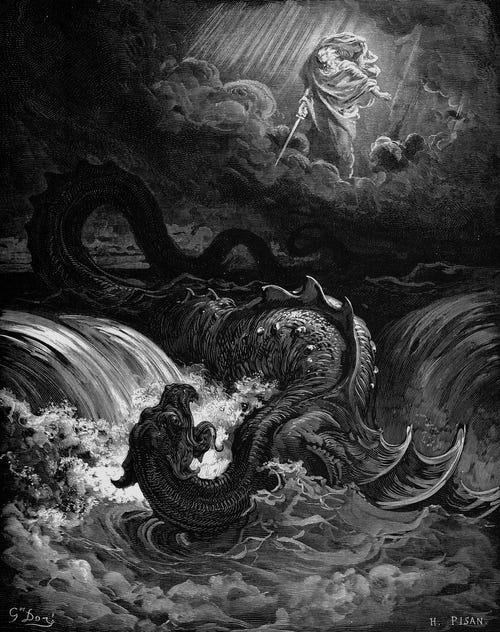
Figure 2: The Ancient of Days vs. Leviathan. It is not a subtle metaphor.3
Also, about the “men : women / order : chaos” analogy, anyone who has ever spent time around a college men’s dorm has some grounds to doubt this association. But I digress. Most importantly, the overgeneralization of a personal preference or a formative experience into a law of nature has got to stop. You guys! Stop it.
At best, that sort of thing is silly idealization that sets one up for being disappointed in actual reality, a dangerous snare since God made reality but you invented your idealized version of it yourself. Most commonly, it’s obnoxious and marginalizing to folks who don’t share those preferences. In its worst instances, it verges on a backdoor Gnosticism. That term might sound a little melodramatic, but I haven’t been able to escape a creepy sense of “this guy or girl believes they have secret knowledge that explains the troubles around them” even in some face-to-face chats at coffee hour lately.
Laura: Backdoor Gnosticism. I like that. It fits right in with how the internet-as-fairyland works, with its way of privileging access to certain kinds of information and rewarding people for the performance of their second sight. In this case, symbolic literacy can almost become a kind of practical magic one can wield against others...
We really need the principle of economy here, don’t we? Because when we couple economy, or oikonomia, with the concept of theologoumena-- that a theological opinion can be likely true but not rise to the level of dogma-- suddenly we have a lot of space for thinking about theological and spiritual and even symbolic things from different perspectives. Something can be good and true and beautiful without being exclusively so. One can like tiddlywink and southern rock and electronic dance music without betraying some greater cosmic principle of rightness.
But I don’t want to just knock symbolic thinking. For many people, regaining a symbolic framework for reality can really help paganize the imagination so that it can finally be appropriately baptized (as I wrote in Technologies for Defeating Demons). But with that analogy, it’s also essential not to get stuck there. Otherwise we get into that problem with identifying with a belief system as a self, and become inclined to use the whole force of our personality in defense against anything different. This is why it’s so important to funnel real spiritual hunger through the hinterlands of content into the county of real, embodied relationships.
Tie this back into Ayn Rand for me, because I love this angle. I, too, was once a teenager who read Ayn Rand, after all! And the way you name it as a pathway to Gnosticism is really important.
Nick: That “second sight” take hits hard. We humans are wired to notice coincidences -- if we see the same idea presented from several different sources, we are super inclined to take it as being significant, or even supernatural. The trouble is, the ‘fairyland’ can (in fact, is designed to) manufacture that experience on demand, imbuing us with an unearned certainty about our opinions concerning the Meaning of Things. And your point about belief-system-as-self is essential, and deserves more attention. If I can’t bear someone critically examining my opinions about metaphysics or theology without experiencing it as a personal attack, I am crippled like the paralytic in the Gospel.
Like Rand’s appeal to the architectural and technical aesthetics of early-1900s capitalism, trad-Christian gesturing at symbolism in everything as understood by an idealized Medieval Christian society (for instance) is doing something sneaky. It’s importing the nostalgically imagined aesthetic of a bygone world we don’t inhabit, one which the speaker and the audience know only through their imagination.
By this invocation, the approach (Objectivist, symbolic, other; pick your aesthetic) gains a powerful appeal to folks searching for meaning -- especially young folks, who have survived fewer actual experiences. Lived experience has a way of grouchily resisting forced categorization. Orthodox Christians are taught by Church tradition, quite properly, to use their imaginations very cautiously in their spiritual lives. Like most pieces of valid spiritual advice, this principle proves itself durable in the contemporary media ecosystem. If you find yourself falling in line with some podcaster, for instance, who critiques some phenomenon of modernity by unfavorably comparing it to 1930s America, or Byzantium, or the ways of the ancient Hellenes, that is imagination, and it’s exactly as good an idea as developing an attachment to a pretty girl whom you’ve never actually met.
Despite the tragic appeal of vanishing grandeur, we American Orthodox owe it to our creed and our own self-knowledge to resist this sort of idealization, while still recognizing that the appeal is effective because something is missing and because the world truly does contain meaning. We have no lasting city. We are looking for a city that is to come.
Laura: Oh, yes. This has come up in context with my work on Charlotte Mason, and how she talks about imagination, and it comes up a lot in our book Patterns for Life. We interact with stories-- even historical ones-- through our imaginations. This is why it helps us to really think through what a healthy imagination is, what it looks like and how it behaves.
I’ve said elsewhere that a misuse of the imagination has far less to do with reading Harry Potter and far more to do with allowing the media machine to give form to one’s thinking.
And I think you’re right. Generic gnosticism is almost necessarily predicated by this category of misuse, this switching of locus from real relationship with others to mediated relationship through ideas. I’ll be thinking about this for a while...
How long have you been sitting on this, anyway? What should we do about it all?
Nick: Lord, that’s a good question. I suppose I was inoculated against this kind of thing from my youth up, for the reasons I said, but these concerns have been nagging at me since I started enjoying the world of Orthodox-adjacent podcasts four or five years ago. Just like you and Dr. Shaw, I want stories to be the technologies we use against the demons. But the trouble with weaponized technology in a war is that both sides may use it. Rand’s Atlas Shrugged was a potent weapon for ill, fueled by the refined nuclear material of modernity’s decaying beauty. I get the horrors when I think of people doing something similar using our ancient, winsome creed to power their ideological engines.
As far as what we might do, I’ll level with you; my inspiration for doing this piece was that I thought of a funny name and wanted to use it for something.
I want to propose “the Ayn Rand Polka” as a term for the snare I’ve described here -- using philosophical/theological proofs to show that your preferred arrangements are the optimal, definitely God-ordained situation. Especially in the context of an unfavorable comparison to some idealized past or other, exotic culture with better optics.
Henceforth, let it be known: this sort of silliness shall be termed “doing the Ayn Rand Polka” (an informal fallacy like the No True Scotsman) and calling it out will be a hobby of mine. I hope the availability of this term helps people prone to follow self-proclaimed spiritual teachers (or even ordained and qualified teachers who are stepping outside the lane of their expertise) in the process of noticing that they are allowed to politely ignore those gurus’ opinions.
Laura: So now we have a game to play when we see people dancing close to this error! We just need a good meme to stick it on.
Seriously, though, a lot of the problem is that human beings take themselves too seriously. Friends will tell you that when opinion talk gets too heavy, I’m liable to break into song. Nothing even remotely tiddlywink, but rather that great classic by .38 Special, Hold On Loosely:
Just hold on loosely
But don’t let go
If you cling too tightly
You’re gonna lose control
Nick: I love me some Southern rock, but I can’t think of any lines that work here. I’m a Simple Man. I’ll bring in a couple pieces of classic poetry instead:
“Our little systems have their way.
They have their way, and cease to be.
They are but broken lights of Thee,
And Thou, O Lord, are more than they.”
— Alfred, Lord Tennyson
And also (particularly applicable to aggressive online discourse):
“[Expletive]s talk a lotta shit but it’s after I’m gone
‘Cause they fear me in the physical form.”
— 2Pac
Anyway. I hope that calling out this kind of thing helps those prone to perform guruism to check twice and three times before they confidently assert How Things Are.
Laura: Not likely, I think. Fairyland rewards confident unambiguity, at least until the mark strides confidently into the ruins of a red cap’s castle.
Nick: That is terrifyingly true -- another potent feature of online discourse that I’ve always subtly felt, but you’ve put to words. I feel the pull of the confidently unambiguous speaker as strongly as anyone. Is it just some part of us trying to return to our childhood, where we could ask our mother or father about something, they would tell us, and then the matter would be settled? So charming and proper in little children, so dangerous in grown women and men.
It reminds me of the quote from the great Fr. Alexander Schmemann, who understood the dangers of idealization better than anyone else I’ve read. Little children, keep yourself from gurus.
“Students’ confessions. Always sex. I am beginning to think that this sin is useful; otherwise they would consider themselves saintly and plunge into guruism. As it is, they are half convinced [of their spiritual achievements].”
— Fr. Alexander Schmemann, quoted in First Things by Richard John Neuhaus
Laura: That’s an interesting through-line— the line from fairyland deception of the self, to strong personality forcefully trying to convince others of the objective rightness of his or her opinions, all the way to this idea of guruism. Without humility (and maybe a bit more levity!) we run the risk of getting high on our own supply. May God preserve us all from guruism, both in the self and others!
Nick: Yup. Amen.
Nicholas Marshall is a professor of chemistry, writer, tree enthusiast, and Brazilian jiu-jitsu instructor. He and his family live in South Carolina, USA. He can be reached at nicholas.mclane.marshall@gmail.com.
It is not polka. More like parlor music. Still weird. - NM
Comments
Nothing yet. Say the first thing.
Sign in to join the conversation.